
Top 14 Recruitment Marketing Tools in 2026 (Ranked for Enterprise HR)
Recruitment marketing tools provide solutions for employer branding, targeted job ads, candidate engagement, analytics, and streamlining the hiring funnel.

TL;DR
- Most hiring teams over-invest in sourcing and under-invest in screening — 69% still report recruiting difficulty (SHRM 2025 Talent Trends) because high application volume without a skills filter burns recruiter capacity before a single interview is scheduled
- The $4,700 average cost-per-hire (SHRM 2025 Benchmarking) drops by up to 50% for organizations with strong employer brands (LinkedIn Talent Solutions 2025) — recruitment marketing tools make that ROI measurable and attributable by source
- 75% of candidates research company reputation before applying (LinkedIn Talent Solutions 2025) — employer brand is a candidate acquisition channel, not a communications exercise
- The Testlify Attract-Assess-Convert (AAC) Framework maps the three layers every enterprise stack must cover: build a qualified pipeline, verify skills before recruiter review, and convert offer-ready candidates efficiently
- This guide ranks 14 platforms against enterprise HR criteria — sourcing depth, ATS integration quality, analytics, and candidate experience — evaluated against SERP benchmarks and practitioner data
- Pre-screening with validated assessments (Testlify) reduces the screen-to-interview ratio from 60:1 to under 10:1 for teams handling 500 or more applications per role per month, with 55% faster time-to-hire across Testlify customer benchmarks
 ChatGPT
 Gemini
 Claude
 Grok
Grok Perplexity
What are recruitment marketing tools?
Recruitment marketing tools are software platforms that help organizations attract, engage, and convert qualified candidates before they apply. They combine employer branding, job distribution, candidate relationship management, and analytics into a single workflow. The best platforms connect sourcing with skills verification to reduce pipeline waste and improve quality-of-hire.

Why does recruitment marketing software matter in 2026?
In 2026, attracting quality candidates requires more than posting job listings. Organizations need tools that manage employer brand, candidate experience, and pipeline analytics simultaneously, as 69% of hiring teams still report recruiting as difficult despite increased automation adoption.
The data makes the business case clear. SHRM’s 2025 Talent Trends report found that 51% of hiring difficulties stem from low applicant volume — not a shortage of candidates broadly, but a shortage of the right candidates seeing the right opportunities. Recruitment marketing tools close that gap.
Three numbers worth knowing before you evaluate platforms:
- $4,700: average cost-per-hire for non-executive roles (SHRM 2025 Benchmarking)
- 75%: share of candidates who research employer reputation before applying (LinkedIn Talent Solutions 2025)
- 50%: reduction in cost-per-hire for companies with strong employer brands (LinkedIn Talent Solutions)
In my work with HR teams at 1,000-plus employee organizations, I have seen the same pattern: teams with no recruitment marketing stack spend twice as long filling roles and accept below-benchmark candidates because pipeline volume is too thin to be selective.
What should you look for in a recruitment marketing platform?
Four criteria determine fit for enterprise HR teams: candidate sourcing depth, employer brand tools, ATS integration quality, and analytics that connect spend to quality-of-hire outcomes.
1. Candidate sourcing capabilities
Does it reach passive candidates, not just active job seekers? Look for multi-channel distribution (job boards, social, programmatic advertising) and a built-in talent CRM.
2. Employer brand infrastructure
Can you build and manage a career site, host employee testimonials, and control how the brand appears on third-party review platforms?
3. ATS and HRIS integration
A platform that does not connect cleanly to your existing applicant tracking system creates data silos. Ask vendors for a certified integration list before signing any contract.
4. Analytics tied to quality-of-hire
Page views and click-through rates are vanity metrics. The right tool shows source-to-hire conversion rates and tracks which campaigns produce candidates who pass 90-day performance reviews.
Tool | Best For | Pricing Tier | Testlify Integration |
|---|---|---|---|
Phenom | Enterprise talent experience | Custom (enterprise) | API available |
Beamery | Talent CRM + AI sourcing | Custom (enterprise) | API available |
SmartDreamers | Programmatic job advertising | Custom | Via ATS |
Jobvite | Mid-market ATS + marketing | Custom | Via Greenhouse |
Teamtailor | Employer brand + career site | From ~$150/month | API available |
iCIMS Talent Cloud | Large enterprise suite | Custom | Native |
Workable | SMB to mid-market hiring | From $189/month | Direct integration |
TalentLyft | Cost-efficient sourcing CRM | From $99/month | API available |
Manatal | AI-powered ATS + CRM | From $15/user/month | Via Zapier |
LinkedIn Talent Solutions | Passive candidate sourcing | Custom (per seat) | Native |
Glassdoor Employer Center | Employer brand management | Custom | Via ATS |
Testlify | Skills-based candidate filtering | From $139/month | Native |
Eightfold AI | AI talent intelligence | Custom (enterprise) | API available |
Hubspot | Recruitment CRM & candidate relationship management | Custom (enterprise) | API available |
What are the top 14 recruitment marketing tools in 2026?
1. Phenom
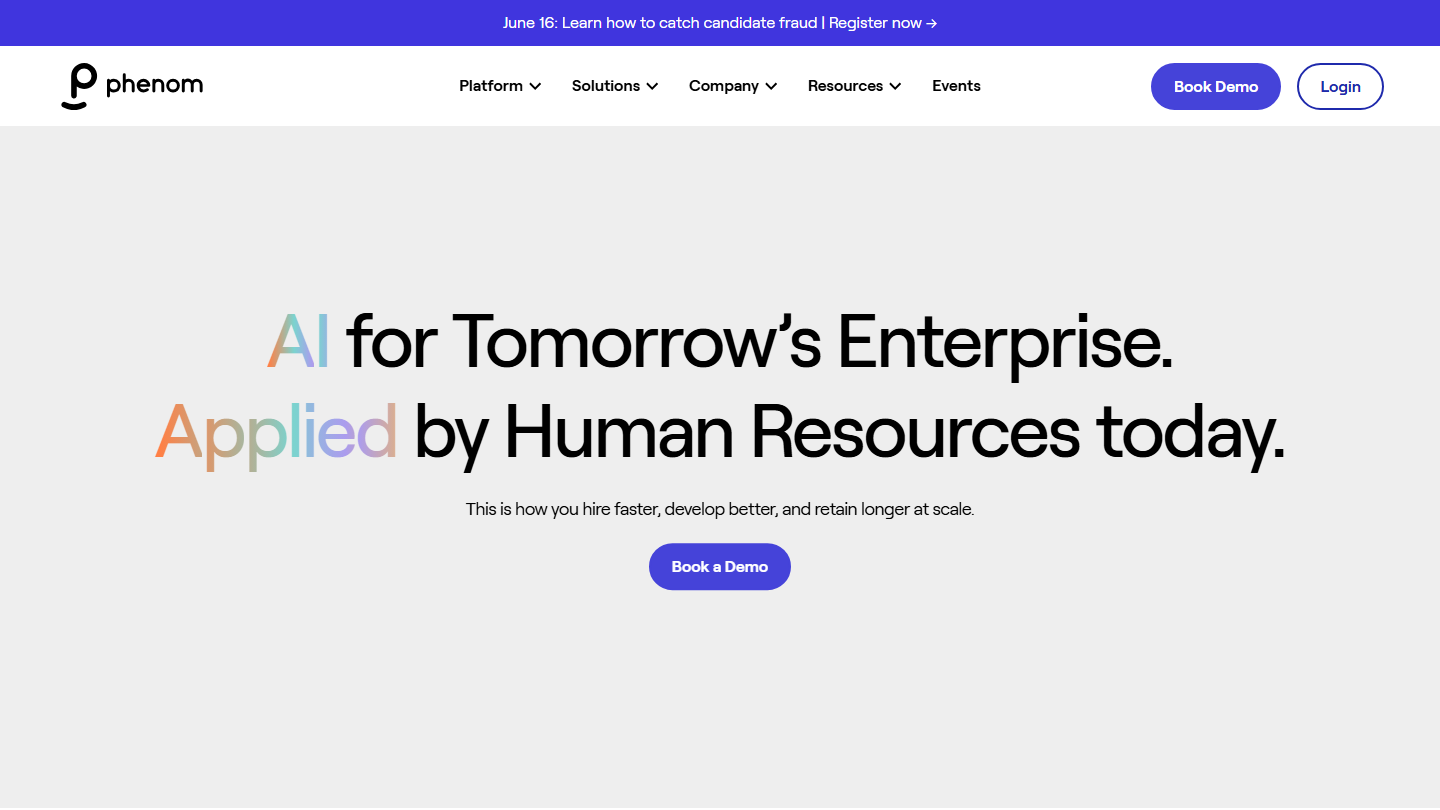
Phenom is an enterprise talent experience platform that connects job seekers, employees, recruiters, and HR leaders in a single AI-powered system. It builds personalized career sites, automates candidate nurture campaigns, and surfaces pipeline insights in real time. Phenom works best for organizations running high-volume hiring across multiple locations. Its AI layer matches candidates to roles based on skills and experience signals, not just keyword matches. Enterprises using Phenom report measurable reductions in time-to-fill for hard-to-recruit roles.
- AI-powered career site personalization
- Automated candidate nurture sequences
- CRM with talent pool segmentation
- Real-time recruiter productivity dashboards
- Workforce intelligence and mobility tools
Pros: Deep ATS integrations; strong employer brand tooling; AI job matching reduces irrelevant applications Cons: Complex setup for teams under 500 employees; pricing is not transparent; requires dedicated admin resources Pricing: Custom enterprise pricing; no public free tier
2. Beamery
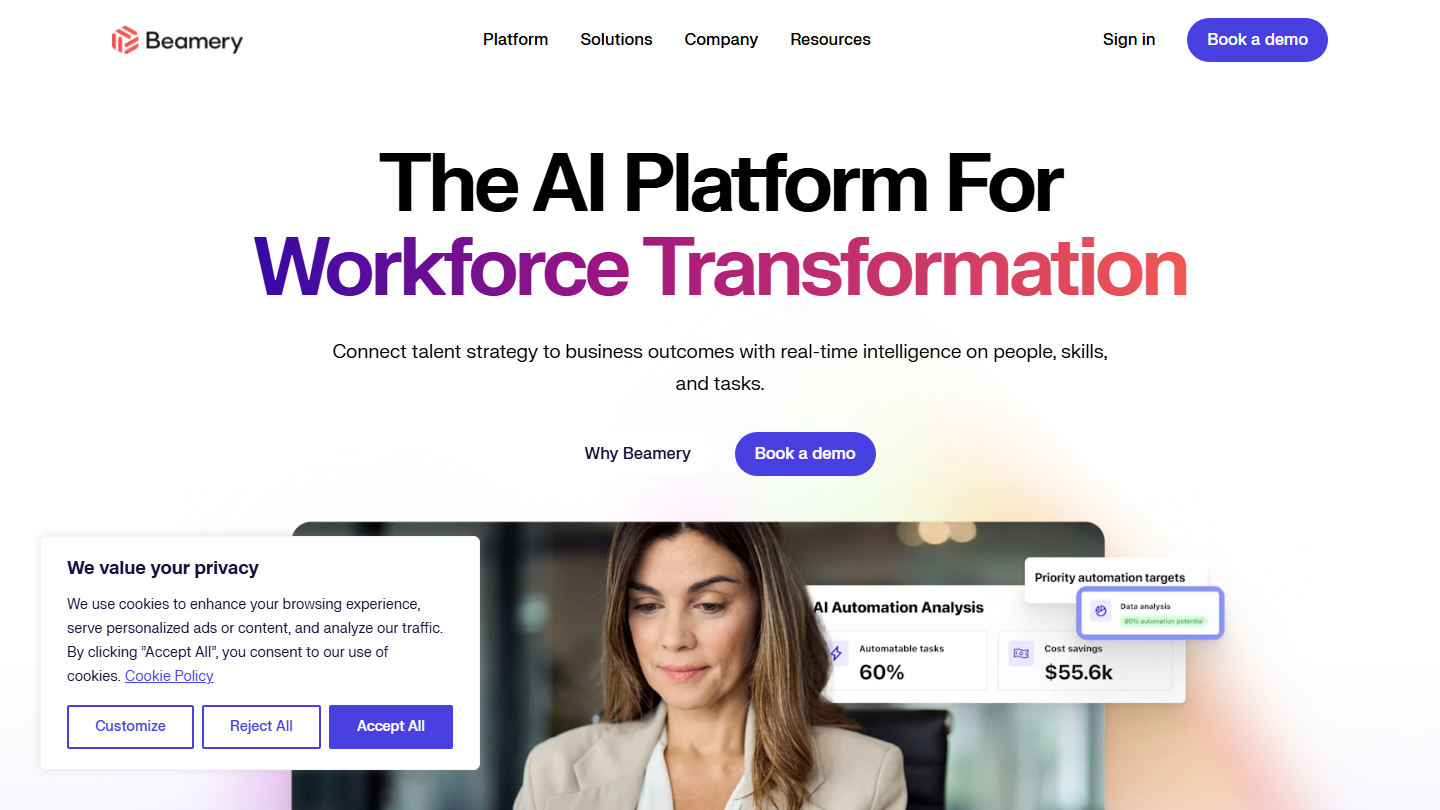
Beamery is a talent CRM and operating system built for enterprise talent acquisition teams. It centralizes candidate data across sources, applies AI to surface the best matches for open roles, and automates outreach workflows that keep passive candidates warm. In my experience reviewing platforms for high-growth companies, Beamery stands out for its skills ontology — it maps job requirements to actual candidate capability signals rather than job title proxies. This matters when hiring at scale for technical or specialized roles where resume titles rarely reflect true capability.
- Skills-based talent graph and ontology
- Automated multi-channel outreach campaigns
- Talent pool management with lifecycle tracking
- Workforce planning and headcount analytics
- DEI hiring pipeline visibility
Pros: Strongest skills data model in this list; strong for internal mobility programs; integrates with Workday and SAP SuccessFactors Cons: Enterprise-only pricing; heavy implementation timeline (6-12 weeks typical); requires clean CRM data to deliver value Pricing: Custom pricing; implementation cost is separate
3. SmartDreamers
SmartDreamers is a recruitment marketing automation platform focused on programmatic job advertising and employer brand amplification. It distributes job listings across 500-plus channels, optimizes ad spend in real time based on application conversion data, and tracks which channels produce candidates who progress past the first interview stage. For high-volume roles in retail, logistics, or customer support, SmartDreamers reduces cost-per-application by automatically shifting budget toward channels that convert.
- Programmatic job advertising across 500+ channels
- Real-time budget optimization by conversion signal
- Career site builder with SEO optimization tools
- Candidate journey tracking from first touch to hire
- Integration with major ATS platforms
Pros: Strong ROI visibility on advertising spend; good for multi-location hiring; no wasted budget on low-converting channels Cons: Not an ATS replacement; analytics require setup time; better suited for volume hiring than specialist search Pricing: Custom pricing based on hiring volume
4. Jobvite
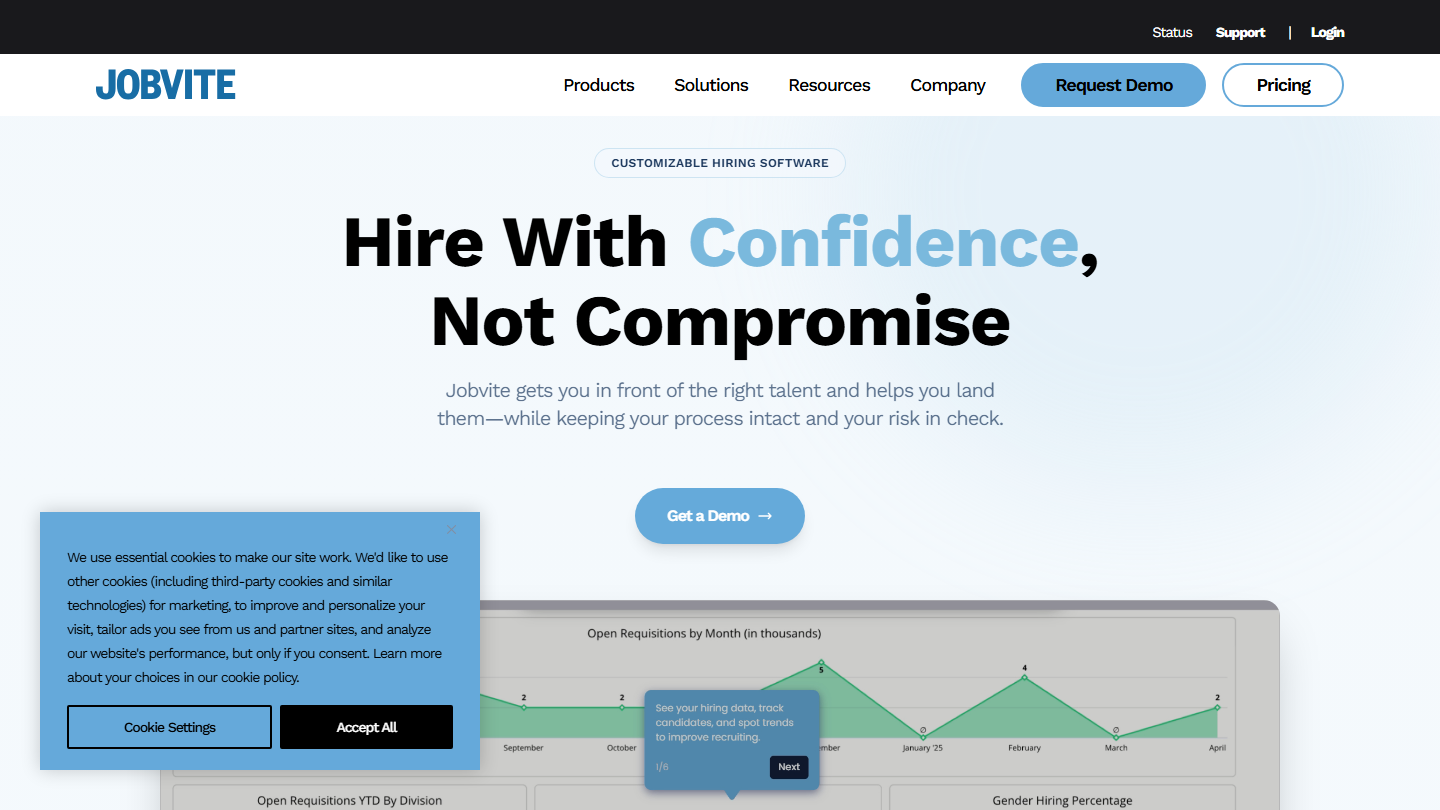
Jobvite is a unified recruitment platform that combines an ATS with recruitment marketing tools in one product. It covers employer branding, career site management, CRM, social media job distribution, and analytics. Mid-sized companies (200-2,000 employees) tend to get the most value from Jobvite because it reduces the need for multiple point solutions. The platform also includes an AI screening layer that flags high-fit candidates early in the funnel, reducing recruiter time spent on manual triage.
- Branded career site with SEO management tools
- Social recruiting and job broadcasting
- Candidate relationship management (CRM)
- AI-assisted screening and fit scoring
- Interview scheduling automation
Pros: All-in-one for mid-market teams; good for employee referral programs; strong social media distribution Cons: Reporting depth is limited for large enterprises; mobile candidate experience is inconsistent; support response times vary Pricing: Custom; typically $25,000-$75,000/year depending on headcount
5. Teamtailor
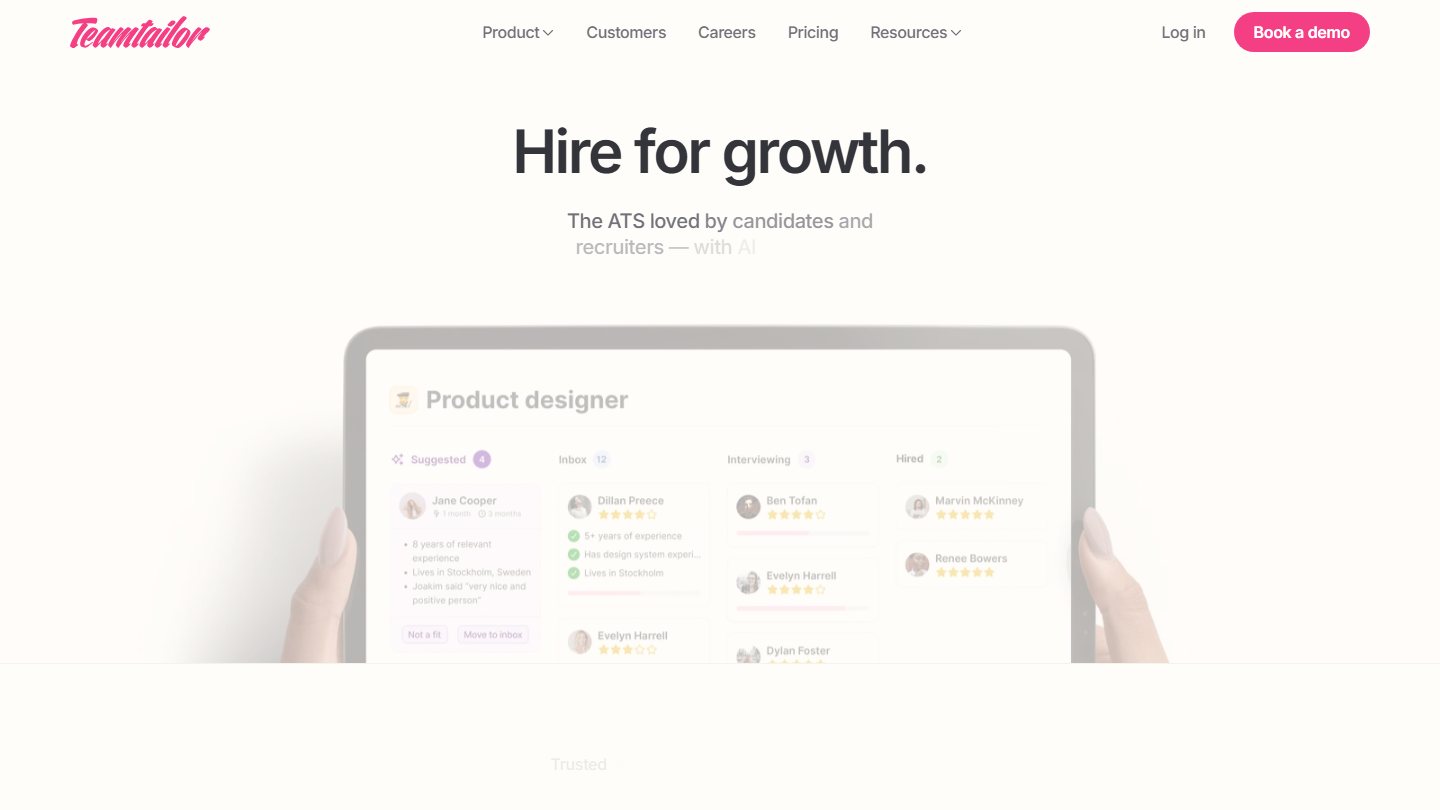
Teamtailor is a recruitment platform built around employer branding. Its career site builder lets HR teams create responsive, media-rich pages without developer support, and its CRM keeps candidate relationships active between hiring cycles. More than 9,000 companies use Teamtailor for its clean candidate experience and team collaboration features. For companies prioritizing how they appear to candidates — not just how efficiently they process applications — Teamtailor delivers one of the strongest brand-forward experiences at a mid-market price point.
- Drag-and-drop career site builder
- Built-in video interview tools
- Candidate nurture and automated messaging
- Team collaboration with hiring stage visibility
- GDPR-compliant candidate data management
Pros: Best career site builder at this price range; no developer dependency; strong candidate experience scores Cons: ATS features are thinner than enterprise alternatives; limited programmatic ad integration; surface-level analytics Pricing: From approximately $150/month; enterprise tiers available on request
6. iCIMS Talent Cloud
iCIMS Talent Cloud is a large-enterprise recruitment suite used by Fortune 500 companies running complex, multi-entity hiring operations. It covers the full talent acquisition lifecycle: recruitment marketing, applicant tracking, onboarding, and internal mobility. iCIMS processes more than 4 million job applications per month across its customer base. Its core strength is in compliance, configurability, and depth of integration with major HRIS platforms including Workday, SAP, and Oracle HCM.
- Full-lifecycle talent acquisition platform
- AI-driven candidate matching and ranking
- Employer branding and career site tools
- Compliance management across geographies
- 700+ partner ecosystem integrations
Pros: Handles enterprise-scale complexity; deep HRIS integrations; strong compliance controls; good for multi-country hiring Cons: Implementation typically runs 6+ months; UI is dated compared to newer entrants; high total cost of ownership Pricing: Custom enterprise pricing
7. Workable
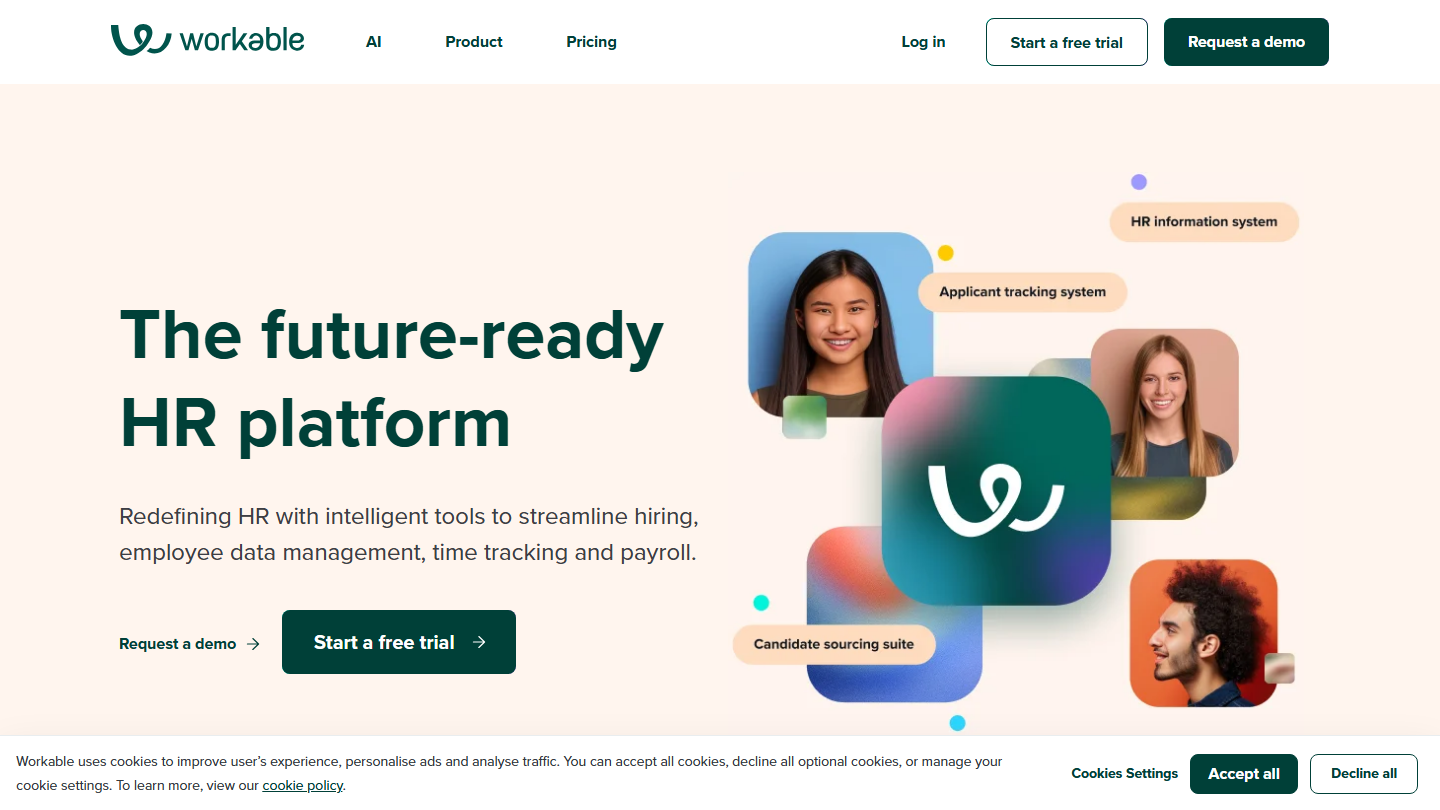
Workable is one of the most widely used hiring platforms for companies scaling from 50 to 2,000 employees. It combines sourcing tools, a built-in job board network, ATS features, and lightweight CRM in a single interface that most HR generalists can operate without training. Workable’s AI sourcing extension finds passive candidates on LinkedIn and GitHub and adds them to your pipeline automatically. For teams moving off spreadsheets or basic ATS tools, Workable is a practical entry point into structured recruitment marketing. (see how Testlify integrates with Workable)
- One-click job posting to 200+ job boards
- AI sourcing for passive candidate discovery
- Structured interview kits and scorecards
- Collaborative hiring with team feedback tools
- Direct integration with Testlify for skills screening
Pros: Fast to implement (days, not months); intuitive UI; solid AI sourcing for the price; Testlify integration available Cons: Limited employer brand customization; basic reporting; not built for high-volume enterprise hiring Pricing: Starter from $189/month; Growth and Premier tiers available; 15-day free trial
8. TalentLyft
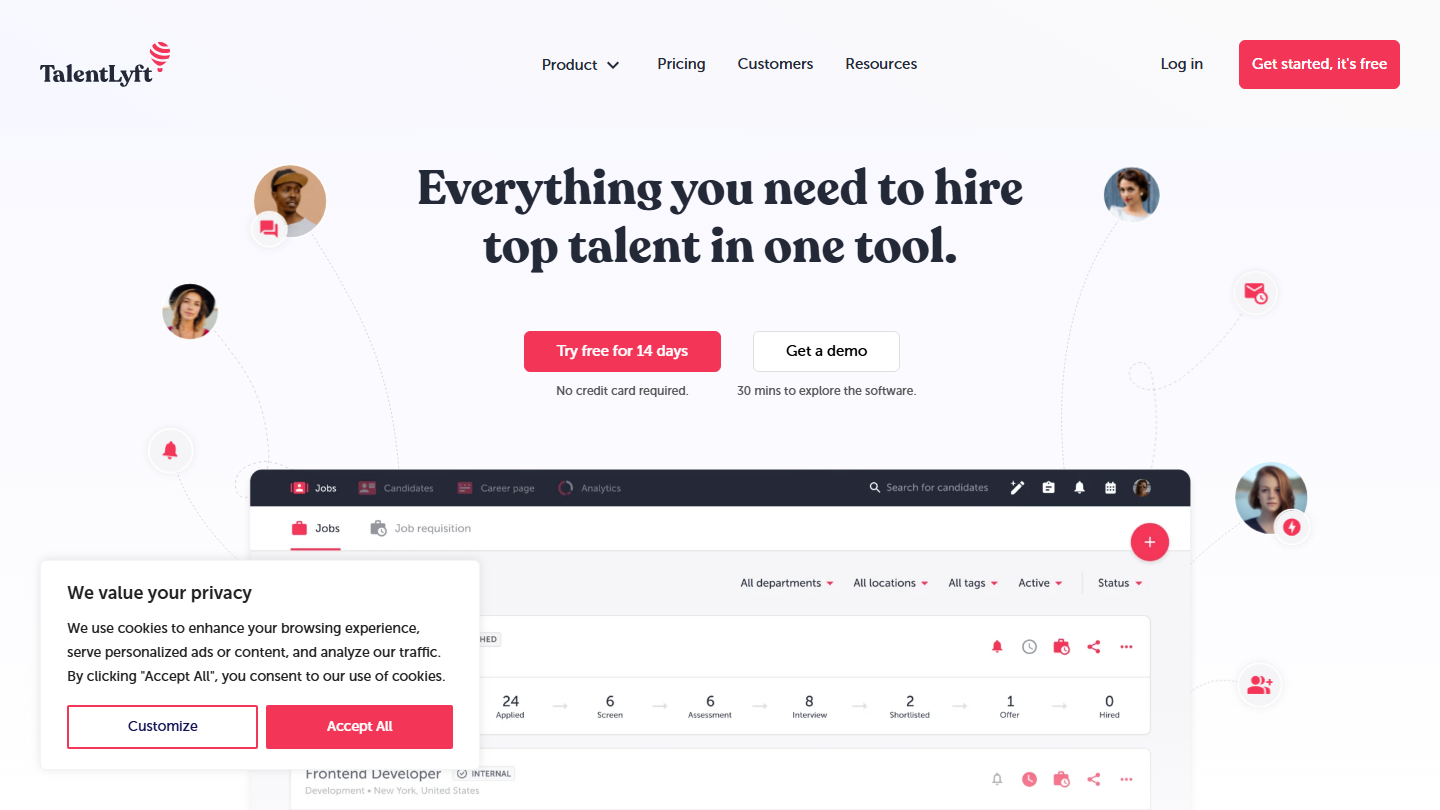
TalentLyft is a recruitment marketing and ATS platform built for cost-conscious teams that still need multi-channel sourcing, a careers page, and a basic CRM. It posts to 2,000+ job boards, tracks candidates from source to hire, and provides email marketing tools for candidate nurture campaigns. For companies between 50 and 500 employees, TalentLyft offers the core recruitment marketing stack at a price that enterprise platforms cannot match.
- Multi-channel job distribution (2,000+ boards)
- Career site builder with custom branding
- Candidate relationship management
- Email campaign automation
- Source tracking and hire attribution
Pros: Strong value for the price; easy job board distribution; solid for small-to-mid HR teams without dedicated TA operations Cons: AI features are limited; integration depth narrower than enterprise tools; analytics need improvement Pricing: From $99/month; free trial available
9. Hubspot
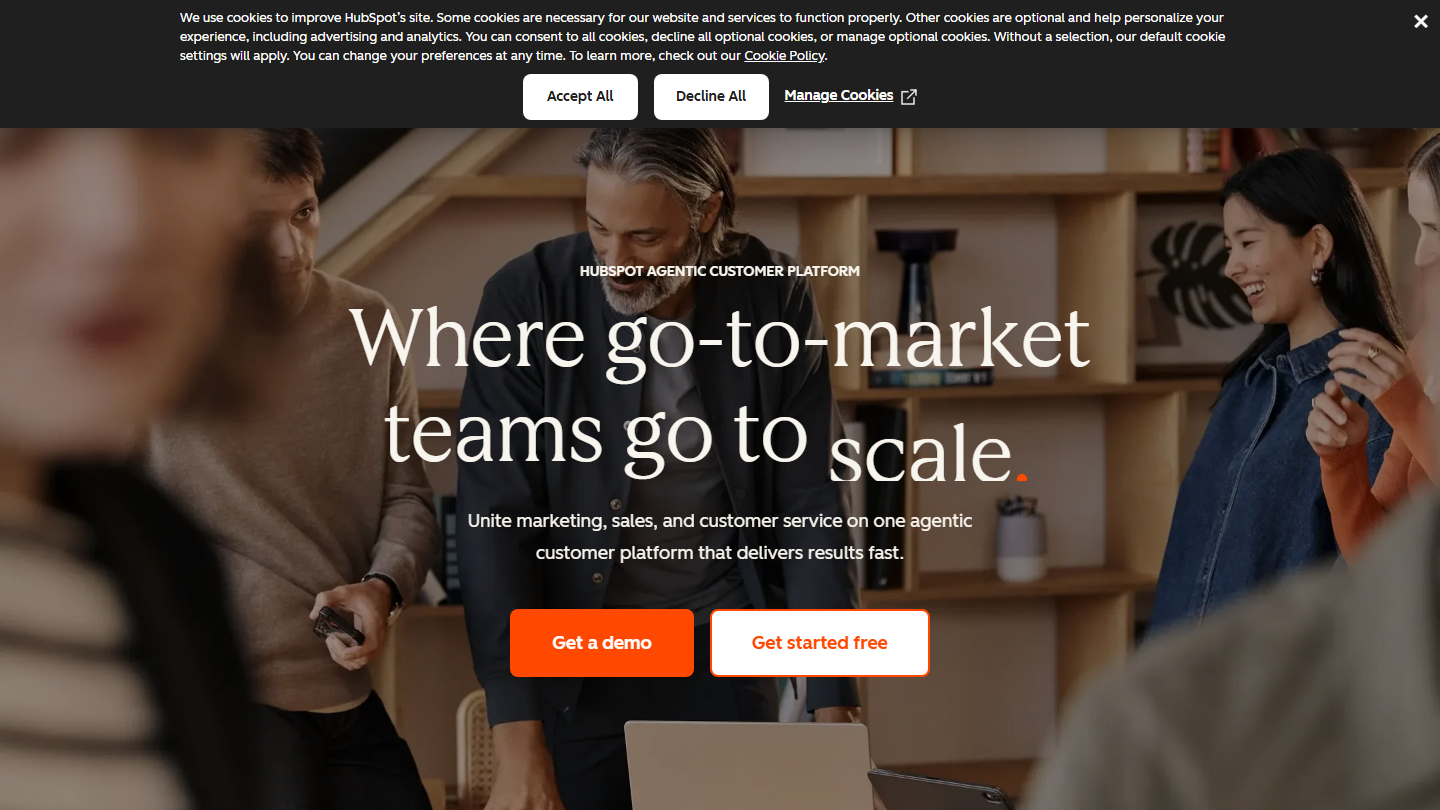
HubSpot combines CRM, recruitment marketing, and candidate relationship management in one platform, helping recruiting teams attract, nurture, and convert candidates through automated workflows. Its AI-powered tools assist with email creation, lead scoring, workflow automation, and candidate engagement, making it particularly useful for organizations focused on employer branding and talent pipelines. Pricing is custom and generally geared toward mid-market and enterprise teams.
- AI-powered CRM and candidate relationship management
- Recruitment marketing automation and email campaigns
- Talent pipeline tracking and workflow automation
- Custom reporting and recruitment analytics
- Career site integrations and form builders
- Extensive integrations and API access
Pros: Excellent for candidate nurturing and employer branding; powerful automation capabilities; highly customizable; strong reporting and integration ecosystem Cons: Higher cost than traditional ATS platforms; recruiting features are not purpose-built like dedicated ATS tools; setup can be complex for smaller teams Pricing: Custom pricing (enterprise-focused); free CRM available; paid plans start with HubSpot Marketing and Sales Hubs
10. Manatal
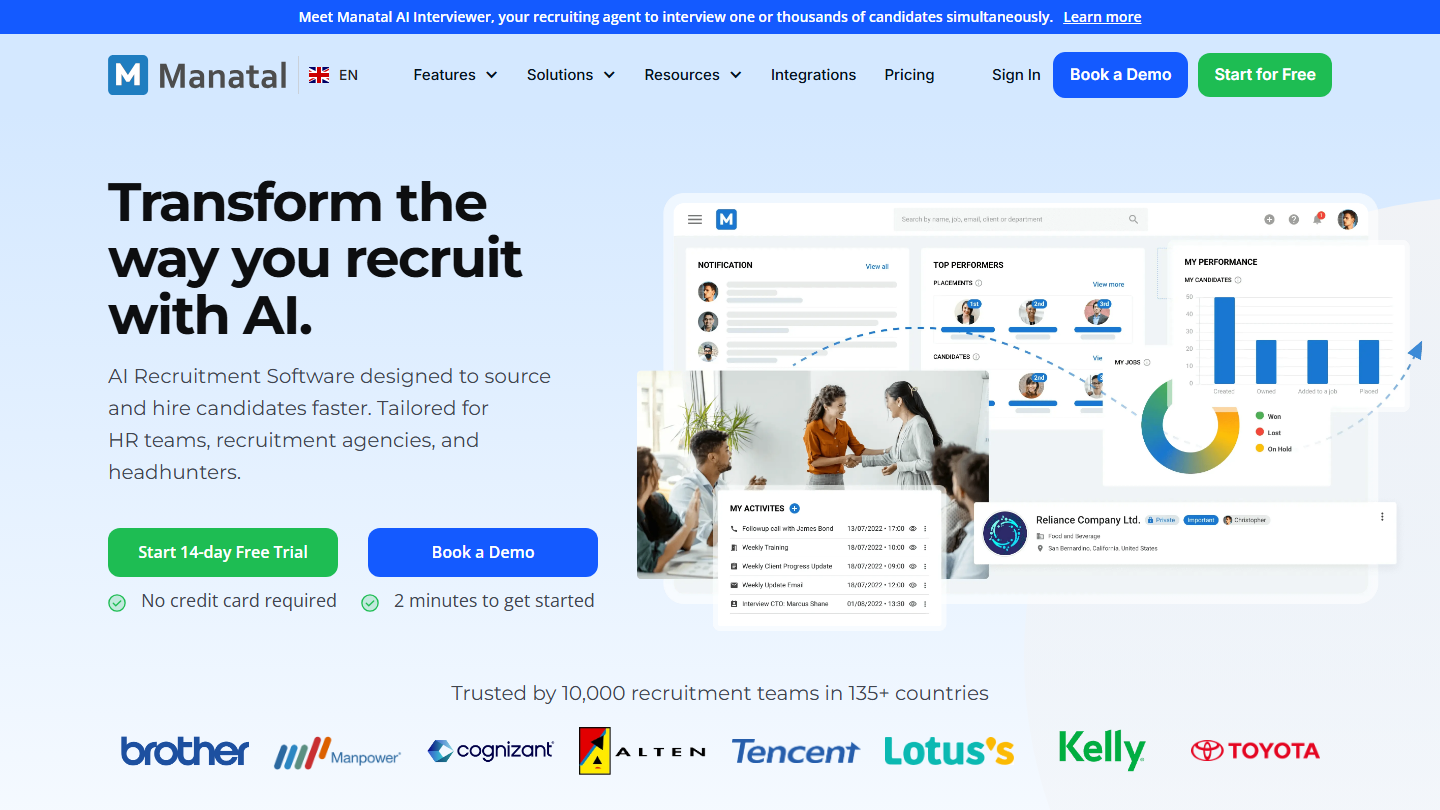
Manatal is an AI-powered recruitment platform combining ATS, CRM, and sourcing tools with a focus on usability and speed. Its AI recommendation engine scores candidates against job requirements and surfaces the highest-fit profiles first, reducing time spent reviewing irrelevant applications. Manatal also pulls publicly available candidate data from LinkedIn and other sources to enrich profiles automatically. At $15 per user per month, it is one of the most accessible options for growing teams that want AI-assisted recruitment marketing without enterprise pricing.
- AI candidate scoring and recommendation
- Social media profile enrichment (LinkedIn, GitHub)
- Pipeline management with kanban view
- Career page hosting and job posting
- Reporting on recruiter and source performance
Pros: Best price-to-feature ratio in this list; fast setup; AI scoring accurate for common roles; works for agencies and in-house teams Cons: Limited employer brand customization; not designed for enterprise compliance; support is chat-only on base tier Pricing: From $15/user/month; 14-day free trial
11. LinkedIn Talent Solutions

LinkedIn Talent Solutions remains the dominant platform for reaching passive candidates in professional and technical roles. With more than 1 billion members globally, LinkedIn gives recruiters access to a talent pool that no other single platform matches in scale. LinkedIn Recruiter, Job Slots, and Pipeline Builder together form a sourcing and nurture workflow that integrates with most ATS platforms. The platform’s InMail response rates average 2-3x higher than cold email for professional roles, based on LinkedIn Talent Insights benchmark data.
- Access to 1 billion+ professional profiles
- InMail outreach with AI-suggested messaging
- Pipeline Builder for passive talent engagement
- Talent Insights for labor market benchmarking
- Sponsored job listings with algorithmic distribution
Pros: Unmatched candidate reach for professional roles; strong brand visibility; integrations with Workday, Greenhouse, and others Cons: High cost per seat; InMail limits per license tier; less effective for trade, healthcare, and hourly roles Pricing: LinkedIn Recruiter from approximately $10,000/seat/year; Job Slots priced separately
12. Glassdoor Employer Center
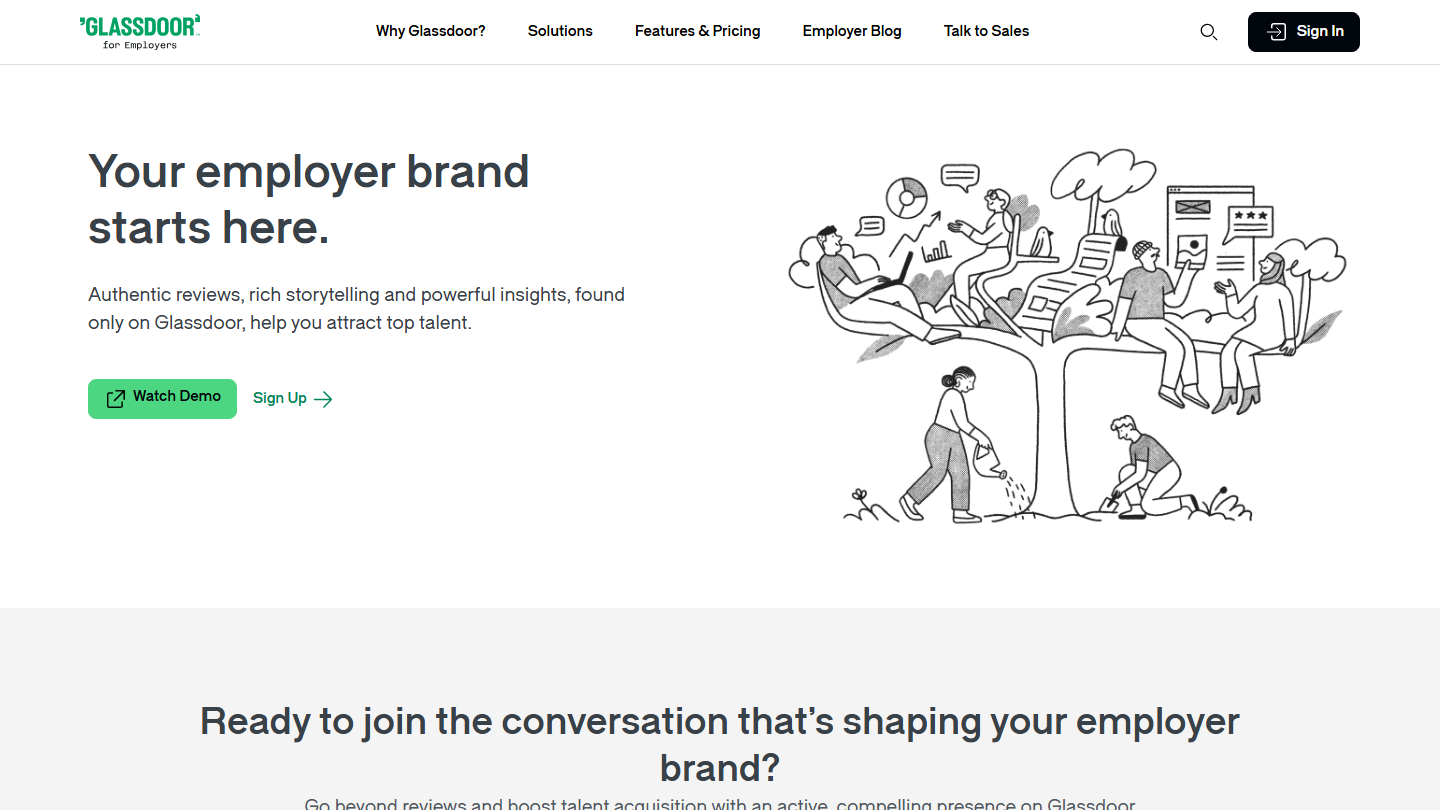
Glassdoor Employer Center lets organizations actively manage their employer brand on the platform where 86% of job seekers read company reviews before accepting an offer. It includes tools to respond to reviews, publish company updates, showcase culture content, and advertise open roles to a high-intent audience. For enterprises managing perception gaps or rebuilding employer brand after organizational change, Glassdoor’s Employer Center is the most direct channel to address candidate concerns at scale. (Glassdoor employer resources)
- Review response and reputation management tools
- Enhanced company profile with media and culture content
- Targeted job advertising to in-market candidates
- Competitive benchmarking against similar employers
- Candidate insights from review and search behavior
Pros: Direct access to high-intent job seekers; strong for employer brand recovery; integrated job advertising Cons: Cannot remove negative reviews; ROI harder to attribute than direct sourcing tools; pricing tied to ad spend volume Pricing: Enhanced Profile from approximately $10,000/year; job advertising is additional
13. Testlify
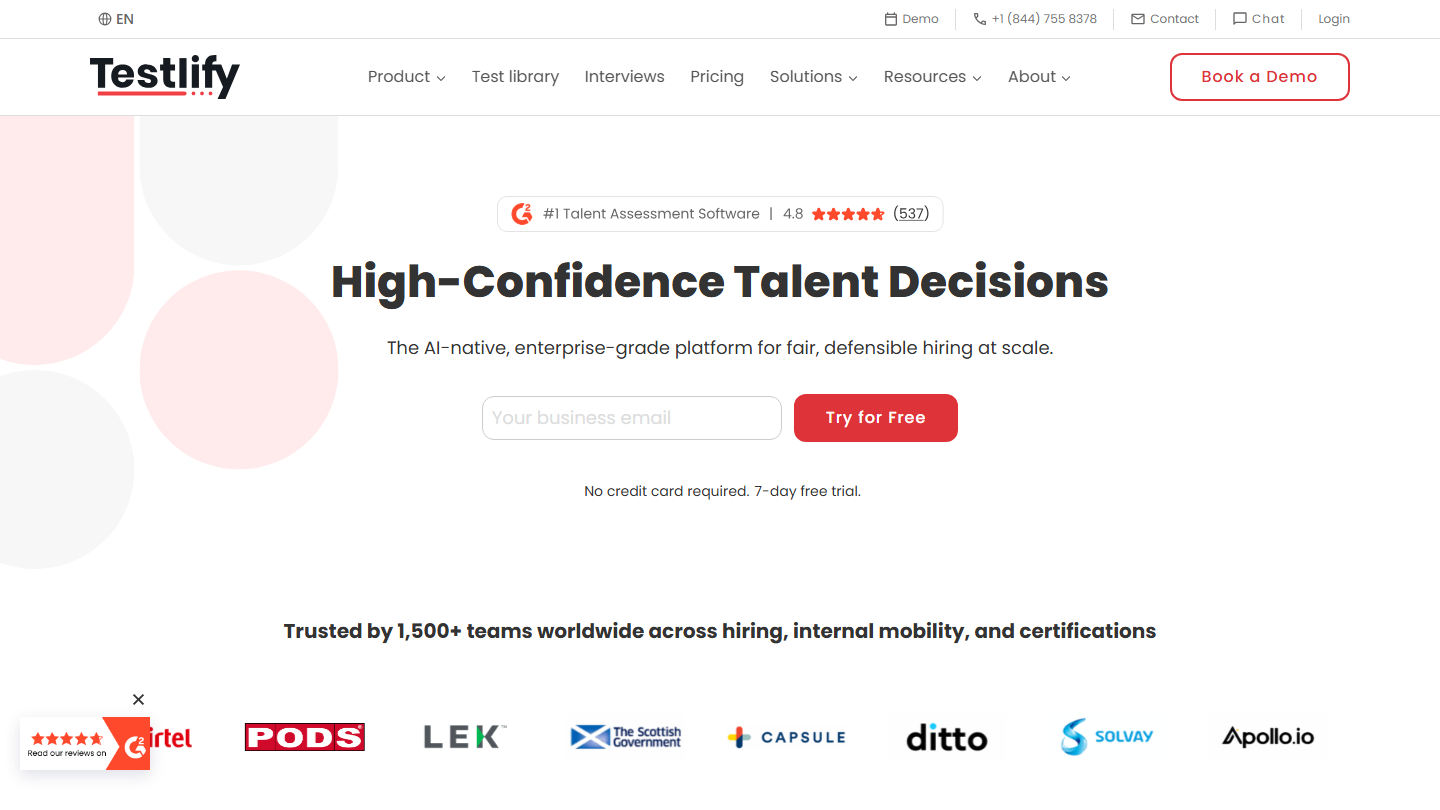
Testlify is a talent assessment platform that sits inside the recruitment marketing funnel at the pre-screen stage, filtering applications by verified skill rather than self-reported resume claims. It integrates with Workable, Greenhouse, Lever, and other ATS platforms to add a skills verification layer between candidate sourcing and recruiter review. (explore pre-employment testing) For enterprise HR teams running high-volume hiring, Testlify reduces recruiter time spent screening unqualified applicants by 40-60%, based on customer benchmarks across teams handling 500-plus applications per month.
A pattern I keep observing across HR teams at scale: the sourcing layer works, but the screening layer is where time gets lost. Recruiters receive 150-plus applications for a single role and spend 3-4 hours manually filtering before a single interview is scheduled. Testlify automates that filter using role-specific assessments across 3,500+ tests mapped to 4,500+ job roles, with results delivered within 24 hours of application submission.
Enterprise teams using Testlify report a 55% reduction in time-to-hire and a 94% candidate satisfaction score — the latter matters because candidate experience directly affects offer acceptance rates and employer brand perception on review platforms. Testlify connects natively to 100+ ATS platforms including Greenhouse, Lever, Workable, and BambooHR, eliminating middleware dependencies that delay most assessment integrations. For teams already running ATS-integrated assessments, Testlify adds a verified skills layer without disrupting existing hiring workflows.
- 3,500+ pre-built skill assessments across 4,500+ job roles
- 100+ ATS integrations including Greenhouse, Lever, and Workable
- AI-proctored assessments with integrity monitoring
- Custom test builder for role-specific evaluation
- 94% candidate satisfaction score with completion rates above industry benchmarks
Pros: Reduces unqualified applicants before recruiter review; fast time-to-result (24 hours); candidate-friendly interface; strong enterprise integrations Cons: Best used as a layer inside an existing stack, not a standalone recruitment marketing platform; sourcing and job distribution are outside its scope Pricing: From $139/month; enterprise plans available; free trial with full feature access
14. Eightfold AI
Eightfold AI is an enterprise talent intelligence platform built on a deep-learning model trained on more than 1 billion career profiles. It understands skills adjacency — meaning it can identify candidates who have never held a specific job title but have the underlying competencies to perform well in it. This makes Eightfold particularly strong for organizations adopting skills-based hiring practices, internal mobility programs, and workforce planning at scale. (skills-based hiring framework)
- AI talent matching based on skills, not job titles
- Internal mobility and career pathing tools
- Diversity hiring pipeline with bias reduction signals
- Workforce planning and skills gap analysis
- Integration with Workday, SAP, Oracle, and others
Pros: Best AI for skills-based sourcing; strong for large, complex organizations; excellent internal mobility use case Cons: Enterprise-only; complex implementation; requires HR data quality many organizations do not yet have Pricing: Custom enterprise pricing
What is the Attract-Assess-Convert (AAC) Framework for recruitment marketing?
Most recruitment marketing guides treat the funnel as two stages: attract candidates, then track them through the ATS. The Attract-Assess-Convert (AAC) Framework, developed through Testlify’s work with enterprise hiring teams, adds a critical middle layer that most recruitment stacks currently skip.
Attract: Use sourcing, employer branding, and job distribution tools — Phenom, Beamery, LinkedIn Talent Solutions, SmartDreamers — to build a high-volume, high-quality inbound pipeline. Measure: applicant volume by source, employer brand NPS, career site conversion rate.
Assess: Before candidates reach a recruiter, verify core skills using structured assessments (Testlify) and AI ranking (Eightfold, Manatal). The goal is to cut time-to-review by filtering unqualified applicants before human review. Measure: screen-to-interview ratio, assessment completion rate, quality-of-hire at 90 days.
Convert: Automate candidate nurture for high-fit candidates who did not accept an offer, keep talent pools warm between cycles, and use data from the Assess stage to improve Attract targeting. Measure: offer acceptance rate, pipeline reactivation rate, source-to-hire conversion.
Pro Tip: Start with your Assess layer before investing in more Attract tools. I have seen teams double their sourcing spend and still fill roles slowly because the screen-to-interview ratio was 60:1. Fix the filter, then scale the funnel.
Key Takeaway: The AAC Framework turns recruitment marketing from a top-of-funnel activity into a full-funnel system. Every tool in this list fits into one of three layers. Match your current bottleneck to the right layer before buying.
The table below maps each platform to its primary AAC layer, so HR teams can identify gaps in their current stack before evaluating new tools.
Tool | AAC Layer | Primary Strength |
|---|---|---|
Phenom | Attract | AI career site + talent CRM for enterprise pipelines |
Beamery | Attract | Skills ontology + automated passive candidate nurture |
SmartDreamers | Attract | Programmatic ad spend optimization across 500+ channels |
LinkedIn Talent Solutions | Attract | 1 billion+ professional profiles for passive sourcing |
Glassdoor Employer Center | Attract | Employer brand management on the #1 candidate review platform |
Teamtailor | Attract | Career site builder with employer brand focus |
TalentLyft | Attract | Multi-board distribution at SMB-accessible pricing |
HubSpot | Attract + Convert | CRM + automated nurture for candidate pipeline management |
Jobvite | Attract + Convert | ATS + recruitment marketing unified for mid-market teams |
iCIMS Talent Cloud | Attract + Convert | Full-lifecycle enterprise suite with 700+ integrations |
Workable | Attract + Convert | 200+ job boards + ATS for growing teams |
Manatal | Attract + Convert | AI candidate scoring + profile enrichment at $15/user/month |
Testlify | Assess | Skills-based pre-screening across 3,500+ tests / 4,500+ job roles |
Eightfold AI | Attract + Assess | Talent intelligence + skills adjacency matching at enterprise scale |
How do recruitment marketing tools integrate with your ATS?
Integration quality determines whether your recruitment marketing stack produces clean data or duplicated records. Before committing to any platform, verify three things:
- Bidirectional sync: Does candidate data flow both ways — from the sourcing tool into the ATS, and from the ATS back into reporting? One-way integrations create manual reconciliation work that compounds at scale.
- Native vs. middleware: Native integrations are maintained by the vendor and update when either product changes its API. Middleware (Zapier, Make) integrations break more often and require a separate paid subscription.
- Data fields mapped: Verify that source attribution, assessment scores, and stage timestamps carry through the integration. Missing fields mean you cannot accurately calculate cost-per-hire or quality-of-hire by channel.
For enterprises already on Workday, SAP SuccessFactors, or Oracle HCM, prioritize platforms with certified partnerships at those HRIS vendors. iCIMS, Beamery, Phenom, and Eightfold all maintain active Workday integrations. Testlify integrates directly with Greenhouse, Lever, and Workable with no middleware required. (ATS integration guide)
Frequently asked questions about recruitment marketing tools

Content Writer
Yashika Khandelwal is a Content Writer with 3+ years of experience creating research-backed content on hiring, talent assessment, and HR technology. She is a registered Organizational Psychologist and subject matter expert who combines behavioral science with practical recruitment insights to produce accurate, evidence-based content.
LinkedInRelated resources
View all
HR & recruitment
Top 14 Applicant Tracking Systems (ATS) for Enterprise HR in 2026

HR & recruitment
Top 7 recruitment trends in sales manager hiring

HR & recruitment
Common examples of unfair hiring practices & how to avoid them

HR & recruitment
Effective ways to identify hiring needs

HR & recruitment
How to build a successful recruitment team

HR & recruitment
Bridging communication gaps in the gig economy
Get started.
Hire on proof, not resumes.
Run your first skills-based assessment free — no credit card required.