
Leadership development programs for HR professionals: types, top picks and how to build one
A practical guide to leadership development programs for HR teams: program types, named options, and how to build and measure your own.

Your company probably already runs leadership training, so why is the leadership bench still thin? Leadership development programs are meant to fix that, but only when they work as programs and not as one-off training days.
Leader and manager development is the top priority for CHROs for the second year running, according to a Gartner survey of 430 CHROs published through Evanta in March 2026. The gap is proof: most HR teams cannot show who should join, what changed afterwards, or whether the leadership pipeline filled.
This guide covers what leadership development programs are, six program types and named options for HR professionals. You will also see how to build and measure your own, and how skills assessments make selection fairer.
TL;DR
- Leadership development programs are structured, multi-month plans that combine assessment, learning, coaching and real work.
- They matter for HR teams in 2026 because weak leadership hits retention, change and succession.
- Six program types suit different levels, from rotational HR programs to in-house cohorts.
- Named options include SHRM certification, the Center for Creative Leadership and eCornell.
- An in-house program takes six steps and should be measured at the end, at three months and at twelve months.
- Skills assessments make selection fairer and results easier to prove.
 ChatGPT
 Gemini
 Claude
 Grok
 Perplexity
What are leadership development programs?
Leadership development programs are planned, multi-month efforts to grow current and future leaders, usually run by HR or L&D for a selected group of employees. A program typically combines skills assessment, formal learning, coaching or mentoring, and stretch work on real business problems, then measures whether participants lead better afterwards.
Leadership development programs differ from a one-off training day in three ways:
- Selection: Participants are chosen on purpose, often high-potential employees or people moving into a bigger role.
- Duration: Programs run for months, sometimes two years, so new habits have time to stick.
- Application: Participants practise on live work, such as a cross-team project or a rotation, not only in a classroom.
In HR, the term also covers a specific career route: the rotational HR leadership development program (HRLDP). Large employers hire graduates or MBA students into two-year programs that move them through several roles.
For more background, see the leadership development glossary entry.

Why do leadership development programs matter for HR teams in 2026?
Leadership development programs matter because weak leadership now shows up directly in retention, change and succession. The DDI Global Leadership Forecast 2025, built on responses from 10,796 leaders and 2,185 HR professionals in more than 50 countries, found several warning signs:
- High-potential talent is nearly four times more likely to leave within a year when their manager does not regularly offer growth and development.
- Leaders name setting strategy and managing change as their two biggest skill gaps, yet only 22% of HR teams prioritise those skills.
- Trust in immediate managers has fallen to 29%.
- High-potential individual contributors who intend to leave rose from 13% in 2020 to 21% in 2024.
Leadership training is also the most common career development tactic companies use. In LinkedIn's 2025 Workplace Learning Report, 71% of organisations offered leadership training, ahead of sharing internal job openings (59%) and mentorship programs (55%), according to an Absorb summary of the report.
LinkedIn found that only 36% of organisations qualify as career development champions, and those champions were more likely to lead on AI adoption (51% vs 36%).
The gap is clear. Almost everyone offers leadership training, but few treat it as a program with chosen participants, a skills target and a result.
What does a good leadership development program include?
A good leadership development program includes four building blocks: an honest starting assessment, structured learning, real work to practise on, and a measurement step at the end. Most programs also follow the 70-20-10 rule of thumb, where roughly 70% of growth comes from on-the-job experience, 20% from other people and 10% from formal courses.
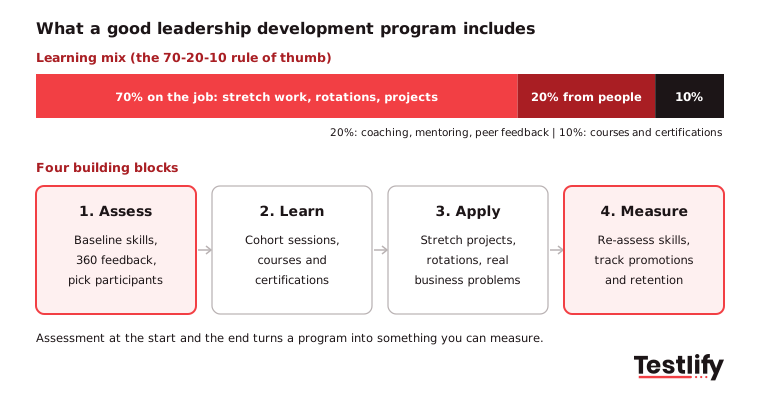
Here is what each block looks like in practice:
- Assess: Start with a baseline that includes leadership skills tests, a 360 feedback round and the participant's current performance data. The baseline shows each person's gaps and gives you something to compare against later.
- Learn: Cohort sessions, workshops, online courses, or a certification cover the concepts: strategy, decision-making, coaching, change, and difficult conversations.
- Apply: Stretch assignments, rotations, and action-learning projects let participants use new skills on real problems, with a sponsor who cares about the outcome.
- Measure: Re-assess the same skills, gather 360 feedback again and track promotions, retention, and team results over the following year.
Coaching and mentoring run across all four blocks. A participant's own manager is the most important coach, so brief managers on the program goals before the first session.
Pro tip: Write the program's skill targets as observable behaviours, such as "runs a weekly one-to-one with each direct report", rather than traits like "strong communicator". Behaviours are easier to coach, assess and see in 360 feedback.
What types of leadership development programs can HR professionals choose?
HR professionals can choose from six main types of leadership development programs, from rotational early-career programs to on-demand course libraries. The right type depends on the person's level, the budget, and whether the goal is a credential, a skill or a promotion-ready successor.
Program type | Best for | Typical format and length | Example |
|---|---|---|---|
Rotational HR leadership development program | Graduates and MBA hires heading for HR leadership | Two years, several HR rotations, mentoring | Johnson and Johnson HR Leadership Development Program |
Professional certification | HR generalists moving to senior or strategic roles | Self-study plus exam | SHRM-CP, SHRM-SCP |
University certificate | HR managers and directors who want strategic HR depth | Online courses over a few months | eCornell Strategic Human Resources Leadership Certificate |
Open-enrolment leadership program | Mid-level and senior leaders, including HR leaders | Multi-day, in person or live online cohort | Center for Creative Leadership Leadership Development Program |
Sponsored or association program | Emerging HR professionals | Year-round, mentoring and events | SHRM Foundation HR Tomorrow Leadership Program |
In-house program | Building a pipeline for your own company | Six to eighteen months, cohort based | Designed by your HR and L&D team |
Most mid-market and enterprise HR teams end up combining two or three types: an in-house program for the business, external programs or certifications for HR's own senior people, and an on-demand library to fill gaps.
Which leadership development programs are worth a look for HR professionals?
The leadership development programs below are well-known, current options for HR professionals at different career stages. Each entry covers who it suits and what to check before enrolling.
Details were checked on the providers' pages in October 2026. Confirm dates and fees directly, because both change often.
SHRM-CP and SHRM-SCP certification
SHRM certification is one of the best-known HR credentials in the US and a common step for HR professionals moving into leadership. The SHRM-SCP is aimed at senior and strategic HR roles: candidates need at least three years of strategic-level HR work, or three years holding the SHRM-CP.
The exam mixes knowledge questions with situational judgment items and runs in two testing windows a year. Certification builds HR knowledge and judgment; pair it with real leadership practice to build leadership itself.
Center for Creative Leadership programs
The Center for Creative Leadership (CCL) runs one of the longest-standing open-enrolment programs, the Leadership Development Program (LDP), aimed at mid-level leaders and offered in person or live online. CCL also runs programs by level, from first-time managers to the C-suite, and a 2.5-day "Succession Reimagined" working session for executives and HR leaders.
CCL suits HR leaders who want an external cohort and structured feedback on their own leadership.
eCornell Strategic Human Resources Leadership Certificate
The Cornell ILR School's Strategic Human Resources Leadership Certificate, delivered online through eCornell, is built for HR managers and directors. The program has six courses, including aligning HR strategy with business strategy, talent management and talent analytics, and usually takes about three months.
The certificate suits HR professionals who need to move from running HR processes to shaping business strategy.
SHRM Foundation HR Tomorrow Leadership Program
The HR Tomorrow Leadership Program is a year-round program for up to 10 emerging HR professionals per cohort, with two to four years of HR experience, from groups underrepresented in the field. Participants receive SHRM membership, conference grants, certification exam support and mentoring.
The program is a strong option for early-career HR talent your team wants to keep and grow.
Rotational HR leadership development programs
Rotational HR programs at large employers are both a hiring route and a leadership program. The Johnson and Johnson HR Leadership Development Program runs two-year tracks; the experienced track rotates participants through three HR roles across business segments and locations.
If your company is large enough, a rotational program is one of the fastest ways to build a bench of future HR business partners and heads of HR.
LinkedIn Learning and other on-demand libraries
On-demand libraries such as LinkedIn Learning offer short leadership and HR courses that people take at their own pace. They work well to fill specific gaps, such as giving feedback or running a meeting, and as pre-work for a cohort program.
On their own, course libraries rarely change how someone leads, because they lack practice, feedback and accountability.
How do you choose the right leadership development program for your HR team?
Choosing the right leadership development program starts with the gap, not the brochure. Decide which leadership skills the person or group is missing, then pick the format that closes that gap at the right level and cost.
Use these questions to compare options:
- What is the goal? A credential (certification), a skill (cohort program or coaching), or a ready successor (rotations and stretch roles).
- What level is the participant? First-time managers need people-leadership basics; senior HR leaders need strategy, change and business acumen.
- How much real practice is built in? Look for projects, simulations or rotations, not only lectures.
- How will you know it worked? Ask the provider what they measure and plan your own before and after assessment.
- What will the manager do? Programs work best when the participant's manager sets goals with them and follows up.
- What is the total cost? Count time away from work, travel and backfill, not only fees.
For the HR team itself, many companies pick a certification or university certificate for depth in HR, plus an external cohort program for leadership skills. For the wider business, an in-house program usually wins because it can be shaped around your strategy and culture.
How do you build an in-house leadership development program?
Building an in-house leadership development program takes six steps: tie it to a business goal, define the skills, assess and select participants, design the learning mix, run it with support, and measure the results. The Harvard Business Impact guide to creating a leadership development program follows a similar path, starting with business alignment and ending with impact measurement.
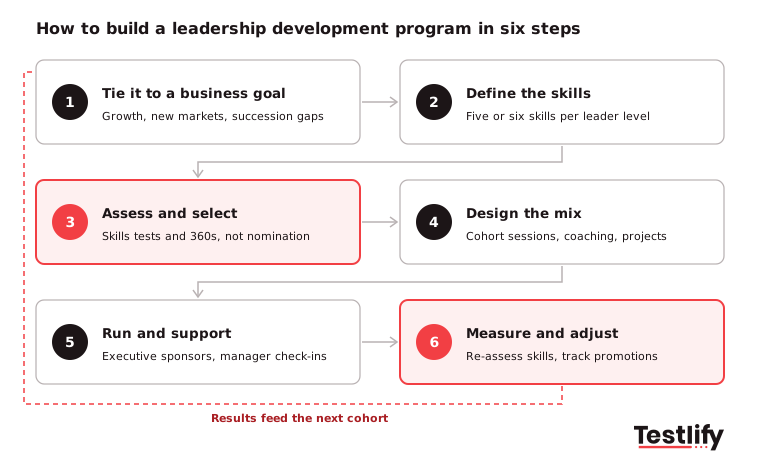
Step 1: Tie the program to a business goal
A business goal gives the program a reason to exist and a way to be judged. Ask senior leaders which gap hurts most, such as thin succession cover or high first-line manager turnover. Write the goal in one sentence and share it with every sponsor.
Step 2: Define the leadership skills
Target skills should be few and written as observable behaviours. Pick five or six per level, such as coaching a direct report or leading a team through change. A short list keeps content focused and makes progress easy to assess.
Step 3: Assess and select participants
Selection works best when manager nominations are checked against objective data. Use leadership and situational judgment tests, 360 feedback and performance history. Give every candidate the same assessment, so people managers do not yet know get a fair chance.
Step 4: Design the learning mix
The learning mix should favour practice over lectures. Combine cohort sessions, coaching and at least one stretch project per participant. Following the 70-20-10 balance keeps most of the effort on real work and peer learning.
Step 5: Run the program with support
Support from sponsors and managers decides whether participants finish and apply what they learn. Assign each person an executive sponsor, schedule regular manager check-ins and protect time for program work in their calendar.
Step 6: Measure and adjust
Measurement closes the loop and shows whether the program met its goal. Re-assess the same skills used at the start, review the results with sponsors and feed the lessons into the next cohort.
For a deeper walkthrough of design choices, read the guide on how to design and implement HR leadership development programs and the steps to create a leadership development plan for each participant.
How to measure the success of a leadership development program?
Measuring the success of a leadership development program means comparing participants against their own baseline and tracking business results over time. Measure in three waves: right after the program, three months later, and at twelve months.
When | What to measure | How |
|---|---|---|
End of program | Skill gain on the target skills | Re-take the same leadership assessment and compare with the baseline |
End of program | Participant experience | Short survey on relevance and how often they used what they learned |
After 3 months | Behaviour change on the job | Repeat 360 feedback from manager, peers and direct reports |
After 3 months | Project results | Sponsor review of the stretch project's business outcome |
After 12 months | Pipeline strength | Share of open leadership roles filled internally, ready-now successors per critical role |
After 12 months | Retention and engagement | Participant retention vs a similar group, engagement scores of their teams |
Track the internal fill rate in particular. A program that grows leaders who then leave, or never get promoted, has not solved the pipeline problem.
Link the numbers to your succession planning process so the program and succession reviews use the same data.
Where do skills assessments fit in leadership development programs?
Skills assessments fit at the start and the end of leadership development programs: at the start to choose participants fairly and find each person's gaps, and at the end to prove what changed. Without them, selection depends on who managers notice, and results depend on how participants feel.
Testlify's test library includes 3,500+ tests, among them leadership-focused ones HR teams can use for both steps:
- The leadership and people management test and the strategic thinking test for selection and baselines.
- The 360 degree feedback test to gather structured input from managers, peers and direct reports.
- Situational judgment and emotional intelligence tests to see how people handle realistic leadership scenarios.
Reports show per-skill scores and benchmarks, so HR can compare cohorts and spot common gaps. The same tests support internal mobility, helping you find high-potential employees outside the usual nomination list.
Key takeaway: The best leadership development programs for HR professionals are chosen and run like any other business investment. Pick participants on evidence, build in real practice, and measure the same skills before and after so you can show the program filled your leadership pipeline.
Ready to try leadership assessments with your next cohort? Book a demo to see how Testlify can help you set them up and identify top leadership talent.
Frequently asked questions (FAQs)
Related resources
View all
HR & recruitment
Applications of generative AI in hiring

HR & recruitment
HR strategies to attract top talent

HR & recruitment
Tackling communication challenges in the onboarding process

HR & recruitment
Offer management: HR tips to close top talent
HR & recruitment
Verify candidate credibility with background checks and references

HR & recruitment
Top 5 practices in online tests to maintain integrity
Get started.
Hire on proof, not resumes.
Run your first skills-based assessment free — no credit card required.