
Testlify vs. TalentClick: Which Skills Assessment Platform is Best for HR Teams?
Testlify vs. TalentClick: Discover which skills assessment platform best suits your hiring needs
Testlify and TalentClick both assess candidates before you hire them, but they measure different things. TalentClick profiles behaviour and safety risk, mostly through self-reported personality surveys. Testlify measures what a candidate can actually do across coding, cognitive, software and role-specific work, then adds proctoring and AI interviews on top. Pick the one that matches the risk you are trying to price.
TL;DR
- TalentClick is a behavioural and safety-risk specialist. Its strength is predicting how someone is likely to behave in roles where safety, trust and compliance carry the cost.
- Testlify is a broad skills-assessment platform: 3,000+ tests, 45+ programming languages, coding and software-skills tests, plus conversational AI interviews in chat, voice and video.
- The real split is self-report versus demonstrated work. Personality surveys ask candidates to describe themselves. Skills tests make them show you.
- Proctoring is the sharpest gap. TalentClick relies on self-reporting with minimal fraud prevention; Testlify ships webcam monitoring, tab-switch detection and AI-assistance detection.
- Teams hiring across technical and non-technical roles usually need the wider library. Teams hiring high-volume frontline staff for safety-critical work may find TalentClick's niche is genuinely the better fit.
 ChatGPT
 Gemini
 Claude
 Grok
Grok Perplexity
What is Testlify?
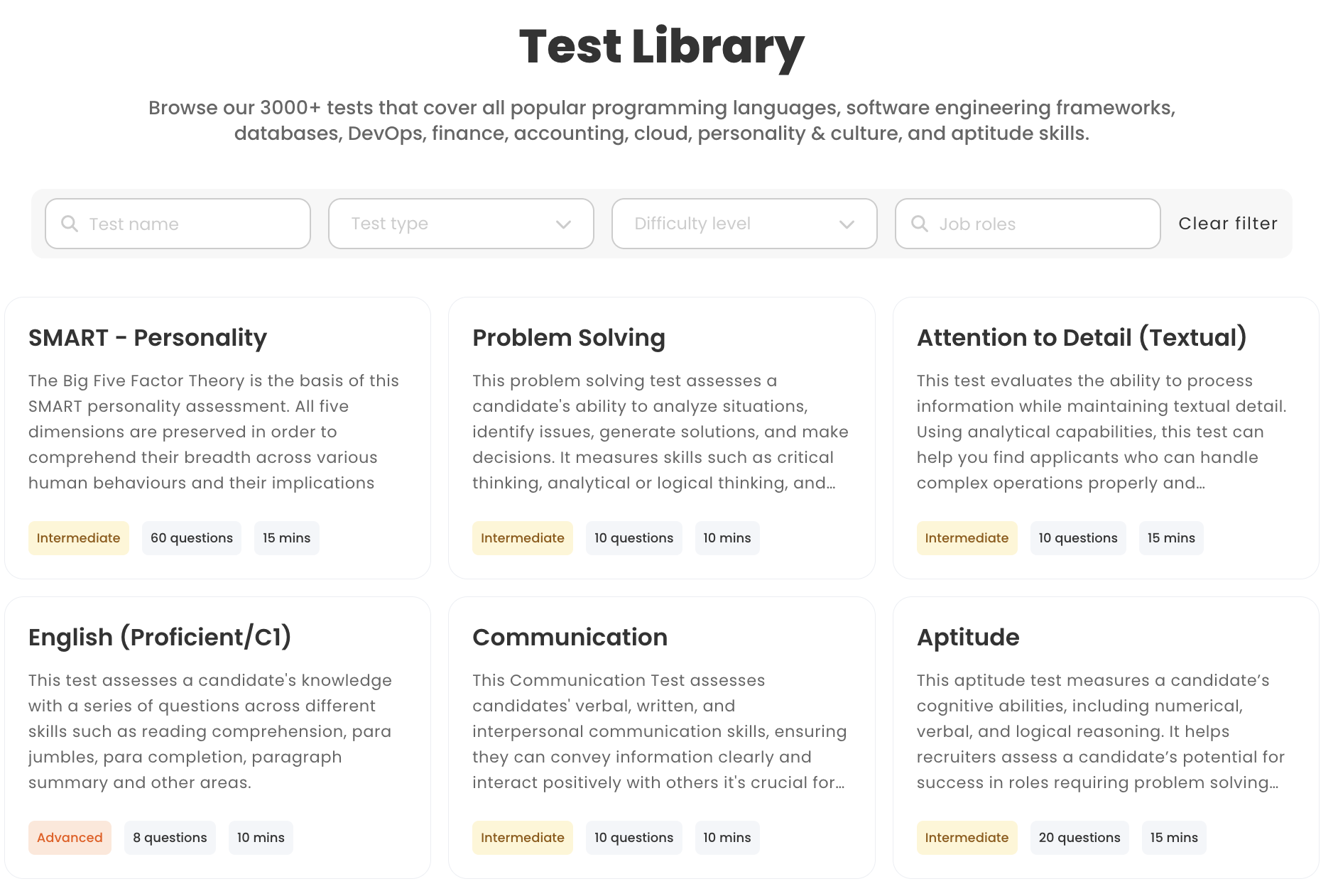
Testlify is a talent assessment platform that helps hiring teams verify skills before an interview instead of guessing from a resume. It covers 3,000+ tests across 4,500+ job roles, spanning coding, cognitive ability, psychometrics, language, software skills and role-specific work samples, with proctoring and AI interviews built in.
That breadth matters more than it used to. The World Economic Forum's Future of Jobs Report found employers expect 39% of workers' core skills to change by 2030. A test library pinned to the roles of five years ago ages badly.
How does Testlify work?
1. Create tailored assessments
Start from the role, not the test. Pick from the library or build a custom assessment, mixing skills tests with your own questions. You can weight sections so the competency that actually predicts performance counts for more than the one that is easy to measure.
2. Send candidate invitations
Invite candidates by bulk email, a shareable public link, or automatically from your ATS. Reminders go out on their own, so a recruiter is not chasing response rates by hand.
3. Anti-cheating and proctoring measures
Testlify runs webcam snapshots, photo ID verification, tab-switch detection, full-screen enforcement, copy-paste monitoring, multi-monitor detection and AI-assistance detection. Strictness is configurable, so a warehouse typing test is not policed like a senior engineering assessment. Details sit in the anti-cheating and proctoring documentation.
None of this proves intent. A flag is a prompt to look closer, not a rejection.
4. AI-powered scoring and analytics
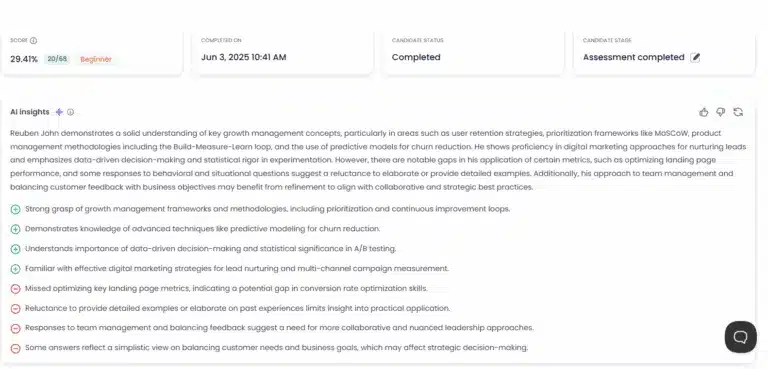
Scoring is automatic and consistent across candidates. Reports break results down by skill, benchmark candidates against each other, and summarize strengths and gaps so a hiring manager can read a shortlist in minutes. AI insights on candidate reports explains what the summaries cover.
There is a reason to prefer scoring over impressions. A meta-analysis of selection decisions found that mechanically combining assessment information predicts outcomes at least as well as experts recombining the same information in their heads.
5. Integration with applicant tracking systems
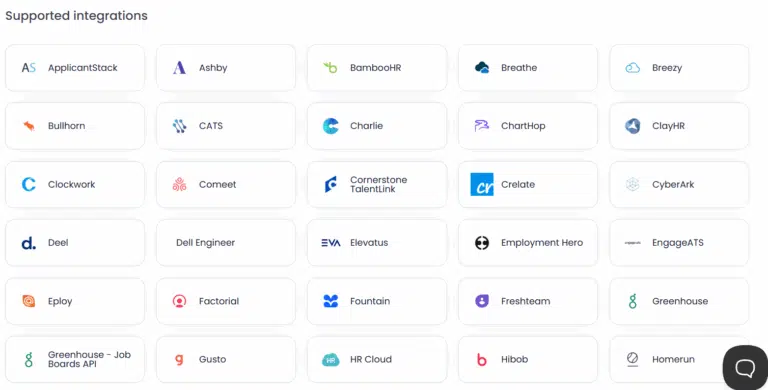
Testlify connects to 100+ ATS and HR tools including Workday, Greenhouse, Lever, SAP SuccessFactors, SmartRecruiters and Zoho Recruit, plus APIs and webhooks. Scores land on the candidate record instead of a spreadsheet.
6. Data compliance
Testlify holds GDPR and CCPA compliance, SOC 2 and ISO 27001. For regulated hiring, the documented process matters as much as the score.

What is TalentClick?
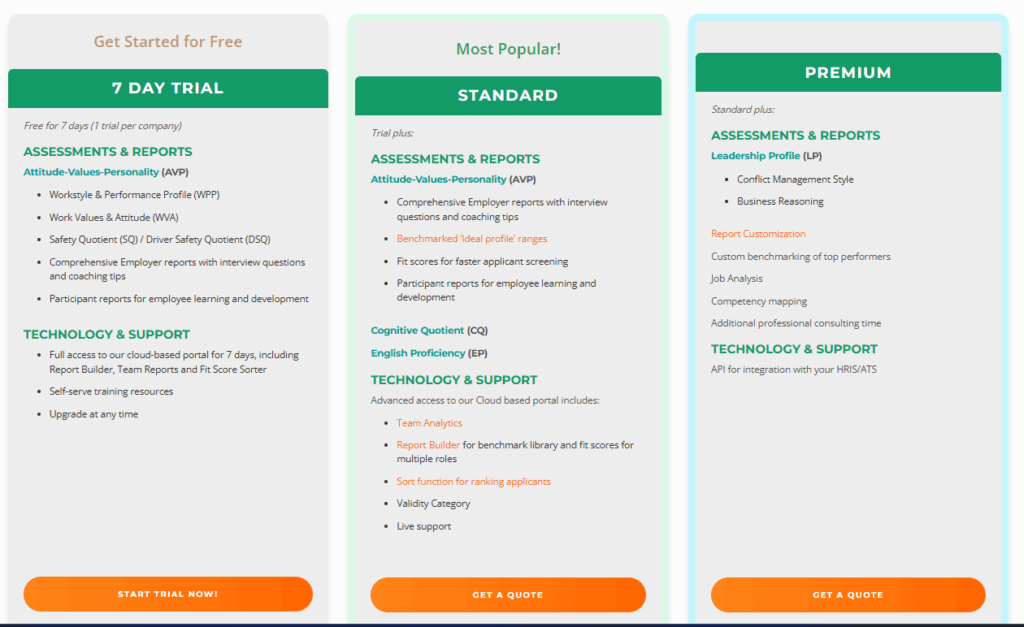
TalentClick is a workforce assessment platform built around behavioural and risk profiling. It sells a catalogue of research-validated surveys that predict how someone is likely to act at work, and reports results as a Fit Score against a benchmark profile for the job. Its best-known product, the Safety Quotient, targets safety-critical and frontline roles.
Its focus is narrower than Testlify's on purpose. TalentClick is not trying to test whether a developer can write working code; it is trying to tell you whether a candidate is likely to take risks, cut corners or clash with a supervisor.
How does TalentClick work?
1. Assessment creation
You select from TalentClick's catalogue of pre-designed assessments rather than building tests yourself. Each one is standardized and research-validated. That is a genuine advantage for consistency and a real limit if your role needs something the catalogue does not cover.
2. Invite candidates
Invitations go out through built-in email templates or SMS. A campaign manager schedules automated reminders and tracks response rates, which helps for high-volume frontline hiring where drop-off is the main enemy.
3. Proctoring measures
There are no built-in proctoring or anti-cheating tools: no webcam monitoring, no lockdown browser. The assessments rely on self-reporting, and fraud prevention is minimal because the content is mostly personality and risk questions. Candidates can complete them on any connected device.
This is a defensible design choice for a personality survey and a real problem if you ever want to test a hard skill, because a self-reported answer cannot be verified.
4. Reporting and analytics
Reports include narrative interpretations, numerical trait scores and a Fit Score comparing the candidate to an ideal benchmark for the role. Short and long forms are available, often with suggested interview questions, coaching tips and development notes, downloadable as PDFs.
5. Data compliance
TalentClick states GDPR and CCPA compliance for candidate data handling.
How do Testlify and TalentClick compare?
Feature by feature, Testlify covers more ground: a wider test library, technical assessments TalentClick does not offer, proctoring, and conversational AI interviews. TalentClick matches it on personality, motivation and cognitive testing, which is exactly where it concentrates.
Features | Testlify | TalentClick |
|---|---|---|
Test Library | ||
Role-specific tests | ✓ | ✓ |
Coding tests | ✓ | ✗ |
Cognitive ability tests | ✓ | ✓ |
Programming tests | ✓ | ✗ |
Number of programming languages supported | 45+ | ✗ |
Situational judgment tests | ✓ | ✗ |
Typing test | ✓ | ✓ |
Software skills tests | ✓ | ✗ |
Non-technical tests | ✓ | ✓ |
Psychometric tests | ✓ | ✗ |
Personality tests | ✓ | ✓ |
Motivation test | ✓ | ✓ |
Assessment templates | ✓ | ✗ |
Custom assessments creation | ✓ | ✗ |
Assessments | ||
Custom assessment builder | ✓ | ✗ |
Custom coding questions | ✓ | ✗ |
Multiple-choice questions | ✓ | - |
Short answer questions | ✓ | - |
Long answer questions | ✓ | - |
Rating questions | ✓ | - |
Date questions | ✓ | - |
Fill in the blanks | ✓ | - |
Microsoft Word/Excel/PowerPoint questions | ✓ | ✗ |
Google Docs/Slides/Sheets questions | ✓ | ✗ |
Qualifier questions | ✓ | ✓ |
File upload questions | ✓ | ✗ |
Assessments curated by I/O psychologists | ✓ | ✓ |
Quality check | ✓ | ✓ |
Interview | ||
Audio interviewing (Voice AI) | ✓ | ✗ |
One-way audio interview | ✓ | ✗ |
Video interviewing (Video AI) | ✓ | ✗ |
One-way video interview | ✓ | ✗ |
Chat simulation (Chat AI) | ✓ | ✗ |
Custom interview questions creation | ✓ | ✗ |
Candidate Experience | ||
Customizable email templates | ✓ | ✓ |
Mobile-friendly | ✓ | ✓ |
Candidate support | ✓ | ✓ |
Welcome video | ✓ | ✓ |
Average assessment length | 40-60 minutes | - |
Assessment attempts | Customizable | - |
Anti-cheating Features | ||
Session recording | ✓ | ✗ |
Snapshot capturing | ✓ | ✗ |
Mouse tracking | ✓ | ✗ |
Disabled copy-paste | ✓ | ✗ |
Microphone and camera access | ✓ | ✗ |
Location access | ✓ | ✗ |
IP address tracking | ✓ | ✗ |
Question-level activity logs | ✓ | ✗ |
Full-screen mode | ✓ | ✗ |
Force full-screen mode | ✓ | ✗ |
Tab proctoring | ✓ | ✗ |
AI assistance detection | ✓ | ✗ |
Restrict multiple monitors | ✓ | ✗ |
Randomization of question sequence | ✓ | ✗ |
Time limit on tests | ✓ | ✗ |
Screen sharing | ✓ | ✗ |
Dual camera proctoring | ✓ | ✗ |
Honesty Agreement | ✓ | ✗ |
Reporting and Analytics | ||
Detailed reports | ✓ | ✓ |
Public link to share reports and scorecards | ✓ | ✓ |
Exportable/downloadable reports | ✓ | ✓ |
Recruiting analytics | ✓ | ✓ |
Candidate benchmarking | ✓ | ✓ |
Completion rate and response insights | ✓ | ✓ |
Enterprise Friendly | ||
White label | ✓ | ✓ |
Custom branding | ✓ | ✓ |
ATS integrations | 100+ | ✓ |
User, role, and access management | ✓ | ✓ |
Bulk candidate invite | ✓ | ✓ |
Share public link invite to candidates | ✓ | ✓ |
Candidate pipeline management | ✓ | ✓ |
Internationalization | ✓ | ✓ |
Campus hiring support | ✓ | ✗ |
Dedicated account manager | ✓ | ✗ |
Security and Compliance | ||
GDPR | ✓ | ✓ |
CCPA | ✓ | ✓ |
SOC2 | ✓ | ✓ |
ISO 27001 | ✓ | ✗ |
Customer Support | ||
24/7 support | ✓ | ✗ |
On-call support | ✓ | ✓ |
Email support | ✓ | ✓ |
Product demo | ✓ | ✓ |
Training & onboarding tour | ✓ | ✓ |
Test library and test types
Testlify offers 3,000+ tests across 4,500+ roles and 50+ industries: coding, programming across 45+ languages, cognitive ability, psychometrics, situational judgment, typing, software skills and language tests. TalentClick's catalogue is deliberately smaller and centred on behavioural surveys with a handful of cognitive assessments.
If you hire only for frontline safety roles, the smaller catalogue is not a problem. If one quarter brings a developer, a finance analyst and a customer-support rep, it is.
Custom question types
Testlify supports custom questions in multiple formats: multiple choice, essay, file upload, video, audio and coding. TalentClick works from its standardized catalogue, so the trade is consistency for flexibility.
White-labeling capabilities
Both platforms support white labelling and custom branding. Testlify adds custom domains and branded candidate emails, which matters at volume when the assessment invite is the first thing a candidate sees from your company.
Conversational AI interviews
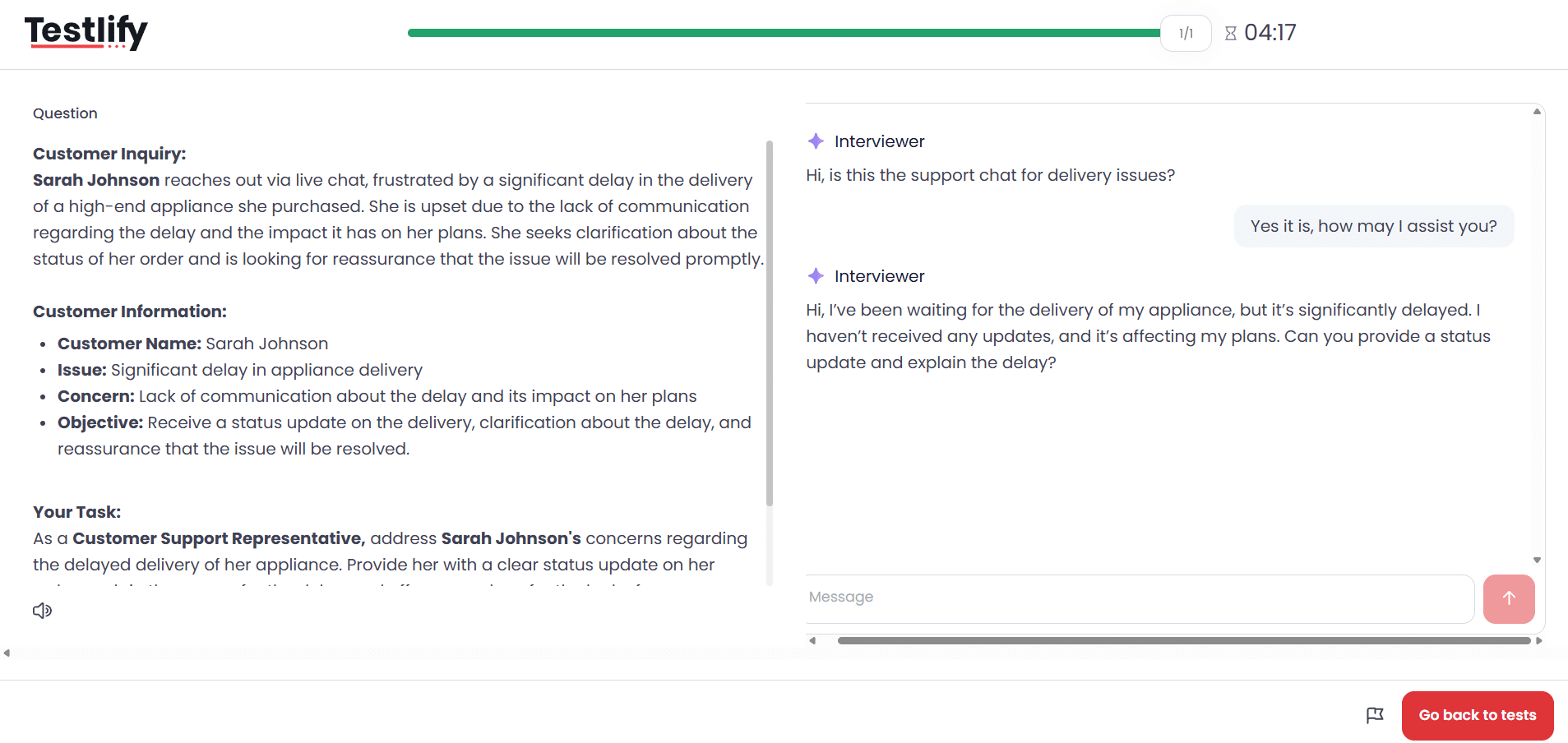
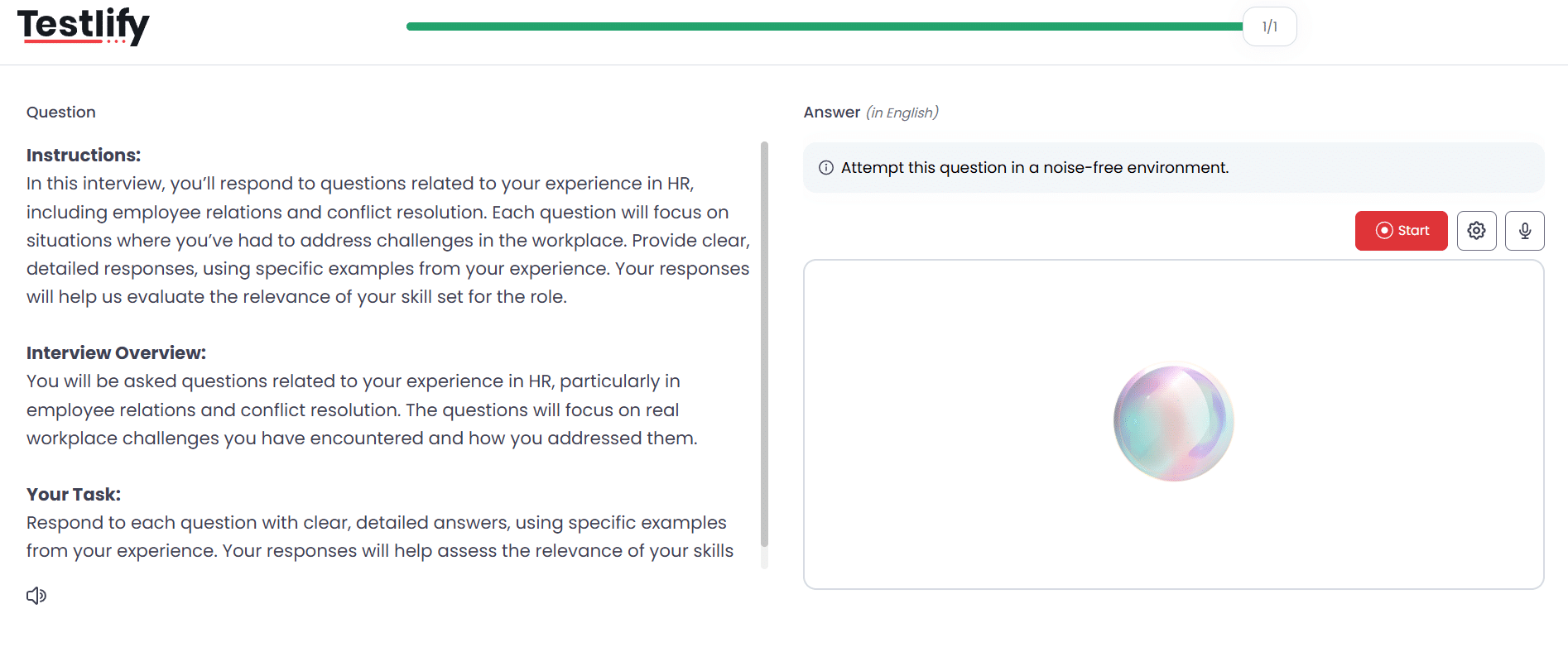
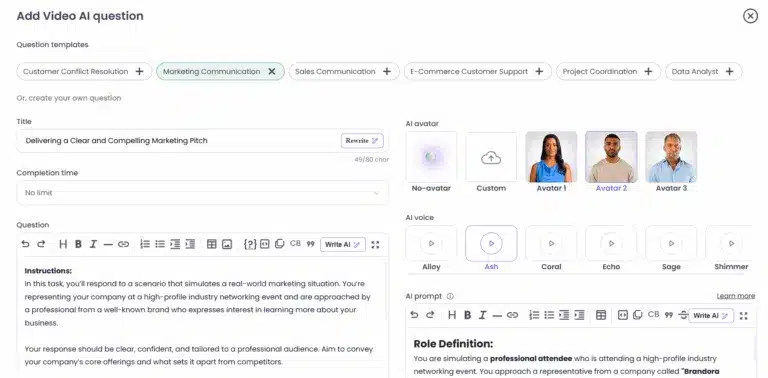
Testlify runs conversational AI interviews in chat, voice and video, building job-realistic scenarios a candidate responds to in the moment. TalentClick does not offer an equivalent.
This is the clearest capability gap between the two. A personality survey tells you how someone describes themselves; a voice interview about a real situation shows you how they reason under mild pressure.
Anti-cheating and proctoring features
Testlify ships identity checks, webcam snapshots, environment scan, tab-switch detection, copy-paste monitoring, multi-monitor detection, IP restriction and AI-assistance detection. TalentClick has none of these, by design.
Testlify layers these: identity assurance, environment control, behaviour monitoring, AI-assistance detection, reviewable evidence and configurable strictness, with the final judgment left to a person. A flag opens a conversation; it never auto-rejects a candidate.
Benchmarking analytics
Both benchmark candidates. TalentClick compares a profile against an ideal-fit benchmark for the role. Testlify benchmarks candidates against each other and against role norms, with skill-level breakdowns rather than a single composite number.
Integrations
Testlify connects to 100+ ATS and HR platforms with APIs and webhooks. TalentClick integrates with a smaller set. For an enterprise stack already running Workday or SuccessFactors, integration depth decides whether scores reach the recruiter or die in an inbox.
AI candidate insights
Testlify generates AI summaries of candidate strengths, gaps and recommended interview probes on top of raw scores. TalentClick's reports carry narrative interpretation written around its trait model, which is genuinely readable, just not adaptive to a custom assessment.
Reporting and insights
Both produce detailed, exportable reports with shareable links. Testlify adds candidate comparison, completion and response-rate insights, and multi-reviewer scoring so a hiring committee records structured feedback in one place instead of three email threads.
Customer support
Testlify provides 24/7 support, on-call and email support, product demos, onboarding tours and dedicated account managers on enterprise plans. TalentClick offers on-call and email support with demos and onboarding, without a 24/7 tier.
Pricing plans
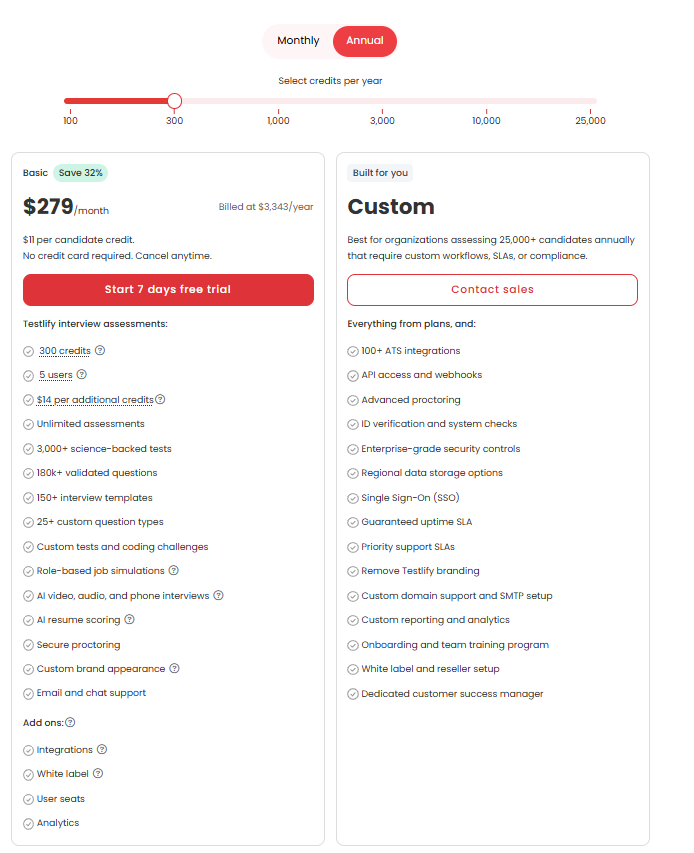
Testlify prices per candidate assessed, with a free trial and plans that scale from a first hire to high-volume recruiting. TalentClick prices per assessment and positions itself as affordable at scale for frontline hiring.
Compare on cost per assessed candidate, not sticker price, and check what happens in a hiring freeze. Current pricing sits on the Testlify pricing page.
Which platform fits which hiring problem?
Match the tool to the risk you are pricing. If the expensive failure is someone behaving unsafely on a site, behavioural risk profiling earns its place. If the expensive failure is someone who cannot do the work, you need evidence of the work.
The Testlify Multi-Signal Talent Evaluation Model is the honest way to run this. It combines several role-relevant signals (skills assessments, interviews, simulations, references and reviewer feedback) instead of trusting one. One signal is fragile. Several pointing the same way is a decision you can defend.
That framing explains why this is not always an either-or. A logistics operator hiring 200 warehouse staff a year could use behavioural risk screening for safety and a short software-skills test for the shift supervisors who touch the WMS. The signals answer different questions.
Where it does become either-or is budget. Running two vendors for 200 hires means two contracts, two candidate experiences and two data-retention conversations with legal. Most teams that consolidate do it for that reason, not because one platform's tests are better.
Resumes will not settle it either way. A 2022 reanalysis of selection-method validity placed structured approaches among the stronger predictors of job performance and years of education and general experience among the weaker ones.
Is Testlify a better alternative to TalentClick?
For most hiring teams, yes, because most teams hire for more than one kind of role. Testlify covers technical and non-technical assessment, proctors the result, interviews with AI and integrates with the ATS already in place. TalentClick does one slice well and leaves the rest to another tool.
The honest exception: if every hire is a frontline, safety-critical role and the only question is behavioural risk, TalentClick's specialization is a real fit and switching buys you breadth you will not use. Say that out loud before you run a procurement cycle.
The cost of getting it wrong is not abstract. Gallup puts the cost of replacing an employee at one-half to two times their annual salary, and estimates voluntary turnover costs US businesses a trillion dollars a year.
What should you check before you switch?
Run the evaluation on your own roles, not on a feature grid. Five checks separate a good demo from a good decision.
- Test one real role end to end. Take a role you are hiring for now and build the actual assessment. Feature lists hide gaps that a real job description exposes in ten minutes.
- Send it to three current employees. If your strongest performer scores badly, the assessment is measuring the wrong thing. This catches more bad configurations than any vendor reference call.
- Check completion rates, not just content. A 45-minute assessment with a 40% drop-off costs you more candidates than it filters.
- Confirm the ATS integration writes back. Plenty of integrations send candidates out and never return the score to the record where a recruiter will see it.
- Ask what happens to candidate data. Retention periods, deletion requests and where the data is hosted. Legal will ask eventually, so ask first.
Pro tip: score your shortlist before the first call, not after. Teams that assess first interview fewer people and spend the saved hours on the candidates who can actually do the job. It also removes the awkward case where someone has already had three interviews by the time a test says no.
Ready to see how it works on a role you are hiring for right now? Book a Testlify demo and bring a live job description. Or start free and build the assessment yourself in an afternoon.
Key takeaways
- The two platforms measure different things. TalentClick profiles self-reported behaviour and safety risk; Testlify measures demonstrated skill. That distinction, not the feature count, should drive the decision, because buying breadth you never use is as wasteful as buying a niche tool that cannot cover your roles.
- Self-report cannot be proctored. TalentClick's lack of anti-cheating tooling is coherent for personality surveys but blocks any move into hard-skill testing, so plan for a second tool if technical roles are coming.
- Library breadth is a hedge against role change. With 39% of core skills expected to shift by 2030, a catalogue tied to today's roles will need replacing sooner than the contract term suggests.
- Structured scoring beats gut-feel judgment. Mechanical combination of assessment data predicts outcomes at least as well as experts reworking the numbers, so protect the scoring model from well-meaning override.
- Multiple signals beat one. A single test, like a single interview, is fragile evidence. Combine assessment, interview and reviewer feedback before advancing a candidate.
- Consolidation is usually a cost decision. Running two assessment vendors doubles contracts, candidate experiences and data-retention obligations, which is what pushes most teams onto one platform.
- Validate on your own roles. Build one real assessment, send it to current strong performers, and check that scores write back to the ATS before you sign anything.
FAQs
Final thoughts
Pick the platform that matches the failure you are trying to prevent, then prove it on a role you are hiring for this quarter. Build one real assessment, send it to two strong performers already doing the job, and see whether the scores agree with what you know about them. That single test tells you more than any comparison table, including this one. Browse the Testlify test library to see what a role-specific assessment looks like before you commit.

Director of Marketing
Akash Patange is the Director of Marketing at Testlify, where he works closely with HR leaders and recruiters to help organizations improve hiring outcomes. He writes about talent assessment, recruitment technology, and data-driven hiring practices.
LinkedInRelated resources
View all
Competitor Comparisons
Testlify vs. ASC Smarter Assessment: Which Skills Assessment Platform is Best for HR Teams?
Competitor Comparisons
Testlify vs Canditech: Which Assessment Platform Wins in 2026?
Competitor Comparisons
Testlify vs. eSkill: Which Skills Assessment Platform is Best for HR Teams?
Competitor Comparisons
Testlify vs. TestInvite: Which Skills Assessment Platform Wins in 2026?
Competitor Comparisons
Testlify vs. HackerRank: Which Skills Assessment Platform is Best for HR Teams?
Competitor Comparisons
Testlify vs. HackerEarth: Which Skills Assessment Platform is Best for HR Teams?
Get started.
Hire on proof, not resumes.
Run your first skills-based assessment free — no credit card required.