
Testlify vs Quest Wing: A detailed comparison
Discover the perfect solution for evaluating your candidates’ skills with Testlify. Dive into our comprehensive Testlify vs QuestWing…
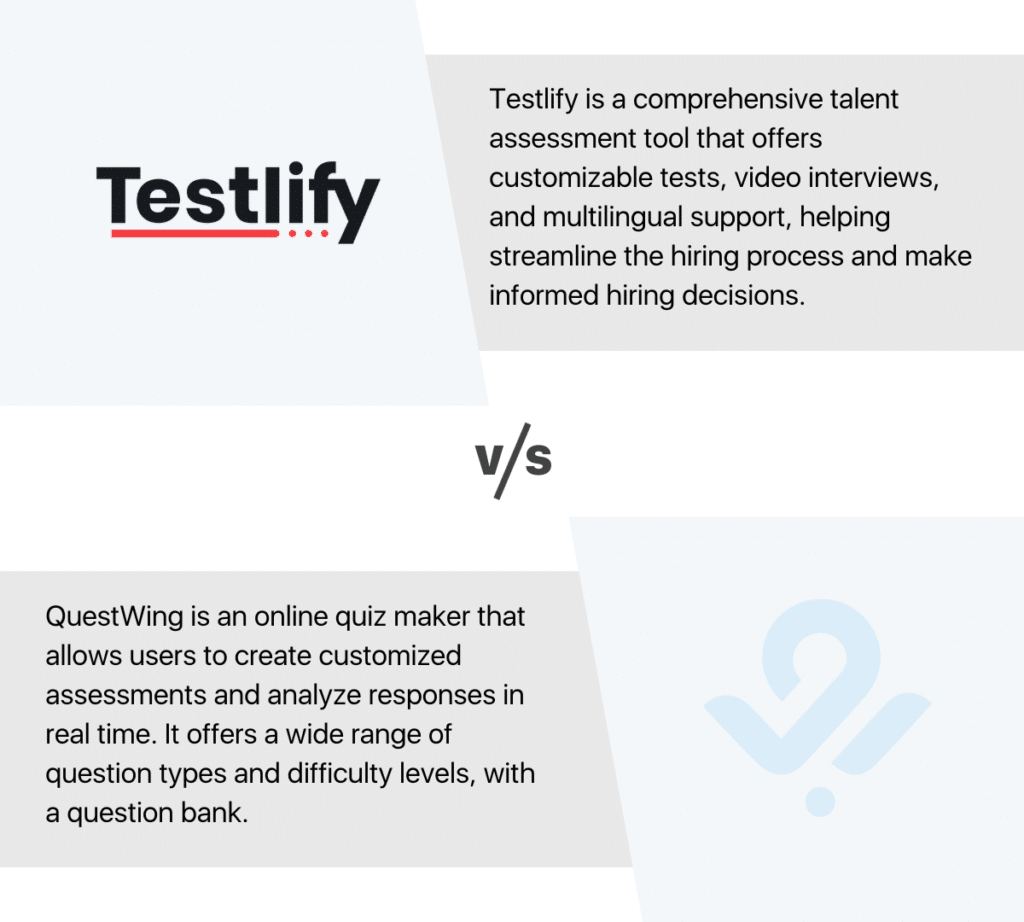
QuestWing is an online quiz maker. Testlify is a pre-hire assessment platform. Most of this comparison follows from that one difference, because a quiz tells you who answered correctly on a Tuesday afternoon and an assessment is built to tell you who can do the job.
Both let you build a test in minutes. Only one of them is designed to carry the weight of a hiring decision, and that distinction matters more than any feature count once a candidate asks why they were rejected.
TL;DR
- QuestWing is a general-purpose quiz builder sold to schools, trainers and corporate teams. Testlify is built specifically for pre-hire screening.
- QuestWing charges per user seat, at $10 a month or $100 a year. Testlify charges per candidate assessed, from $139 a month.
- The moment a score decides who gets an interview, the test becomes a selection procedure, and the employer owns the validation burden. That is where a quiz tool leaves you exposed.
- QuestWing is the better buy for training quizzes, course checks and internal knowledge tests. It was never built to rank job candidates.
- Pick on the decision you need to defend, not on the number of question types.
 ChatGPT
 Gemini
 Claude
 Grok
Grok Perplexity
What is QuestWing?
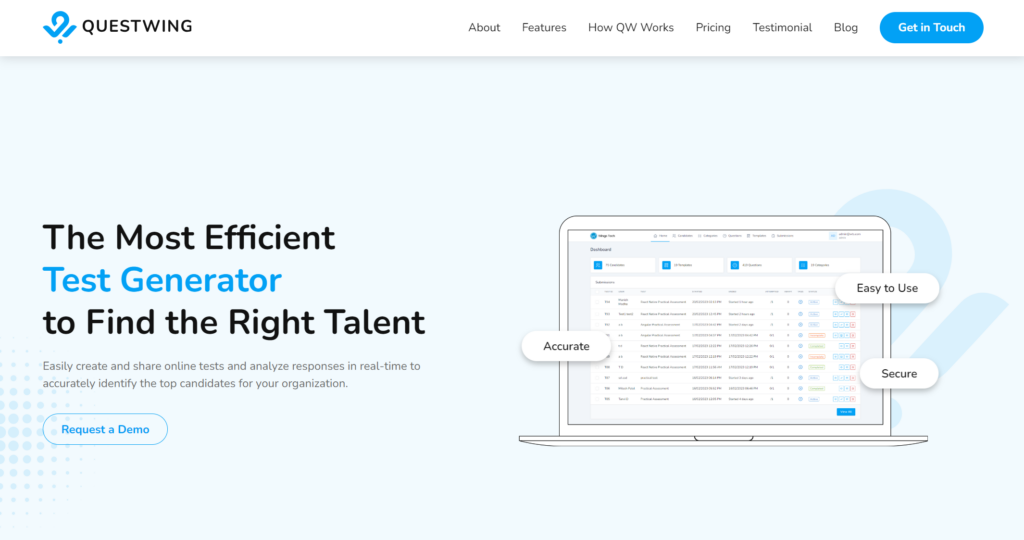
QuestWing is an online quiz and assessment builder. Its own site describes a question bank of 5,000 or more expert-written questions, assessments you can put together in about two minutes, support for every question type including audio and video, media uploads, logo branding, and real-time reporting on scores and completion times.
It sells across education, coaching, IT services, healthcare, finance and more than fifteen other industries. Recruitment is one use case on that list, sitting beside training, self-learning and secure exams.
That breadth is the product's strength and the reason it struggles as a hiring tool. A platform serving a chemistry teacher, a compliance trainer and a recruiter has to stay general. Hiring needs the opposite: role-specific content, benchmarks, and evidence that the score means something.

Testlify vs QuestWing: what is the real difference?
The difference is what each product treats as its output. QuestWing's output is a score on a quiz you wrote. Testlify's output is a ranked, role-relevant read on whether someone can do the work, assembled from more than one kind of evidence.
That is the Testlify Multi-Signal Talent Evaluation Model: one signal is fragile, several pointing the same way create confidence. A candidate should not move forward on one polished interview or one test score, but on skills results, coding or software tasks where the role needs them, structured reviewer feedback and interview evidence lining up together.
This is not an abstract preference. When Sackett and colleagues reanalyzed decades of selection research in the Journal of Applied Psychology, correcting a statistical overcorrection that had inflated earlier figures, many validity estimates came down and structured methods ranked among the strongest predictors of job performance. The exact coefficients are still argued over in print. The shape that survives every reanalysis is that structure beats improvisation, and a single unstructured signal predicts poorly.
A quiz builder gives you one signal, and no structure around what to do with it.
How do the two compare feature by feature?
This page used to carry a 79-row feature grid with dozens of crosses against QuestWing, nearly all of them unsourced. Several were simply wrong. It marked assessment templates as missing, for instance, while QuestWing's own pricing copy advertises unlimited template creation.
So the grid is gone. What replaces it is shorter and built only on things one vendor or the other actually publishes. Where a vendor documents nothing, the cell says "Not published" instead of a cross implying the capability is absent.
Dimension | Testlify | QuestWing |
|---|---|---|
Primary purpose | Pre-hire talent assessment | Quiz and exam creation |
Buyers served | Hiring and talent teams | Education, training, corporate, recruitment |
Ready-made content | Question bank of 5,000 or more questions | |
Role-specific assessments | Yes, mapped to roles | Not published |
Coding and technical tasks | Not published | |
Typing tests | Not published | |
Custom questions | Yes | Yes |
Audio and video questions | Yes | Yes |
Branding on the assessment | Yes | Yes |
Proctoring and anti-cheating | Yes, multiple measures | Not published |
Multiple reviewer scoring | Yes | Not published |
ATS integrations | Not published | |
Published pricing | From $139 a month, priced per candidate | $10 a month, priced per user seat |
Pro tip: when any vendor's comparison grid shows a wall of crosses against the other product, check three of them against that vendor's own documentation before you trust the rest. Unsourced absence marks are the least reliable thing on a comparison page, including on this one before it was rewritten.
How much do Testlify and QuestWing cost?
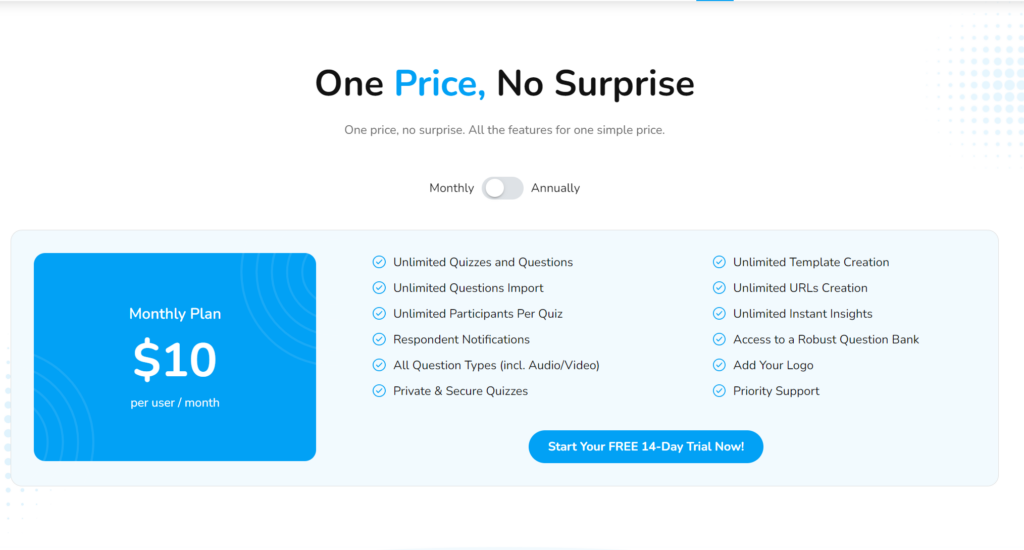
They do not charge for the same thing, and that is the part worth slowing down on. QuestWing bills per user seat: $10 a month, or $100 a year, with unlimited quizzes and unlimited participants included. Testlify bills per candidate assessed, from $139 a month, which works out at $1,668 a year for 100 candidate credits, or $16.68 a candidate.
Read that straight and QuestWing is cheaper, by a lot. Two recruiters running unlimited quizzes cost $200 a year. Assessing 100 candidates on Testlify costs $1,668. No amount of framing makes those numbers close.
The question is what the extra $1,468 buys. SHRM's benchmarking put the average cost per hire at $4,129, so that gap is about a third of what one hire already costs you. A team making 40 hires a year is spending in the region of $165,000 to fill them. Against that, the tooling difference is noise, and the only number that matters is how many unsuitable people still reach a first interview.
Which gives a clean decision rule. If you are running a handful of quizzes and headcount is what scales, per-seat pricing is the cheaper shape. If candidate volume is what scales and each of those candidates represents real interview time, per-candidate pricing lines the cost up with the thing actually consuming your team.
Which tool fits pre-employment screening?
For pre-employment screening, Testlify fits and QuestWing does not, because screening needs role-mapped content, consistent scoring across candidates, integrity controls and a record of how the decision was made. QuestWing supplies the quiz. Everything after the quiz is left to you.
Think about what actually happens after a score exists. Someone has to decide the cutoff. Someone has to explain why 62 percent passes and 58 percent does not. Someone has to answer the candidate who asks what the test measured. With a quiz builder, all three answers are improvised, and improvised answers are the ones that fail later.
The skills problem underneath this is not getting smaller. The World Economic Forum's Future of Jobs research found that 39 percent of workers' existing skill sets will be transformed or become outdated between 2025 and 2030. When the skills you hire for keep shifting, a static quiz written last year ages badly, and hiring on demonstrated skills stops being a philosophy and starts being maintenance.
What does the law expect from a hiring test?
More than most buyers of quiz software expect, and it is the question comparison pages almost never raise.
Once a test result helps decide who advances, it is a selection procedure. EEOC guidance is direct about what follows: employment tests must be job-related and properly validated for the purpose they are used for, and employers stay responsible for that validation even when they are relying on a vendor's documentation. If a selection procedure screens out a protected group at a higher rate, the employer has to look for a less exclusionary alternative that works as well.
New York City goes further. Under Local Law 144, an automated employment decision tool needs an independent bias audit within the previous year, a public summary of the results, and at least 10 business days of notice to candidates before it is used on them. Penalties start at $500 for a first violation and run to $1,500 a day while non-compliance continues.
A quiz maker will not hand you a validation report or a bias audit, because it was never sold as a selection tool. That is not a knock on QuestWing. It is a warning about the job you would be asking it to do.
When is QuestWing the better choice?
Often, and it is worth saying plainly on a page that has an obvious commercial interest.
QuestWing is the better buy when the quiz is not deciding anyone's job. Course knowledge checks. Compliance refreshers. Onboarding tests where everyone is expected to pass and the point is confirming the material landed. Training measurement across a few hundred staff, where participants are unlimited and you only pay for the person building the quiz. Internal certification where you write the questions because you already own the subject.
In those cases everything Testlify adds (role benchmarks, proctoring depth, ATS syncing, reviewer workflows) is cost without benefit. Buying a hiring platform to run a fire-safety refresher is the same mistake pointed the other way.
The line is simple. If the score changes someone's employment outcome, buy for that. If it does not, buy the cheaper, simpler tool.
Ready to screen candidates on real skills?
If your next hiring round needs evidence rather than a quiz score, the fastest way to judge the difference is to run one role through it. Pick a live opening, build the assessment from role-mapped tests, and see what the shortlist looks like before the first call. You can book a walkthrough with the Testlify team or start with the role-based test library and build the first assessment yourself.
Key takeaways
- Category, not features, decides this one. QuestWing is a quiz maker and Testlify is a hiring assessment platform. Comparing them feature by feature hides the fact that they answer different questions, so start by naming the decision the score has to support.
- The old feature grid on this page was not trustworthy. It marked capabilities absent that QuestWing publicly documents, including assessment templates. Unsourced crosses on any vendor comparison, ours included, deserve a spot check before they shape a shortlist.
- The two price different things, so compare the shape, not the number. QuestWing charges per user seat and Testlify charges per candidate assessed, at $16.68 a candidate. QuestWing is genuinely cheaper; against an average cost per hire of $4,129, the gap is small next to the cost of interviewing the wrong shortlist.
- A hiring test carries obligations a quiz does not. EEOC guidance expects job-relatedness and validation, and holds the employer responsible even when a vendor supplies the documentation. In New York City, Local Law 144 adds an annual bias audit, a published summary and 10 business days of candidate notice.
- One signal is fragile. The research consensus that survives every reanalysis is that structured, multi-signal evaluation predicts performance better than any single improvised measure, which is what a standalone quiz score is.
- QuestWing is genuinely the better buy for training and internal knowledge checks. If nobody's job depends on the result, the simpler and cheaper tool is the right call, and a hiring platform would be overspend.
FAQs
Related resources
View all
Competitor Comparisons
Testlify vs Psyft: A detailed comparison
Competitor Comparisons
Testlify vs Psyrecruit: A detailed comparison
Competitor Comparisons
Testlify vs Care Advantage: A detailed comparison
Competitor Comparisons
Testlify vs Benchmark.games: A detailed comparison
Competitor Comparisons
Testlify vs Assestant: A detailed comparison
Competitor Comparisons
Testlify vs Assessment X: A detailed comparison
Get started.
Hire on proof, not resumes.
Run your first skills-based assessment free — no credit card required.