
Testlify vs Psyft: A detailed comparison
Discover the perfect solution for evaluating your candidates’ skills with Testlify. Dive into our comprehensive Testlify vs Psyft…
Testlify and Psyft both measure people, but they answer different questions. Psyft scores personality traits and runs 360-degree feedback surveys, mostly to develop people who already work for you. Testlify scores what a candidate can actually do, across coding, cognitive, language and role-specific skills, before you hire them.
So the choice is less about which tool is better and more about which question you are trying to answer this quarter. This comparison covers the test libraries, the anti-cheating controls, the reporting, the pricing model, and the point where each tool stops being the right fit.
TL;DR:
- Psyft is a psychometrics specialist: Big Five personality assessment, 360-degree feedback, and employee engagement surveys built by qualified psychologists.
- Testlify is a pre-hire assessment platform: role-specific skills tests, coding tests, cognitive tests, psychometric tests, video responses and proctoring in one workflow.
- Personality is a real signal, just a narrow one. In the updated meta-analytic matrix, structured interviews carry a standardized regression weight of .39 in a model predicting job performance, while conscientiousness carries -.04.
- Psyft publishes pricing for its 360-degree feedback survey. The personality assessment is quote-based, so budgeting means a sales call.
- Choose Psyft to develop the people you already employ. Choose Testlify to decide who to hire. Teams that need both usually run them at different stages, not against each other.
 ChatGPT
 Gemini
 Claude
 Grok
Grok Perplexity
What is the difference between Testlify and Psyft?
Psyft is a psychometric assessment provider. Its personality assessment is built on the Big Five model, and it sells 360-degree feedback and engagement surveys alongside it. Testlify is a pre-hire talent assessment platform: it screens candidates on job-relevant skills, then hands hiring teams a scored shortlist. One profiles traits, the other predicts job readiness.
That distinction matters more than any feature checklist, because trait data on its own is a weak basis for a hiring decision. An updated meta-analysis of selection methods put structured interviews at the top of the list, with a mean validity of .42 and an 80 percent credibility interval running from .18 to .66. Cognitive ability, long treated as the standout predictor, came out lower than that. In the same updated matrix, conscientiousness carried a standardized regression weight of -.04 while structured interviews carried .39.
Read that credibility interval carefully, because it is the honest part. Even the best single method swings from .18 to .66 depending on the job and how it is run. That is the argument for collecting more than one kind of evidence, and it is the argument against buying any assessment tool because it promises a single clean score.

Testlify vs Psyft: feature comparison
The table below compares the two platforms across test library, assessment building, video responses, candidate experience, anti-cheating controls, reporting, enterprise features and support. Cells marked "Not stated" are capabilities neither vendor documents publicly, so treat them as unknown rather than absent.
Features | Testlify | Psyft |
|---|---|---|
Test Library | ||
Role-specific tests | ✓ | ✗ |
Cognitive ability tests | ✓ | ✗ |
Programming Tests | ✓ | ✗ |
No. of programming languages supported | 40+ | ✗ |
Situational judgment tests | ✓ | ✗ |
Typing test | ✓ | ✗ |
Software skills tests | ✓ | ✗ |
Non-technical tests | ✓ | ✗ |
Psychometric tests | ✓ | ✓ |
Personality tests | ✓ | ✓ |
Motivation test | ✓ | ✗ |
Assessment templates | ✓ | ✗ |
Custom assessments creation | ✓ | ✗ |
Test recommendations for different job roles | ✓ | ✗ |
Coding tests | ✓ | ✗ |
Assessments | ||
Custom assessment builder | ✓ | ✗ |
Custom coding questions | ✓ | ✗ |
Multiple-choice questions | ✓ | ✓ |
Descriptive questions | ✓ | ✗ |
Video interview questions | ✓ | ✗ |
Assessments curated by I/O psychologists | ✓ | ✓ |
Google doc | ✓ | ✗ |
Google sheets | ✓ | ✗ |
Google slides | ✓ | ✗ |
Audio questions | ✓ | ✗ |
Qualifier questions | ✓ | ✗ |
File upload questions | ✓ | ✗ |
Quality check | Extensive process incl. peer reviews, sample testing, review by psychometrician & more | Not stated |
Video interview questions | ||
One-way video interview | ✓ | ✗ |
Custom video questions creation | ✓ | ✗ |
Candidate's recording attempts per question | ✓ | ✗ |
Live video interview | ✗ | ✗ |
Candidate experience | ||
Fully customizable email templates | ✓ | ✗ |
Custom invitation and rejection email | ✓ | ✓ |
Mobile-friendly | ✓ | Not stated |
Candidate support | ✓ | Not stated |
Instructions before assessment | ✓ | ✓ |
Average assessment length | 40-60 minutes | Not stated |
Anti-cheating features | ||
Session recording | ✓ | ✗ |
Snapshot capturing | ✓ | ✗ |
Mouse tracking | ✓ | ✗ |
Copy-paste disabled | ✓ | ✗ |
Microphone and camera access | ✓ | ✗ |
Location access | ✓ | ✗ |
IP address tracking | ✓ | ✗ |
Randomization of question sequence | ✓ | ✗ |
Time limit on tests | Yes, typically 10 minutes | Not stated |
Reporting and analytics | ||
Detailed reports | ✓ | ✓ |
Easy to share reports and scorecards | ✓ | ✗ |
Exportable/downloadable reports | ✓ | ✓ |
Recruiting analytics | ✓ | ✓ |
Candidate benchmarking | ✓ | ✗ |
Completion rate and response insights | ✓ | ✗ |
Enterprise friendly | ||
White label feature | ✓ | ✗ |
Custom branding | ✓ | ✓ |
ATS integration | ✓ | ✓ |
User, role, and access management | ✓ | ✓ |
Bulk candidate invite | ✓ | ✗ |
Share public link invite to candidates | ✓ | ✗ |
Candidate pipeline management | ✓ | ✓ |
Internationalization | ✓ | ✓ |
Campus hiring support | ✓ | ✗ |
Dedicated account manager | ✓ | ✗ |
GDPR compliant | ✓ | ✓ |
Multilingual abilities | ✓ | ✗ |
Customer support | ||
24/7 support | ✓ | ✗ |
On-call support | ✓ | ✓ |
Email support | ✓ | ✓ |
Product demo | ✓ | ✓ |
Training & onboarding tour | ✓ | ✗ |
What does Psyft do well?
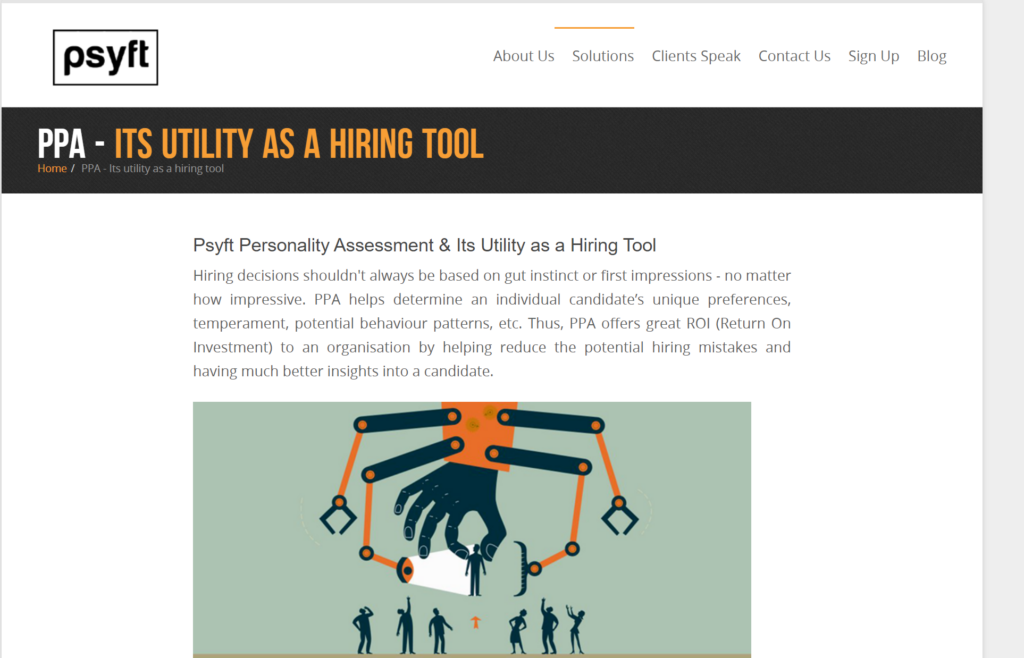
Psyft builds scientifically grounded personality assessments, employee engagement surveys, 360-degree feedback tools, and assessment and development centers. The assessments are designed to resist faking and run on mobile, and Psyft states they have been tested, validated and statistically standardized by qualified psychologists and industry experts.
Its reporting is the strong part. Psyft produces detailed trait analysis with written feedback, plus full-service support for planning an exercise, running it and generating reports. For a people team building a development program, that hand-holding is worth real money, and it is the sort of thing a self-serve tool does not give you.
Here is the honest boundary, and it is worth saying plainly on a Testlify page: if the job is to run 360-degree feedback across people who already work for you, or to build a development center, Psyft is the better fit and Testlify is not the tool. Testlify is a pre-hire platform. It does not do performance management, and it is not an HRIS. Buying it for post-hire development would be the wrong purchase.
What makes Testlify different from Psyft?
Breadth of evidence, and where in the funnel it sits. Testlify covers role-specific tests, coding tests across many languages, cognitive ability, situational judgment, typing, software skills, language and personality, then adds video responses, qualifier questions and proctoring on top. Psyft covers personality and feedback surveys deeply, but not the rest.
That breadth is the point of the Testlify Multi-Signal Talent Evaluation Model, which holds that a candidate should not move forward on one strong resume, one polished interview or one test score. They should move forward when several role-relevant signals point the same way. A personality profile is one of those signals. It is not meant to carry the decision alone, and the validity numbers above are why.
Take a 400-person logistics company hiring 25 warehouse supervisors in a quarter (illustrative, not a customer story). A trait profile tells you who is likely to be conscientious. It does not tell you who can read a shift roster, calculate a load plan, or handle an angry driver at 6am. A general mental ability test plus a situational judgment test answers those questions before anyone books an interview, and the personality data then adds useful context to the shortlist rather than defining it.
Testlify also runs its own personality testing, so this is not a case of dismissing the category. The SMART personality test sits in the same library as the skills tests, which means one workflow instead of two vendors. For teams that want the trait science specifically, the guide to hiring with a Big Five test covers how to read those results without over-reading them, and there is a longer piece on where personality assessment belongs in a screening process.
How much do Testlify and Psyft cost?
Psyft pricing
Psyft publishes a pricing page for its 360-degree feedback survey, but the personality assessment is quote-based: there is no public price, so you contact them for a quote. That is normal for psychometrics sold with consulting attached, and it is not a criticism. It does mean you cannot compare cost without a sales conversation, which slows down a shortlist.
Testlify pricing
Testlify lists its plans on a public pricing page, billed monthly or annually, so a hiring team can size the cost before talking to anyone. For a buyer running a formal evaluation, the practical difference is timing: one vendor can be costed this afternoon, the other after a call.
How do you choose between Testlify and Psyft?
Start with the decision you are funding, not the feature list. If the output is a development plan for existing employees, buy the psychometrics specialist. If the output is a hiring decision, buy the platform that scores job-relevant skills and gives you the trait data as a secondary signal.
The cost of getting this wrong is not abstract. SHRM benchmarking data put the average cost per hire at nearly $4,700 back in 2022, and that figure counts only the recruiting spend, not the months of lost output when the wrong person lands in a hard role. Screening on the wrong signal is how that money gets spent twice.
There is also a shelf-life problem. The Future of Jobs Report 2025 found that employers expect 39 percent of workers' core skills to change by 2030, down from 44 percent in the 2023 edition. Traits are fairly stable across a career. Skills are not. A tool that only profiles traits will keep telling you the same thing about a candidate while the job underneath them changes, which is a good reason to keep a skills layer in the process whatever else you buy.
Pro tip: Run the two kinds of assessment at different stages rather than stacking them into one long test. Skills and cognitive tests belong before the first call, where they cut the shortlist. Personality data is more useful after that, as interview input for the three or four people you are actually considering. Front-loading everything is the fastest way to lose good candidates to assessment fatigue.
Hire on evidence, not just traits
The teams that get the most out of assessment are the ones that decide what evidence a role actually needs before they shop for a tool. If that evidence is job skills, see what a role-specific assessment returns on your own shortlist: book a walkthrough with the team, or browse the assessment tool comparisons to see how the options line up.
FAQs
Related resources
View all
Competitor Comparisons
Testlify vs Psyrecruit: A detailed comparison
Competitor Comparisons
Testlify vs Care Advantage: A detailed comparison
Competitor Comparisons
Testlify vs Benchmark.games: A detailed comparison
Competitor Comparisons
Testlify vs Assestant: A detailed comparison
Competitor Comparisons
Testlify vs Assessment X: A detailed comparison
Competitor Comparisons
Testlify vs Traitify: A detailed comparison
Get started.
Hire on proof, not resumes.
Run your first skills-based assessment free — no credit card required.