
Testlify vs Care Advantage: A detailed comparison
Discover the perfect solution for evaluating your candidates’ skills with Testlify. Dive into our comprehensive Testlify vs Care Advantage…
 ChatGPT
 Gemini
 Claude
 Grok
Grok Perplexity
Testlify vs Care Advantage, in one paragraph
Care Advantage is a behavioural screening tool built for frontline care, clinical and related roles in the Australian and New Zealand aged and disability sectors. Testlify is a general talent assessment platform that tests role skills across industries. If every hire you make wears a care uniform, Care Advantage is purpose-built. If your hiring spans finance, admin, tech and care, one narrow tool will not cover it.
TL;DR
- Care Advantage screens for personality, work attitudes, reasoning and engagement, then scores an applicant against a benchmark of high performers in the same care role.
- Testlify covers a much wider test library (3,500+ tests) across technical and non-technical roles, so it fits employers hiring beyond the care frontline.
- Neither product is a statutory worker screening check. Getting that wrong is the costliest mistake in this category.
- Care Advantage publishes four licence options but no dollar figure; Testlify publishes its plans openly.
- A job fit score is one signal. The research puts even the best single selection method well short of certainty, so treat any single number with care.

What is Care Advantage?
Care Advantage is a pre-employment behavioural screening platform for care organisations in Australia and New Zealand. It assesses an applicant's personality against role-specific benchmarks and flags elevated risk in areas such as hostility and integrity. The pitch is speed and risk reduction: rank a large applicant pool before anyone reads a resume.
The scope is narrower than most comparison pages suggest, and that narrowness is the point. It is built for aged care and disability providers hiring personal care workers, clinical staff and related frontline roles. It does not claim to test coding, software skills or typing, and it never has. Any comparison that marks it absent on those is measuring a screwdriver against a drill.
What does Care Advantage actually measure?
Four assessments, each about seven minutes. According to the vendor's own assessments and reports page, buyers choose which ones to run:
- Personality / Job Fit, 45 questions, untimed. Built on the Five-Factor model across work style, demeanour, rule-abiding, interpersonal and resilience, then compared to a benchmark of high performers in the same role to produce a job fit score.
- Attitudes, 27 questions, untimed. Flags elevated risk on three counter-productive work behaviours: hostility, dependability and integrity.
- Cognitive Ability, timed at exactly seven minutes. Verbal, numerical and spatial reasoning combined into one general reasoning score.
- Engagement, a survey rather than a selection test.
Most clients run only Personality and Attitudes for frontline applicants, roughly 15 minutes of candidate time. All four takes it to just under 30 minutes. The assessments are set at an age 12 reading level, and the platform offers 100 role benchmarks plus custom benchmarks built from an employer's own top performers.
One detail worth pulling out of the vendor's FAQ: candidates can fake these tests, and Care Advantage says so plainly. Its answer is a "Good Impression Scale" built into the Personality and Attitude assessments to flag distorted or random responding. That is an honest position, and it matches what the wider evidence says about this test family.
Which Care Advantage is this?
Search "Care Advantage" and you will get at least three unrelated businesses. There is a health insurance plan family sold in India, a home-care staffing agency in the United States, and the Australian pre-employment screening tool this page compares. They share nothing but a name.
The one covered here is careadvantage.com.au, the Australian and New Zealand behavioural screening product. If a directory listing or a review site seems to describe a completely different company, that is probably why. No other page ranking for this query mentions the collision at all, which is how buyers end up reading reviews of the wrong product.
What is Testlify?
Testlify is a talent assessment platform for pre-hire evaluation across roles and industries. The test library runs to 3,500+ tests covering role skills, cognitive ability, personality and behaviour, language, software and coding, alongside custom assessments and video or audio questions.
Where Care Advantage goes deep on one sector, Testlify goes wide. That is a real tradeoff, not a sales line. A disability services provider hiring only support workers may genuinely prefer a tool with care-specific benchmarks already built. An organisation hiring support workers, rostering coordinators, payroll staff and a data analyst in the same quarter has a different problem, and it is a coverage problem.
Testlify vs Care Advantage compared
The table below only uses dimensions that can be checked against each vendor's published material. Where a vendor documents nothing, it says "Not published" rather than marking an absence the vendor never claimed.
Dimension | Testlify | Care Advantage |
|---|---|---|
Primary purpose | General pre-hire skills and behavioural assessment | Behavioural screening for care-sector roles |
Sector scope | Cross-industry | Aged care, disability and related frontline roles |
Geographic focus | Global | Australia and New Zealand |
Test library size | 3,500+ tests | 4 assessments |
Personality assessment | Yes | Yes, Five-Factor based, 45 questions |
Cognitive ability | Yes | Yes, timed at 7 minutes |
Integrity / counter-productive behaviour | Behavioural and personality assessments | Yes, Attitudes assessment across 3 risk areas |
Role-skill and technical testing | Yes, including coding and software skills | Not offered |
Role benchmarks | Role-based assessments and benchmarking | 100 benchmarks plus custom benchmarks |
Typical candidate time | Varies by assessment built | About 15 minutes for the two core assessments |
Reading level stated | Not published | Age 12 |
ATS integration | Yes | Yes, plus hyperlink, report-text and API options |
Published pricing | Plans published | Four licence options, no public figure |
Faking / distortion control | Assessment integrity controls and proctoring | Good Impression Scale on two assessments |
How much does each platform cost?
Care Advantage does not publish a price. What it does publish, on its pricing page, is the licence structure, and that structure tells you more than a headline number would.
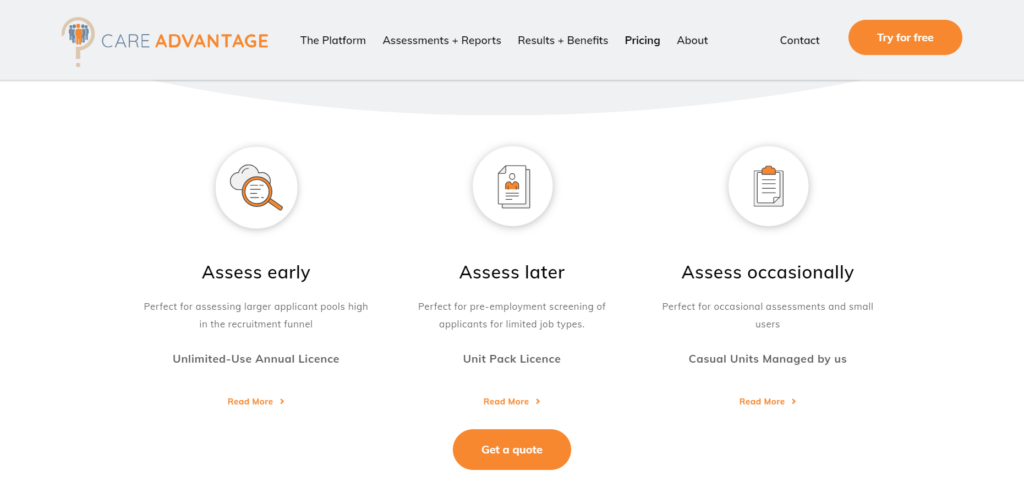
- Assess and Develop All. An unlimited-use annual licence covering all four assessments and reports, the full benchmark suite and unlimited user accounts.
- Assess early. An unlimited-use annual licence aimed at screening high in the funnel for selected job types.
- Assess later. A unit pack licence, one unit per applicant, sold in increments of 50 with volume discounts, for screening after resume review.
- Assess occasionally. Pre-paid casual units valid for 18 months, or a managed service where the vendor runs the screening for you.
The split matters. An unlimited annual licence rewards you for screening early and often, which is exactly the high-volume frontline use case. Unit packs punish that behaviour and suit occasional, late-funnel use. Pick the wrong one and you will either overpay for units or underuse a licence. Testlify publishes its plans and pricing openly, which makes budgeting a shorter conversation.
Worth flagging: an earlier version of this page claimed Care Advantage offered three plans and that pricing was not available publicly. There are four options, and the licence models are documented. That has been corrected.
Is behavioural screening a worker screening check?
No. This is the single most expensive confusion in care-sector hiring, and it deserves a blunt answer.
A behavioural or psychometric assessment predicts how someone is likely to behave at work. A worker screening check is a statutory background clearance against criminal history and other records, administered by government, that an Australian care or disability employer must separately hold for risk-assessed roles. Neither Care Advantage nor Testlify is the second thing, and neither claims to be. Running a personality assessment does not discharge a screening obligation, and passing a screening check says nothing about whether someone will do the job well.
Treat them as different controls answering different questions. Buyers who conflate them end up either over-trusting a job fit score or assuming a compliance box is ticked when it is not.
How well does a job fit score predict performance?
Better than a resume. Not as well as the marketing in this category implies.
The most careful recent re-analysis of selection research, covered by the Society for Industrial and Organizational Psychology, puts structured interviews at .42, job knowledge tests at .40, empirically keyed biodata at .38, work samples at .33 and general cognitive ability at .31. Those are correlations with job performance, and none of them is close to a guarantee. The practical reading: a benchmark-derived job fit score is a useful filter for a pool of 200 applicants, and a poor basis for a final decision on one.
On the attitudes side, the US Office of Personnel Management's summary of integrity and honesty tests is genuinely useful for a care buyer. Such tests predict counterproductive behaviours including absenteeism and theft, show few subgroup differences across gender or race, and are cheap to run, which is a strong combination for high-volume frontline hiring. The caveat is the one Care Advantage also acknowledges: transparent items are easy to fake, so distortion controls matter.
This is where the Testlify Multi-Signal Talent Evaluation Model earns its keep. One signal is fragile; multiple role-relevant signals create confidence. For a care hire that might mean a behavioural profile, a short structured interview against the same competencies, and a reference check, rather than a single percentage doing all the work.
Which one should you choose?
Choose Care Advantage if you are an Australian or New Zealand aged care or disability provider, you hire frontline care staff in volume, and you want role benchmarks that already exist for those jobs. The seven-minute format and the age 12 reading level are not trivial details in this workforce.
That last point is worth sitting with. Among people working in residential aged care services in 2021, 83 percent were female, just over half were born overseas, and 39 percent spoke a language other than English at home, according to Australian government aged care workforce data. Assessment length and reading level are accessibility decisions in this sector, not UX polish.
Choose Testlify if your hiring crosses role types, if you need role-skill evidence rather than behavioural signal alone, or if you operate outside Australia and New Zealand where the care benchmarks and the vendor's support model are a weaker fit. Plenty of care providers need both kinds of evidence, and the honest answer for a mixed workforce is that a single narrow screening tool will leave gaps.
Pro Tip: Before you compare feature lists, write down the three roles you hire most often and the one behaviour that predicts success in each. Then ask each vendor to show you the evidence they produce for those three roles specifically. Most buyer regret in this category comes from buying a tool scoped to somebody else's hiring problem.
Ready to see the assessments side by side?
Testlify covers role skills, cognitive ability and behaviour in one place, with assessments you can build against the competencies that matter for the roles you actually hire. Browse the psychometric tests or the cognitive ability tests, or book a demo and walk through a care-sector assessment with the team.
FAQs
Related resources
View all
Competitor Comparisons
Testlify vs Benchmark.games: A detailed comparison
Competitor Comparisons
Testlify vs Assestant: A detailed comparison
Competitor Comparisons
Testlify vs Assessment X: A detailed comparison
Competitor Comparisons
Testlify vs Traitify: A detailed comparison
Competitor Comparisons
Testlify vs Wired2Perform: A detailed comparison
Competitor Comparisons
Testlify vs Verensics: A detailed comparison
Get started.
Hire on proof, not resumes.
Run your first skills-based assessment free — no credit card required.