
Testlify vs Assestant: A detailed comparison
Discover the perfect solution for evaluating your candidates’ skills with Testlify. Dive into our comprehensive Testlify vs Assestant…
Assestant's website no longer loads. As of September 5, 2026, assestant.com returns no DNS record at all, the company is listed as deadpooled on Tracxn, and its SoftwareSuggest listing carries zero reviews. So if you searched for Assestant to buy credits, log in, or weigh it against Testlify, the real question has changed. It's no longer "which is better" but "what did Assestant actually do, and what replaces it for hiring assessments?" This page answers both. Every Assestant fact below is traced to a public record that still exists, and every Testlify fact comes from the product as it ships today, not from an old brochure.
 ChatGPT
 Gemini
 Claude
 Grok
Grok Perplexity
TL;DR
- Assestant is offline. Its domain doesn't resolve, Tracxn records the company as deadpooled, and no shutdown notice was ever published. Treat it as gone.
- Assestant was a low-cost, pay-as-you-go assessment tool from Chennai (founded 2013) that served exams and training as much as hiring, at roughly $0.60 to $0.90 per credit.
- Testlify is a pre-hire platform. It costs far more per candidate (Starter works out at $16.68 a credit on the annual plan) and buys proctoring with identity checks, AI interviews, work-sample questions and applicant tracking system (ATS) integrations that no Assestant record mentions.
- If your Assestant use was a course quiz or a school exam, Testlify is the wrong replacement. If it was screening candidates, it's the upgrade, and this page shows the cost honestly.
- Moving over takes an afternoon: recover your old result PDFs, rebuild each assessment with AI from the job description, pick a proctoring preset, pilot with 10 candidates, then connect your ATS.

Is Assestant still available in 2026?
No. Assestant's domain, assestant.com, returned no DNS record when Testlify checked it on September 5, 2026, which means the site does not exist, not that it is temporarily down. Tracxn lists the company as deadpooled, and the SoftwareSuggest listing last updated on September 2, 2026 shows zero reviews and no working website.
What that means in practice: there is no login to recover, no support inbox to email, and no way to buy or spend credits. The vendor never published a shutdown date, so nobody can say exactly when access ended. If you still hold unused credits, the 180-day validity on the packs Assestant sold means they had almost certainly expired before the site went dark anyway. The same thing happened with Toggl Hire, and the playbook is the same one Testlify laid out in its Toggl Hire sunset comparison: confirm the vendor is gone, recover what you can, then rebuild on a platform that will still be here next renewal.
Pro Tip: before you rebuild anywhere, search your email for the result PDFs and score alerts Assestant sent you. Candidate scores are the one thing a new platform cannot recreate, and the emails are the only copy left.
What was Assestant?
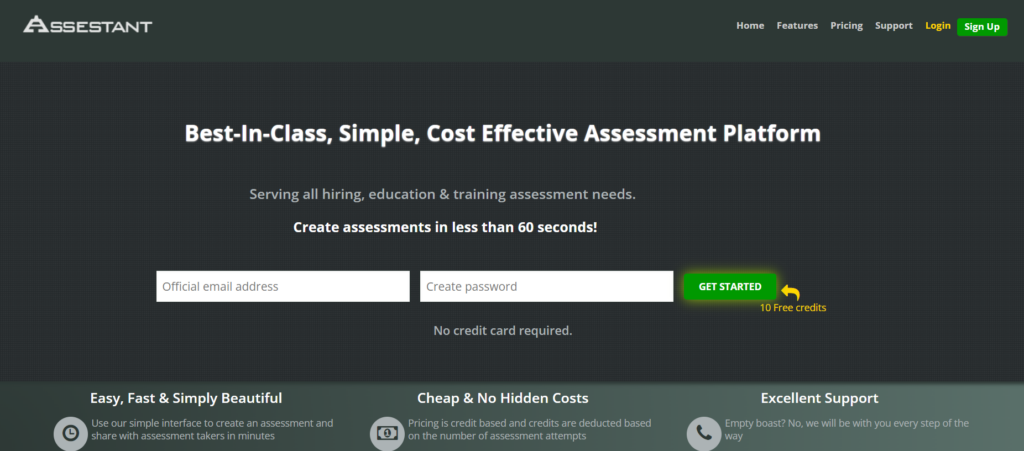
Assestant was an online assessment platform run by RankSheet Online Services Pvt. Ltd. out of Chennai, India, founded in 2013. Tracxn's record describes it as "catering to hiring, education or training needs of any organization", with an inbuilt question bank, a custom question bank, proctoring, credit usage tracking, ranking, visual reporting, email branding and email alerts. Its sales pitch, still quoted on the SoftwareSuggest listing, was "Create assessments in less than 60 seconds!"
Two things about that description matter for the comparison. First, Assestant was a generalist: a training manager running a compliance quiz and a recruiter screening 40 sales candidates were both target users. Second, it was cheap on purpose, priced per attempt with no subscription. Testlify is neither of those things. It is built for one job, deciding who to hire, and it is priced like a hiring tool. So whether it is the right replacement depends entirely on which of Assestant's three uses you had.
Assestant pricing: what the last records show
Three public records survive, and they don't quite agree. Tracxn records a pay-as-you-go model at $0.9 per assessment credit. SoftwareSuggest lists a starting plan of $6 for 6 months with up to 10 credits (its own FAQ on the same page says $7). And Testlify's earlier capture of the vendor's pricing page, shown below, listed credit packs from 10 credits at $9.00 up to 500 credits at $382.50, with 10% off at 100 credits, 15% off at 500, and every pack valid for 180 days.
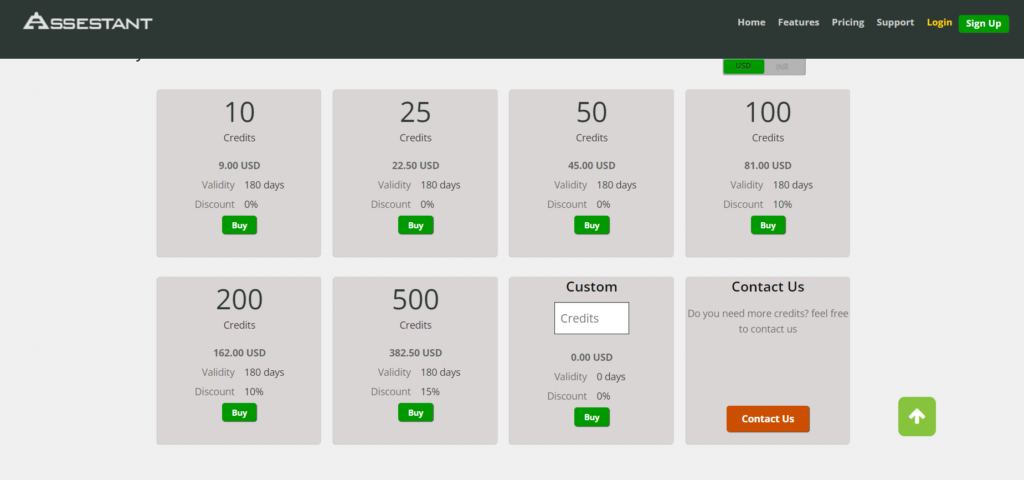
Put together, that is somewhere between $0.60 and $0.90 per candidate attempt, with no monthly fee and no seat charges. None of those figures can be checked against the vendor now, so treat them as history, not a quote. But they set the bar an ex-Assestant buyer will measure any replacement against: a team that screened 100 candidates a year paid under $100. Testlify does not try to match that number, and the section on cost below explains what the difference buys.
How does Testlify compare with Assestant?
Testlify covers everything Assestant's records list, then adds the layers a hiring decision needs and a quiz tool never did: work-sample questions, AI interviews, identity-checked proctoring and per-question statistics. The table sticks to what surviving records actually say about Assestant. Where they say nothing, the cell says "not recorded" rather than guessing a cross.
Dimension | Assestant (last public records) | Testlify (production product, 2026) |
|---|---|---|
Status | Website offline; company listed as deadpooled | Live and actively developed |
Built for | Hiring, education and training assessments | Pre-hire assessment and interviewing only |
Pricing model | Pay-as-you-go credits, about $0.60 to $0.90 each, 180-day validity, no subscription | Plans from $139 a month billed annually (100 credits a year); 1 credit per started assessment; credits do not roll over |
Question bank | Inbuilt bank plus a custom question bank | Library in 13 categories, custom builder, and AI assessment creation from a job description (up to 20 questions) |
Question types | Not itemized in surviving records | 25+, including Google Docs, Sheets and Slides tasks, Word, Excel and PowerPoint tasks, typing tests, file uploads and coding |
Coding tests | Not recorded | Browser-based VS Code editor, up to 20 test cases per question, multi-file project tasks, and vibe coding where candidates direct AI tools to a working solution |
Interviews | Not recorded | One-way video, two-way conversational AI video, voice questions, and outbound AI phone interviews billed at $0.18 a minute |
Proctoring | Listed as a feature, no detail given | Three presets (Standard, Strict, Custom), photo-ID face match, a second phone camera for dual-device monitoring, AI-tool detection, and green, yellow and red flags |
Reporting | Ranking and visual reporting | Percentile benchmarks, difficulty and discrimination indexes per question, PDF and CSV exports, shareable reports |
ATS | Not recorded | 100+ ATS integrations, sold as a $2,388 a year add-on on self-serve plans and included on Custom; a simple built-in hiring pipeline for teams without an ATS |
Free trial | Not recorded | 7 days, no card required; 30-day money-back guarantee |
Candidate browser | Not recorded | Chromium desktop only (Chrome or Edge); phones are a recording fallback, not a way to sit a full assessment |
Where does Testlify go further than Assestant did?
Four places, and each one is a specific product feature rather than a promise. Pick the two that match the roles you hire for; the other two are there when you need them.
Work samples instead of quiz questions
Assestant's records describe a question bank. Testlify's question types include tasks inside the real tools: Google Docs, Sheets and Slides, and Microsoft Word, Excel and PowerPoint, so an analyst candidate builds the pivot table rather than answering a multiple-choice question about one. For developers there is a VS Code editor in the browser with up to 20 visible or hidden test cases, and a vibe-coding mode that, in the product's own words, "lets candidates direct AI tools to reach a working solution, instead of writing syntax manually". That is the closest thing to watching someone do the job in 2026.
AI interviews you configure, with humans deciding
You choose the AI avatar, the voice, the persona and the prompts. You set the number of attempts (including no limit), the recording time up to 5 minutes per video, and the preparation time a candidate gets to read the question. Transcripts are automatic and multilingual for any recording over 30 seconds. AI scoring is advisory by design: the product itself says "AI scores and insights are for guidance only. Use human judgment for final decisions", and a toggle keeps the AI score out of the final average entirely if you want it that way. The one honest gap is scheduling: Testlify does not coordinate calendars for a live panel of human interviewers.
Proctoring that produces evidence, not automatic rejections
Assestant listed proctoring as a feature and left it there. Testlify ships three presets and a dual-device option where the candidate's phone becomes a second camera pointed at them and their screen; the assessment will not start until that feed is live. A yellow flag reads "Some behavior during the session wasn't ideal. A quick manual review is recommended", which is the point: flags go to a human, and auto-termination is a separate, opt-in setting with a threshold you choose. Face-verification data is deleted after 30 days. If you want the full menu of what different proctoring modes catch, Testlify's guide to online proctoring types walks through each one.
Statistics on the questions themselves
Every question in a Testlify assessment reports a difficulty index, a discrimination index and a quality-risk flag for items with very low accuracy or high skips. That is test-publisher territory. It means that when 60% of candidates fail question 7, you can tell whether the question is hard or simply bad, and fix it before the next round instead of rejecting good people for it.
How much does Testlify cost compared with Assestant?
A lot more per credit, and it's worth saying so plainly. Here are the current annual tiers from Testlify's pricing page. Monthly billing uses the same tier names with fewer credits at higher prices (Starter is $198 a month for 10 credits).
Testlify tier (annual) | Credits a year | Price | Per credit | Seats |
|---|---|---|---|---|
Starter | 100 | $139 a month, billed $1,668 a year | $16.68 | 3 |
Basic | 300 | $279 a month, billed $3,348 a year | $11.16 | 5 |
Business | 1,000 | $699 a month, billed $8,388 a year | $8.39 | 10 |
Premium, Enterprise, Custom | 3,000 to 25,000+ | Contact sales | Volume-based | 20 to 40 |
Against Assestant's $0.60 to $0.90 per credit, Starter is roughly 18 to 28 times the per-credit price. A worked example makes the trade concrete. Say a 40-person marketing agency hires 12 people a year and sends 5 finalists per role through an assessment: 60 started assessments. On Assestant's last recorded prices that was $36 to $54 a year. On Testlify it is the $1,668 Starter plan, with 40 credits unused because credits don't roll over, and any candidate beyond 100 costs $21 more. Extra seats are $15 a seat a month. White labeling, ATS integrations and SAML SSO are each paid add-ons on the self-serve tiers (ATS integrations are $2,388 a year) and included on Custom. The softer terms: a 7-day free trial with no card, a 30-day money-back guarantee, prices locked for 24 months, and 25% off for non-profits.
What the extra money buys is the list above: identity-checked proctoring, AI interviews, work-sample tasks and per-question statistics. For that agency, one bad account-manager hire costs clients as well as salary, and that is the number to weigh the plan against. For a training team running a 20-question course quiz, it never will, and the next section says so.
Who should not switch from Assestant to Testlify?
Be honest with yourself about what you used Assestant for, because Testlify is a poor fit in five cases.
- Exams and course quizzes. Testlify is a pre-hire platform. It has no classroom, gradebook or course structure, and its personality and culture tests are qualitative with no total score, so they can't be used as pass/fail exams.
- Budgets under $100 a year. The cheapest way into Testlify is $198 for one month of 10 credits. If Assestant's $9 pack covered you, no Testlify plan will feel cheap.
- Candidates on phones or non-Chromium browsers. Assessments run on desktop Chrome or Edge. The mobile app is a fallback for recording video and audio answers, not a way to sit a full test.
- Teams that need live panel scheduling. Testlify runs one-way and conversational AI interviews; it does not book a human panel's calendars.
- Anyone expecting credits to roll over or a free plan. There is neither. Unused annual credits expire.
If two or more of those describe you, use Testlify's shortlist of talent assessment tools to find a closer fit before you commit to a trial.
How do you move from Assestant to Testlify?
Six steps, and none of them needs Assestant to be online.
- Recover what you can. Collect the result PDFs and score alerts from your inbox, and the question lists you drafted in documents before pasting them into Assestant. Assume anything that lived only inside Assestant is gone.
- Start the 7-day trial. No card is needed, and there is a 30-day money-back guarantee once you do subscribe.
- Rebuild each assessment. Paste the job description into AI assessment creation (it accepts up to 3 files or 5 MB of .txt and .pdf and drafts up to 20 questions), or pick tests from the Testlify test library. Your old single-select, multiple-select and yes/no questions can be bulk-uploaded.
- Choose a proctoring preset. Standard for most roles, Strict for regulated or high-stakes hires, Custom when you know exactly which checks you want.
- Pilot with 10 candidates. Compare pass rates with your old Assestant cut-offs before you trust the new ones. Scores are not comparable across platforms, so recalibrate rather than copy.
- Connect your ATS, or don't. If you already run one, Testlify integrates with it (see the integrations directory) and leaves it as the system of record. If you don't, the built-in pipeline posts the job, takes applications and moves candidates from applied to reviewed to shortlisted.
Why does skills evidence beat a resume screen?
Because the things a resume shows predict performance weakly, and the things an assessment shows predict it well. The 2022 Sackett reanalysis of selection research in the Journal of Applied Psychology places structured interviews among the strongest predictors of job performance and puts years of education and general years of experience among the weaker ones. A resume is almost entirely the weak column.
The second reason is newer. In Gartner's 2025 survey of 3,000 job candidates, 6% admitted to interview fraud, either posing as someone else or having someone else pose as them, and Gartner expects 1 in 4 candidate profiles worldwide could be fake by 2028. An unproctored quiz, which is what Assestant's records describe, verifies less every year. That is why the Testlify Multi-Signal Talent Evaluation Model combines several role-relevant signals, such as a work-sample assessment, an AI interview with a transcript, proctoring evidence and reviewer feedback, rather than trusting one score. One signal is fragile. A candidate should move forward when several of them point the same way.
Ready to replace Assestant?
Start with the one role you hire for most often. Rebuild that assessment first, run 10 candidates through it on the free trial, and judge Testlify on whether the shortlist it produces is better than the one your old quiz produced. If you would rather see the proctoring and AI-interview set-up before you build anything, book a Testlify demo and bring your old Assestant question list.
Key Takeaways
- Assestant is gone, not paused. The domain has no DNS record and the company is recorded as deadpooled. Waiting for it to come back costs you hiring time; plan the replacement now.
- Recover scores from email first. Result PDFs and alerts are the only surviving copy of your candidate data, and no new platform can rebuild them.
- Know which Assestant you used. It served exams, training and hiring at $0.60 to $0.90 a credit. Testlify replaces only the hiring use, so a course-quiz team should look elsewhere.
- Testlify costs 18 to 28 times more per credit and says so. Starter is $1,668 a year for 100 credits. The premium buys proctoring with identity checks, AI interviews, work samples and per-question statistics that no Assestant record mentions.
- Evidence beats the resume, and fraud is rising. Sackett's 2022 reanalysis ranks structured evidence above education and experience, and Gartner found 6% of candidates admitting interview fraud. A quiz alone no longer settles who to hire.
- Migration is an afternoon. Trial, rebuild with AI from the job description, pick a proctoring preset, pilot with 10 candidates, recalibrate your cut-offs, then connect the ATS you already run.
FAQs
Related resources
View all
Competitor Comparisons
Testlify vs Assessment X: A detailed comparison
Competitor Comparisons
Testlify vs Traitify: A detailed comparison
Competitor Comparisons
Testlify vs Wired2Perform: A detailed comparison
Competitor Comparisons
Testlify vs Verensics: A detailed comparison
Competitor Comparisons
Testlify vs Journeyfront: A detailed comparison
Competitor Comparisons
Testlify vs FurstPerson: A detailed comparison
Get started.
Hire on proof, not resumes.
Run your first skills-based assessment free — no credit card required.