
Testlify vs HighMatch: A detailed comparison
Discover the perfect solution for evaluating your candidates’ skills with Testlify. Dive into our comprehensive Testlify vs HighMatch…
If HighMatch is not matching the way your team hires, you have fewer real options than the review sites suggest, and Testlify is one of them. Testlify is a pre-hire assessment platform: skills tests, coding tests, cognitive and personality assessments, AI interviews, and proctoring. This page compares the two honestly, and shows you how to judge any assessment tool before you sign.
Built for hiring teams that screen on evidence rather than on resumes.
 ChatGPT
 Gemini
 Claude
 Grok
Grok Perplexity
TL;DR
- This decision usually turns on coverage, not on price. HighMatch is built around personality, cognitive ability, and job-fit profiling. If you also need to test coding, software skills, typing, or language, you are buying a second tool.
- Testlify covers those in one platform, adds video and audio questions, and adds proctoring controls the comparison table below sets out in full.
- Neither vendor publishes pricing for every plan, so build your shortlist on evidence quality first and negotiate the number second.
- The research is blunt about what predicts performance: structured, job-relevant evidence beats resumes and gut feel, and a score you combine mechanically beats one an expert re-reads and overrides.
- Hiring assessment is now regulated technology in the EU, so the platform you pick has to produce records you can defend, not just a ranked list.

What are the best HighMatch alternatives?
The best HighMatch alternatives are the ones that cover the roles you actually hire for. HighMatch is strongest on personality, cognitive ability, and job-fit profiling. If your hiring is mostly technical, high-volume, or multilingual, you need a platform with a wider test library and stronger integrity controls. That is the gap Testlify is built for.
Be careful with the alternatives lists you find on review sites. They rank tools by review volume, which measures how long a vendor has been collecting reviews, not how well it will predict who succeeds in your roles. A platform with a bigger review count and no coding tests is not a better fit for an engineering team than one with fewer reviews and a live coding environment. Read the capability list, not the star rating.
What makes Testlify different from HighMatch?
Testlify is built on the Testlify Multi-Signal Talent Evaluation Model: combine several role-relevant signals rather than trusting one. A candidate moves forward when assessment results, interview responses, work simulations, references, and reviewer feedback point the same way, not because one profile scored well. One signal is fragile. Several agreeing signals are what confidence actually looks like.
In practice that shows up as breadth. HighMatch profiles a candidate against a role template built by psychologists. Testlify does that too, and adds coding tests in 45+ languages, software-skills tests, typing tests, one-way video questions, audio questions, and file-upload questions, so a single assessment can carry a technical role and a frontline role without a second vendor.
The second difference is what happens after the test. Testlify reports are shareable and exportable, with candidate benchmarking and completion-rate insight, so a hiring manager can see why someone ranked where they did. The third is integrity: session recording, snapshot capture, browser and copy-paste controls, and IP checks, configured per role rather than switched on for everyone.
How should you evaluate an assessment platform?
Judge any platform on the quality of evidence it produces, not on its feature count. Five checks separate a tool that will hold up from one that will not:
- Does it test the job, not the person in the abstract? Sackett and colleagues' 2022 reanalysis of selection validity places structured methods among the strongest predictors of job performance, and years of education and general years of experience among the weakest. Structure is the thing that earns its keep. The exact coefficients are still argued over in print; the ranking is not.
- Does it score mechanically? Kuncel and colleagues found that combining assessment data by formula predicts outcomes at least as well as experts recombining the same data in their heads. Your platform should hand the hiring team a consistent score. What the team does with it stays a human decision.
- Can you defend the outcome? The US Uniform Guidelines on Employee Selection Procedures supply the four-fifths rule, where a selection rate under 80% of the highest-scoring group's rate flags a process for a closer look. It is an enforcement rule of thumb rather than a line between lawful and unlawful, so treat it as a monitoring trigger. Either way you need per-stage pass rates out of the tool, not a spreadsheet you rebuild by hand.
- Does it fit the regulation you are about to be under? The EU AI Act classes AI systems used to recruit, screen, filter, or evaluate candidates as high-risk, with obligations phasing in over several years. None of this is legal advice, and no product configuration is a safe harbor, so confirm what applies to your roles and jurisdictions. The practical question for a demo is simple: what record does this platform keep of how a candidate was scored?
- Will it still fit in three years? The World Economic Forum's Future of Jobs research puts nearly 40% of skills required on the job set to change by 2030. A fixed library ages badly. Ask how often tests are rewritten and who reviews them.
Run those five questions at every vendor demo you take, including Testlify's. A vendor who cannot answer the scoring question and the record-keeping question has told you something useful.
Feature-wise comparison for Testlify vs HighMatch
Compare the two side by side before you decide. The table below covers the test library, assessment building, candidate experience, anti-cheating controls, reporting, enterprise features, and support. Cells marked "Not stated" are capabilities the vendor does not document publicly, which is different from a capability that is missing.
Features | Testlify | HighMatch |
|---|---|---|
Test Library | ||
Role-specific tests | ✓ | ✓ |
Cognitive ability tests | ✓ | ✓ |
Programming Tests | ✓ | ✓ |
No. of programming languages supported | 45+ | Not stated |
Situational judgment tests | ✓ | ✓ |
Typing test | ✓ | ✗ |
Software skills tests | ✓ | ✗ |
Non-technical tests | ✓ | ✓ |
Psychometric tests | ✓ | ✗ |
Personality tests | ✓ | ✓ |
Motivation test | ✓ | ✓ |
Assessment templates | ✓ | ✓ |
Custom assessments creation | ✓ | ✓ |
Test recommendations for different job roles | ✓ | ✓ |
Coding tests | ✓ | ✗ |
Assessments | ||
Custom assessment builder | ✓ | ✓ |
Custom coding questions | ✓ | ✗ |
Multiple-choice questions | ✓ | ✓ |
Descriptive questions | ✓ | ✗ |
Video interview questions | ✓ | ✗ |
Assessments curated by I/O psychologists | ✓ | Not stated |
Google doc | ✓ | ✗ |
Google sheets | ✓ | ✗ |
Google slides | ✓ | ✗ |
Audio questions | ✓ | ✗ |
Qualifier questions | ✓ | ✓ |
File upload questions | ✓ | ✗ |
Quality check | Extensive process incl. peer reviews, sample testing, review by psychometrician & more | Not stated |
Video interview questions | ||
One-way video interview | ✓ | ✗ |
Custom video questions creation | ✓ | ✗ |
Candidate's recording attempts per question | ✓ | ✗ |
Live video interview | ✗ | ✗ |
Candidate experience | ||
Fully customizable email templates | ✓ | Not stated |
Custom invitation and rejection email | ✓ | ✓ |
Mobile-friendly | ✓ | ✓ |
Candidate support | ✓ | ✗ |
Instructions before assessment | ✓ | ✓ |
Average assessment length | 40-60 minutes | Not stated |
Anti-cheating features | ||
Session recording | ✓ | ✗ |
Snapshot capturing | ✓ | ✗ |
Mouse tracking | ✓ | ✗ |
Copy-paste disabled | ✓ | ✗ |
Microphone and camera access | ✓ | ✗ |
Location access | ✓ | ✗ |
IP address tracking | ✓ | ✗ |
Randomization of question sequence | ✓ | ✗ |
Time limit on tests | Yes, typically 10 minutes | Not stated |
Reporting and analytics | ||
Detailed reports | ✓ | ✓ |
Easy to share reports and scorecards | ✓ | ✗ |
Exportable/downloadable reports | ✓ | ✗ |
Recruiting analytics | ✓ | ✗ |
Candidate benchmarking | ✓ | ✗ |
Completion rate and response insights | ✓ | ✗ |
Enterprise friendly | ||
White label feature | ✓ | ✗ |
Custom branding | ✓ | ✓ |
ATS integration | ✓ | ✓ |
User, role, and access management | ✓ | ✗ |
Bulk candidate invite | ✓ | ✗ |
Share public link invite to candidates | ✓ | ✗ |
Candidate pipeline management | ✓ | ✗ |
Internationalization | ✓ | Not stated |
Campus hiring support | ✓ | Not stated |
Dedicated account manager | ✓ | ✗ |
GDPR compliant | ✓ | ✗ |
Multilingual abilities | ✓ | Not stated |
Customer support | ||
24/7 support | ✓ | ✓ |
On-call support | ✓ | ✗ |
Email support | ✓ | ✓ |
Product demo | ✓ | ✓ |
Training & onboarding tour | ✓ | Not stated |
How does HighMatch work?
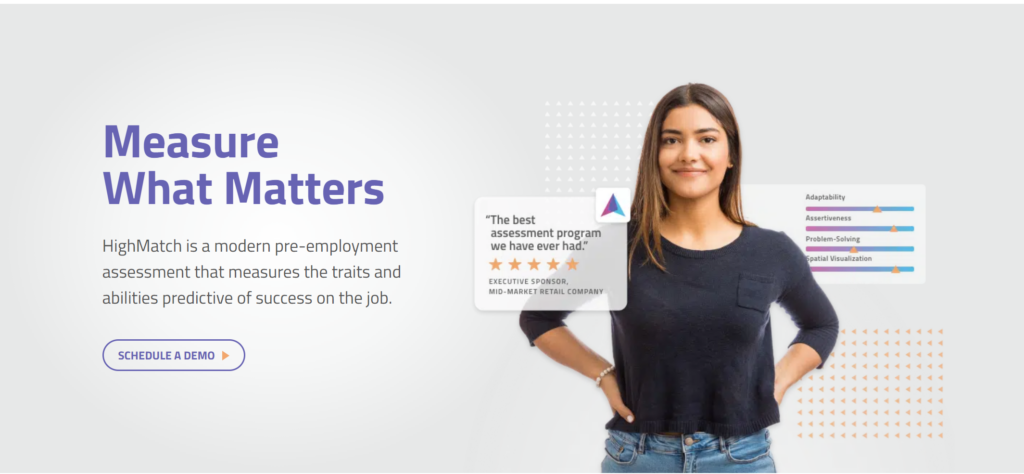
HighMatch assesses candidates against carefully built job profiles. Those profiles start as templates, then get reviewed and validated by a team of psychologists working from market data.
Once a profile exists, you can adjust it to the traits and abilities the role genuinely needs, and tune the assessment to measure the qualities in your version of the profile.
The distinguishing move is weighting: skills that matter more to you count for more. Candidates are scored on how closely they line up with your hiring profile, and HighMatch treats that closeness as a signal of how well someone will do in the role.
It is a sound model, and for a company hiring one kind of person into one kind of role it can be all you need. The limitation shows up when your roles diverge. A profile-fit score says little about whether a developer can debug a race condition or whether a support agent can hold a tone under pressure, which is why teams hiring across technical and non-technical roles end up adding a skills platform alongside it.
Testlify vs HighMatch: Pricing
Neither vendor puts every number on a public page, so plan for a quote conversation. What you can compare before that call is the pricing model, which matters more than the headline figure.
HighMatch pricing
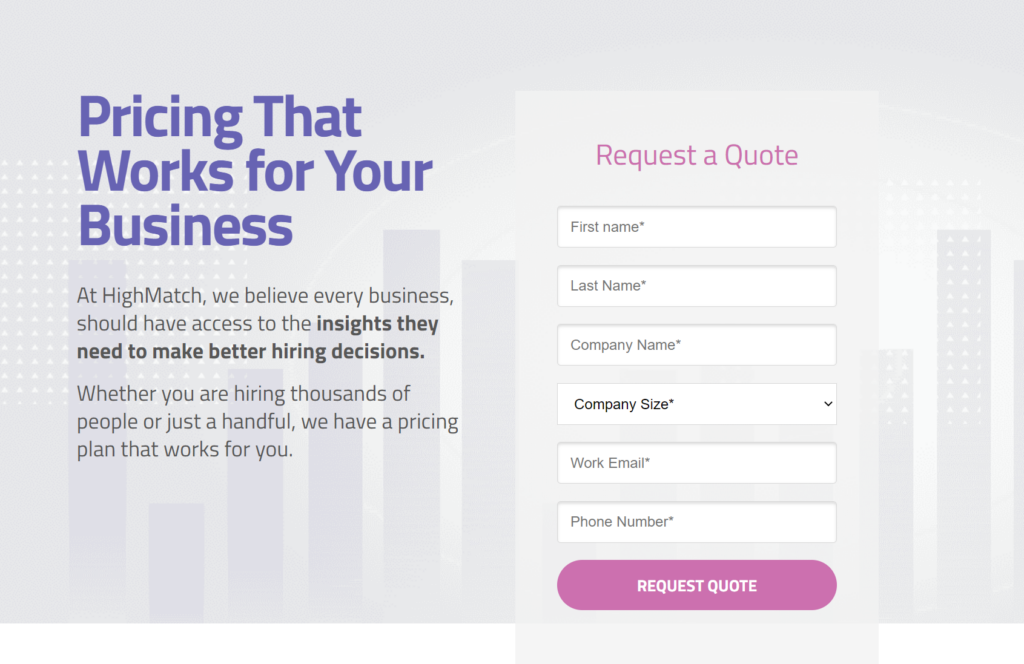
HighMatch does not publish its pricing. You contact the company and they build a quote around your roles and volume.
Testlify pricing
Testlify lists its plan tiers on the Testlify pricing page, with a free trial so you can score real candidates before committing. Ask both vendors the same three questions: what triggers a charge (a candidate invited, a candidate who finishes, or a seat), what happens when hiring volume drops in a slow quarter, and what it costs to add a test type you did not plan for.
Pro Tip: run the same five finalists through both platforms during the trial, then check whether the rankings agree. Where they disagree, ask each vendor which signal drove the gap. That one exercise tells you more than a feature grid, because it shows you what the tool is actually measuring.
Ready to see the difference on your own roles? Start free with a role-based assessment from the test library, add proctoring controls where the role warrants them, or book a demo and bring a live job description with you.
Key takeaways
- Coverage decides this comparison, not price. HighMatch is strong on personality, cognitive ability, and job-fit profiling. Testlify covers that ground and adds coding, software skills, typing, video, and audio. If your roles span technical and non-technical work, the narrower platform quietly becomes two platforms, and the second licence never appears in the original business case.
- Structure is what predicts performance. The 2022 reanalysis of selection validity puts structured, job-relevant methods among the strongest predictors and general experience among the weakest. So the platform that makes structure easy is the one that improves your hiring, whatever it charges.
- Let the formula do the combining. Mechanical scoring predicts at least as well as an expert rereading the same evidence. Use the platform's score as the input to a human decision, and stop letting a strong interview overwrite a weak work sample.
- Buy for defensibility, not just for ranking. Adverse-impact monitoring and the EU AI Act's high-risk classification of hiring AI both assume you can show how a candidate was scored. Ask what records come out of the tool during the demo, because retrofitting that after a complaint is expensive.
- Test libraries age. With nearly 40% of on-the-job skills set to change by 2030, ask how often tests are rewritten and who validates them. A library that was excellent in 2023 and untouched since is a liability dressed as an asset.
- Trial on real candidates, not on demo data. Run the same finalists through both tools and compare the rankings. Disagreement is the useful result, because it exposes what each platform actually measures before you have committed a budget to it.
FAQs
Related resources
View all
Competitor Comparisons
Testlify vs BryQ: A detailed comparison
Competitor Comparisons
Testlify vs Crystal: A detailed comparison
Competitor Comparisons
Testlify vs Equalture: A detailed comparison
Competitor Comparisons
Testlify vs Moodle: A detailed comparison
Competitor Comparisons
Testlify vs SuccessFinder: A detailed comparison
Competitor Comparisons
Testlify vs Reveal: A detailed comparison
Get started.
Hire on proof, not resumes.
Run your first skills-based assessment free — no credit card required.