
Testlify vs Talentoday: A detailed comparison
Discover the perfect solution for evaluating your candidates’ skills with Testlify. Dive into our comprehensive Testlify vs Talentoday…
 ChatGPT
 Gemini
 Claude
 Grok
Grok Perplexity
Searching for a Talentoday alternative?
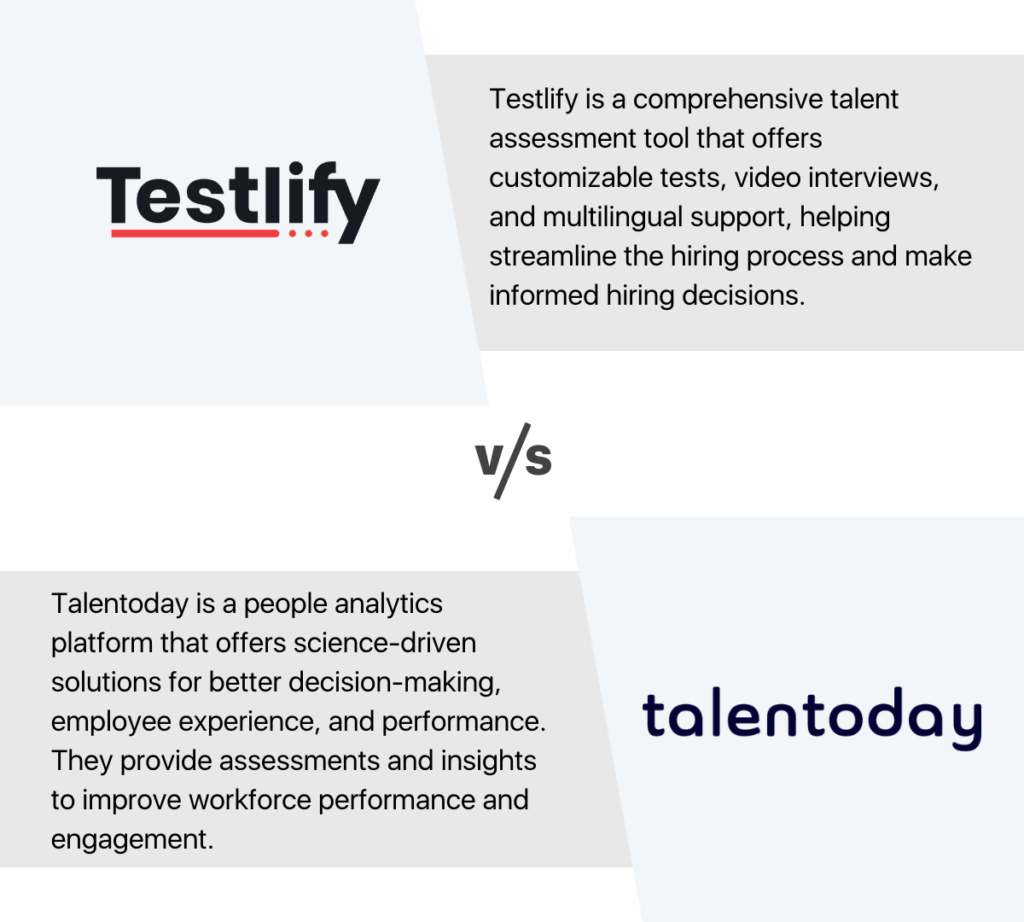
Testlify and Talentoday answer two different questions. Testlify measures whether someone can do the job, across role skills, coding, cognitive ability and personality. Talentoday measures soft skills only, through a psychometric profile called MyPrint. And as of 2026, that profile is no longer something a hiring team can simply go and buy.
That last point is the one most comparison pages miss, so it belongs up front. Medix, the staffing firm behind the product, now states on its own site that Talentoday's technology and assessment are only available to Medix's staffing clients. Buyers outside the Americas are pointed at a consulting partner and the Talentobe brand instead. If you are shortlisting assessment vendors this quarter, that changes the shape of the decision before you get anywhere near a feature grid.
7-day free trial, no credit card required. 30-day money-back guarantee.

TL;DR: Testlify vs Talentoday at a glance
- Talentoday is not a self-serve purchase any more. Its assessment now reaches buyers through Medix staffing engagements in the Americas, or a consulting partner elsewhere.
- Talentoday measures personality, motivations and professional behaviors. It does not test coding, software skills, typing, job knowledge or role-specific ability.
- Testlify runs the soft-skills signal and the hard-skills signal, from a library of 3,500+ tests built on 180k+ validated questions.
- Proctoring is the widest gap. Testlify ships session recording, snapshot capture, browser controls and IP checks. A personality questionnaire has little to proctor.
- Testlify publishes its pricing (Standard at $139 a month, or $1,668 billed annually). Talentoday's pricing now depends on the engagement you buy it inside.
- If you only want a coaching-grade personality profile, a dedicated psychometric tool is still a fair choice. If you need a hiring decision, one signal will not carry it.
Is Talentoday still available to buy?
Not as a standalone platform. Medix, which owns the product, says its technology and assessment are now only available to Medix's staffing clients. Outside the Americas, buyers are routed to a consulting partner and to Talentobe, the brand the product trades under in those markets. A direct subscription is no longer the simple purchase it was.
For a talent team, that is a procurement question before it is a product question. You are no longer buying a tool with a login and a renewal date. You are buying access to an assessment that sits inside somebody else's service model, with whatever contract, region and partner conditions come attached. Teams that run global hiring feel this fastest: the Americas path and the rest-of-world path are not the same path.
None of that makes the underlying assessment bad. MyPrint has a real research history and people who use it tend to like the report. But vendor continuity is a legitimate criterion, and it is the kind that only shows up when someone checks. A shortlist built from a 2023 feature grid would still have Talentoday on it as a normal SaaS option, which it is not.
Pro Tip: before you compare features, ask every assessment vendor two boring questions. Who owns the product today, and can we buy it directly in every region we hire in? Those two answers eliminate more shortlist candidates than any capability matrix.
What makes Testlify different from Talentoday?
Breadth of evidence. Talentoday produces one kind of signal, a soft-skills profile. Testlify produces several, and scores them against the role rather than against a personality archetype: role-specific tests, coding tests, cognitive ability, situational judgment, software skills, typing, language and personality, plus video and audio responses.
This is the Testlify Multi-Signal Talent Evaluation Model in practice. One signal is fragile. A candidate can present well on a personality questionnaire and still be unable to write the SQL the job needs every day. Confidence in a shortlist comes from several role-relevant signals pointing the same way, which is why Testlify never treats one score as the decision.
On this the CIPD is unambiguous. Its selection methods advice states that test results should never be the sole basis for a selection decision. A platform that can only produce one test is structurally unable to follow that.
The second difference is integrity, and it is the one the TL;DR calls the widest gap. Once a test is scored and unsupervised, someone will try to game it. Testlify handles that with session recording, snapshot capture, mouse tracking, copy-paste blocking, camera and microphone access, location and IP checks, and randomized question order, with time limits per test. Talentoday publishes no equivalent stack, which is reasonable for what it sells: a self-report profile has no right answer to steal. The moment a score gates who reaches an interview, though, that absence stops being neutral and starts being a hole in the evidence.
Where does that leave a buyer who genuinely wants personality data? Testlify has personality and culture tests in the same test library as the technical ones, so the soft-skills signal is a section of the assessment rather than a separate purchase, a separate login and a separate report to reconcile.
Feature-wise comparison for Testlify vs Talentoday
The grid below is the working comparison, category by category. Read the anti-cheating and enterprise rows first if you hire at volume, and the test-library rows first if you hire for technical roles. Those are the blocks where the two products stop being comparable at all.
Features | Testlify | Talentoday |
|---|---|---|
Test Library | ||
Role-specific tests | ✓ | ✗ |
Cognitive ability tests | ✓ | ✓ |
Programming Tests | ✓ | ✗ |
No. of programming languages supported | 45+ | ✗ |
Situational judgment tests | ✓ | ✗ |
Typing test | ✓ | ✗ |
Software skills tests | ✓ | ✗ |
Non-technical tests | ✓ | ✓ |
Psychometric tests | ✓ | ✓ |
Personality tests | ✓ | ✓ |
Motivation test | ✓ | ✓ |
Assessment templates | ✓ | ✗ |
Custom assessments creation | ✓ | ✗ |
Test recommendations for different job roles | ✓ | ✗ |
Coding tests | ✓ | ✗ |
Assessments | ||
Custom assessment builder | ✓ | ✗ |
Custom coding questions | ✓ | ✗ |
Multiple-choice questions | ✓ | ✓ |
Descriptive questions | ✓ | ✗ |
Video interview questions | ✓ | ✗ |
Assessments curated by I/O psychologists | ✓ | ✓ |
Google doc | ✓ | ✗ |
Google sheets | ✓ | ✗ |
Google slides | ✓ | ✗ |
Audio questions | ✓ | ✗ |
Qualifier questions | ✓ | ✗ |
File upload questions | ✓ | ✗ |
Quality check | Extensive process incl. peer reviews, sample testing, review by psychometrician & more | Not stated |
Video interview questions | ||
One-way video interview | ✓ | ✗ |
Custom video questions creation | ✓ | ✗ |
Candidate's recording attempts per question | ✓ | ✗ |
Live video interview | ✗ | ✗ |
Candidate experience | ||
Fully customizable email templates | ✓ | ✗ |
Custom invitation and rejection email | ✓ | ✗ |
Mobile-friendly | ✓ | ✓ |
Candidate support | ✓ | ✗ |
Instructions before assessment | ✓ | ✓ |
Average assessment length | 40-60 minutes | Not stated |
Anti-cheating features | ||
Session recording | ✓ | ✗ |
Snapshot capturing | ✓ | ✗ |
Mouse tracking | ✓ | ✗ |
Copy-paste disabled | ✓ | ✗ |
Microphone and camera access | ✓ | ✗ |
Location access | ✓ | ✗ |
IP address tracking | ✓ | ✗ |
Randomization of question sequence | ✓ | ✗ |
Time limit on tests | Yes, typically 10 minutes | Not stated |
Reporting and analytics | ||
Detailed reports | ✓ | ✓ |
Easy to share reports and scorecards | ✓ | ✗ |
Exportable/downloadable reports | ✓ | Not stated |
Recruiting analytics | ✓ | ✓ |
Candidate benchmarking | ✓ | ✗ |
Completion rate and response insights | ✓ | ✗ |
Enterprise friendly | ||
White label feature | ✓ | ✗ |
Custom branding | ✓ | ✗ |
ATS integration | ✓ | ✓ |
User, role, and access management | ✓ | ✓ |
Bulk candidate invite | ✓ | ✗ |
Share public link invite to candidates | ✓ | ✗ |
Candidate pipeline management | ✓ | ✓ |
Internationalization | ✓ | Not stated |
Campus hiring support | ✓ | ✗ |
Dedicated account manager | ✓ | ✓ |
GDPR compliant | ✓ | Not stated |
Multilingual abilities | ✓ | ✓ |
Customer support | ||
24/7 support | ✓ | ✗ |
On-call support | ✓ | ✓ |
Email support | ✓ | ✗ |
Product demo | ✓ | ✓ |
Training & onboarding tour | ✓ | ✓ |
How Talentoday works?
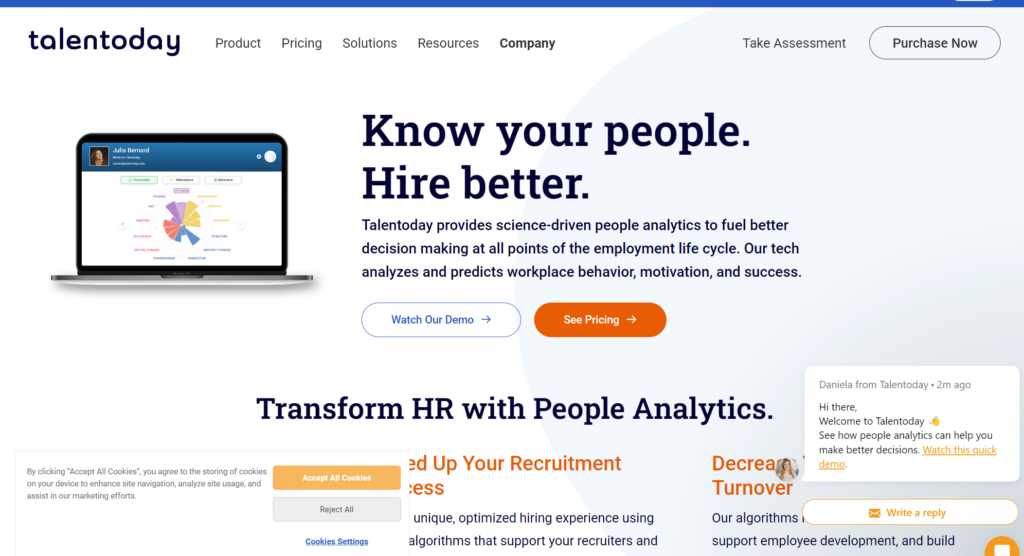
Talentoday is a people-analytics product built around one assessment. A candidate or employee completes MyPrint, and the platform returns a profile covering personality traits, motivations and professional behaviors, with team and manager views layered on top. The pitch has always been self-awareness and fit rather than screening throughput.
The workflow reflects that. Profiles are the unit of work, not requisitions. There is no assessment builder in the sense a recruiter means it, no coding sandbox, no proctored test session, and no premade ATS connectors, so results tend to be read as a document rather than consumed as a pipeline stage. That is a design choice, not an oversight. It suits coaching, career guidance and team development, which is the work the product grew up doing.
It is a poor fit for the job most hiring teams are actually trying to do, which is to compare 200 candidates on job-relevant ability without reading 200 CVs.
What does the MyPrint assessment measure?
Soft skills. MyPrint profiles personality traits, work motivations and professional behaviors, and reports them as a self-awareness and fit picture rather than a pass or fail score. It does not measure coding ability, software proficiency, typing speed, job knowledge or role-specific technical skill, and it is not an English language proficiency test.
That clarification matters because the claim gets miswritten across the web, and an earlier version of this page repeated the error. MyPrint is a psychometric instrument in the personality and motivation family. Calling it a language test misrepresents what the vendor built and would send a buyer looking for the wrong thing.
Used for what it is, the profile is useful. Motivation data helps a manager work out why a strong performer is drifting. Behavioral styles help a team talk about how they disagree. Neither of those is evidence that a candidate can do the job on day one, and treating a personality report as a hiring gate is where organizations get into trouble, both for accuracy and for defensibility.
Which platform covers more of your hiring?
Testlify, by a wide margin, because it covers the part of the role that changes. Employers expect 39% of key skills required in the job market to change by 2030. Personality does not churn like that. Skills do, and a tool that cannot test them ages badly.
The scale underneath that shift is worth holding in view. The World Economic Forum's Future of Jobs Report 2025 projects 170 million new jobs created this decade against 92 million displaced, a net gain of 78 million. Most of that movement lands on hiring teams as unfamiliar roles they have never screened for before. When the role is new, there is no internal benchmark and no manager instinct to fall back on, which is exactly when a validated skills test earns its keep.
There is a second reason coverage matters, and it is about how long you get to be wrong. US median tenure with a current employer is 3.9 years, and only 2.7 years for workers aged 25 to 34. A mis-hire in that band is not a decade-long problem, it is a two-year problem that repeats. Gallup puts the failure rate bluntly for one role type: companies fail to choose the candidate with the right talent for the job 82% of the time when they hire managers.
Take an illustrative case. A regional logistics operator opens 40 warehouse-supervisor roles across 6 sites and gets roughly 900 applications in three weeks. A personality profile would rank all 900 on traits like patience and structure, which sounds useful until two candidates with identical profiles turn out to differ on whether they can read a stock report or run a shift handover. A screening assessment built from a situational judgment test, a numerical reasoning section and a short software-skills task cuts that pool to an interviewable shortlist on job-relevant evidence, and the personality section still rides along as one input rather than the whole verdict. The scenario is hypothetical, but the shape of it is the ordinary case for volume hiring.
A soft-skills profile can tell you how a manager will probably behave under pressure. It cannot tell you whether they can read a P&L, run a forecast, or write the brief. Testlify's coverage of both is the difference, and it is why the comparison is not really a like-for-like contest. For a wider view of the category, the roundup of talent assessment tools worth shortlisting puts both styles of product side by side.
Testlify vs Talentoday: Pricing
Pricing is the clearest split between the two. One publishes numbers you can budget against. The other now prices inside a service relationship, which means the number depends on what else you are buying.
Talentoday pricing
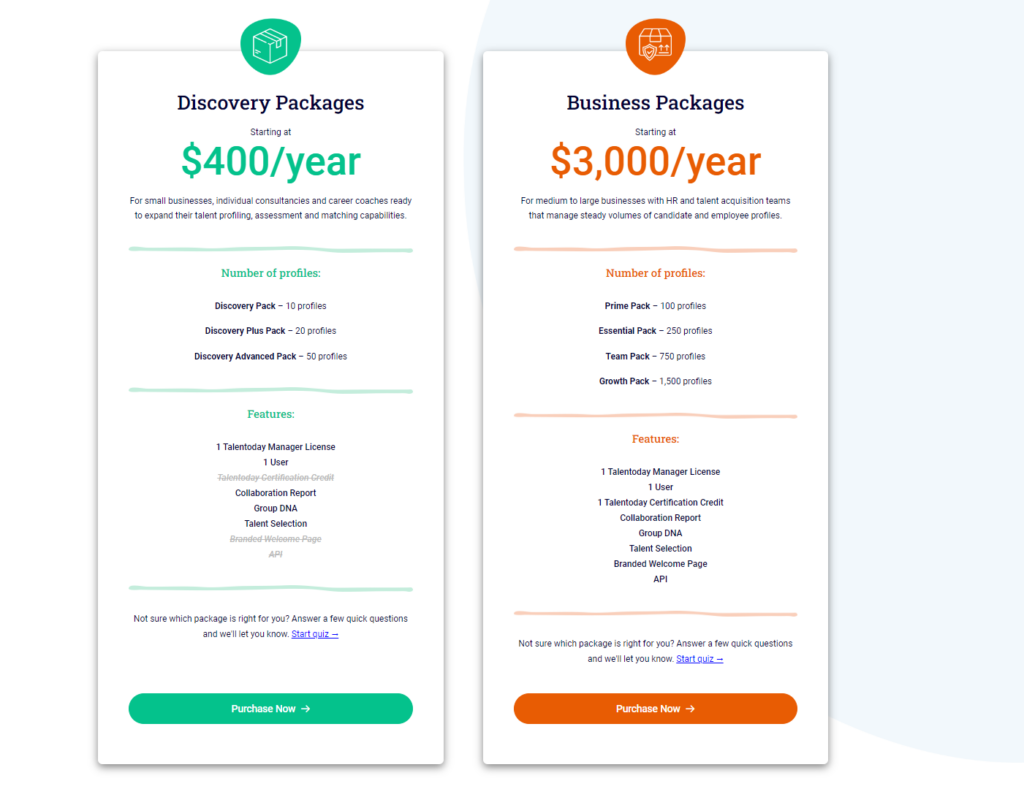
Talentoday no longer lists a public self-serve price. Because access runs through Medix staffing engagements in the Americas, and through a consulting partner in other markets, the cost sits inside that engagement rather than on a pricing page. Older figures still circulating on comparison sites describe packages that are no longer purchasable in that form, so this page no longer repeats them.
Practically, that means a quote and a conversation. Budget for procurement time as well as license cost, and confirm which entity you are contracting with in each region you hire in.
Testlify pricing
Testlify publishes its plans. The Standard plan runs $139 a month, or $1,668 billed annually, and includes 100 candidate credits a year and 3 user seats, with extra seats at $15 a month and extra credits at $21 each. Every plan carries 100+ ATS integrations rather than gating them behind an enterprise tier. Organizations assessing more than 25,000 candidates a year move to a custom plan.
There is a 7-day free trial with no credit card, and a 30-day money-back guarantee. The full breakdown sits on the Testlify pricing page.
Which tool is right for your team?
Pick Talentoday, or Talentobe, if what you want is a coaching-grade personality and motivation profile for people you have already hired, you have a consultant or a Medix relationship to buy it through, and you are not trying to screen a funnel. It does that job well and it has done it for years.
Pick Testlify if you are screening candidates and need job-relevant evidence before an interview. That is the honest split, and it is not a close call once you write down which of the two things you are actually doing this quarter.
The caveat worth naming: Testlify is a pre-hire assessment platform, not an ATS, an HRIS or a background-check provider. It integrates with those systems, it does not replace them. Anyone selling an assessment tool as the whole hiring stack is overselling it, and a team that buys on that promise ends up blaming the tool for failing at a job it never claimed.
One more edge case. If your organisation has already standardized on MyPrint for internal development and the reports are embedded in how managers run reviews, do not rip that out to unify vendors. Run skills assessment for hiring and keep the development instrument where it is working. Consolidation is a nice-to-have, not a reason to break something people trust.
How do you move off Talentoday?
Treat it as a swap of the screening stage, not a full re-platform. Most teams can be running assessments again in about two weeks, because the pieces that take time are the role definitions rather than the software.
- Export the existing profiles and reports you still need. Anything you cannot export, you do not own.
- List the 5 to 10 roles that account for most of your hiring volume. Those get built first, the long tail waits.
- For each role, write down what success looks like in the first 90 days, then pick the tests that produce evidence for it. Skills first, personality as a supporting section.
- Set the pass bands with the hiring manager, not the recruiter alone. Managers defend cutoffs they helped set.
- Connect the ATS so results land in the pipeline rather than an inbox.
- Run one live requisition in parallel with the old process, compare the shortlists, then switch.
The parallel run in step 6 is the one people skip and the one that settles internal arguments. A shortlist scored on job-relevant tests next to a shortlist scored on a personality profile makes the difference visible in an afternoon.
See Testlify on your own roles
A feature grid only takes a decision so far. The faster test is to build an assessment for a role you are hiring for right now and look at what comes back. Start with the free trial, or book a walkthrough with the Testlify team and bring one open requisition to it.
Key takeaways
- Availability changed, and it changes the shortlist. Talentoday's assessment now reaches buyers through Medix staffing engagements or a regional consulting partner. That is a vendor-continuity risk to raise with procurement, not a footnote, and it should be confirmed in writing before a contract is signed.
- One signal cannot carry a hiring decision. A personality profile describes how someone tends to work. It does not evidence whether they can do the work. Pair the soft-skills signal with role-relevant testing, or accept that the decision is running on an interview impression.
- Skills churn faster than traits. With 39% of key job skills expected to change by 2030, a tool that cannot test current ability loses accuracy every year. Budget for a platform whose library keeps pace rather than one whose model is fixed.
- Proctoring is the widest capability gap. Session recording, snapshot capture, browser controls and IP checks matter the moment testing is remote and unsupervised. If assessment results feed a real decision, integrity controls are the difference between evidence and a guess.
- Published pricing is a buying advantage. Testlify's $139 a month Standard plan can be budgeted without a sales cycle. Access-based pricing cannot, so add procurement time to any comparison that includes it.
- Keep what already works. If MyPrint is embedded in internal development, leave it there and change only the screening stage. Vendor consolidation is rarely worth breaking a process managers already trust.
FAQs
Related resources
View all
Competitor Comparisons
Testlify vs SHL: A detailed comparison
Competitor Comparisons
Testlify vs PXT Select: A detailed comparison
Competitor Comparisons
Testlify vs McQuaig: A detailed comparison
Competitor Comparisons
Testlify vs Kolbe: A detailed comparison
Competitor Comparisons
Testlify vs HireSharp: A detailed comparison
Competitor Comparisons
Testlify vs HiringBranch: A detailed comparison
Get started.
Hire on proof, not resumes.
Run your first skills-based assessment free — no credit card required.