
What Is Talent Benchmarking? A 2026 Guide for Hiring Teams
A plain guide to talent benchmarking: what it is, the main types, how to build a benchmark, what to measure and the mistakes to avoid.

Talent benchmarking is the practice of comparing candidates or employees against a defined standard, such as the skill profile of your top performers or a global score norm for the same test. Hiring teams use it to see what "good" looks like for a role before they meet anyone, and then to judge every applicant against that same bar.
TL;DR: This guide explains what talent benchmarking is and how it differs from benchmarking HR metrics such as time-to-fill. It covers how a benchmark works, the four types you will meet, the benefits for hiring teams, a six-step way to build one, a worked example, the measures that matter and the mistakes that make benchmarks unfair or out of date.
 ChatGPT
 Gemini
 Claude
 Grok
 Perplexity
What is talent benchmarking?
Talent benchmarking is a way to measure people against a clear, shared standard for a role. The standard can come from inside the company, usually the skills and scores of current top performers, or from outside, such as industry norms or the global average for a skills test. Candidates and employees are then compared with that standard, skill by skill.
In hiring, the term usually means candidate benchmarking: you build a profile of what strong performance in the role requires, assess applicants on the same skills, and see who meets or beats the bar. In talent management, the same method is applied to current employees to find skill gaps, plan training and spot people ready for a bigger role.
The idea is simple. A recruiter who knows that strong support agents in the team score around 80 on a written communication test can read a candidate's 62 with real context, instead of guessing whether 62 is good.

How is talent benchmarking different from HR benchmarking?
Talent benchmarking compares people with a skills standard, while HR benchmarking compares the company's HR numbers with other organizations. Both use the word "benchmark", which is why search results mix them up. One answers "Is this candidate strong enough for the role?" and the other answers "Is our hiring process slower or costlier than our peers?"
Talent benchmarking | HR or talent acquisition benchmarking | |
|---|---|---|
What is compared | Candidates or employees | The organization's HR metrics |
Compared against | Top performers, a role profile or a global test norm | Industry peers, competitors or past years |
Typical measures | Skill scores, behaviors, work samples | Time-to-fill, cost-per-hire, turnover, offer acceptance |
Main user | Recruiters, hiring managers, L&D | HR leaders, people analytics, finance |
Decision it informs | Who to shortlist, hire, train or promote | Where to fix the hiring process or budget |
Most teams need both. SHRM's recruiting benchmarking data, drawn from over 4,600 organizations, puts the median time-to-fill for nonexecutive roles at 39 calendar days. Only talent benchmarking tells you whether the people coming out of that process are any good. For the metrics side, see our guide to HR benchmarking.
How does talent benchmarking work?
Talent benchmarking works in four stages: define what the role needs, build the benchmark from real performance data, assess candidates on the same measures, and compare each result with the benchmark before a person decides.

- Define the role. List the skills and behaviors the job needs, with the hiring manager. A competency framework helps keep the list consistent.
- Build the benchmark. Current top performers take the same assessment candidates will take. Add a global norm for the same test if one exists.
- Assess candidates. Give every applicant the same test, under the same conditions, so the scores are comparable.
- Compare and decide. Use the gaps against the benchmark to shortlist and plan interview questions. A person makes the final call.
Pro tip: Benchmark skills, not job titles. Two companies can use the same title for very different jobs, so a benchmark built on your own role definition beats a generic one.
What are the types of talent benchmarking?
Talent benchmarking has four common types: internal, external, performance and practice benchmarking. Internal and external describe where the standard comes from. Performance and practice describe what is compared, numbers or ways of working.
- Internal benchmarking. The standard comes from your own people, usually top performers in the same role. It fits your culture and tools, but small teams give small samples.
- External or global benchmarking. The standard comes from outside: industry data, a peer group, or the global average of everyone who has taken the same skills test. It helps when a new role has no top performers yet.
- Performance benchmarking. Compares numbers, such as skill scores or sales results.
- Practice benchmarking. Compares how work gets done, such as how other teams interview or train.
Most hiring teams combine an internal benchmark with a global norm. The global norm stops you setting the bar too low where your current team happens to be weak.
What are the benefits of talent benchmarking?
Talent benchmarking gives hiring teams a shared definition of a strong hire, fairer comparisons, faster shortlists and clearer skill gaps.
- Better quality of hire. Hiring against a proven profile raises the odds that new hires perform. LinkedIn's Future of Recruiting 2025 found that 89% of TA professionals say measuring quality of hire will matter more, yet only 25% are highly confident they can measure it.
- Fairer, more consistent decisions. One standard for every applicant cuts the room for gut feel and "culture fit" shortcuts.
- Faster shortlists. Recruiters can rank applicants against the benchmark the moment results arrive.
- Clear skill gaps. Benchmarking current staff shows where training will pay off, which matters when SHRM's 2025 Talent Trends reports that 69% of organizations still struggle to fill roles and 28% now require new skills for full-time roles.
How do you build a talent benchmark?
Building a talent benchmark takes six steps: pick the role, define the skills, choose the assessments, test your top performers, set score ranges, and review the benchmark against real hiring results.
- Pick the role. Choose a role you hire for often or where a bad hire is expensive.
- Define the skills. Agree on 4 to 6 skills that separate strong performers from average ones. Use job analysis, not just the old job description.
- Choose the assessments. Pick one test per skill: role knowledge, cognitive ability, situational judgment, language or a coding task. The Testlify test library has 3,500+ tests to choose from.
- Test your top performers. Test more than a handful of strong performers, plus a few average ones to see which skills separate the groups.
- Set score ranges. Turn the results into a target range per skill, not a single pass mark. Check the ranges against the global norm for each test.
- Review against outcomes. After 6 to 12 months, compare new hires' benchmark scores with their performance and retention. Adjust skills or ranges that did not predict success.
Key takeaway: A talent benchmark is a starting hypothesis about what good looks like. It earns trust only when you check it against how the people you hired actually perform.
What does a talent benchmark look like in practice?
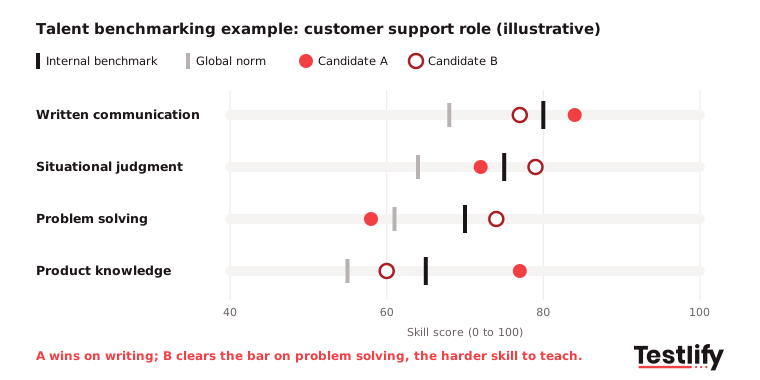
A talent benchmark in practice is a short scorecard that shows each candidate's results next to the target range for every skill. The example below is illustrative, for a customer support role benchmarked on four skills, with an internal benchmark from top performers and a global norm from all test takers.
Skill | Internal benchmark (top performers) | Global norm | Candidate A | Candidate B |
|---|---|---|---|---|
Written communication | 80 | 68 | 84 | 77 |
Situational judgment | 75 | 64 | 72 | 79 |
Problem solving | 70 | 61 | 58 | 74 |
Product knowledge | 65 | 55 | 77 | 60 |
Candidate A writes very well and already knows the product, but sits 12 points below the benchmark on problem solving. Candidate B is within 3 points of the bar or above it on three skills, with a 5-point gap on product knowledge, which training can close. Without a benchmark, A's writing would likely win the interview. With one, the team sees that problem solving is harder to teach and probes it next.
What should you measure in talent benchmarking?
Talent benchmarking should measure the skills that drive success in the role, plus a few process measures that show whether the benchmark works.
Measure | What it tells you | Where it comes from |
|---|---|---|
Skill scores per area | How a candidate compares with the bar, skill by skill | Skills tests, coding tasks, simulations |
Interview ratings | Whether structured interviews confirm the test results | Scorecards with set criteria |
New hire performance | Whether high benchmark scores lead to strong work | Manager ratings at 90 days and 1 year |
Retention | Whether benchmark hires stay | HRIS data |
Pass rates by group | Whether the benchmark screens out any group unfairly | Assessment and ATS data |
Keep the list short. A benchmark with 15 skills is hard to explain and harder to keep current. Use the same measures across the teams that hire for a role, so results are comparable between offices and regions.
What are the challenges of talent benchmarking?
Talent benchmarking has four main challenges: small or biased samples, cloning the current team, benchmarks going stale, and fairness rules for automated tools.
- Small samples. A benchmark built from two or three people reflects those people, not the role. Add a global norm, or wait until you have a larger group.
- Cloning the current team. If today's top performers share a background, a benchmark built only from them can screen out people who would also succeed. Benchmark skills and results, not traits like schooling or past employers.
- Stale benchmarks. Roles change fast, especially with AI tools in daily work. Review each benchmark at least once a year, or when the role changes.
- Fairness and audits. Check pass rates by group every time the benchmark changes. If you use automated scoring to screen candidates in New York City, Local Law 144 requires a bias audit within one year before use, a public summary of the results and notice to candidates.
Benchmarking is not only for candidates. A 2025 SHRM Executive Network article describes a defense contractor that compared its onboarding timelines with peer contractors and then cut time-to-hire by 50%. The lesson holds across the teams involved in hiring: compare against a clear standard, act on the gap, then measure again.
How does Testlify support talent benchmarking?
Testlify supports talent benchmarking through skills tests with built-in global and assessment-level benchmarking, so candidate reports show how a score compares with others who took the same test. Teams can also test their own top performers to set an internal bar.
- One test per skill. 3,500+ tests and 25+ question types cover tech and non-tech roles, including cognitive ability, situational judgment, language and coding.
- Benchmarked reports. Each report has a per-skill breakdown, AI-written strengths and gaps, and a view of how the candidate compares globally. See reporting and analytics.
- Clear scoring. Automated and weighted scoring applies the same rules to every candidate. Learn more in how Testlify AI scoring works.
- Trustworthy results. 20+ proctoring checks help make sure the score belongs to the candidate, and tests run in 15+ languages for global hiring.
Frequently asked questions
Ready to set your first talent benchmark?
Pick one role you hire for often and build its benchmark this month. Browse the test library for the skills that role needs, or start a 7-day free trial of Testlify, no credit card required, and see benchmarked candidate reports on your own applicants.

Content Writer
Yashika Khandelwal is a Content Writer with 3+ years of experience creating research-backed content on hiring, talent assessment, and HR technology. She is a registered Organizational Psychologist and subject matter expert who combines behavioral science with practical recruitment insights to produce accurate, evidence-based content.
LinkedInRelated resources
View all
Talent assessment
Soft skills interview question bank (100+ behavioral indicators)

Talent assessment
Top qualities every talent leader should have in 2026

Talent assessment
What Is a Job Simulation? Types, Benefits & How to Create One (2026 Guide)

Talent assessment
How to build a hiring process with talent assessment tools

Talent assessment
Best Talent Assessment Software in 2026: How to Evaluate and Choose

Talent assessment
Top coding assessment software for recruiters
Get started.
Hire on proof, not resumes.
Run your first skills-based assessment free — no credit card required.