
Top 15 Pixonality Alternatives and Competitors
Discover 15 powerful Pixonality alternatives to streamline your hiring process and assess candidates with confidence.
Pixonality is a Canadian talent assessment marketplace. It sells ready-made psychometric tests from seven publishers (Hogan, SHL, Pearson, HRID, Humance, SuccessFinder and Assessio) one report at a time, priced in Canadian dollars, inside one management portal. If that is exactly what you need, it does the job. Most teams that land on this page need something else: tests they can shape to a role, coding and software tasks, proctoring, and a price that does not climb with every candidate.
So here is the short answer. The best Pixonality alternative for a team that hires on job skills is a subscription platform with its own test library and custom questions. Testlify leads this list because it covers psychometrics and role skills in one place at a flat annual price. The other 14 tools each win a narrower case, and we say which.
Every price below was read from the vendor's live pricing page in September 2026. Where a vendor hides pricing behind a sales call, we say "quote-based" and leave it there.
 ChatGPT
 Gemini
 Claude
 Grok
Grok Perplexity
TL;DR
- Pixonality resells publisher psychometrics (about 130 products across personality, skills, cognitive and management) at CAD $28 to $2,250 per assessment, in English and French. It is a catalog, not a test builder.
- Per-assessment pricing is fine for 10 leadership hires a year and painful for 200 applicants a month. Subscription platforms flip that math.
- Testlify is the strongest all-round alternative: 3,500+ tests, 25+ question types including coding and Office tasks, AI video and phone interviews, proctoring, and a Starter plan at $139 a month billed annually.
- Coding-only tools (Codility, HackerRank, Coderbyte) and quote-based enterprise suites (Mercer Mettl, iMocha, HireVue) suit specific teams, not a 40-person agency hiring account managers.
- Stay with Pixonality if a client or board asks for a Hogan or SHL report by name. Nothing on this list sells a publisher's branded report.

What is a Pixonality test?
A Pixonality test is a third-party psychometric assessment bought through Pixonality's marketplace and delivered from its platform. Pixonality writes none of the tests. Its catalog lists about 130 products from Hogan, HRID, Humance, Pearson, SHL, SuccessFinder and Assessio, and its platform page describes 150 assessment solutions from 7 providers. You pay per assessment and a publisher report is emailed when the candidate finishes.
The catalog skews toward personality. Pixonality's assessment collection shows 59 personality products, 28 skills, 27 combined, 10 cognitive and 6 management titles. Prices run from CAD $28 for SHL's Verify General Ability Screen to CAD $2,250 at the top end, with Hogan's High Potential Report at CAD $500 and its Leadership Forecast Series at CAD $638. Results are treated as valid for about 24 months, and Pixonality runs certification workshops (in person, live online and on demand) for teams that want to interpret Hogan or similar reports themselves.
Two practical limits show up in Pixonality's own documentation: questionnaires and reports are available in English and French, and some assessments do not run on a phone or tablet. The platform itself is SOC 2 Type 2 certified and works in Chrome, Firefox, Edge and Safari.
Why do teams look for Pixonality alternatives?
Because the marketplace model stops fitting the moment hiring volume goes up or the role gets technical. Four reasons come up again and again.
Per-assessment pricing scales the wrong way. Pay CAD $89 for a Watson-Glaser III on 10 finalists and you have spent about CAD $890. Run the same test on 150 applicants for a customer support team and it is CAD $13,350 for one role. A subscription platform charges a flat fee for a credit pool, so the 150th candidate costs the same as the first.
No custom questions and no coding tasks. Pixonality's platform page describes a portal for projects, invitations, progress tracking and reports. It does not offer a question builder, and the catalog categories stop at personality, skills, cognitive, combined and management. If you need a candidate to write SQL, fix a spreadsheet or reply to an angry customer email, you need a different tool.
Proctoring is the publisher's problem, not the platform's. Publisher personality inventories are not usually proctored, which is fine for development and coaching. For a hiring decision on a cognitive test taken at home, you want webcam checks, tab monitoring and an AI-assistance flag.
Two languages. English and French cover Canada. They do not cover a Mexico City sales team or a Manila support center.
The honest counterpoint: if you run leadership development or succession work and a board or client asks for a Hogan report by name, an aggregator is a perfectly good buy. None of the 15 platforms below sells Hogan or SHL branded reports. They sell their own validated tests instead.
How we evaluated these Pixonality alternatives
We scored each tool against the buyer who actually searches for Pixonality alternatives: a company of 20 to 200 people, often an agency or professional-services firm, where the founder or one operations lead owns hiring and does not do it full time. Five criteria, in order of weight:
- Test breadth beyond psychometrics. Cognitive and personality tests plus role skills, software tasks and coding, so one tool covers the whole shortlist.
- Custom questions and work samples. The evidence matters here. The Sackett, Zhang, Berry and Lievens 2022 re-analysis in the Journal of Applied Psychology put structured interviews at an operational validity of .42, job knowledge tests at .40, work samples at .33 and cognitive ability at .31, as reported by SIOP. A tool that only offers off-the-shelf personality inventories leaves the strongest predictors on the table.
- Anti-cheating. At minimum, webcam snapshots, tab-switch detection and an AI-assistance flag, with a human deciding what a flag means.
- Published pricing and a real trial. Quote-based pricing is a Con on this list. A small team should know the cost before booking a demo.
- Fit for a small team's stack. ATS integrations if you have one, a light built-in pipeline if you do not.
This is the Testlify Multi-Signal Talent Evaluation Model applied to a buying decision: combine several role-relevant signals (assessment, work sample, interview, references) rather than trusting one personality report, and pick the platform that can collect the most of those signals without a second subscription.
Quick comparison table
Tool | Best for | Library (vendor claim) | Pricing model, Sept 2026 | Free trial |
|---|---|---|---|---|
Testlify | All-round skills plus psychometrics for teams under 200 | 3,500+ tests, 180k+ questions | Published, from $139/mo billed annually | 7 days, no card |
TestGorilla | Teams that want a free tier first | 350+ tests | Published, free tier then $142/mo annual | Free plan |
Adaface | Low-volume hiring, chat-style tests | 500+ tests | Published, from $180/yr | 14 days |
Vervoe | Job simulations with AI grading | Not stated on pricing page | Quote-based | On request |
Codility | Structured engineering hiring | Coding task library | Published, from $1,200/yr | Scoped by sales |
Mercer Mettl | Enterprise psychometrics and proctored exams | Not stated on pricing page | Quote-based | Free sign-up |
iMocha | Enterprise skills inventories | 10,000+ evaluations claimed | Quote-based | Demo |
HireVue | High-volume video interviewing | Interview and game content | Quote-based (Essential, Premium) | Demo |
TestDome | Pay per candidate, no subscription | 2,000+ questions, 130+ skills | Published, $7 to $20 per candidate | Trial sign-up |
Coderbyte | Startups hiring developers | Coding challenges and projects | Published, $99/mo for 20 invites | 14 days |
HireMojo | Job distribution and screening automation | Not an assessment library | Not published | Demo |
HackerRank | Developer screening at scale | Coding question library | Tiered, on its pricing page | Check live page |
TestInvite | Build-your-own exams | Custom-first, with templates | Published, from $900/yr | 100 free credits |
eSkill | Large custom test banks | 600+ subjects, 70,000 questions | Quote-based | Demo |
Canditech | Job simulations for small teams | Simulation library | Tiers listed, prices on request | Free start, no card |
1. Testlify
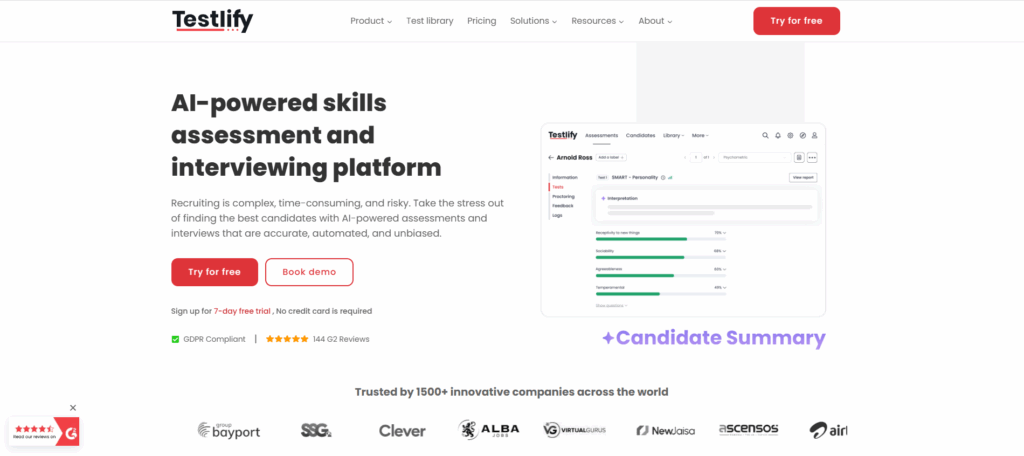
Testlify is a skills assessment and AI interviewing platform that covers what Pixonality sells (personality, cognitive, psychometric) and what it does not (coding, software tasks, role-specific skills, interviews) in one subscription. It is built for the team that wants one shortlist score across several signals rather than one publisher report.
Key features
- 3,500+ tests and 25+ question types. The test library spans cognitive ability, personality and culture, psychometric, situational judgement, software skills, coding and blue-collar roles. Question types include coding in an embedded VS Code editor, typing, file upload and live Google Docs, Sheets, Slides, Word, Excel and PowerPoint tasks.
- Custom questions and AI-built assessments. Paste a job description and get a draft assessment of up to 20 questions, then edit it. Any question can be weighted, made mandatory or left unscored.
- AI video, audio and phone interviews. One-way and two-way conversational formats with selectable avatars and voices, attempt and recording-time limits, automatic multilingual transcripts and AI scoring you can keep advisory. Phone interviews bill at $0.18 per minute.
- Proctoring with three presets. Standard, Strict or Custom: webcam snapshots, tab-switch and multi-monitor detection, AI-tool detection, photo ID with face match, and dual-device monitoring that turns the candidate's phone into a second camera. Face verification data is deleted after 30 days.
- Item-level psychometrics. Difficulty index, discrimination index and quality-risk flags per question, so you can see which items actually separate strong candidates from weak ones.
Pros
- Psychometrics and job skills in one credit pool, with real-time translation of tests into the candidate's preferred language.
- The product ships the line "AI scores and insights are for guidance only. Use human judgment for final decisions," and you can exclude AI scores from the final average.
- A simple built-in hiring pipeline (job posting, application form, applied to shortlisted stages) for teams without an ATS, plus 100+ ATS integrations for teams that have one.
Cons
- Candidates need a Chromium desktop browser (Chrome or Edge) for a full assessment; the mobile app is a recording fallback, not a test-taking platform.
- ATS integrations, white labeling and SSO are paid add-ons on the self-serve tiers ($2,388 a year each for ATS integrations and white labeling).
- No Hogan or SHL branded reports. Testlify's personality, DISC and culture-fit reports are its own.
Best for
A company under 200 people, an agency or a professional-services firm that hires across account management, ops, support and a few technical roles and wants one platform for all of them.
Pricing
Published on the pricing page. Annual billing: Starter $139 a month ($1,668 a year, 100 credits, 3 seats), Basic $279 a month ($3,348 a year, 300 credits), Business $699 a month ($8,388 a year, 1,000 credits). Premium, Enterprise and Custom are quote-based. One credit per started assessment. 7-day free trial with no card, 30-day money-back guarantee, and a 25% non-profit discount.
2. TestGorilla
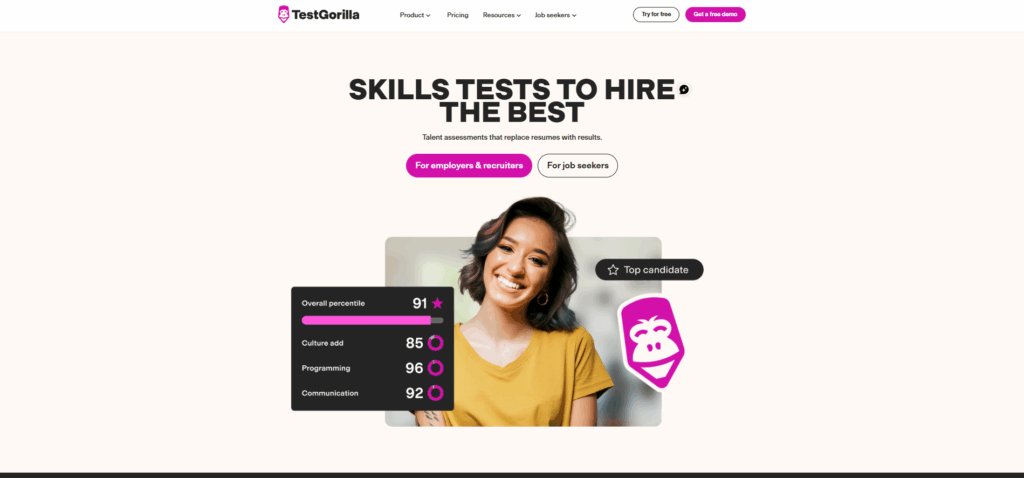
TestGorilla is the closest like-for-like alternative in shape: a large off-the-shelf library, a free tier and published pricing. It's the tool many small teams try first, because the free plan costs nothing to evaluate.
Key features
- 350+ tests on paid plans across cognitive ability, personality, language, software skills and role skills.
- Video questions, AI interviews (limited on the free plan), resume scoring and qualifying questions.
- Free plan with 10 credits a month, 5 essential tests, 5 preset custom questions and one full-access seat.
Pros
- You can run a real pilot for $0.
- Pricing is public and predictable.
Cons
- The free plan limits you to 5 tests, so the pilot does not show the full library.
- The Plus tier starts at $400 a month on an annual commitment, a big jump from Core.
Best for
Teams that want to test the category before spending, and are hiring mostly non-technical roles.
Pricing
Free plan at $0. Core $142 a month on an annual commitment ($1,704 billed annually). Plus from $400 a month ($4,800 a year). Enterprise is quote-based.
3. Adaface
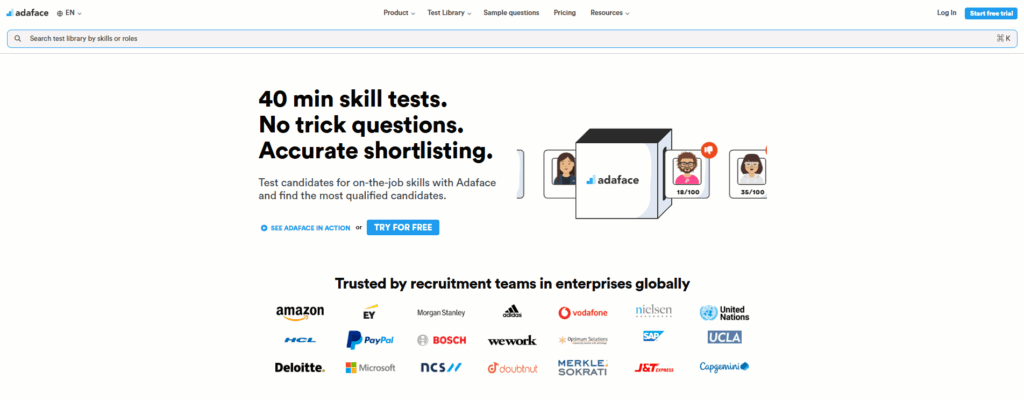
Adaface delivers assessments as a chat conversation with "Ada" instead of a wall of multiple-choice questions, and sells credits in small packs. For a team hiring five people a year, the entry price is hard to beat.
Key features
- 500+ tests covering programming, data, IT, accounting, finance, aptitude, psychometric, language and typing.
- Conversational delivery that adapts question difficulty as the candidate answers.
- Credit-based plans where one credit equals one candidate invite.
Pros
- The Individual plan at $180 a year for 12 credits is the cheapest paid entry point on this list.
- Every plan includes the full library.
Cons
- Twelve credits is one small role. Costs climb to $3,000 a year at 500 credits.
- The chat format is distinctive, and not every hiring manager wants a quirky candidate experience for a finance role.
Best for
Very low-volume hiring where candidate experience matters more than volume tooling.
Pricing
Individual $180 a year (12 credits), Starter $500 (50), Pro $900 (100), Scale $3,000 (500), Growth $5,500 (1,000), Enterprise $20,000 (5,000), Unlimited $50,000. 14-day free trial.
4. Vervoe
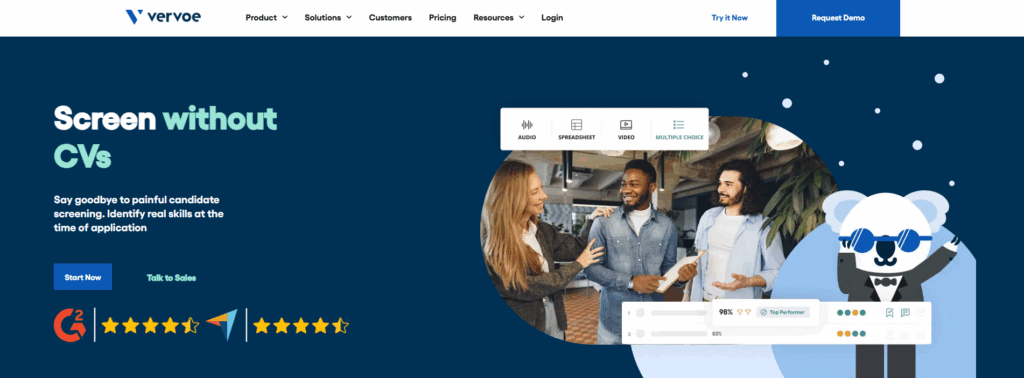
Vervoe's pitch is merit over resumes: candidates complete job simulations and AI ranks the responses. It is a work-sample tool first and a test library second, which suits roles where the task is the test (support, sales, marketing).
Key features
- Job simulations mixing text, video, file uploads and spreadsheet tasks.
- AI grading and ranking of open-ended responses, with team review and notes.
- Positioned for "skills-first hiring at scale."
Pros
- Strong on realistic tasks, the work-sample signal that scored .33 in the 2022 re-analysis and that a personality-only stack lacks.
- Collaborative review keeps the decision with people.
Cons
- Pricing is request-only as of September 2026, so you cannot compare cost without a demo.
- Thin on the publisher-grade psychometrics a Pixonality buyer may be used to.
Best for
Mid-size teams hiring frontline and go-to-market roles where a realistic exercise beats a personality profile.
Pricing
Quote-based. The pricing page offers "Request pricing" and a demo booking; no plan figures are published.
5. Codility
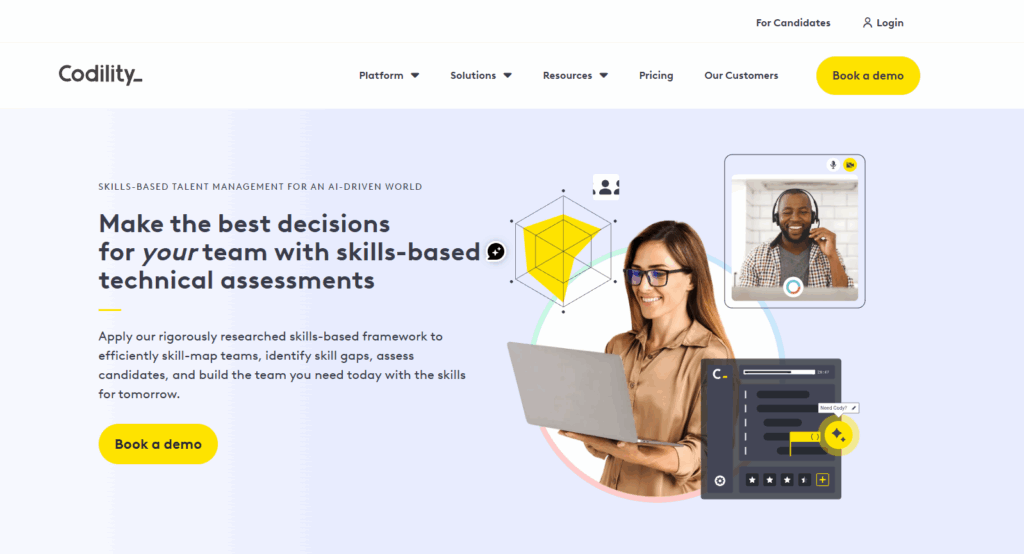
Codility is an engineering assessment platform, full stop. If your open roles are all developers, it fills the coding gap in Pixonality's catalog. If they are not, most of what you pay for goes unused.
Key features
- Coding tasks with automated scoring, plus live collaborative technical interviews.
- Basic proctoring on Starter, premium proctoring and SSO on Custom.
- Skills Intelligence analytics on the Custom tier.
Pros
- Published entry pricing, unusual for engineering-focused vendors.
- Built for structured, repeatable technical hiring.
Cons
- No personality, cognitive or non-technical role tests.
- Starter includes 1 platform user and 120 invites a year; trials are scoped through sales rather than self-serve.
Best for
Software teams that hire engineers steadily and want a dedicated coding pipeline.
Pricing
Starter $1,200 a year (120 invite credits, 1 user), Scale $6,000 a year (300 credits, 3 users, monthly option available), Custom quote-based.
6. Mercer Mettl
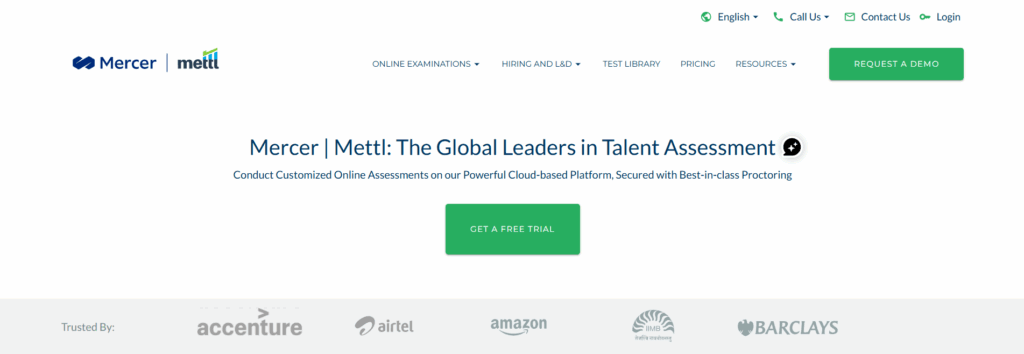
Mercer Mettl is the enterprise psychometrics-and-proctoring suite on this list, used for corporate hiring, campus drives and certification exams. It is the alternative that feels most like Pixonality's publisher rigor, at enterprise scale and with an enterprise sales motion.
Key features
- Psychometric, behavioral, cognitive and domain assessments plus coding tests.
- Proctoring options including AI monitoring and human proctors.
- Branding, custom subdomains and percentile benchmarks.
Pros
- Depth in behavioral assessment and secure high-stakes testing.
- Part of Mercer, the HR consultancy, with a large research base behind its assessments.
Cons
- Pricing is customized per organization; the pricing page publishes no figures.
- Sales-led, which slows a 30-person firm that wants to start this week.
Best for
Large organizations running high-stakes or high-volume proctored assessments.
Pricing
Quote-based ("Customised plan as per your organisation"). A free sign-up exists, but plan prices do not appear on the site.
7. iMocha
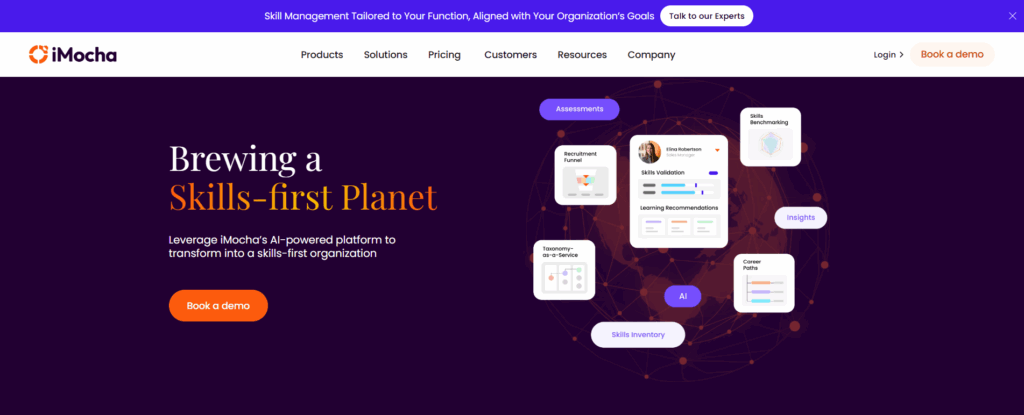
iMocha sells skills intelligence to enterprises: a very large skills library, assessments and an AI layer that maps a workforce's skills for hiring and upskilling. Customers named on its site include Capgemini and Deloitte, which tells you the target buyer.
Key features
- A skills library the vendor describes as 10,000+ real-world evaluations.
- Custom test builder and AI-assisted interviews.
- Skills-gap analytics for learning and development as well as hiring.
Pros
- Breadth across niche domains such as SAP, cybersecurity and financial services.
- One platform for hiring and internal upskilling.
Cons
- No public pricing; the path is a personalized demo.
- Enterprise-first packaging for a buyer that may only need 100 credits.
Best for
Enterprises with a learning-and-development mandate as well as hiring volume.
Pricing
Quote-based. The pricing page routes to "Book a Demo" and lists no plans or figures.
8. HireVue
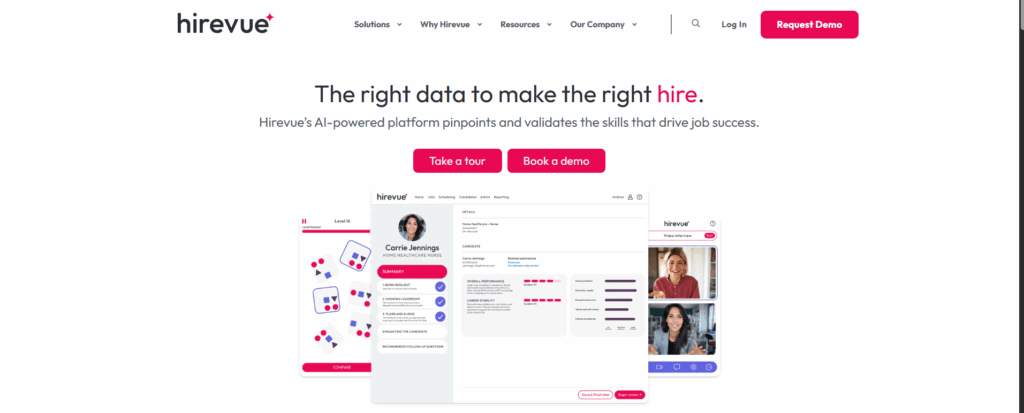
HireVue is a video interviewing and assessment platform for high-volume enterprise hiring. It solves a different problem from Pixonality: moving thousands of applicants through structured video interviews and game-based assessments, not buying a Hogan report for a VP finalist.
Key features
- On-demand and live video interviews with structured scoring.
- Game-based and AI-driven assessments and a validated interview content library.
- Scheduling automation, candidate chatbots and ATS integration.
Pros
- Proven at very high applicant volumes.
- Interviewing, scheduling and assessment in one enterprise contract.
Cons
- Two packages (Essential and Premium) with no published prices.
- Sized for enterprise budgets and procurement cycles.
Best for
Retail, hospitality and call-center employers screening thousands of applicants a quarter.
Pricing
Quote-based. The pricing page describes Essential and Premium packages and asks you to request a demo.
9. TestDome
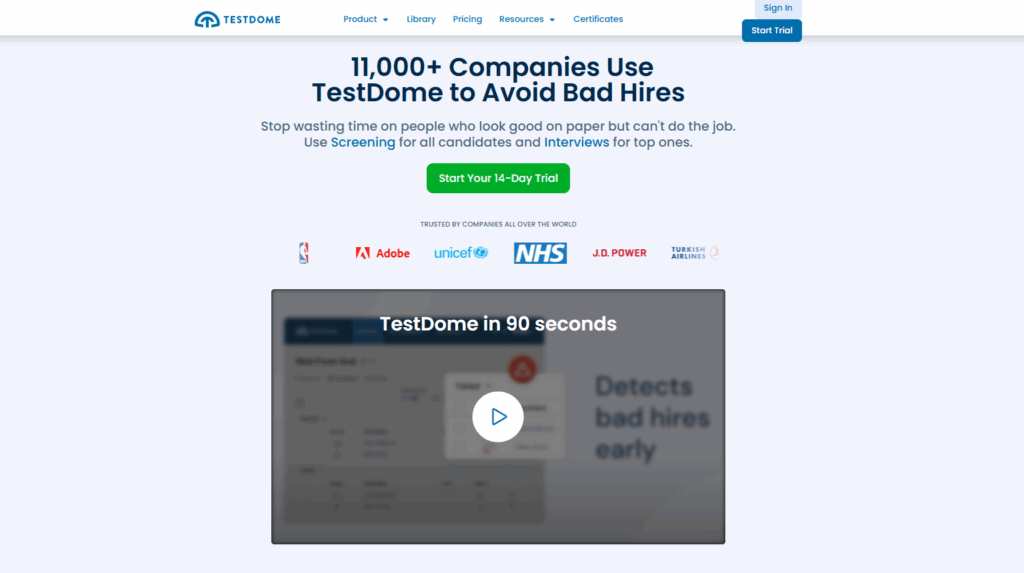
TestDome keeps the one thing Pixonality buyers like, paying per candidate with no subscription, and applies it to work-sample skills tests instead of publisher psychometrics. You buy a pack, invite people, and the pack never expires.
Key features
- 2,000+ questions and pre-made tests for 130+ skills, with 30+ coding languages and frameworks.
- Work-sample style questions across software, accounting, customer service and data entry.
- Custom questions mixed with the library.
Pros
- Transparent per-candidate pricing from $7 to $20, packs that never expire, and refunds on invites not used within 6 days.
- No annual commitment.
Cons
- Light on personality and culture assessment compared with a psychometrics catalog.
- Per-candidate pricing still scales with volume, just more gently than CAD $89 a report.
Best for
Teams with lumpy, unpredictable hiring who refuse to pay a subscription in quiet months.
Pricing
Starter $20 per candidate (5 for $100), Small $16 (25 for $400), Medium $10 (100 for $1,000), Large $8 (300 for $2,400), Extra Large $7 (600 for $4,200).
10. Coderbyte
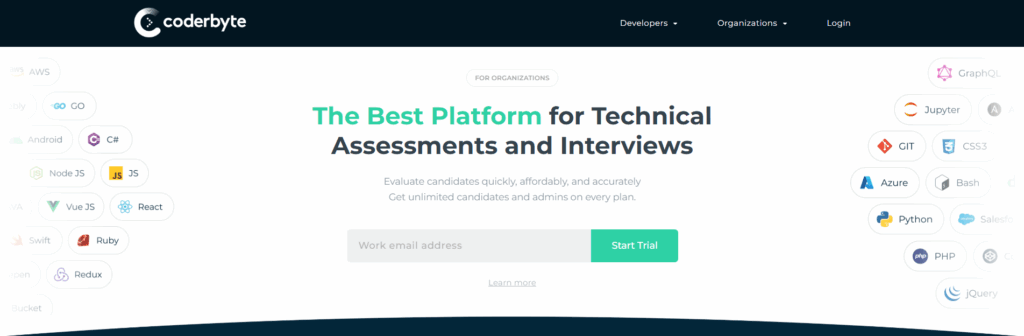
Coderbyte is a developer assessment platform aimed at startups and mid-size companies, with pricing that starts low and a Pro plan that removes candidate limits. It is coding-first, with personality testing sold as an add-on.
Key features
- Coding challenges, take-home projects, multiple-choice and SQL questions.
- Live coding interviews with a shared editor, spreadsheets and a whiteboard.
- Cheating detection and 200 video responses on Pro.
Pros
- $99 a month for 20 invites, with unused invites rolling over.
- Pro annual at $1,799 with unlimited candidates and admins.
Cons
- ATS integrations ($1,499 a year), SSO ($1,499) and personality testing ($1,199) are separate add-ons.
- Not built for non-technical roles.
Best for
Small engineering teams that want unlimited coding assessments without an enterprise contract.
Pricing
Monthly $99 for 20 invites ($20 per extra invite). Pay as you go $500 per 50 invites, valid 365 days. Pro annual $1,799. Enterprise from $12,495 a year. 14-day free trial.
11. HireMojo
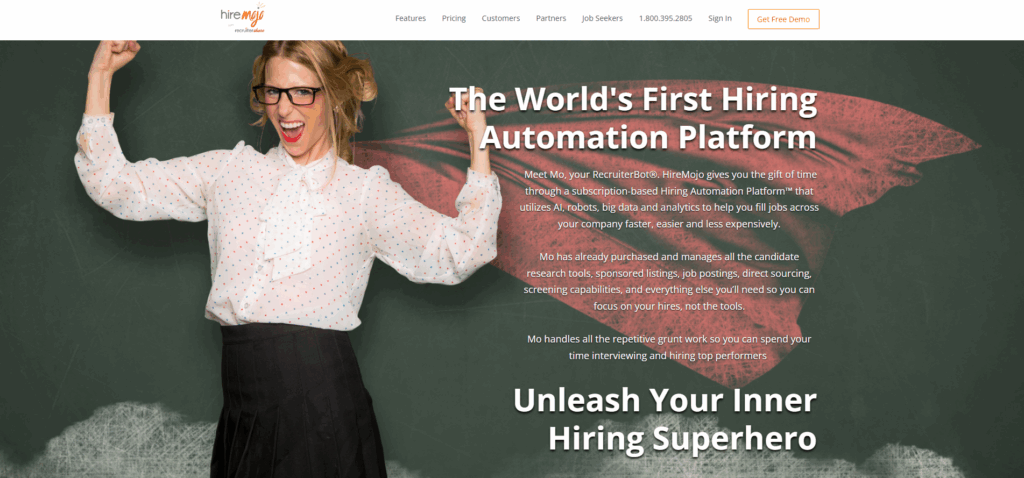
HireMojo is recruiting automation, not an assessment library. It posts jobs across LinkedIn, Indeed, Glassdoor and other boards, screens applicants with a scored questionnaire and tracks them in one dashboard. It belongs on this list because some Pixonality searchers are really shopping for the whole hiring workflow.
Key features
- Multi-channel job distribution and a database the vendor describes as 4 million pre-sourced candidates.
- "Mo," an AI screening assistant that scores and ranks applicants.
- Applicant tracking, resume screening and source analytics.
Pros
- Covers sourcing and screening in one place.
- Good fit for teams without a recruiter or a tracking system.
Cons
- Screening questionnaires are not validated skills or personality assessments.
- Pricing is not shown on the site; you book a demo.
Best for
Owner-operators who need applicants first and assessments second.
Pricing
Not published. The site offers a free demo.
12. HackerRank
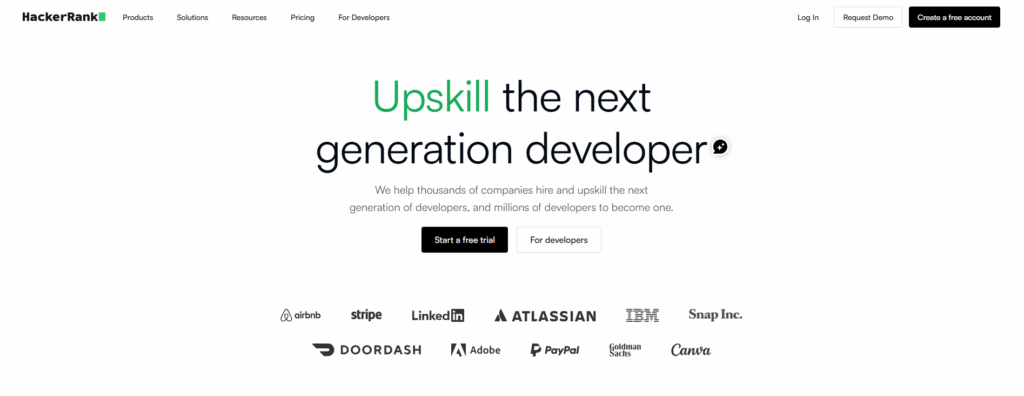
HackerRank is the veteran developer-screening platform: coding tests, live pair-programming interviews and take-home projects, with plagiarism detection and IP tracking. Like Codility, it fills Pixonality's coding gap and nothing else.
Key features
- Coding assessments across dozens of languages, from algorithms to debugging and domain problems.
- Live interview environment and take-home projects in one workflow.
- Plagiarism detection, IP tracking and time-violation alerts.
Pros
- Deep technical content and a candidate experience developers already know.
- Integrates with major ATS platforms.
Cons
- No personality, cognitive or non-technical assessments.
- Priced for engineering organizations; overkill for one developer hire a year.
Best for
Companies hiring developers continuously who want the platform candidates already recognize.
Pricing
Tiered plans are listed on HackerRank's pricing page. Our checker could not load that page in September 2026, so confirm current figures directly rather than trusting a third-party summary.
13. TestInvite
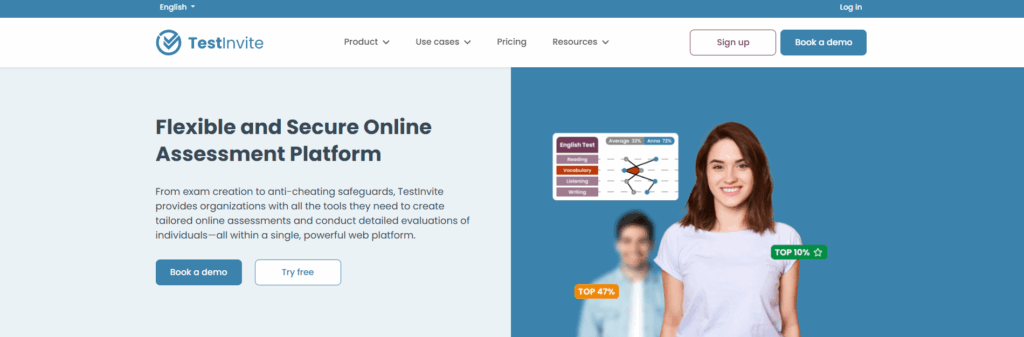
TestInvite is exam software you build yourself: a flexible test builder, many question types, lockdown and AI-driven cheating detection, and scoring you can reshape after the fact. It is the choice when your assessment is proprietary and you just need a secure place to run it.
Key features
- Custom test creation with configurable scoring logic, norms and score categories.
- Template library for common skills alongside your own tests.
- Lockdown browser, randomization and AI cheating detection.
Pros
- Free sign-up with 100 testing credits and no card.
- Every standard plan includes 500 credits a year; extra credits run from $0.90 down to $0.20 at volume.
Cons
- You do the authoring. There is no large validated psychometric library to lean on.
- Starter caps you at 250 questions, 5 tests and 1 teammate.
Best for
Training providers, certifiers and employers with an in-house test they need to deliver securely.
Pricing
Starter $900 a year, Essential $1,900, Advanced $2,900, Pro $3,900, Premium $6,000, Premium+ $35,000; Enterprise is custom.
14. eSkill
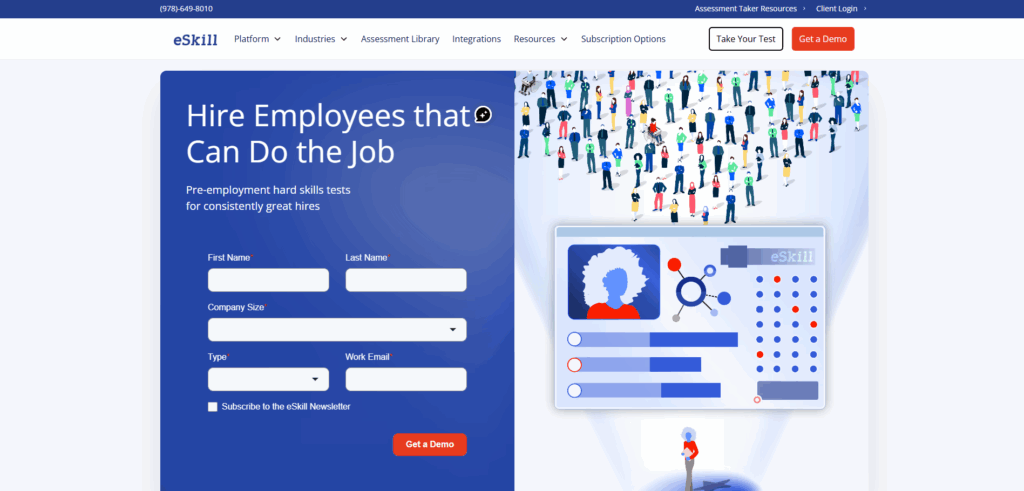
eSkill is a long-running pre-employment testing platform with a very large question bank and a custom-test builder that lets you assemble a test subject by subject. It covers hard skills, soft skills, cognitive aptitude, behavioral and personality assessments.
Key features
- 600+ subjects and about 70,000 questions to draw from.
- Interactive job simulations alongside standard questions.
- Behavior monitoring for copy-paste and tab switching.
Pros
- Unusual depth for building a role-specific test from existing items.
- Personality and behavioral coverage, unlike the coding-only tools.
Cons
- Quote-based pricing with no self-serve trial; the path is "Talk to sales."
- No published entry price, which makes it hard for a small team to budget.
Best for
Mid-size employers that want a highly customized test bank and are fine with a sales process.
Pricing
Quote-based. No prices are published; demos are booked through sales.
15. Canditech
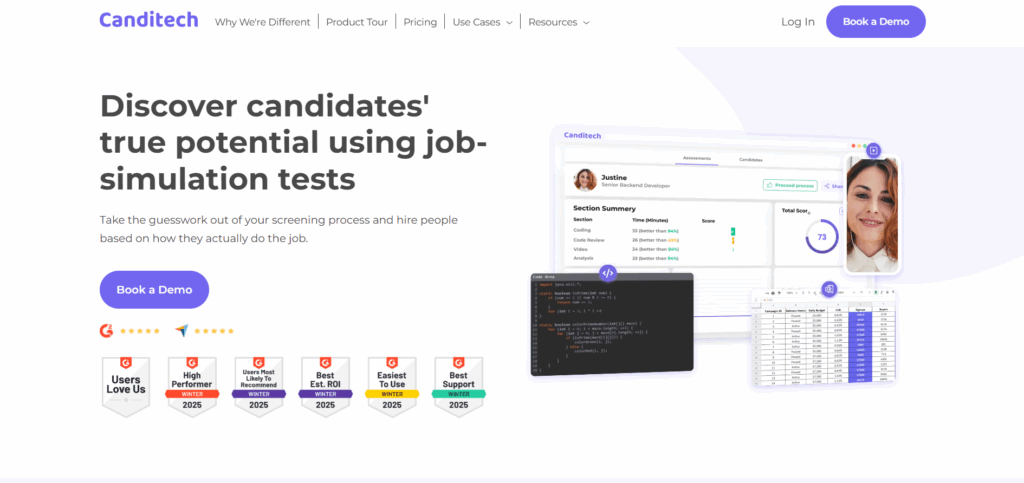
Canditech specializes in job simulations: write the code, fix the spreadsheet, draft the reply, handle the scenario. Scoring is automatic and the same rubric applies to everyone, which is the fairness argument for work samples in one sentence.
Key features
- Simulation-style assessments plus a library of expert-built tests.
- Automatic scoring and ranking against a shared rubric.
- Four tiers: Individual (1 assessment, 3 users), Team (2 assessments, 8 users), Pro and Enterprise (unlimited).
Pros
- Start free with no card.
- Strong realistic tasks for ops, finance and support roles.
Cons
- The lower tiers cap the number of active assessments, not just candidates.
- The pricing page we loaded lists features by tier but no dollar amounts.
Best for
Small teams hiring for one or two roles at a time who want work samples over questionnaires.
Pricing
Individual, Team, Pro and Enterprise tiers. Prices were not displayed on the pricing page in September 2026; start free and request figures.
Pro Tip: Before you switch, list the last 12 assessments you actually bought from Pixonality and what each decision was for. If more than half were leadership development or coaching reports, keep a small Pixonality budget for those and move hiring to a subscription platform. If they were all hiring screens, you can move the whole spend.
Which Pixonality alternative is best for your team?
Pick by hiring pattern, not by feature count. Three patterns cover most readers of this page.
You hire across roles at a company under 200 people. Take an all-in-one platform with published pricing: Testlify first, TestGorilla if you want a free tier to start. Picture a 60-person marketing agency in Toronto that hires 8 account managers, 4 designers and 2 analysts a year and screens about 25 applicants per role (an illustrative case, not a customer). That is roughly 350 assessments. On Pixonality at CAD $89 per Watson-Glaser that is about CAD $31,000 before any personality report. On Testlify's Basic plan it is $3,348 a year for 300 credits plus 50 extra credits at $14, about $4,050, and each invite can bundle a cognitive test, a role skills test and a short personality inventory.
You hire developers, mostly. Codility, HackerRank or Coderbyte will out-test any generalist on code, and Coderbyte is the cheapest way in. Add a cognitive or personality test from a generalist only if the hiring manager will actually use it.
You run leadership assessment or coaching. Stay on Pixonality, or go direct to a publisher. None of the tools above sells a Hogan report, and a board that asked for one will not accept a substitute.
Whatever you pick, the adoption data says testing is not a fad. In SHRM's 2022 survey of 1,688 members, 56% of employers used pre-employment assessments and 78% of HR professionals using them said quality of hire had improved (SHRM, 2022). The teams pulling ahead test more candidates earlier, which is exactly what per-report pricing discourages.
More evidence sits in our skills-based hiring statistics and in how psychometric tests predict job performance.
See Testlify on your own roles
The fastest way to compare is to run one real role through both. Take the last assessment you bought from Pixonality, build the same screen in Testlify from the test library during the 7-day free trial, and send both to the same three shortlisted candidates. If you already run an ATS, check the integrations list first. Or book a demo and we will build the assessment with you. Our Testlify vs Pixonality comparison has the feature-by-feature detail.
Key Takeaways
- Pixonality is a marketplace, not a platform. It resells about 130 publisher assessments at CAD $28 to $2,250 each. That is the right buy for occasional leadership reports and the wrong one for screening at volume.
- Per-report pricing is the hidden decision. At 350 assessments a year the same screen costs about CAD $31,000 on Pixonality and about $4,050 on a Testlify Basic plan. Run your own volume through both before you compare features.
- Work samples and structured interviews predict better than personality alone. The 2022 Sackett re-analysis puts structured interviews at .42 and work samples at .33 against .31 for cognitive ability, so choose a tool that can collect several signals.
- Published pricing separates the small-team tools from the enterprise ones. Testlify, TestGorilla, Adaface, TestDome, Coderbyte, Codility and TestInvite publish prices. Mettl, iMocha, HireVue, Vervoe, eSkill and HireMojo do not.
- Coding-only platforms are not general alternatives. Codility, HackerRank and Coderbyte fix Pixonality's coding gap and nothing else. Pair them with a generalist or pick a generalist that includes coding.
- Keep a human on the decision. Whatever the AI score, the flag or the percentile says, a person should make the call, and the better platforms make that a setting rather than a promise.
FAQs

Director of Marketing
Akash Patange is the Director of Marketing at Testlify, where he works closely with HR leaders and recruiters to help organizations improve hiring outcomes. He writes about talent assessment, recruitment technology, and data-driven hiring practices.
LinkedInRelated resources
View all
Alternatives
Top 15 Perspect AI Alternatives and Competitors
Alternatives
Top 15 Evalgator Alternatives and Competitors
Alternatives
Top 15 Peoplogica Skills Alternatives and Competitors
Alternatives
Predictive Index alternatives: 10 tools to compare in 2026
Alternatives
Top 15 Sova Alternatives and Competitors
Alternatives
Top 15 Glider AI Alternatives and Competitors
Get started.
Hire on proof, not resumes.
Run your first skills-based assessment free — no credit card required.