
Top 15 Evalgator Alternatives and Competitors
Discover 15 powerful Evalgator alternatives to streamline your hiring process and assess candidates with confidence.
Evalgator is an all-in-one digital assessment platform designed to help companies streamline their screening process with comprehensive technical and non-technical tests. This AI-powered platform enables hiring teams to create customized, branded assessments and conduct coding interviews, helping them make the right hiring decisions.
However, the platform may not be the best fit for every team. If you’re looking for a platform with stronger candidate experience, conversational AI interviews, more flexible pricing, or advanced anti-cheating features, there are several strong alternatives to consider.
In this blog, we review the top 15 Evalgator alternatives, comparing their features, G2 ratings, and pricing to help you find the solution that best aligns with your team’s workflow, tech stack, and hiring goals.
 ChatGPT
 Gemini
 Claude
 Grok
Grok Perplexity
Testlify
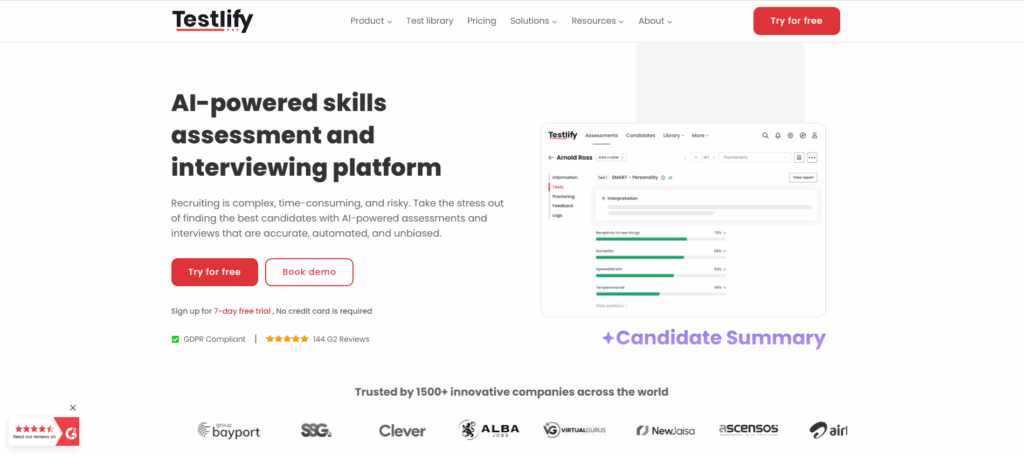
Testlify is an AI-native skills assessment and interviewing platform designed to help companies hire top talent quickly, accurately, and affordably by evaluating candidates based on real-world skills rather than just resumes.
The platform features a library of 3,500+ validated tests covering technical, cognitive, and soft skills, alongside AI-powered conversational interviews (chat, audio, and video) and 20+ advanced proctoring features to ensure assessment integrity
Features
- Extensive test library: Gain access to over 3,500 ready-made tests across 50+ industries, allowing for a diverse evaluation of skills across 4,500+ job roles.
- Conversational AI interviews: Create immersive job simulations using AI-powered chat, voice, or video interactions. These realistic simulations mimic recruiter-style conversations, naturally assess job-specific skills, and are perfect for high-volume hiring needs.
- AI insights: Automatically generate clear and concise performance summaries, spotlighting candidates’ strengths and identifying areas for improvement.
- 100+ ATS integrations: Effortlessly integrates with 100+ applicant tracking systems, including Greenhouse, Lever, and Workable.
- Anti-Cheating & proctoring measures: Safeguards the integrity of your assessments with advanced security features like dual webcam monitoring, randomized question banks, AI assistance detection, and a secure lockdown browser.
G2 Rating: 4.7
Testlify pricing
Testlify offers flexible pricing plans that scale with your business, providing everything from basic assessments for startups to advanced features for enterprise-level hiring.
- Starter plan: Ideal for small teams and startups, this plan starts at $139/month (billed at $1,663/year) and includes 100 candidate credits at $17 per credit with support for 3 users.
- Basic plan: Designed for growing businesses, the Starter starts at $279/month (billed at $3,343/year) and includes 300 credits at $11 per credit with support for 5 users.
- Business plan: Built for scaling teams, this plan costs $699/month (billed at $4,192/year) and includes 1,000 credits at $8 per credit with 10 users.
- Premium plan: Suited for high-growth organizations, the Premium plan includes 3,000 credits and supports 20 users, with pricing available upon contacting the sales team.
- Enterprise plan: Designed for large enterprises, this plan includes 10,000 credits and supports 30 users, with pricing available upon contacting the sales team.
- Enterprise plus plan: Designed for large-scale hiring programs, this plan includes 25,000 credits and supports up to 40 users, with pricing details available upon contacting the sales team.
- Unlimited plan: For companies seeking unrestricted access, Testlify offers an unlimited plan that includes unlimited candidate credits and full platform functionality, with pricing available on request from the sales team.

HackerRank
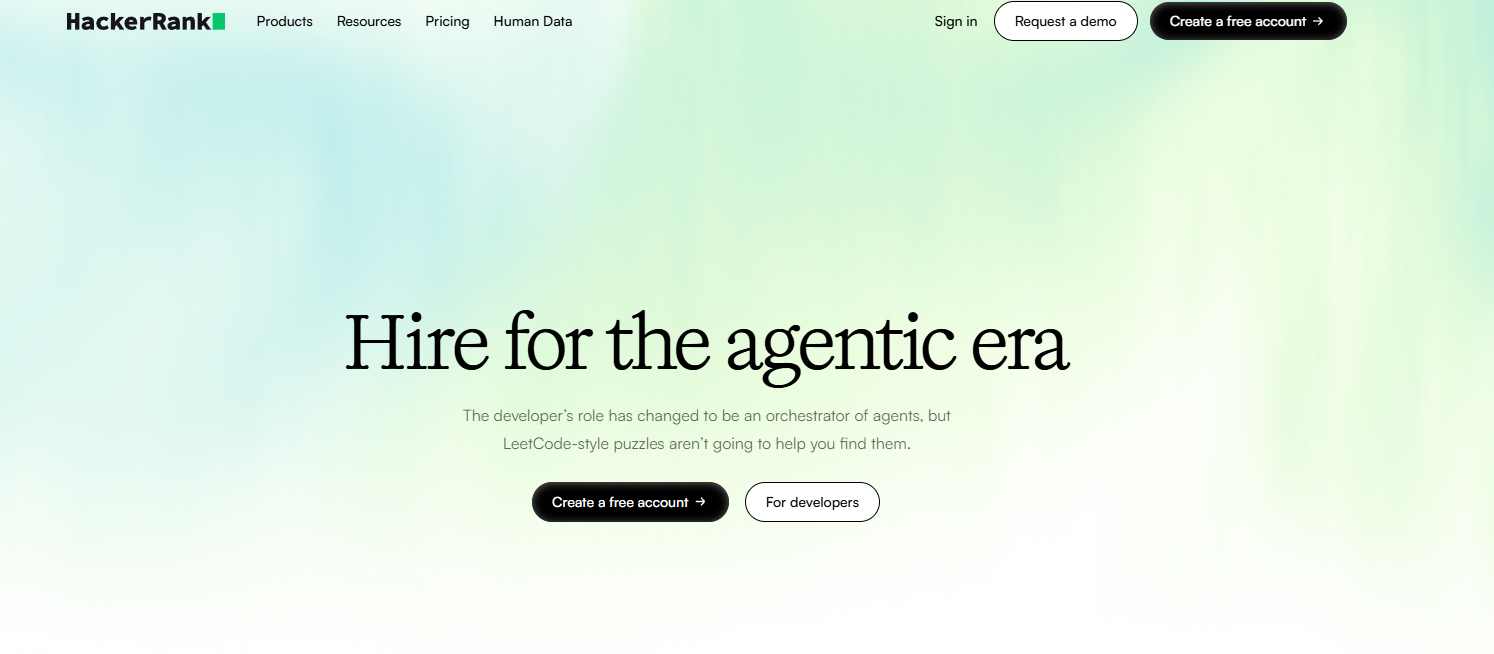
HackerRank is a technology hiring platform and developer skills assessment service to objectively evaluate candidates' coding proficiency, problem-solving abilities, and technical knowledge.
Features
- Question library: More than 7,000 questions across 50+ programming languages and 180 technical skills, plus certified role-based assessments you can launch without building a test from scratch.
- Plagiarism and AI-use detection: Proprietary models trained on HackerRank data flag copied or AI-generated code, alongside face detection, tab-switch alerts, multi-monitor detection and full session replay.
- AI-assisted IDE and AI interviewer: You can switch on an in-editor AI assistant for candidates so the test measures how they direct a tool rather than how much syntax they memorised, and an AI interviewer runs coding rounds without a human on the call. Both sit in a paid AI add-on.
- Live interviews and integrations: Collaborative coding interviews with auto-filled scorecards and a shared timeline, plus integrations with the major applicant tracking systems.
G2 rating: 4.6/5
Pricing: Three tiers of pricing plans available: Starter from $79 per month and Pro from $419 per month, both billed annually Enterprise plan is custom and requires interested customers to directly reach out to the sales team.
HackerEarth
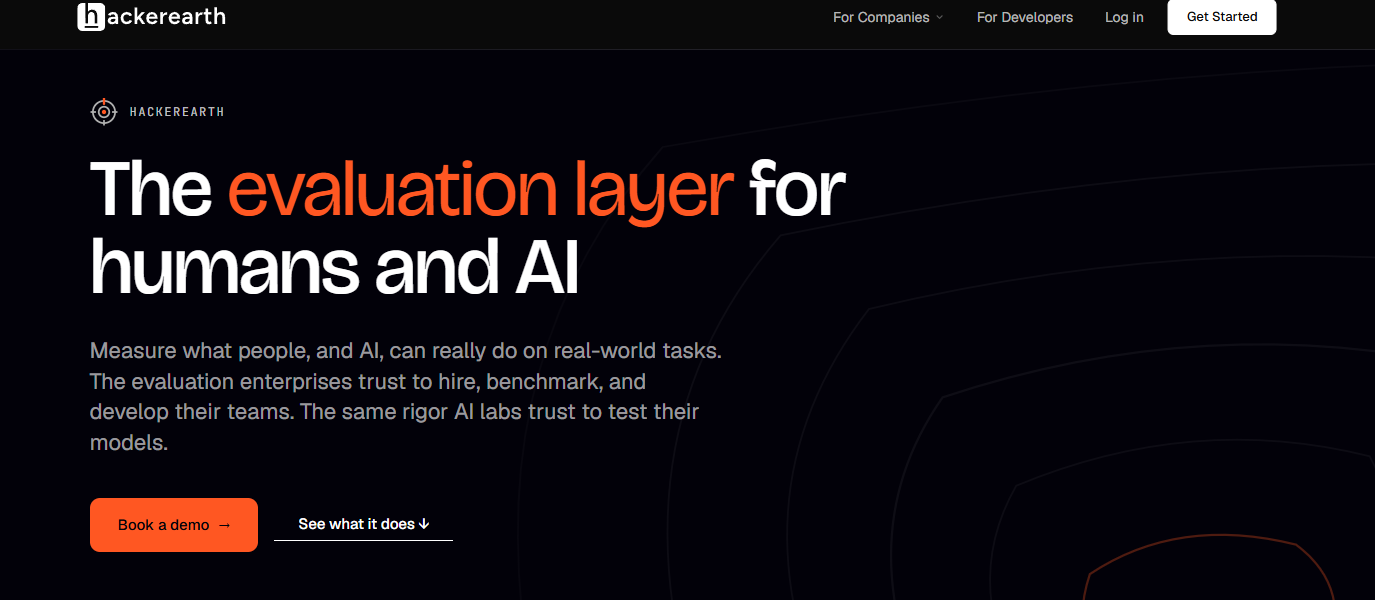
HackerEarth is a technical hiring platform that enables recruiters to run proctored coding assessments, campus drives, and hiring hackathons at volume.
Features
- Assessment library: Questions across 1,000+ skills and 40+ programming languages, with role-specific tests for areas such as DevOps, QA automation, and embedded systems rather than algorithm puzzles alone.
- Proctoring: Tab-switch reporting, periodic candidate snapshots, copy-paste blocking and a smart browser desktop app for locked-down sessions, with stringency you set per test. HackerEarth positions its proctoring as detecting AI-assistant use, not only tab switches.
- FaceCode and AI interview agent: Live collaborative coding interviews with recording, code playback and automated summaries, plus an AI interview agent that runs adaptive technical screens before a human round.
- Campus and hackathon hiring: Hosted hiring challenges and university drives sit in the same platform, which overlaps directly with the campus recruiting evaluator sells into.
G2 rating: 4.5/5
Pricing: a growth plan from $99 per month billed monthly, covering 10 test invites a month, with two months free on annual billing. Enterprise is custom and adds question pooling, API access, SSO, and professional services. Free trial available.
Vervoe
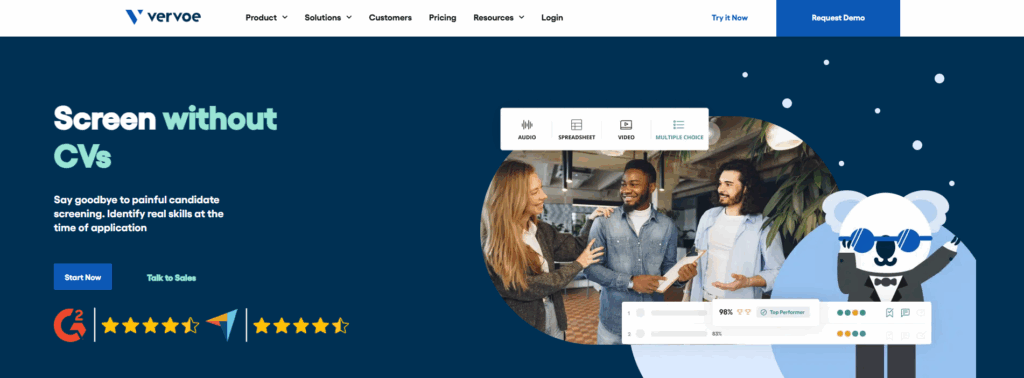
Vervoe is a platform that redefines hiring by focusing on merit rather than resumes. It enables employers to assess candidates by observing their performance on job-related tasks, with AI automatically grading and ranking responses.
Covering both technical and soft skills, Vervoe emphasizes practical, real-world exercises, allowing candidates to demonstrate their true capabilities and ensuring a more accurate assessment of their potential..
Features
- Job simulations: Access 300+ pre-built tests designed to evaluate candidates’ ability to perform on-the-job tasks across a variety of roles, including customer support, sales, marketing, technology, and operations.
- Multi-format testing: Choose from a wide range of assessment formats, including text, video, file uploads, spreadsheets, and more, to assess candidates across different performance dimensions.
- AI grading: Automatically score and rank candidates based on accuracy, effort, and relevance using sophisticated AI-driven models, ensuring unbiased and efficient evaluations.
- Team review & collaboration: Enable multiple team members to review responses, provide feedback, and collaborate on hiring decisions, all through a centralized, unified dashboard.
G2 Rating: 4.6/5
Pricing: Follows a pay-as-you-go model that can be ideal for organizations that have even hiring cycles or want to finely control costs. The entry plan starts at $300 per year for 10 candidates, with pricing increasing as more candidates are added.”
Codility
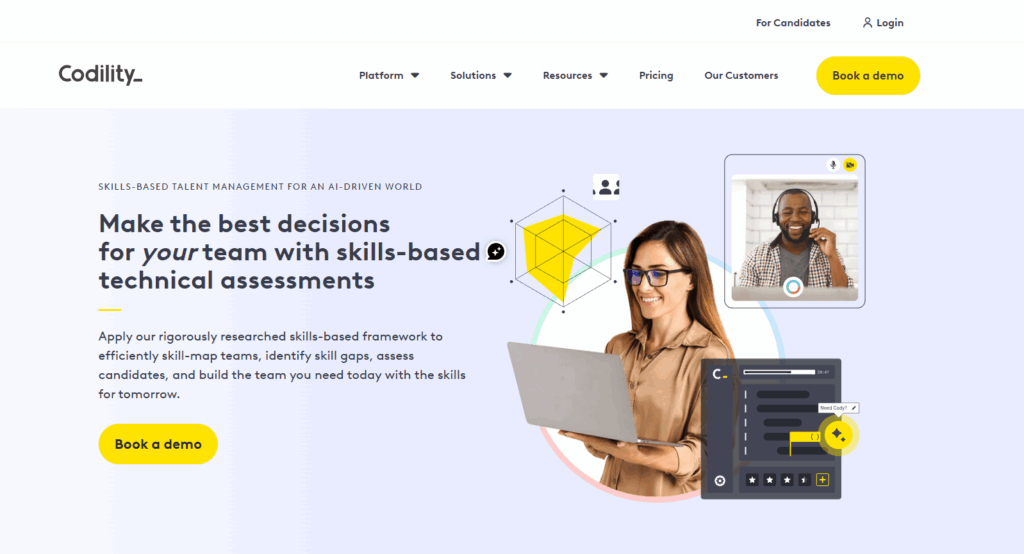
Codility is a coding assessment platform built for large-scale engineering recruitment, allowing teams to evaluate candidates through real-world coding challenges and collaborative technical interviews.
Features
- Comprehensive coding test bank: Access a vast collection of over 1,100 coding challenges across 45+ programming languages, ranging from basic algorithms to complex system design, providing a thorough assessment of a candidate’s coding skills.
- Live interviews: Conduct live collaborative coding interviews within Codility’s IDE, featuring syntax highlighting, a built-in compiler, and a test runner for a seamless interview experience.
- Automated scoring: Automatically evaluate code submissions for logic, correctness, efficiency, and readability, generating detailed reports without the need for manual code reviews.
- Reporting & analytics: Receive in-depth candidate reports with task breakdowns, test case results, and code quality scores, helping recruiters make informed hiring decisions.
G2 Rating: 4.6/5
Pricing: Codility offers three structured pricing tiers: the Starter plan at $1,200 per year, the Scale plan at $6,000 per year, and a custom plan for large enterprises
Mercer Mettl
Mercer | Mettl is a comprehensive assessment platform backed by Mercer, specializing in behavioral and psychometric evaluations. Known for its research-based assessments and secure proctoring, it is widely used in corporate hiring, campus recruitment, and professional certification.
Features
- Comprehensive test coverage: Access 200+ job-specific assessments across technical, cognitive, behavioral, and psychometric domains. All tests are research-based and fully customizable.
- Enterprise-grade proctoring: Maintain integrity with AI-powered face recognition, browser lockdown, and live human invigilation.
- Brand personalization: Deliver a consistent candidate experience by customizing assessments with your branding, logos, and a dedicated test domain URL.
- Reporting & analytics: Gain detailed insights with competency-based scoring, percentile comparisons, and hiring recommendations aligned with organizational frameworks.
G2 Rating: 4.4/5
Pricing: Mercer Mettl’s pricing is customized. Organizations need to contact Mettl for a quote, as costs depend on the number of tests, candidates, and features.
iMocha
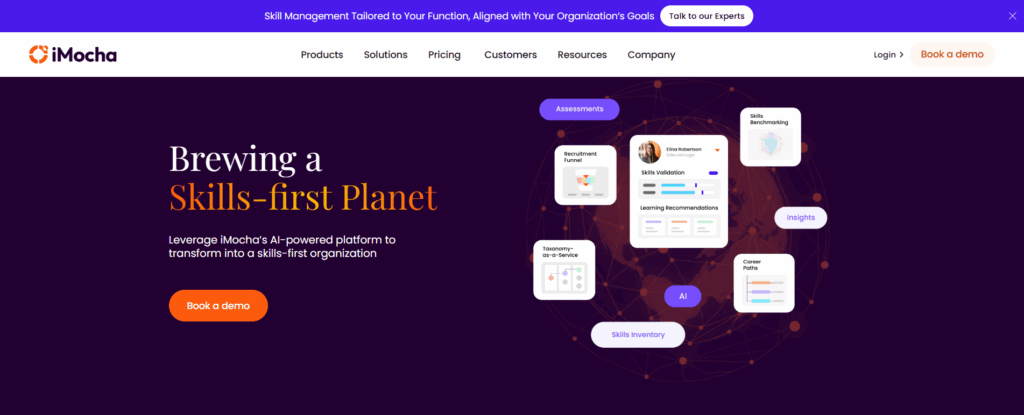
iMocha is an AI-powered skills assessment platform tailored for pre-employment testing and workforce upskilling. Boasting one of the industry’s largest skills databases, along with its advanced Skills Intelligence features, iMocha enables companies to evaluate candidates across a broad spectrum of skills, including coding, IT, finance, languages, and more.
Features
- Extensive test library: Access over 3,000 ready-to-use assessments and 30,000+ skills mapped to real job roles, including specialized areas such as SAP, cybersecurity, and financial services.
- Custom test builder: Enable HR teams to create tailored assessments by combining existing questions or designing new ones, with customizable scoring logic to meet specific requirements.
- AI Interviewer “Tara”: A virtual AI-powered interviewer that conducts real-time conversational assessments. Tara engages candidates through natural, chat-based dialogues and adaptive questioning, offering a more personalized experience compared to traditional tests.
- Reporting & analytics: Obtain detailed insights into candidate performance across domains and skill groups, helping organizations make informed, data-driven hiring decisions.
G2 Rating: 4.4/5
Pricing: 14-day free trial available. Plans start at $999/year (Starter) and scale up for larger teams.
Maki People
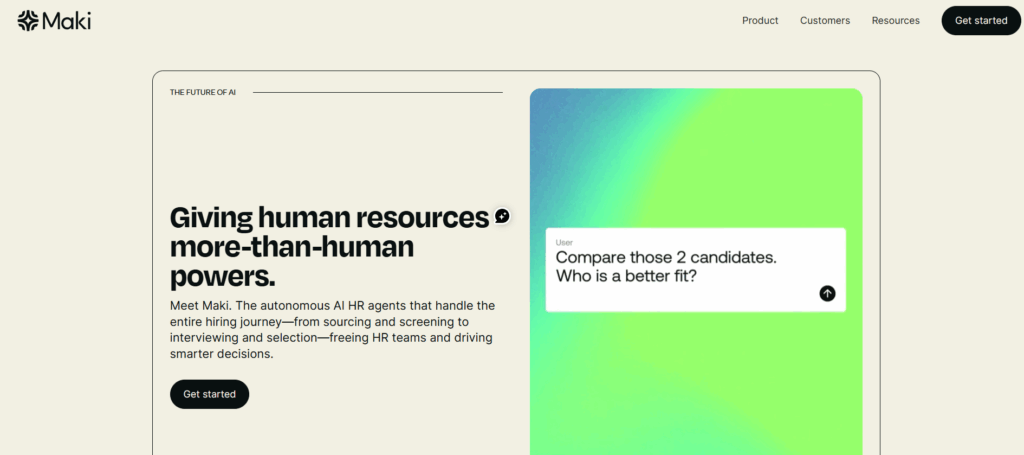
Maki People is a next-generation talent assessment platform dedicated to bias-free skills evaluation and an exceptional candidate experience. Offering over 200+ ready-made tests across diverse skills and roles, Maki’s “playing by the facts” philosophy ensures fair, objective hiring.
Features
- AI HR agents (autonomous workflows): Build fully customizable AI hiring agents that integrate with your branding, tone, and hiring objectives to manage candidate sourcing, screening, interviewing, and selection autonomously.
- Bias-free skills assessment: Evaluate over 300 skills including cognitive abilities, soft skills, power skills, language proficiency, and technical expertise using fine-tuned LLMs grounded in psychometrics for real-time accuracy and fairness.
- ATS and HR system integrations: Seamlessly integrate with more than 30 ATS and HR systems such as Workday, SAP, SmartRecruiters, Phenom, and Eightfold.
G2 Rating: 4.7/5
Pricing: Maki People does not disclose its pricing on its website. Recruiters and employers must contact the sales team directly to discuss requirements and obtain a custom quote, which may vary based on factors such as assessment type, scale of hiring, and additional services.
TestDome
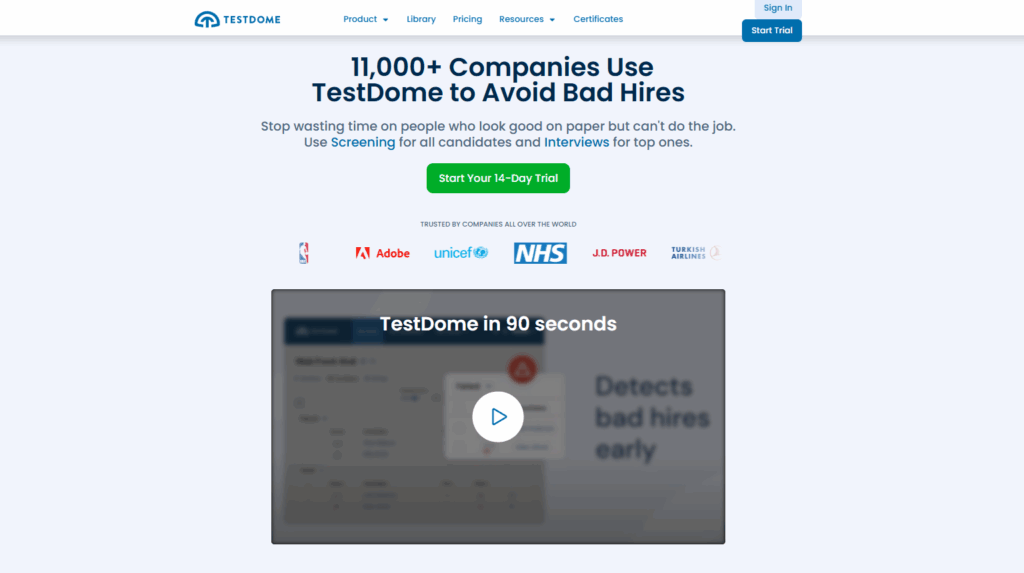
TestDome is a skills testing platform that specializes in work-sample assessments. Unlike traditional trivia or theoretical quizzes, TestDome provides over 150 pre-made tests that simulate on-the-job tasks. These tests span various domains, including programming, IT, accounting, and customer service, enabling employers to assess how candidates will perform in the actual role.
Features
- Work-sample testing: Evaluate candidates with realistic tasks that closely mirror actual job responsibilities.
- Library of 150+ pre-built tests: Cover roles in software development, accounting, customer service, data entry, and more. Tests are short, effective, and designed to quickly filter out unqualified applicants.
- Custom question creation: Build your own tasks or combine them with TestDome’s library. Assess specific coding languages, logical reasoning, writing ability, or numerical skills.
- Benchmarking and analytics: Compare candidate performance with visual scorecards, percentile rankings, and clear pass/fail indicators.
G2 Rating: 4.5/5
Pricing: Coderbyte pricing is subscription-based. Plans start at around $199/month, which allows unlimited candidates and tests. (Discounted annual plans are available for organizations that prefer yearly billing.)
Coderbyte
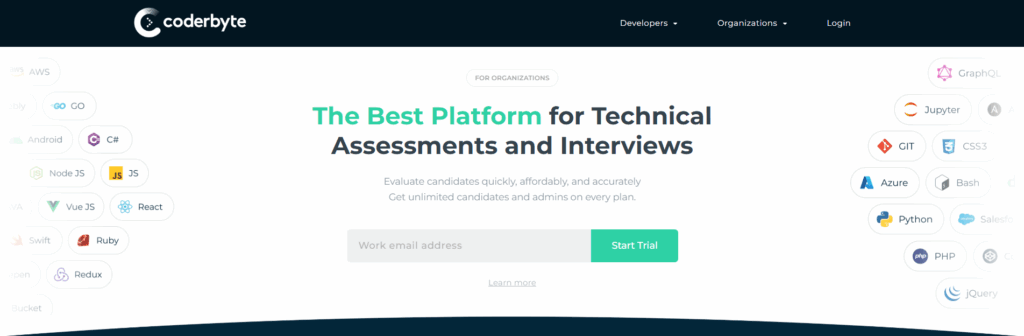
Coderbyte is a technical assessment platform tailored for startups and mid-sized companies hiring developers and data scientists. It offers unlimited coding tests, challenges, and take-home projects on a subscription model, making it a flexible solution for growing teams.
Features
- Extensive coding challenges: Offers a library of 1,000+ coding challenges across 30+ programming languages and over 100 different technical skills. You can also include full project-based exercises to thoroughly vet candidates.
- Multiple question types: Supports various question formats including not only coding tasks, but also multiple-choice questions, open-ended written responses, and SQL/database queries for comprehensive technical screening.
- Integrated interview tools: Provides a built-in platform for live technical interviews with features like video conferencing, a collaborative real-time code editor, support for Jupyter notebooks and spreadsheets, and a virtual whiteboard for system design or diagramming.
- Detailed reporting: Generates in-depth reports for each assessment and interview, including the candidate’s code submissions, replayable coding session recordings, automated scorecards, skill ratings, and internal benchmarking charts to compare candidates.
G2 Rating: 4.4/5
Pricing: Coderbyte pricing is subscription-based, at approximately $199/month for unlimited candidates and tests. (Discounted annual plans are available for organizations that prefer yearly billing.)
The Talent Games
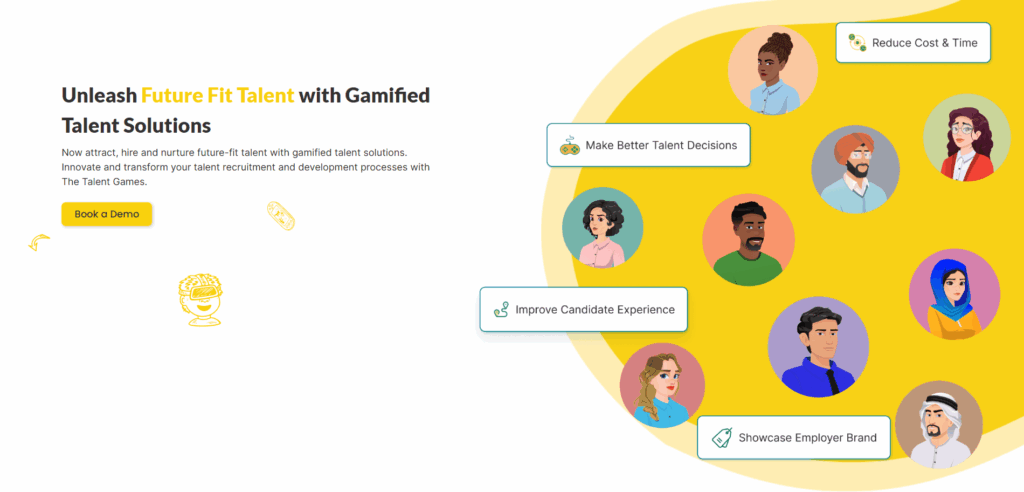
The Talent Games is a dynamic platform focused on gamified assessments for large-volume hiring. It provides an engaging experience with real-time feedback and competitions designed to evaluate candidates’ problem-solving skills in a competitive environment.
Features
- Gamified assessments: Engage candidates with interactive games that test key job-related skills such as decision-making, teamwork, and adaptability in a fun and dynamic way.
- Competitive challenges: Allow candidates to compete in timed scenarios, demonstrating their ability to perform under pressure and showcasing their skills in real-world conditions.
- Job simulations: Provide candidates with immersive, game-based simulations that replicate actual job tasks and challenges, offering a realistic preview of the role.
G2 Rating: 4.1/5
Pricing: The Talent Games does not disclose its pricing on its website. Recruiters and employers must contact the sales team directly to discuss requirements and obtain a custom quote, which may vary based on factors such as assessment type, scale of hiring, and additional services.
TalentMetrix
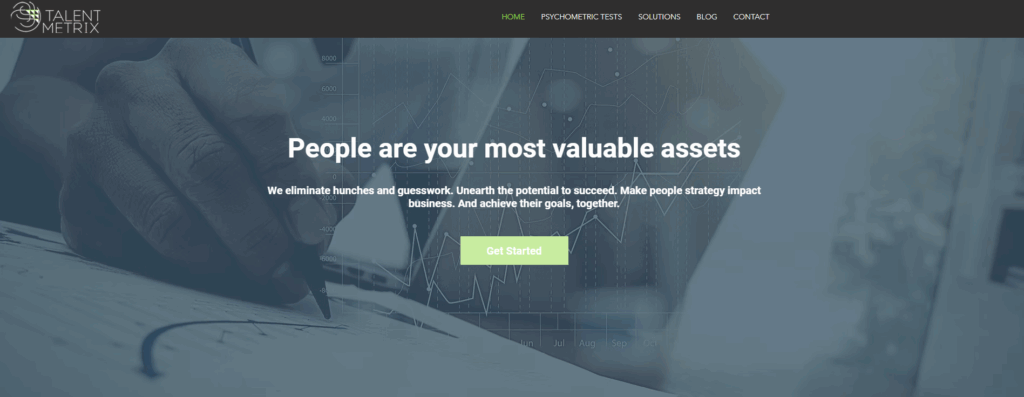
TalentMetrix specializes in providing scientifically-backed psychometric tests designed to assess hidden aspects of a candidate’s personality and behavior, which are often difficult to evaluate in traditional interviews.
Features
- Comprehensive psychometric assessments: TalentMetrix offers a diverse array of psychometric tests designed to evaluate key aspects of a candidate’s personality, cognitive abilities, emotional intelligence, and job-specific competencies.
- Deeply diagnostic reports: TalentMetrix delivers research-backed, highly diagnostic reports that combine quantitative scoring with qualitative insights, providing clear metrics alongside actionable feedback.
- User-friendly platform: The platform features an intuitive online interface for administering assessments, ensuring a seamless experience for both candidates and organizations throughout the testing process.
G2 Rating: N/A
Pricing: TalentMetrix does not disclose its pricing on its website. Recruiters and employers must contact the sales team directly to discuss requirements and obtain a custom quote, which may vary based on factors such as assessment type, scale of hiring, and additional services.
TalentLens
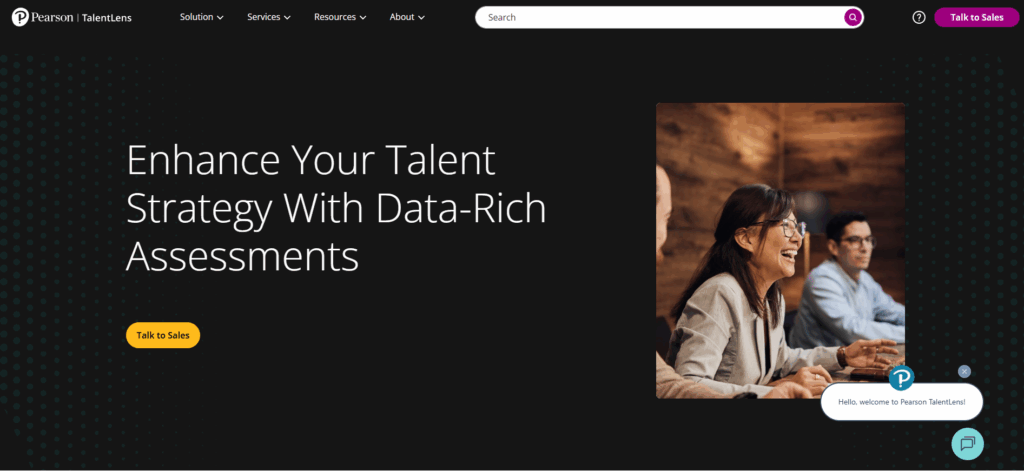
TalentLens, a division of Pearson plc, specializes in psychometric assessments and talent management solutions. Their extensive portfolio includes a wide array of tests and tools tailored to support organizations in recruitment, employee development, and engagement, helping them make informed decisions and foster a more effective workforce.
Features
- Psychometric assessments: TalentLens offers a range of psychometric tests, including cognitive ability tests, personality assessments, and motivation evaluations, to provide a holistic view of candidates.
- Motivation assessments: These tools help in understanding what drives candidates, aiding in predicting job satisfaction and long-term engagement.
- Scientific rigor: All assessments are developed according to best practice standards set out by the British Psychological Society (BPS) and European Federation of Psychological Associations (EFPA), ensuring reliability and validity.
G2 Rating: 4.6/5
Pricing: The TalentLens does not disclose its pricing on its website. Recruiters and employers must contact the sales team directly to discuss requirements and obtain a custom quote, which may vary based on factors such as assessment type, scale of hiring, and additional services.
TestInvite
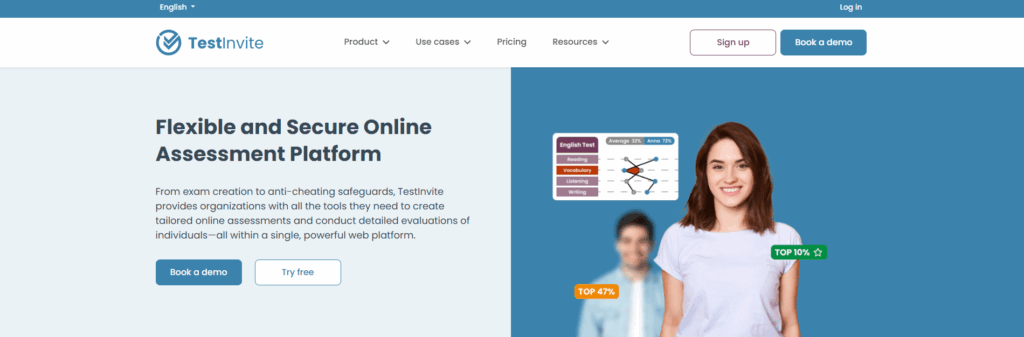
TestInvite is a versatile online exam and assessment platform that provides secure, customizable testing solutions for various use cases, including pre-employment screening, educational assessments, and professional certifications.
What sets TestInvite apart is its precise control over the testing process, enabling organizations to design fully customized questions while enforcing stringent proctoring measures. This blend of flexibility and security makes TestInvite the ideal choice for institutions and businesses with demanding assessment requirements.
Features
- Custom test creation: Create custom assessments using a variety of question types, including multiple-choice, essays, coding challenges, video responses, and more. Customize scoring logic and timing to assess the exact competencies you need
- Talent assessment library: Access a comprehensive library of pre-built tests that measure core abilities such as problem-solving, communication, and other role-specific competencies.
- Detailed reports: Leverage powerful reporting tools with full customization over scoring, metrics, benchmarks, and score categorization. Add textual interpretations for deeper insights into candidate performance.
- Anti-cheating & proctoring: Safeguard assessments with features like lockdown browser mode, AI-powered cheating detection, randomized question banks, and video or audio monitoring options.
G2 Rating: 4.7/5
Pricing: Starts at $37/month for the Starter, which includes a limited number of test attempts per month. Higher-tier plans with more features and greater usage limits are available for organizations that require more candidates or advanced functionality. Pricing can increase based on the add-ons and scale of usage.
eSkill
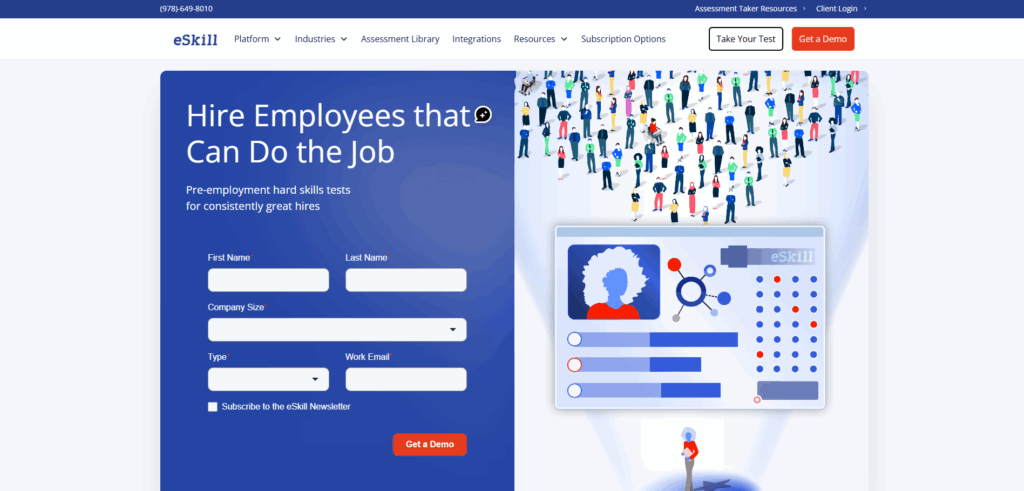
eSkill is a comprehensive pre-employment testing platform offering a broad selection of skills assessments. It provides both pre-made and customizable tests across various domains, including clerical skills, software proficiency, literacy and math, accounting, legal, call center scenarios, and more.
Features
- Extensive test library: Access over 600 ready-to-use tests, with the option to create custom assessments by selecting from thousands of questions across specific topics and software tools, tailored to the exact requirements of a job role..
- Job simulations: Go beyond traditional Q&A formats with interactive simulations that assess how candidates perform in real-world job scenarios, such as simulating customer service calls, data entry tasks, or IT troubleshooting exercises.
- Advanced proctoring: Enforce strong anti-cheating measures to ensure test integrity, including monitoring behaviors like copy-pasting, excessive tab switching, or irregular response patterns, and automatically flagging suspicious activity in real-time.
- Detailed analytics: Receive comprehensive candidate reports that provide overall scores along with performance breakdowns by subject area or question type, helping hiring managers quickly identify candidates’ strengths and weaknesses relative to the job’s requirements.
G2 Rating: 4.5/5
Pricing: eSkill does not disclose its pricing publicly. Recruiters need to get in touch with the sales team to get a custom quote
Which is the best Evalgator alternative?
When considering all these options, Testlify stands out as the best Evalgator alternative.
Testlify features an extensive test library (over 3,500 tests), AI-powered candidate evaluations, and conversational AI interviews for creating realistic job simulations at scale. It also supports 100+ ATS integrations out of the box.
Whether you’re looking for pre-employment testing tools or a conversational AI-powered interview platform for high-volume hiring, Testlify excels at delivering everything you need without overwhelming your budget.
Read our in-depth Testlify vs Evalgator comparison article to make the best choice for your hiring needs.

Director of Marketing
Akash Patange is the Director of Marketing at Testlify, where he works closely with HR leaders and recruiters to help organizations improve hiring outcomes. He writes about talent assessment, recruitment technology, and data-driven hiring practices.
LinkedInRelated resources
View all
Alternatives
Top 15 Peoplogica Skills Alternatives and Competitors
Alternatives
Predictive Index alternatives: 10 tools to compare in 2026
Alternatives
Top 15 Sova Alternatives and Competitors
Alternatives
Top 15 Glider AI Alternatives and Competitors
Alternatives
Top 15 Criteria Corp Alternatives and Competitors
Alternatives
Top 15 WeCP Alternatives and Competitors
Get started.
Hire on proof, not resumes.
Run your first skills-based assessment free — no credit card required.