
What is a PEO broker? How they work, get paid and help you choose
Learn what a PEO broker does, how brokers get paid, how they compare with going direct, and what to ask before you sign with a PEO.

A PEO broker is an independent advisor who helps a business compare, choose and sign with a professional employer organization (PEO). The broker learns what your company needs, collects proposals from several PEOs, lines them up side by side and helps negotiate the contract.
In most cases the PEO, not the employer, pays the broker. That sounds simple, but it raises fair questions about bias and cost.
This guide explains what a PEO broker does, how brokers get paid, when to use one and how to choose well. It also shows what a PEO leaves to your hiring team.
TL;DR / Key takeaways
- A PEO broker matches your business with the right PEO by assessing needs, gathering quotes, comparing them and negotiating terms.
- Most PEO brokers are paid a referral fee or commission by the PEO after you sign, so you usually pay nothing directly.
- Some PEOs pay brokers more than others, and no broker represents every PEO. Always ask how they are paid and which PEOs they work with.
- First-time PEO buyers, companies hiring in several states, and lean HR teams gain the most. If you already know the two or three PEOs you want, go direct.
- Check that any shortlisted PEO appears on the IRS list of certified PEOs and read the exit terms before you sign.
- A PEO runs payroll, benefits and compliance after the hire. Screening candidates and judging their skills stays with your team.
 ChatGPT
 Gemini
 Claude
 Grok
 Perplexity
What is a PEO broker?
A PEO broker is a specialist who helps employers find and sign with a PEO that fits their size, industry, states and benefits needs. A broker works across several PEOs, unlike a PEO sales rep, who sells only one. The broker's job is to make the comparison fair and the contract clear.
A PEO itself is an outside firm that takes over payroll, benefits, workers' compensation and HR compliance through a co-employment arrangement. Your company still decides who to hire, what they do and how much they earn. The PEO becomes the employer of record for tax and benefits purposes. For the full model, see what a professional employer organization is.
The market is large enough that comparing it alone takes real time. NAPEO's industry statistics count 502 PEOs serving about 233,000 clients, and report that businesses using a PEO have 12% lower employee turnover and are 50% less likely to go out of business.
You may also see the terms PEO consultant or PEO advisor. In practice they describe the same role, though a consultant is more likely to charge the client a fee.

What does a PEO broker do?
A PEO broker runs the PEO search for you in five steps: a needs assessment, market research, proposals, side-by-side comparison with negotiation, and support through the switch. Good brokers stay involved after you sign and step in at renewal time.
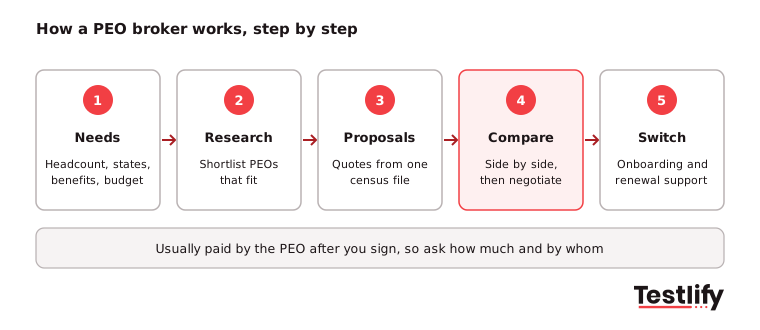
- Needs assessment: The broker asks about headcount, growth plans, states you hire in, industry, current benefits, HR gaps and budget.
- Market research: The broker shortlists PEOs that fit, for example ones with strong plans in your states or experience in your industry.
- Proposals: The broker requests quotes, often with one census file, so you do not repeat the same data for every PEO.
- Comparison and negotiation: The broker turns very different proposals into one view of fees, benefits, services and contract terms, then pushes for better pricing.
- Transition and support: The broker helps with the move to the new PEO, answers questions in the first months and reviews the deal at renewal.
Pro tip: Ask every PEO to quote the same pricing model. PEOs charge either a flat fee per employee per month or a percentage of payroll, and the two are hard to compare unless the broker converts them to one annual cost.
How do PEO brokers get paid?
PEO brokers are usually paid by the PEO, not by the employer. The most common setup is a referral fee or an ongoing commission that the PEO pays once you sign. Some brokers and consultants instead charge the client a flat fee, and a few use a mix of both.
- Referral fee or commission from the PEO: The broker is paid only when a deal closes. You pay nothing directly, but the cost is usually built into the PEO's pricing.
- Client-paid fee: You pay the broker for the search or for advice. This is more common with consultants and can make the advice more independent.
- Hybrid: A smaller client fee plus a commission from the PEO.
Payment from the PEO is not a problem in itself, but it creates a risk of bias. Some PEOs pay higher commissions than others, and a broker may steer you toward them. G&A Partners, a PEO, makes the same point in its guide to brokers and advises buyers to ask how the broker is paid and whether they have preferred providers.
PEO broker vs going direct vs benefits broker: what is the difference?
A PEO broker helps you pick a PEO, going direct means you run that search yourself, and a benefits broker skips the PEO and finds insurance plans for your own company. A PEO consultant is close to a PEO broker but often charges you a fee instead of taking a commission.
PEO broker | Going direct to a PEO | Benefits broker | PEO consultant | |
|---|---|---|---|---|
What you get | A shortlist and comparison of several PEOs | One PEO's proposal at a time | Group health and other benefit plans for your own company | Advice on whether and which PEO to use |
Who pays | Usually the PEO | No middle party | Usually the insurance carrier | Usually you |
Payroll and HR outsourced | Yes, through the chosen PEO | Yes | No, you keep payroll and HR | Depends on the outcome |
Choice | Wide, but limited to the PEOs the broker works with | Only the PEOs you contact | Wide choice of carriers and plans | Wide |
Best for | First-time buyers, multistate employers | Teams that already know what they want | Companies with in-house HR that want their own plans | Larger or complex companies wanting independent advice |
Many companies move between these over time. A common path is to start with a PEO for benefits and compliance, then move payroll in-house and work with a benefits broker once the HR team grows. Teams weighing other options should also look at an administrative services only (ASO) model, which outsources HR admin without co-employment.
What are the pros and cons of using a PEO broker?
The main benefits of a PEO broker are market knowledge, time saved and a clearer comparison. The main drawbacks are possible bias from commissions, a network that may not cover every PEO, and an extra layer between you and the provider.
Pros:
- Market knowledge: Brokers know which PEOs are strong in which states, industries and company sizes.
- Time saved: One intake and one census file instead of a dozen sales calls.
- Clearer pricing: Proposals converted into comparable annual costs, with fees and benefit premiums shown separately.
- Negotiation: Brokers who place many clients may get better terms than a single buyer.
- Ongoing help: Some brokers support renewals and step in when service slips.
Cons:
- Commission bias: Advice can lean toward PEOs that pay more.
- Limited network: The best PEO for you may not be one the broker represents.
- Extra layer: If you already know your shortlist, a broker can slow things down.
- Uneven quality: Brokers vary widely in experience, and many work with little formal oversight.
When should you use a PEO broker?
A PEO broker is most useful when you are buying a PEO for the first time, hiring across several states, leaving a PEO you have outgrown, or running HR with a very small team. A broker adds less value when you already know the PEOs you want and have time to compare them yourself.
Use a broker when:
- You have never bought a PEO and do not know what fair pricing looks like.
- You are opening offices or hiring remote staff in new states, each with its own payroll tax and leave rules.
- Your benefits needs are complex, for example a mixed workforce or employees in high-cost health markets.
- Your current PEO's renewal jumped and you want to test the market quickly.
Go direct when you have a clear shortlist, an HR lead with time to run a request for proposal (RFP), and the confidence to negotiate on your own.
How do you choose a PEO broker?
Choosing a PEO broker comes down to how they are paid, which PEOs they represent, their experience with companies like yours and what support they give after you sign. Interview two or three brokers, ask the same questions, and walk away from anyone who is vague about money.
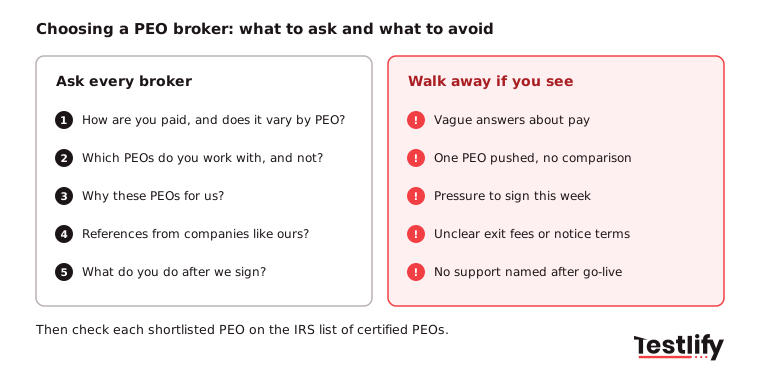
Ask every broker:
- How are you paid, and does the amount differ by PEO?
- Which PEOs do you work with, and which ones do you not?
- Why did you pick these PEOs for us?
- Can you share references from companies of our size and industry?
- What do you do after we sign, including at renewal?
Then check the PEOs themselves. The IRS certifies PEOs under section 7705 of the tax code, and the IRS list of certified PEOs shows which are active, suspended or revoked. For worksite employees, a certified PEO is generally solely responsible for federal employment taxes on the wages it pays, which reduces your exposure if something goes wrong.
Watch for these red flags: pressure to sign this week, a single recommended PEO with no comparison, unclear exit fees, and no answer on who supports you after go-live.
Key takeaway: A good PEO broker is open about pay, shows you more than one option and explains the contract terms you would miss on your own.
What does a PEO not cover in hiring?
A PEO does not find, screen or assess candidates for you. The PEO starts working at the offer and onboarding stage: it runs payroll, enrols the new hire in benefits and keeps employment paperwork compliant. Sourcing, interviews and judging whether someone can do the job stay with your hiring team.
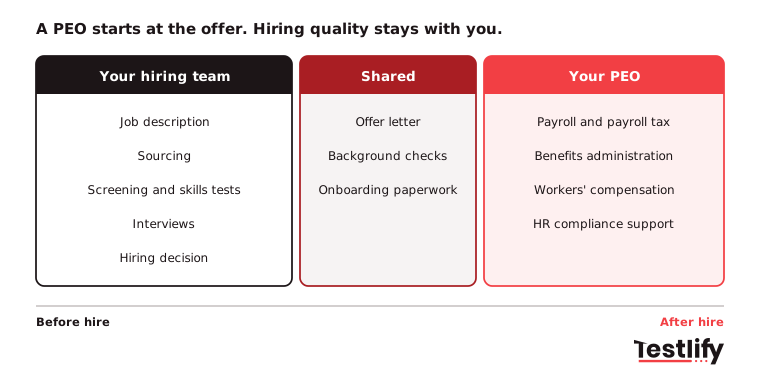
This gap matters most for growing companies, which are often the ones signing a PEO. Hiring is still hard: SHRM's 2025 Talent Trends report found that 69% of organizations are still struggling to fill roles. We have seen fast-growing teams assume the PEO will also take care of hiring, then find their recruiters screening hundreds of resumes by hand.
- Owned by the PEO: payroll, payroll taxes, benefits administration, workers' compensation, HR policies and employment compliance support.
- Owned by your team: job descriptions, sourcing, screening, skills assessment, interviews and the final hiring decision.
- Shared: offer letters, background checks and onboarding paperwork, depending on the PEO contract.
To close the gap, add a structured screening step before interviews. Testlify lets hiring teams send role-based skills tests from a library of 3,500+ tests, with 25+ question types, 20+ proctoring checks and support for 15+ languages, so every candidate is judged on the same evidence. For the basics, read the guide to pre-employment assessments, and keep the legal compliance checklist for hiring next to your PEO's own compliance support.
Ready to make every hire count?
Your PEO handles payroll and benefits once someone joins. Make sure the right person joins in the first place. Browse the Testlify test library and start a 7-day free trial, no credit card required.
Frequently asked questions

Content Writer
Yashika Khandelwal is a Content Writer with 3+ years of experience creating research-backed content on hiring, talent assessment, and HR technology. She is a registered Organizational Psychologist and subject matter expert who combines behavioral science with practical recruitment insights to produce accurate, evidence-based content.
LinkedInRelated resources
View all
HR tools
AI for performance reviews: what it does and where it falls short

HR tools
Top talent acquisition tools that integrate with existing HR systems

HR tools
10 top-rated recruitment automation tools for 2026

HR tools
12 best online interview platforms for hiring teams in 2026

HR tools
What is AI proctoring and why it matters in certification

HR tools
Prioritization matrix: What it is & how to use it effectively
Get started.
Hire on proof, not resumes.
Run your first skills-based assessment free — no credit card required.