
Testlify vs ModernHire: A detailed comparison
Discover the perfect solution for evaluating your candidates’ skills with Testlify. Dive into our comprehensive Testlify vs Modern Hire…
Testlify vs ModernHire is a comparison between a live product and a brand that no longer sells on its own. Modern Hire was acquired by HireVue in May 2023, modernhire.com now redirects to hirevue.com, and its Virtual Job Tryout is sold as a HireVue assessment. So the real question is whether you want an enterprise, quote-only assessment suite built for Fortune 100 volume, or a self-serve platform with 25+ question types, conversational AI interviews and a public price list. This page walks both, row by row, with sources.
 ChatGPT
 Gemini
 Claude
 Grok
Grok Perplexity
TL;DR
- Modern Hire is now part of HireVue. The acquisition was announced on 9 May 2023, and modernhire.com sends you straight to hirevue.com. If you're evaluating "Modern Hire" in 2026, you're evaluating HireVue.
- The Virtual Job Tryout is still the strongest thing Modern Hire built: 40+ job-specific simulations that candidates finish on any device, with a fit profile at the end. It's designed for high-volume frontline and entry-level hiring.
- Testlify covers a wider evidence set in one tool: 3,500+ tests, 25+ question types including Google and Microsoft Office tasks and vibe coding, AI video, voice and phone interviews, and three proctoring presets with dual-device monitoring.
- Pricing is the sharpest split. Testlify lists Starter at $139 a month on annual billing with a 7-day trial. HireVue names Essential and Premium packages and routes every buyer to sales.
- Pick Modern Hire (HireVue) for Fortune-100-scale frontline volume and mobile-first candidates. Pick Testlify if you're under about 200 people, want to start this week, and need skills tests and interviews in one place.

What happened to Modern Hire?
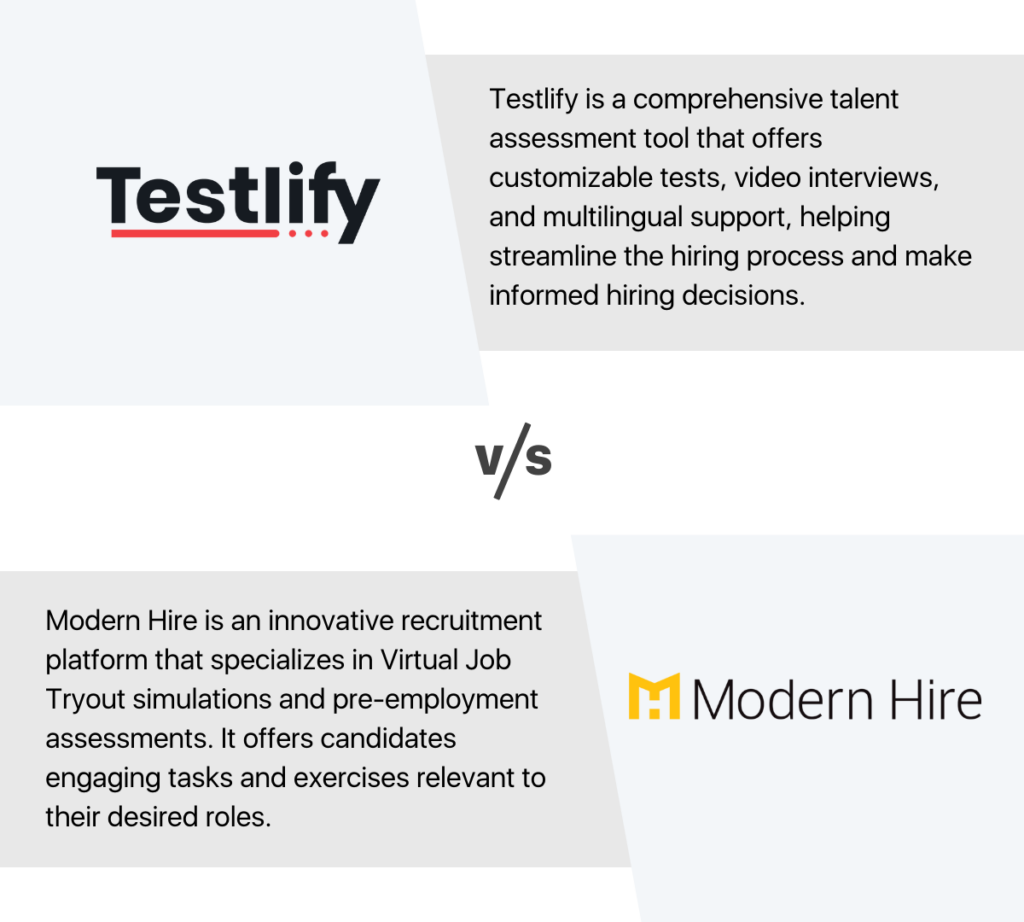
Modern Hire stopped being an independent vendor in 2023. HireVue announced on 9 May 2023 that it had acquired the company, saying Modern Hire brought more than 450 customers to HireVue's 700, for a combined base of over 1,150 customers that includes more than half of the Fortune 100. Since then the two products have been sold under one roof.
Here's why that matters for a buyer. Every comparison page you'll find on this query, ours included until today, describes a Modern Hire that no longer exists as a separate line item. Contracts, packaging and support now run through HireVue. HR Dive's coverage of the deal singled out the Virtual Job Tryout, Modern Hire's role-based simulation product, as the asset HireVue wanted, and that's the part that survived with its name intact.
The practical consequence is simple. When you compare Testlify to Modern Hire today, you're comparing against HireVue's assessment suite as a whole, and against HireVue's buying process, which is enterprise sales with no public prices. That shapes every section below.
Where does modernhire.com go now?
Type modernhire.com into a browser and you land on hirevue.com. The old domain returns a permanent redirect to HireVue's homepage, with no Modern Hire landing page in between. Product pages for the Virtual Job Tryout, the assessment builder and AI-scored interviews all live under hirevue.com/platform now.
If you had a Modern Hire login, bookmarks or an integration pointed at the old domain, you're dealing with HireVue's support and HireVue's roadmap. And if you searched "modernhire.com" because a colleague mentioned the tool, you're looking for a video-interview and assessment platform sized for large enterprises. The rest of this page is about whether that size fits you.
What is the Modern Hire Virtual Job Tryout?
The Virtual Job Tryout is a job simulation. HireVue describes it as an assessment that "immerses candidates in job-related tasks", and it currently lists more than 40 job-specific tryouts covering entry-level to manager roles. A customer service candidate handles a mock interaction, a sales candidate works an objection, and the hiring team gets a candidate fit profile that rates competencies and predicts how likely the person is to perform and stay.
Two details are worth pausing on. First, candidates can complete it on any device with an internet connection, phones included, which is a real advantage for retail, logistics and call-center hiring where most applicants never touch a laptop. Second, it sits inside a wider HireVue suite: game-based assessments, AI-scored interviews, technical assessments, language proficiency tests and an assessment builder that HireVue says draws on "hundreds of validation studies", with combined assessments finishing in under 20 minutes.
What you don't get is a self-serve product. There's no trial, no test library to browse before a sales call, and the tryouts are built per role rather than assembled by you. That's the right trade for a 20,000-person employer running one high-volume role at scale. It's the wrong trade for a 60-person company that hires eight different roles a year.
What does Testlify do that Modern Hire does not?
Testlify is a pre-hire assessment and interviewing platform you set up yourself. The test library holds 3,500+ tests and 180k+ validated questions across cognitive ability, coding, role-specific skills, situational judgment, personality, language and software skills, and you combine them into one assessment with 25+ question types. It also ships a simple built-in ATS (job posts, an application form, a hiring pipeline) for teams that don't run one, and integrates with the ATS you already trust if you do.
The question types are where the gap opens. Candidates can complete real tasks in Google Docs, Sheets and Slides and in Microsoft Word, Excel and PowerPoint, so a marketing coordinator builds an actual spreadsheet instead of answering multiple-choice questions about one. Coding questions run in an embedded VS Code editor with up to 20 test cases, and a "vibe coding" mode lets candidates direct AI tools to a working solution, which is how a lot of developers work in 2026. Typing tests score 60% accuracy and 40% speed by default, and the weighting is yours to change.
Then there's integrity. Testlify offers three proctoring presets (Standard, Strict, Custom) and a dual-device option where the candidate's phone becomes a second camera pointed at them and their screen. The assessment won't start until that mobile feed is live. Flags come back as green, yellow or red with the evidence attached, and the yellow state explicitly asks for "a quick manual review" rather than auto-rejecting anyone. Face-verification data is deleted after 30 days.
The Testlify Multi-Signal Talent Evaluation Model is the idea behind all of this: no candidate should advance on one strong resume, one polished interview or one test score. They advance when several role-relevant signals (a skills test, a work sample, a structured interview, a reference) point the same way. A single simulation, however well built, is one signal.
Testlify vs Modern Hire: feature comparison
This table only carries rows we could verify on a live product page or in the product itself. Where HireVue doesn't publish a detail, the cell says so rather than guessing.
Feature | Testlify | Modern Hire (HireVue) |
|---|---|---|
Ownership and buying | Independent, self-serve, 7-day free trial, public prices | Part of HireVue since May 2023, enterprise sales, no public prices |
Test library | 3,500+ tests, 180k+ validated questions, 13 categories | 40+ job-specific Virtual Job Tryouts plus game-based, technical and language assessments |
Question types | 25+ including single and multiple select, coding, typing, file upload, Google and Microsoft Office tasks, video, audio, Voice AI and Video AI | Simulation tasks, game-based items, interview questions; not itemized publicly |
Job simulations | Practical and hands-on questions with file or URL submission, Office-app tasks, coding projects | Virtual Job Tryout, built per role, candidate fit profile |
Video and AI interviews | One-way, two-way conversational AI video, voice and outbound AI phone calls; avatars, voices and custom prompts; 150+ templates | AI-scored interviews and HireVue's video interviewing platform |
AI scoring and human control | AI scores for open-ended answers with a toggle to exclude them from the final average; in-product note that AI scores are guidance only | AI helps score against "predefined, job-related criteria"; "regularly reviewed to help minimize bias" |
Proctoring | Standard, Strict and Custom presets; dual-device monitoring; photo ID face match; AI-tool detection | Not detailed on public pages |
Candidate devices | Chrome or Edge on desktop; mobile app only as a capture fallback | Any device with an internet connection, including smartphones |
Item analytics | Difficulty index, discrimination index, quality-risk flag per question | Not published |
ATS | 100+ integrations ($2,388 a year add-on on self-serve tiers) plus a simple built-in pipeline | ATS integrations through the HireVue platform |
Languages | Real-time translation of tests into the candidate's language; multilingual auto transcripts | Not stated on the Virtual Job Tryout page |
Security | SAML SSO, SCIM, 2FA, audit logs with SIEM streaming, custom roles | Enterprise-grade; details on request |
Pro Tip: the old version of this page marked Modern Hire as having "no cognitive ability tests" and "no video interview questions". HireVue's suite now lists game-based assessments and AI-scored interviews, so neither row holds. Treat any checkmark table that's more than a year old as a hypothesis, and ask each vendor for a live walkthrough of the exact row you care about.
Which has the better AI video interview?
Both do AI-assisted video interviews, and the honest difference is configurability versus scale. HireVue's AI-scored interviews are part of the platform that made one-way video interviewing mainstream, and they're tuned for very large candidate pools. Testlify's video interviewing tool gives a smaller team the dials.
In Testlify you choose the format: a one-way recorded answer, a two-way conversational AI interview with a live back-and-forth (the candidate is muted while the AI speaks, so it's genuine turn-taking), audio-only questions, or an outbound AI phone call billed at $0.18 a minute for candidates who don't have a good camera. You pick the avatar and voice, write the persona and prompts, set the number of attempts (or no limit), the recording time, a preparation window, and whether recording auto-starts. Transcripts are automatic and multilingual for any recording over 30 seconds, and reviewers can watch, download, replay the screen and regenerate the interview report.
Scoring is where the two philosophies show. Testlify's AI produces a score and insights, then hands control back: "Display AI scores to the reviewer" and "Include AI score in the final average" are both toggles, and the product tells you outright that AI scores are guidance and the final call is a human one. A hiring manager can run every interview with AI purely advisory. You can read more about how that flow works in our guide to AI interviews for candidate screening.
The one thing Testlify doesn't do is schedule live panels of human interviewers. If your process ends with three people on a calendar invite, you'll still book that elsewhere. That's the only honest video-related Con, and it's the same for both products' AI layers.
Which is safer on bias and compliance?
Neither vendor gives you a compliance pass, and anyone who claims otherwise is selling. What you can compare is how much control and evidence each one hands you, because the rules now assume automated tools will be audited.
New York City's Local Law 144, enforced since 5 July 2023, bars employers from using an automated employment decision tool unless it has had an independent bias audit within the past year and candidates were told in advance. The federal Uniform Guidelines supply the four-fifths rule: a selection rate for any group below 80% of the highest group's rate is generally treated as evidence of adverse impact. And the EU's AI Act, published in July 2024, lists AI used to recruit, screen or evaluate candidates as high-risk under Annex III.
HireVue's answer is institutional: assessments "designed by IO psychologists, tested for reliability and job relevance, and regularly reviewed to help minimize bias", backed by what it calls "hundreds of validation studies". That's credible, and for a Fortune 100 employer it's often what procurement wants to hear.
Testlify's answer is operational. AI scoring is advisory by design, human override is a toggle, a question can be routed to a named reviewer, and every proctoring flag ships with the evidence so a person decides. Candidates can request accommodation through a structured, human-reviewed flow, DEI data is collected anonymously and never shared with the employer, and a disqualified candidate is told why. Item-level analytics (difficulty index, discrimination index, quality-risk flag) let you spot a question that's quietly filtering the wrong people. For a team without an in-house I/O psychologist, controls you can see beat assurances you can't.
How should you compare hiring products?
Compare hiring products on what they predict, what they cost per candidate, and how much of the decision they leave with a human. Five questions cover most of it.
- Which signals does it collect? A 2022 re-analysis of selection research by Sackett and colleagues in the Journal of Applied Psychology re-estimated structured interviews at a validity of about .42 and cognitive ability tests at about .31, and the exact figures are still argued over in print. What survives every re-analysis is the shape: structured beats unstructured, and combining several job-relevant signals beats any one of them. A tool that only runs one simulation, or only one interview, caps you at one signal.
- Can you see the price? A published price list is the fastest test of whether a vendor wants your size of company. Quote-only pricing usually means annual contracts and implementation fees.
- Who makes the final call? Look for a documented human-override path, not a marketing line about "ethical AI".
- Will candidates finish it? Device support, length and clarity of instructions decide completion rates. Ask for both vendors' device requirements in writing.
- Does it fit the stack you already have? If you run Greenhouse, Workday or Lever, the assessment tool should plug in as the screening layer and leave your ATS as the system of record.
Run Testlify and HireVue through those five and the answer usually sorts itself by company size before it sorts by feature.
How much do Testlify and Modern Hire cost?
Testlify lists its prices; HireVue doesn't. On Testlify's pricing page the annual Starter plan is $139 a month, billed at $1,668 a year for 100 candidate credits ($16.68 per credit, 3 seats). Basic is $279 a month for 300 credits and Business is $699 a month for 1,000. Monthly billing costs more per credit: Starter is $198 a month for 10 credits. There's a 7-day free trial with no card, a 30-day money-back guarantee, and the base price is locked for 24 months.
Plan | Testlify (annual billing) | Modern Hire (HireVue) |
|---|---|---|
Entry | Starter: $139/mo, 100 credits/yr, 3 seats | Essential package: price on request |
Mid | Basic: $279/mo, 300 credits/yr, 5 seats | Not published |
Growth | Business: $699/mo, 1,000 credits/yr, 10 seats | Premium package: price on request |
Add-ons | White label $2,388/yr; 100+ ATS integrations $2,388/yr; extra seats $15/seat/mo; AI phone interviews $0.18/min | Not published |
Trial | 7 days, no card; 30-day money-back | Demo via sales |
Two things to be straight about. A credit is spent per started assessment by a qualified candidate and credits don't roll over, so size the plan to your real applicant count, not your hire count. And the 100+ ATS integrations and white labeling are paid add-ons on the self-serve tiers, included only on the Custom plan. Budget for them if you need them.
A worked example, purely illustrative: a 60-person marketing agency that hires 15 account managers and 5 designers a year and screens about 200 candidates would outgrow Starter's 100 credits. Basic at $3,348 a year covers 300 candidates at $11.16 each, with room for a busy quarter. The same agency asking HireVue for a quote would be talking about an enterprise contract, and that conversation alone usually answers the question.
When is Modern Hire the better pick?
Three cases, and they're real ones.
You hire one frontline role at very high volume. If you're filling thousands of retail, warehouse or contact-center seats a year, a role-specific Virtual Job Tryout with a validated fit profile and a phone-first candidate flow is exactly what Modern Hire was built for, and HireVue's scale is a feature, not a cost.
Your candidates only have phones. Testlify runs on Chrome or Edge on a desktop, with the mobile app as a capture fallback for audio and video, and several proctoring features are desktop-only. If most of your applicants would sit the assessment on a smartphone, HireVue's any-device completion is the safer bet.
You're already on HireVue. If your interviews, scheduling and assessments run there, adding a second vendor for tests is friction you don't need. Stay put and turn on the assessment modules.
Is Testlify the best Modern Hire alternative?
For companies under about 200 people, and for mid-size teams hiring across many roles, yes. You get the wider evidence set (tests, work samples in real Office apps, coding, structured AI interviews, references) in one product, you keep the human in charge of every AI score, and you can see the bill before you talk to anyone. That's the combination the Multi-Signal Talent Evaluation Model calls for, and it's what a founder or hiring manager who does this part-time actually needs.
The honest Cons: Testlify is desktop-and-Chromium for candidates, it doesn't schedule live human panels, ATS integrations and white labeling cost extra below the Custom plan, and AI resume scoring is currently a Greenhouse-only beta. If none of those bite, Testlify is the more flexible and far more transparent buy. If you want to weigh other options, our roundup of Modern Hire alternatives and the list of HireVue alternatives cover the wider field.
Hire on evidence, starting this week
Pick the two roles you hire most often, build one assessment each from the test library, and run the same structured AI interview for every shortlisted candidate. You'll have comparable evidence on real applicants inside two weeks. Book a Testlify demo and we'll map your first assessment to the role in the call, or start the free trial and build it yourself.
Key Takeaways
- Modern Hire is HireVue now. The acquisition closed in May 2023 and modernhire.com redirects to hirevue.com, so every buying decision runs through HireVue's enterprise sales process. Budget your time, and your contract expectations, accordingly.
- The Virtual Job Tryout is a strong single signal. Forty-plus role-specific simulations with any-device completion and a fit profile suit high-volume frontline hiring. It's one signal, though, and the research keeps rewarding teams that combine several.
- Testlify's edge is breadth plus control. 25+ question types, real Office-app work samples, vibe coding, AI video, voice and phone interviews, and three proctoring presets, all with AI scoring you can make advisory with one toggle. That matters most to teams without a dedicated assessment function.
- Published pricing changes who can buy. Starter at $1,668 a year with a 7-day trial means a 60-person company can run a pilot this week. Quote-only pricing means a procurement cycle. Neither is wrong; they serve different companies.
- Compliance is about evidence you can show. Local Law 144 audits, the four-fifths rule and the EU AI Act all assume you can explain how a score was produced and who overrode it. Choose the tool that leaves that trail by default.
- Know the Cons before the demo. Testlify is desktop-only for candidates and charges for ATS and white-label add-ons; HireVue is phone-friendly but opaque on price and built for scale you may not have. Match the trade-off to your applicant pool.
FAQs
Related resources
View all
Competitor Comparisons
Testlify vs Wonderlic: A detailed comparison
Competitor Comparisons
Testlify vs Thomas International: A detailed comparison
Competitor Comparisons
Testlify vs Indeed Hiring Platform: A detailed comparison
Competitor Comparisons
Testlify vs HireQuotient: A detailed comparison
Competitor Comparisons
Testlify vs Testwise: Comparison guide for recruiters
Competitor Comparisons
Testlify vs Symphony Talent: Which Is Better in 2026?
Get started.
Hire on proof, not resumes.
Run your first skills-based assessment free — no credit card required.