
Testlify vs Testwise: Comparison guide for recruiters
Compare Testlify vs Testwise across features, integrations, candidate experience, and pricing.
The growing shift toward skills-based hiring has made structured assessments more important than ever. Recent research shows that 85% of employers have adopted skills-based hiring practices, while 76% now use skills tests to validate candidate abilities before making hiring decisions.
This shift is happening because traditional hiring methods often fall short. Resumes highlight credentials, not actual ability, and unstructured interviews are highly subjective. Studies consistently show that skills assessments are among the strongest predictors of job performance, helping organizations make more objective, data-driven hiring decisions.
As a result, companies are increasingly relying on modern assessment platforms to evaluate candidates across technical skills, cognitive ability, coding proficiency, and behavioral traits before interviews even begin.
In this guide, we break down Testlify vs Testwise across every important evaluation area, features, pricing, integrations, security, support, use cases, and overall strategic fit so you so you can determine which platform delivers the strongest value for your hiring needs.
 ChatGPT
 Gemini
 Claude
 Grok
Grok Perplexity
What is Testlify
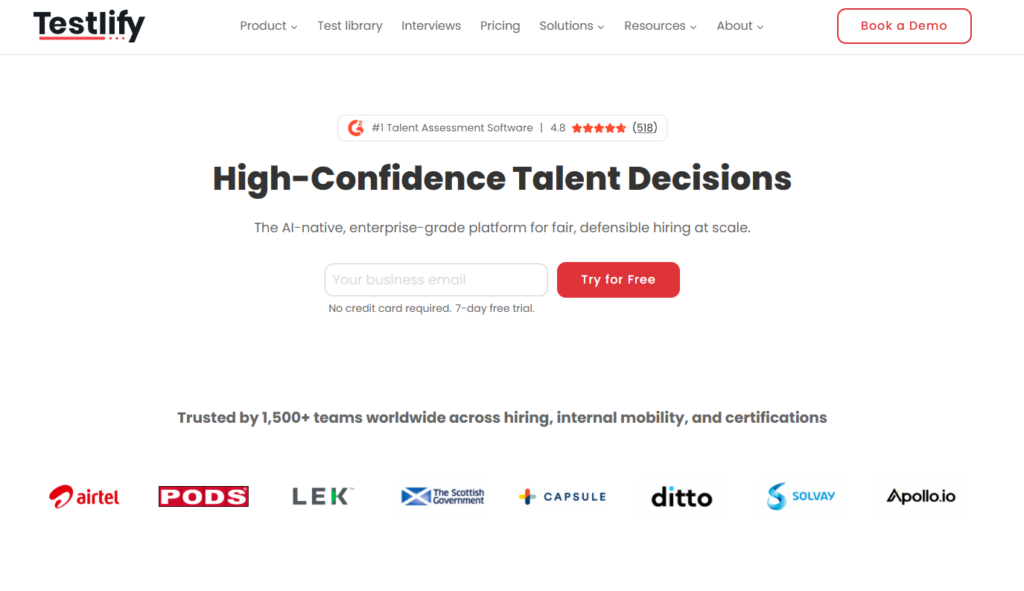
Testlify is a leading AI-powered skills assessment and interviewing platform that provides access to 3,500+ role-specific tests available in 16+s, empowering organizations to hire confidently across global talent markets.
Features
- Extensive test library: Over 3,500 validated skill tests covering technical, cognitive, and soft skills. Custom tests can also be created.
- Custom question formats: Supports 25+ custom questions ranging from standard MCQs and essay responses to innovative video AI and voice AI interviewing formats.
- Conversational AI interviews: Simulate on-the-job scenarios using conversational AI interviews across chat, voice, and video formats, enabling recruiters to evaluate candidate thinking, communication, and problem-solving abilities at scale
- Psychometric tests: Support a wide range of psychometric tests that measure the personality, behavior, and thinking style of candidates.
- AI insights: Generate concise summaries of candidates’ performance, highlighting strengths and areas for improvement.
- Extensive ATS integrations: Supports over 100 ATS integrations such as Workday and SAP SuccessFactors to streamline recruitment workflows.
- Anti-cheating & proctoring: Features 18+ anti-cheating and proctoring measures such as dual-camera proctoring, AI assistance detection, live video proctoring, and more to ensure test integrity
Target audience
Testlify is built for teams that want a simple and reliable way to identify top talent based on real skills. It is designed for:
- Recruiters managing high volumes of applicants
- Enterprises that require secure and compliant screening processes
- Staffing agencies hiring for multiple roles and clients
- Companies that are expanding hiring across different countries
- Teams looking to reduce bias with structured assessments
- Hiring managers evaluate both technical and soft skills
- Organizations seeking conversational AI interviews to replace traditional interview screening processes

What is Testwise?
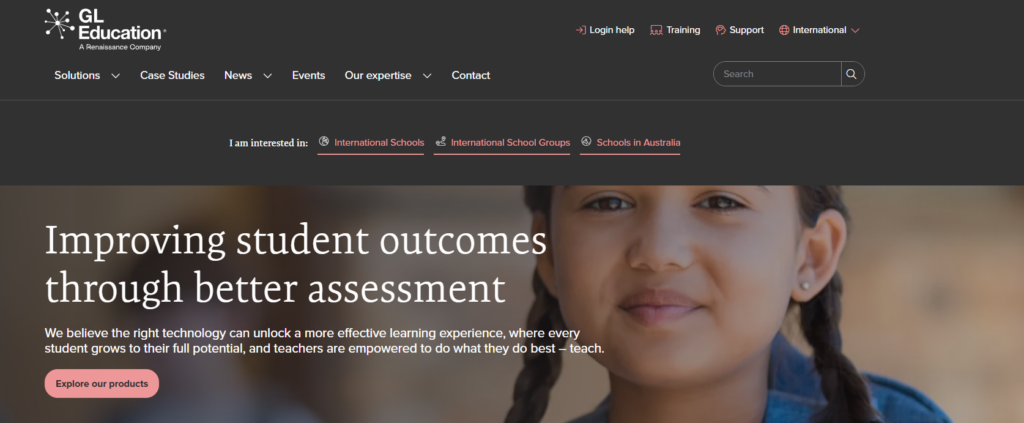
Testwise is a digital assessment platform offered by GL Assessment. It is primarily used in the education sector, allowing schools to administer standardized tests and access performance reports.
It is designed for:
- Schools and educational institutions
- Academic benchmarking
- Pupil performance analysis
Market positioning
Before comparing features, it is important to clarify positioning.
- Testlify → Talent acquisition and pre-employment assessment
- Testwise (GL Assessment) → Academic testing and student evaluation
Understanding this distinction is essential when choosing the right platform for your organization.
Testlify is designed around the realities of modern hiring, including managing high applicant volumes, technical hiring, remote and global recruitment, and interview automation.
Testwise is built for academic testing and student benchmarking. It is not designed for recruitment in mind and does not provide role-specific tests, AI interviews, and advanced analytics that are now standard in modern skills assessment platforms.
For recruiters and HR leaders, using a platform that is not built for talent acquisition can lead to process gaps, limited evaluation depth, and poor integration with existing HR systems.
Testlify vs TestWise: Core Purpose
Understanding the core purpose of Testlify and Testwise is the single most important step in this comparison. While both platforms are assessment-driven, they are built for fundamentally different stakeholders, environments, and outcomes.
One evaluates job readiness and workforce performance. The other measures academic progress and student development.
Let’s break this down comprehensively.
Dimension | Testlify | Testwise |
|---|---|---|
Primary Audience | Recruiters, HR teams, enterprises | Schools, educational institutions |
Core Objective | Evaluate job readiness and hiring fit | Measure academic progress and student ability |
Decision Type | Hiring decision | Academic placement and support decision |
Outcome Impact | Workforce productivity, revenue, and business performance | Student learning progression and educational attainment |
Evaluation Context | Workplace simulation and role-based competency | Curriculum-based and standardized testing |
Behavioral Analysis | Yes | No recruitment behavioral modeling |
ATS Integration | Yes (100+ ATS platforms) | No HR integrations |
Anti-Cheating Focus | Remote hiring, integrity, and proctoring | Admissions and academic test integrity |
Benchmarking Type | Candidate-to-industry comparison | Student-to-national benchmark comparison |
Industry Focus | Talent acquisition and recruitment tech | Education and school admissions |
Testlify: Built for helping recruiters identify top talent globally
Testlify is purpose-built for talent acquisition teams. Every feature, workflow, and AI capability present in the platform is designed to answer one central business question:
Is this the best candidate for the job? The core purpose of Testlify includes:
- Screening large volumes of applicants efficiently
- Identifying job-specific competencies
- Simulating real-world work scenarios
- Reducing time-to-hire
- Minimizing hiring bias
- Preventing cheating in remote hiring
- Automating candidate evaluation
- Supporting enterprise compliance
The platform evaluates not only knowledge, but also:
- Behavioral traits
- Communication ability
- Emotional intelligence
- Practical job execution skills
- Cultural fit indicators
Testlify operates in high-stakes hiring environments where a poor decision directly impacts productivity, revenue, and team performance. In short, it is built to support commercial workforce outcomes.
GL Assessment Testwise: Built For Student Development
Testwise serves a completely different ecosystem i.e., education. Its central purpose is to answer:
How is this student performing academically, and how can schools support their development? Testwise supports:
- Academic benchmarking
- 11+ admissions testing
- Fair banding assessments
- Curriculum progress tracking
- Cognitive reasoning measurement
- Reading ability diagnostics
- Mental health screening tools
- Identification of additional learning needs
The platform helps schools:
- Group pupils by ability
- Measure national-level performance benchmarks
- Provide evidence of progress
- Support children with vision impairment (via RNIB collaboration)
- Deliver standardized testing at scale
The outcome focus is not job readiness or workforce placement. It is centered around educational development and academic success.
Bottom Line
Testlify and Testwise are not competitors in the same vertical. Testlify exists to optimize workforce selection and hiring performance, whereas Testwise exists to measure and improve academic outcomes.
The choice is not about features, but rather it is about institutional purpose and industry alignment.
Testlify vs TestWise: Feature depth
When comparing feature depth between Testlify and Testwise, the difference becomes even clearer. Testlify is engineered for dynamic hiring environments where speed, accuracy, automation, and behavioral insight matter. Testwise is structured around standardized academic testing frameworks.
Let us break this down in detail.
Capability area | Testlify | Testwise |
|---|---|---|
AI-powered interviews | Yes | No |
Workplace simulations | Yes | No |
Role-based hiring assessments | Yes | No |
Academic curriculum testing | No | Yes |
Live coding environments | Yes | No |
Behavioral analysis | Yes | No |
Enterprise proctoring | Yes | Limited academic controls |
ATS integration | Yes | No |
Candidate benchmarking | Yes | Academic benchmarking |
Recruitment automation | Yes | No |
Testlify features
Testlify offers a deeply layered feature ecosystem built specifically for modern recruitment teams.
Conversational AI interviews
Testlify supports conversational AI interviews in chat, voice, and video formats. Recruiters can have AI simulate real workplace scenarios such as customer handling, sales negotiation, conflict resolution, and technical troubleshooting.
Once the candidate finishes the interview, AI evaluates their responses based on accuracy, clarity, tone, behavioral cues, and emotional intelligence. This allows recruiters to assess how candidates think and communicate under realistic job conditions.
3,500 plus validated skill tests
Testlify provides thousands of structured skill tests covering technical roles, blue-collar hiring, language proficiency, cognitive ability, psychometrics, and live coding challenges. Tests are aligned to 4,500 plus job roles across 50 plus industries.
This ensures hiring teams do not rely on generic testing but instead measure job specific competency.
Custom assessment creation
Recruiters can build tailored assessments using 15+ custom question types present within the platform, including:
- Multiple Choice Questions (MCQs)
- Open-ended and descriptive questions
- AI-powered Chat simulation
- AI-powered Video interview
- AI-powered Audio interview
- Custom coding questions and live coding tests
- Fill-in-the-blanks
- File upload questions
- Google Docs, Sheets, and Slides questions
- Microsoft Office questions
- Rating, number, and date questions
- Qualifier questions
Weighted scoring allows employers to prioritize the most critical competencies.
Advanced proctoring and anti-cheating
Testlify includes enterprise-grade integrity controls such as face detection, dual camera monitoring, screen recording, AI assistance detection, IP tracking, and focus guard mode. This ensures authenticity in remote hiring.
Automated AI scoring and benchmarking
Recruiters receive instant scoring insights, skill breakdowns, benchmarking comparisons, and exportable reports. AI overviews summarize candidate strengths and improvement areas, enabling faster and more confident decisions.
ATS and HRMS integrations
Testlify integrates with 100-plus applicant tracking systems, including Greenhouse, Workday, SAP SuccessFactors, and BambooHR.
GL Assessment Testwise features
Testwise focuses on academic testing and student development. It includes:
- Fair banding assessments using verbal and non-verbal reasoning
- 11 plus admissions tests
- CAT4 cognitive abilities testing
- NGRT adaptive reading assessments
- Progress Test Series for English, maths, and science
- PASS survey for pupil attitudes
- WellComm speech and language toolkit
- Mental health screening tools such as HADS and GHQ
These tools are highly valuable in school environments for academic benchmarking and admissions processes. However, they are not designed for hiring workflows, workplace simulations, or enterprise recruitment automation.
Bottom line
When comparing features and capabilities through a recruitment-focused lens, Testlify clearly offers:
- Greater assessment customization
- Advanced AI interviewing features
- Enterprise-grade proctoring
- Recruitment-specific analytics
Testwise is a strong academic assessment system, but it is not designed for hiring environments.
Testlify vs Testwise: Pricing and scalability
Pricing is not just about the monthly cost. It reflects scalability, hiring volume flexibility, automation depth, and long-term return on investment.
When comparing Testlify and Testwise, the pricing structures reveal their intended markets. Testlify follows a scalable SaaS model built for growing hiring teams. Testwise follows institutional licensing aligned to school procurement cycles.
Pricing factor | Testlify | Testwise |
|---|---|---|
Pricing transparency | Clear published tiers | Institution specific contracts |
Built for | Recruiters and enterprises | Schools and authorities |
Scales with hiring volume | Yes | Not hiring focused |
Credit based structure | Yes | No |
Includes AI interviews | Yes | No |
Includes proctoring | Yes | Academic supervision |
ATS integrations included | Yes | No |
Enterprise custom plans | Yes | Education procurement contracts |
Testlify pricing structure
Testlify offers transparent, tiered pricing plans designed to scale with hiring volume and organizational growth.
Plan | Monthly price | Annual billing | Candidate credits | Cost per credit | User seats |
|---|---|---|---|---|---|
Starter | 139 dollars | 1,633 dollars | 100 | 17 dollars | 3 users |
Basic | 279 dollars | 3,343 dollars | 300 | 11 dollars | 5 users |
Business | 699 dollars | 4,192 dollars | 1,000 | 8 dollars | 10 users |
Premium | Custom | Custom | 3,000 | Custom | 20 users |
Enterprise | Custom | Custom | 10,000 | Custom | 30 users |
Enterprise Plus | Custom | Custom | 25,000 | Custom | 40 users |
Unlimited | Custom | Custom | Unlimited | Custom | Custom |
Why the Testlify pricing model favors growing hiring teams
- Cost per candidate decreases as volume increases
- Multiple user seats support collaborative hiring
- AI interviews, proctoring, and analytics are included
- Enterprise tiers support large-scale recruitment drives
- Unlimited plan removes volume constraints for aggressive hiring
This makes Testlify economically attractive for mid-sized and enterprise teams running large recruitment campaigns. More importantly, pricing includes access to AI interviews, proctoring, analytics, and integrations.
GL Assessment Testwise pricing model
Testwise operates on a different commercial structure.
Pricing is typically:
- School-based licensing
- Admissions testing contracts
- Authority level procurement
- Annual education budgets
Costs vary depending on:
- Test type
- Volume of pupils
- Physical paper testing or digital administration
- Marking services or Quartz software usage
This model is well-suited for school systems but does not align with recruitment SaaS pricing expectations, such as per candidate credits, ATS integration bundles, or scalable hiring automation packages.
Bottom line
For organizations focused on structured hiring, workforce growth, and recruitment automation, Testlify provides flexible, scalable, and economically efficient pricing. Testwise pricing is aligned to educational institutions and does not support enterprise hiring scalability.
Testlify vs Testwise: Integrations and workflow automation
A modern assessment platform should not operate in isolation. Recruitment teams rely on applicant tracking systems, HRMS platforms, and collaborative hiring workflows. The ability to integrate seamlessly determines whether a tool accelerates hiring or creates operational friction.
When comparing Testlify and Testwise, workflow automation clearly favors Testlify for recruitment environments.
Testlify integrations and workflow ecosystem
Testlify integrates with over 100 applicant tracking systems and HR tools, including:
- Greenhouse
- Workday
- SAP SuccessFactors
- BambooHR and more
This integration framework enables:
- Automatic candidate sync: Candidate data flows directly from the ATS into Testlify. There is no need for manual data entry.
- Assessment results pushed back into ATS: Scores, reports, and AI insights are automatically updated within the hiring system. Recruiters and hiring managers can review performance without switching platforms.
- Centralized collaboration: Hiring managers can evaluate candidates inside their existing workflow while accessing detailed Testlify analytics.
- API access and scalability: For enterprises with complex hiring ecosystems, API capabilities allow custom automation and advanced workflow configurations.
- Reduced administrative overhead: Automation eliminates repetitive manual tasks such as exporting spreadsheets or copying reports across systems.
This ensures that Testlify enhances existing recruitment infrastructure rather than disrupting it.
GL Assessment Testwise integrations
Testwise integrates with educational and local authority systems. Its workflow compatibility is designed for:
- School administration platforms
- Educational reporting systems
- Admissions coordination
- Standardized test management
It does not integrate with applicant tracking systems, HRMS platforms, or recruitment collaboration tools. The workflow structure is aligned with academic calendar cycles rather than hiring pipelines.
Bottom line
For recruitment teams, disconnected tools create delays and inefficiencies. When assessment results must be manually exported, emailed, or uploaded into an ATS, hiring slows down. Testlify eliminates these friction points by embedding assessment data directly into the hiring workflow.
This produces measurable advantages:
- Faster shortlisting
- Reduced administrative burden
- Improved cross-team visibility
- Better hiring manager alignment
- Stronger data consistency
Testwise delivers value in school administrative environments, but it does not provide the workflow automation capabilities required for modern enterprise recruitment, as seen in Testlify.
Testlify vs Testwise: Candidate experience
Candidate experience is no longer a secondary consideration. In competitive talent markets, the way candidates interact with your assessment platform directly influences employer brand, completion rates, and offer acceptance.
When comparing Testlify and Testwise from a user experience standpoint, the design philosophy clearly reflects their intended audiences. Testlify is optimized for job applicants across industries and geographies. Testwise is structured for students within formal academic environments.
Experience factor | Testlify | Testwise |
|---|---|---|
Mobile optimization | Yes | Limited education focus |
AI conversational format | Yes | No |
Workplace simulation | Yes | No |
Employer branding customization | Yes | No |
Multilingual hiring support | Yes | Education context |
No registration access | Yes | School-controlled access |
Global remote readiness | Yes | Not hiring focused |
Testlify candidate experience strengths
Testlify is designed to remove friction from the hiring journey while maintaining assessment rigor. The platform’s greatest strengths in the realm of candidate experience are:
- No account registration required: Candidates can access assessments directly through secure links. This reduces drop off and improves completion rates.
- Mobile-optimized platform: Testlify is fully mobile-friendly. Candidates can complete assessments and interviews from smartphones or tablets without compromising experience quality.
- Conversational AI interaction: Instead of static question forms, candidates engage in dynamic chat, voice, and video-based AI interviews. This creates a more realistic and engaging evaluation process.
- Multilingual support: Testlify enables organizations to conduct assessments in 16+s. This supports global hiring and reduces bias against non native speakers.
- White-label and custom branding: With white-labeling features, companies can customize logos, communication templates, and messaging tone. This reinforces employer branding throughout the candidate journey.
- Clear instructions: The platform provides structured navigation, progress indicators, and transparent scoring mechanisms. This builds trust and confidence among candidates.
The result is a professional and engaging hiring experience aligned with modern workforce expectations.
GL Assessment Testwise user experience model
Testwise is designed for students participating in structured academic testing environments.
Its experience framework includes:
- Familiarization materials before testing
- Controlled assessment conditions
- Standardized digital interfaces
- Adaptive testing in certain tools, such as NGRT and WellComm
This works well for school admissions and curriculum assessments. However, it is not designed around employer branding, global hiring campaigns, or remote workforce engagement. It prioritizes standardized academic fairness over interactive workplace simulation.
Bottom line
For organizations hiring across regions, industries, and remote environments, Testlify provides a modern, accessible, and brand-aligned candidate experience.
Testwise serves educational assessment needs effectively, but for recruitment-focused organizations, Testlify is the far better choice.
Testlify vs Testwise: Customer support
Even the most powerful assessment platform can fail if onboarding is weak and support is slow. Implementation quality determines how quickly teams realize value and how effectively they adopt advanced features.
When comparing Testlify and Testwise, the support structure once again reflects their primary markets. Testlify is built to support fast-moving hiring teams. Testwise is structured to support schools operating on academic timelines.
Support dimension | Testlify | Testwise |
|---|---|---|
Dedicated onboarding | Yes | Education focused |
Recruitment workflow guidance | Yes | No |
ATS integration support | Yes | No |
Enterprise account management | Yes | Yes in education context |
Proctoring setup assistance | Yes | Academic testing support |
Help center resources | Yes | Yes |
Hiring campaign optimization | Yes | No |
Testlify customer onboarding and support model
Testlify provides a hands-on support experience tailored to recruitment environments. New customers receive personalized onboarding guidance. This ensures:
- Correct test setup
- Interview workflow configuration
- Proctoring settings activation
- ATS integrations implementation
- Scoring calibration
This reduces setup errors and accelerates time to value.
Support is delivered by real customer success professionals rather than automated ticket-only systems. This is especially valuable during high-volume hiring campaigns. Enterprise customers receive higher-tier support, including faster response times and account management guidance.
Feedback loops are actively incorporated into platform updates. This ensures the system evolves alongside recruiter needs.
Furthermore, documentation, FAQs, and best practice guides enable teams to self-serve while still having access to live support when required.
GL Assessment Testwise support model
Testwise offers structured support aligned with school environments.
This includes:
- Individual account manager support during testing periods
- Familiarization materials for students
- Guidance for fair banding and admissions processes
- Support for accessibility compliance, including RNIB collaboration
This support model works effectively within educational cycles and standardized test administration.
However, it does not focus on:
- Recruitment workflow optimization
- Hiring automation setup
- ATS integration troubleshooting
- Behavioral analytics calibration
Its support infrastructure is aligned with academic administration rather than talent acquisition acceleration.
Bottom line
In recruitment, implementation speed directly affects hiring velocity. Delays in setup or poor integration can slow down pipeline progression and increase vacancy costs.
Testlify ensures that:
- Hiring teams activate features quickly
- Integrations work seamlessly
- Recruiters understand scoring insights
- Advanced proctoring is properly configured
- Large-scale hiring campaigns run smoothly
This reduces operational risk and increases adoption rates.
Testwise provides reliable administrative support for schools but for hiring teams seeking speed, automation, and operational guidance, Testlify remains the strategically stronger choice.
Final verdict
Testlify and Testwise are built for entirely different industries. However, when the evaluation lens is recruitment, enterprise hiring, and workforce performance, Testlify stands out as the strategically superior solution.
GL Assessment Testwise is a respected educational assessment platform. It excels in academic benchmarking, admissions testing, and student progress tracking. However, it is not designed for recruitment workflows, workplace simulation, or enterprise hiring automation.
If your goal is to:
- Identify job-ready talent
- Simulate real workplace scenarios
- Automate candidate evaluation
- Protect against remote hiring fraud
- Integrate seamlessly with your ATS
- Scale hiring across regions and roles
Then Testlify is the platform built to deliver those outcomes. Book a demo with Testlify today and see how role-specific tests and conversational AI interviews can help you identify top talent faster and with complete confidence.
Frequently asked questions (FAQs)

Head of Assessments
Usha brings a rare depth of expertise to Testlify’s assessment function, over 40 years of multidisciplinary experience spanning banking, insurance, healthcare, automotive, IT services, manufacturing, pharmaceuticals, and enterprise software. At Testlify, she ensures that every assessment, scoring methodology, and competency structure meets the highest standards of enterprise-grade transparency, fairness, and consistency, the kind that holds up under audit and earns the trust of the world’s most rigorous hiring teams.
LinkedInRelated resources
View all
Competitor Comparisons
Testlify vs Symphony Talent: Which Is Better in 2026?
Competitor Comparisons
Testlify vs TestTrick: Which skills assessment platform is best for recruiters?
Competitor Comparisons
Testlify vs CodeSignal: Which Talent Assessment Platform is Best for You?
Competitor Comparisons
Testlify vs. Equip: Which Skills Assessment Platform is Best for HR Teams?
Competitor Comparisons
Testlify vs. Harver: Which Skills Assessment Platform is Best for HR Teams?
Competitor Comparisons
Testlify vs. Talview: Which Skills Assessment Platform is Best for HR Teams?
Get started.
Hire on proof, not resumes.
Run your first skills-based assessment free — no credit card required.