
How to screen electrical engineer candidates: a 6-step process
A practical process for screening electrical engineers: the skills to check by specialty, test types, interview questions, and red flags.

Knowing how to screen electrical engineer candidates comes down to one idea: check proof of skill before you spend interview time. A good screen defines the specialty and level first, filters resumes on must-haves, uses a short online skills test and a practical work sample, and only then runs structured interviews and license and reference checks, all scored on one scorecard.
TL;DR:
- Screen electrical engineers in six steps: define the role, filter resumes, run a short skills test, set a work sample, hold a structured interview, then verify licenses and references.
- Put a 10 to 20 minute online test before any phone screen. Candidates who pass it go on to a practical design or fault-finding task.
- Screen by specialty. Power, controls, electronics and embedded engineers need different checks, so one generic quiz is not enough.
- A PE license matters only for roles that sign off on public work. Entry-level electrical engineers do not need one.
- Score every candidate on the same weighted scorecard, with a 1 to 5 rating and a line of evidence for each criterion.
- BLS expects electrical engineering jobs to grow 10% from 2025 to 2035, so a slow screen loses good candidates to faster employers.
 ChatGPT
 Gemini
 Claude
 Grok
 Perplexity
What does screening electrical engineer candidates involve?
Screening electrical engineer candidates means checking, before the main interviews, whether each applicant has the theory, practical skill, tools and credentials the role needs. A screen narrows a large applicant pool to a short list of people worth a hiring manager's time, using the same evidence for everyone.
For electrical roles, a resume alone tells you little. Two candidates can both list "power systems" and "circuit design", yet only one can size a cable run or find a fault in a control panel. Screening closes that gap with three kinds of evidence:
- Knowledge: Circuit analysis, electromagnetism, power systems, analog and digital electronics, and control theory.
- Application: Designing, simulating, testing and troubleshooting real circuits and systems.
- Working style: Safety habits, documentation, communication with technicians and other engineers, and teamwork.

Why is it hard to screen electrical engineers right now?
Screening electrical engineers is hard because demand is rising, the field is broad, and resumes rarely show hands-on ability. According to the US Bureau of Labor Statistics, there were about 199,700 electrical engineer jobs in 2025, median pay was $120,630 in May 2025, and employment is projected to grow 10% from 2025 to 2035, with about 16,300 openings a year across electrical and electronics engineers.
Hiring overall has not eased either. SHRM's 2025 Talent Trends found that 69% of organizations still struggle to fill full-time roles, and 28% now require new skills for those roles. For engineering teams, that means more applicants who look right on paper and a real cost to every week a role stays open.
The breadth of the field adds to the problem. Electrical engineers work in electronics manufacturing, power generation, telecommunications, aerospace, renewable energy and automation, and each one asks for a different mix of skills.
How to screen electrical engineer candidates, step by step?
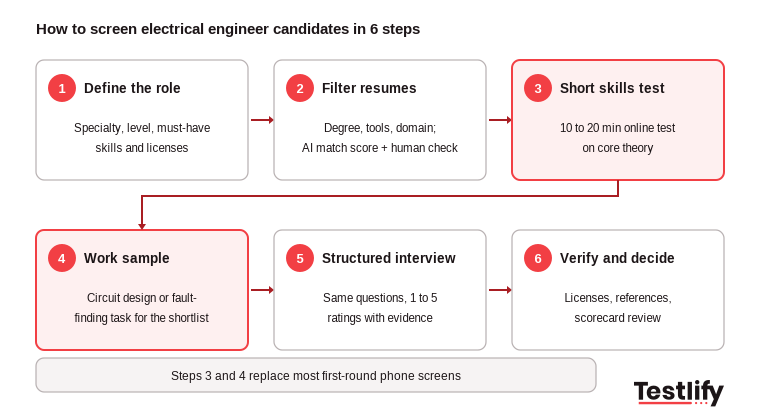
Screening electrical engineer candidates works best as six steps in a fixed order: define the role, filter resumes, run a short skills test, set a work sample, hold a structured interview, then verify and decide. Each step removes candidates who lack a must-have, so the expensive stages only see people with proven skill.
Define the role
Write down the specialty (power, controls, electronics, embedded, instrumentation), the level, the three to five must-have skills, the tools, and any license the role needs. Start from an electrical engineer job description template and edit it to match the actual project work.
Filter resumes on must-haves only
Check the degree, domain experience, tools and, where needed, license status. Keep the filter short so you do not screen out career changers or strong technicians moving into design roles.
Run a short online skills test
Send a 10 to 20 minute test on core theory to everyone who passes the resume filter. Pick the topics, difficulty and duration to fit the level, so a junior test checks fundamentals and a senior test checks deeper analysis.
Set a work sample for the shortlist
Ask the top scorers to design a simple circuit, read a schematic, or find the fault in a described system. Keep it under an hour and close to real work.
Hold a structured interview
Ask every candidate the same questions, rate each answer from 1 to 5, and note the evidence. Bring in the hiring manager and one engineer who will work with the new hire.
Verify and decide
Verify candidates’ licenses and qualifications, contact their references, and use the scorecard to compare them objectively rather than relying on personal impressions from the interview.
Pro tip: Put the skills test before the phone screen, not after. A short test removes most poor matches in minutes, so recruiters and engineers spend their calls only on people who already showed the basics.
Which skills should you screen for in each electrical specialty?
The skills to screen for depend on the specialty, because a power engineer, a controls engineer and an electronics designer solve different problems. Screen every candidate on core theory, then add the checks that match the specialty and the industry.
Specialty | Core skills to check | Typical industries | How to check |
|---|---|---|---|
Power systems | Load flow, protection, transformers, DC and AC machines, grid codes | Utilities, renewable energy, data centers | Theory test plus a protection or sizing problem |
Controls and automation | Control theory, PLC logic, sensors, motor drives | Manufacturing, robotics, process plants | PLC test plus a fault-finding task |
Electronics design | Analog and digital circuits, PCB layout, signal integrity | Consumer devices, telecom, medical devices | Circuit design task and schematic review |
Embedded and hardware | Microcontrollers, firmware basics, test equipment | IoT, automotive, aerospace | Coding task plus a debugging scenario |
Instrumentation and test | Measurement, calibration, oscilloscopes and analyzers | Aerospace, energy, labs | Practical task on reading test results |
Industry changes the weight of each skill. In aerospace, avionics and electrical systems engineers must show exact, safety-first work. In renewable energy, electrical design engineers and power systems analysts must apply theory to new generation and storage systems. In automation, control systems engineers must design and maintain systems that run reliably for years.
Tools matter as well. Hiring guides for the role commonly list MATLAB, Simulink, PSpice and AutoCAD for design and simulation, and oscilloscopes, multimeters and power analyzers for testing. Screen for the tools your team actually uses, for example, with a MATLAB test or a PLC programming test.
Which assessment types work best for electrical engineers?
The assessment types that work best for electrical engineers are a short theory test early, then practical tasks for the shortlist, with aptitude, coding and behavioral checks added when the role needs them. No single format covers everything, so combine two or three across the screening stages.
Assessment type | What it shows | Best stage |
|---|---|---|
Technical knowledge test | Circuits, electromagnetism, power systems, electronics | First screen |
Aptitude and problem-solving test | Logical reasoning and analysis under time limits | First screen, junior roles |
Practical skills task | Designing circuits, fixing electrical faults | Shortlist |
Simulation task | Using software to model circuits or systems | Shortlist |
Design project or case study | Approach, trade-offs and how the candidate presents a solution | Final round, senior roles |
Coding task | MATLAB or Python for analysis, control or embedded work | Shortlist, embedded and controls roles |
Situational judgment and behavioral checks | Decisions, safety habits, teamwork | Interview stage |
A ready-made electrical engineering test covers the first screen. The Testlify version is a 12-question, 10-minute intermediate test on DC machines, power systems, and analog and digital electronics, written for roles such as power system, control systems, instrumentation and electrical construction engineers. For entry-level roles, an electrical aptitude test adds a check on reasoning.
Multiple-choice questions suit the first screen because they are quick to take and score. Case studies and presentations suit the final round because they show how a candidate thinks and explains, which matters for engineers who brief clients or lead technicians. For a wider view of formats, see this guide on how to assess technical skills.
What should an electrical engineer screening scorecard include?
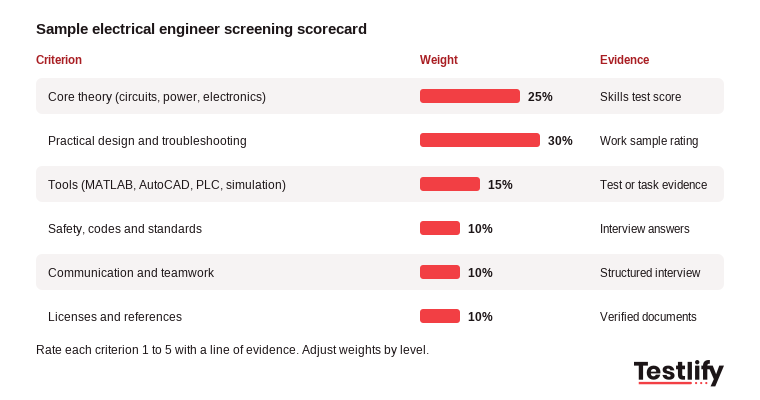
An electrical engineer screening scorecard should list five or six weighted criteria, the evidence for each, and a 1 to 5 rating that every reviewer uses the same way. Core theory, practical design and troubleshooting, tools, safety, communication, and licenses and references cover most roles.
- Weight practical skill highest: For most hands-on roles, the work sample tells you more about job performance than the theory score.
- Adjust weights by level: Raise theory and tools for junior roles. Raise design judgment, safety and communication for senior and lead roles.
- Ask for evidence, not impressions: Each rating needs one line on what the candidate did or said.
- Use two raters for the work sample: A second engineer catches scoring drift and keeps grading consistent.
Read test results by section, not only as a total. A candidate with a high overall score but a weak power systems section may be the wrong pick for a utility role. This guide on how to interpret technical assessment results explains how to set benchmarks and cut scores.
What interview questions help you screen electrical engineer candidates?
Interview questions that help screen electrical engineer candidates ask for real past work, a worked problem, and safety judgment. Ask every candidate the same set, then rate the answers against what a strong response includes.
- Past project: "Walk me through a circuit or system you designed. What constraints did you have and what would you change now?" A strong answer names the requirements, the trade-offs and the testing.
- Troubleshooting: "A motor trips its breaker shortly after start-up. How would you find the cause?" A strong answer works through checks in a logical order, starting with safety isolation.
- Standards and safety: "Which codes or standards guided your last design, and how did you check compliance?" A strong answer names the standard and the review step.
- Tools: "Which simulation or design tools do you use, and for what?" A strong answer ties each tool to a task.
- Teamwork: "Tell me about a time you disagreed with a technician or another engineer on site." A strong answer shows listening, evidence and a clear outcome.
Use the interview to confirm the test results, not to repeat them. If a candidate scored well on theory but struggled in the work sample, ask about hands-on experience directly.
How do you check licenses, degrees and references?
Checking credentials for electrical engineers means confirming the degree, any professional license the role requires, and what former managers say about the candidate's work. Do this last, for the final two or three candidates only.
- Degree: Most roles need a bachelor's degree in electrical or electronics engineering or a related field. Some employers prefer a master's degree for specialist work.
- Licenses: The BLS Occupational Outlook Handbook notes that a license is not needed for entry-level roles. State licensure usually starts with the Fundamentals of Engineering (FE) exam, and a Professional Engineering (PE) license, earned after several years of experience and a second exam, lets an engineer oversee other engineers and sign off on projects.
- References: Ask former managers about specific work: a design the candidate owned, how they handled a failure, and how they worked with technicians.
What red flags should you watch for when screening?
Red flags when screening electrical engineers include resume claims the skills test does not support, vague answers about past projects, and a weak grasp of safety. Any one of these is a reason to probe further before an offer.
- Gaps between resume and results: A resume that lists advanced power systems work paired with a weak power systems test section.
- Vague project answers: The candidate cannot explain their own part in a team design.
- Shortcuts on safety: Skipping isolation or lockout steps in a troubleshooting answer.
- Unexplained job changes: Frequent short stints with no clear reason. Ask, since contract work is common in engineering.
- Answers that do not sound like the candidate: Polished written answers followed by a weak live explanation of the same topic.
How do you keep screening fair, accessible and secure?
Fair and secure screening uses the same tests, time limits and scoring for every candidate, offers accommodations, and checks that answers are the candidate's own. A screen that is fair and well explained also improves the candidate experience and your employer brand.
- Keep tests job-related: The EEOC guidance on employment tests says tests should be job-related and consistent with business necessity, and employers must provide reasonable accommodations in how a test is given.
- Use the same conditions: Same questions, time limits and scoring rules for everyone, with clear instructions sent in advance.
- Explain the purpose: Some candidates see a test as an extra hurdle. Tell them what it covers, how long it takes and how results are used.
- Offer support: Give a contact for technical problems so a dropped connection does not end a strong candidate's application.
- Protect integrity: Remote tests need checks such as webcam snapshots, tab tracking and copy-paste blocking, set up through anti-cheating and proctoring tools.
- Share feedback: Telling candidates where they did well and where they can improve leaves a better impression, even on a rejection.
Results also help after the hire. The same scores show where a new engineer needs training, which gives managers a starting point for a development plan.
Key takeaway: A fair screen is a consistent screen. Same test, same time, same scorecard, plus accommodations for anyone who needs them.
How does Testlify help you screen electrical engineers?
Testlify helps hiring teams screen electrical engineers by putting resume screening, skills tests, work samples and AI interviews in one platform, with scores that feed straight back into the ATS. Recruiters get a ranked shortlist, and engineers review only candidates who already proved the basics.
- Test library: 3,500+ tests, including electrical engineering, electrical aptitude, electronics engineer, microelectronics, PLC programming, MATLAB and AutoCAD tests.
- Custom questions: 25+ question types, including file upload, coding, video and practical tasks, so you can add your own schematic or fault-finding task. The AI test builder creates a role-specific assessment from a job description in under a minute.
- Resume screening: The AI resume screener pulls resumes from the ATS and gives each an explainable match score with High, Medium or Low fit labels.
- Interviews: One-way video and audio interviews and AI interviews by video, voice or chat, so first-round questions are the same for every candidate.
- Integrity: 20+ proctoring checks, including AI assistance detection, webcam snapshots and copy-paste blocking.
- Integrations: 100+ ATS and HRIS integrations, including Workday, Greenhouse, Lever and SAP SuccessFactors.
Teams that want to move toward skills-based hiring can start with one electrical role and expand from there.
Ready to build your electrical engineer shortlist?
Pick the tests that match your specialty, add one work sample, and send the assessment to every applicant who passes your resume filter. Testlify is credit-based, so you pay only when a candidate starts, and you can start a 7-day free trial with no credit card. For a walkthrough with your own role, book a demo.
Frequently asked questions (FAQs)

People and Talent Partner
Arushi Shah runs day-to-day talent acquisition and candidate experience at Testlify. She writes on interviewing, structured hiring, and giving candidates a fair, fast process.
LinkedInRelated resources
View all
HR & recruitment
How to simplify candidate screening with SQL tests

HR & recruitment
How to simplify candidate screening with resilience test

HR & recruitment
Resilience testing in hiring: what it measures and how to use it

HR & recruitment
How project manager test helps you screen candidates

HR & recruitment
How Management test helps you screen candidates

HR & recruitment
How to incorporate Management test into your recruitment strategy
Get started.
Hire on proof, not resumes.
Run your first skills-based assessment free — no credit card required.