
Resilience testing in hiring: what it measures and how to use it
What resilience testing measures, which test types work, sample questions, how to read scores and how to add it to hiring without bias.

Resilience testing shows what a resume cannot: how a candidate acts when a deadline slips or a customer shouts. Interviews rarely reveal that side of a person.
This guide shows what to measure, which test types work and how to read scores. It also covers how to add the test to your process without bias.
A resilience test is a structured assessment that shows how a candidate copes with stress, setbacks and change at work. Every candidate gets the same scenarios and scoring, so recruiters can compare people fairly.
TL;DR:
- Resilience testing measures how a candidate copes with pressure, recovers from setbacks and adapts to change, using scenarios or self-report statements scored the same way for everyone.
- The traits to test are stress tolerance, self-control, adaptability, perseverance and problem solving under pressure. O*NET groups the first two as "emotionally resilient" work styles.
- Situational judgment tests are the hardest format to fake and the easiest to tie to a real job. Self-report quizzes are quick but easy to game.
- The case is strong: Gallup found 40% of employees worldwide felt a lot of stress on the previous day, and 67% of employers in the WEF Future of Jobs Report 2025 call resilience, flexibility and agility a core skill.
- Use the score as one signal next to skills tests and a structured interview, never as the only reason to reject.
- Test work behavior, never mental health. EEOC guidance treats a test that can flag a mental disorder as a medical exam, which is not allowed before a job offer.
 ChatGPT
 Gemini
 Claude
 Grok
 Perplexity
What is resilience testing?
Resilience testing, in hiring, is a pre-employment assessment that measures how well a candidate handles pressure, bounces back from setbacks and keeps working well through change. Candidates answer job-like scenarios or rate statements about themselves, and every answer is scored against the same criteria, so recruiters can compare people fairly.
The term has a second meaning. In software, resilience testing means injecting faults into a system to see how it recovers. This guide is about testing people.
A resilience test usually sits early in the funnel, next to skills tests, so the hiring team knows who can do the work and who can keep doing it when the work gets hard. Testlify's resilience test is a 10-minute situational judgment test built for this stage.

What does a resilience test measure?
A resilience test measures five related traits: stress tolerance, self-control, adaptability, perseverance and problem solving under pressure. O*NET, the US government's occupational database, groups self-control and stress tolerance as "emotionally resilient" work styles and defines stress tolerance as coping and functioning effectively in stressful situations at work.
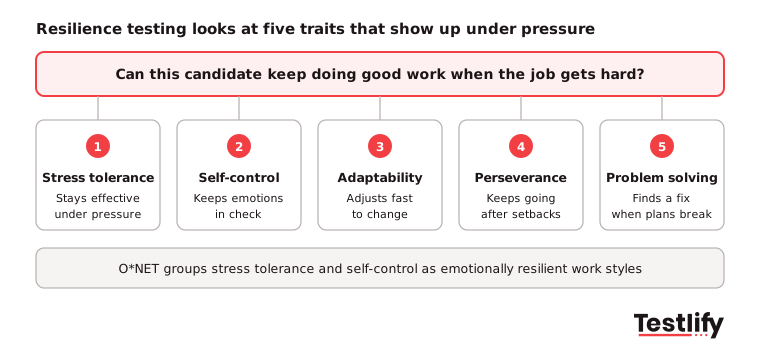
O*NET's list of work styles also covers adaptability, perseverance and optimism, which most resilience tests fold in. Problem solving overlaps with cognitive skills, so many teams pair the resilience test with a problem-solving assessment.
Why does resilience testing matter in hiring?
Resilience testing matters because interviews and resumes show what a candidate has done, not how they behave when the job gets hard. A structured test fills that gap, so teams can predict who will cope with pressure, adapt to change and stay in demanding roles.
Workplace pressure is high. Gallup's State of the Global Workplace data found that 40% of employees worldwide experienced a lot of stress on the previous day in 2025, while global engagement fell to 20%. According to the American Psychological Association's 2025 Work in America survey of 2,017 US workers, 54% say job insecurity has a significant impact on their stress.
Employers have noticed: 67% of employers in the World Economic Forum's Future of Jobs Report 2025 call resilience, flexibility and agility a core skill, second only to analytical thinking.
Resilience testing helps hiring teams in seven ways:
- See how candidates handle stress: Scenarios show who stays calm and keeps working when pressure rises.
- Predict fit for demanding roles: Resilient people tend to do better where deadlines are tight, plans change fast and problems arrive without warning.
- Check problem solving and adaptability: The same scenarios show whether a candidate thinks clearly and adjusts to new priorities, markets or tools.
- Reduce early turnover: People who cope with job stress are less likely to burn out and leave, one reason teams use psychometric tests to reduce turnover.
- Make teams stronger: Resilient employees support colleagues in hard weeks and keep morale up, which helps team dynamics.
- Lower hiring risk: A low-resilience hire in a high-pressure role can mean missed targets, absence and a costly rehire.
- Make better, fairer decisions: Every candidate gets the same scenarios and scoring, which adds evidence to resumes and interviews instead of gut feel.
What types of resilience tests are there?
Resilience tests come in five formats: self-report questionnaires, situational judgment tests (SJTs), behavioral interviews, AI interviews and job simulations. Self-report questionnaires are fastest, SJTs balance speed with resistance to faking, and interviews and simulations add depth for final rounds.
Format | How it works | Time | Easy to fake? | Best stage |
|---|---|---|---|---|
Self-report questionnaire | Candidate rates statements such as "I bounce back after a setback" on an agree to disagree scale | 3 to 10 min | Yes | Development, low-stakes screening |
Situational judgment test | Candidate picks the best response to job-like scenarios | 10 to 15 min | Harder | Early screening at volume |
Behavioral interview | Interviewer asks about real past setbacks and scores against a rubric | 20 to 30 min | Moderate | Final rounds |
AI interview | Video, voice or chat questions scored against the same criteria for all | 10 to 20 min | Moderate | First round, high volume |
Job simulation | Candidate works a realistic task with interruptions or time pressure | 15 to 45 min | Hard | Critical roles |
Self-report scales are well established. The Harvard Chan Center for Health and Happiness lists 35 published resilience measures, from the 6-item Brief Resilience Scale to the 25-item Connor-Davidson Resilience Scale. Learn more about situational judgment tests.
Free online quizzes such as Psychology Today's 20-statement test use this style. These scales were built for research and well-being, so for hiring, an SJT tied to real work is usually the better pick.
Online tests: suit remote and high-volume hiring. Candidates take them anywhere, results come back at once and everyone gets the same conditions.
Offline tests: suit sites with weak internet and let an assessor add context face to face. Whichever you choose, the test must be accurate, consistent and relevant to the job.
Which roles need resilience testing most?
Roles with constant pressure, emotional labor or frequent change benefit most from resilience testing: contact center and customer service agents, nurses and other healthcare staff, sales executives, IT support, project managers and supply chain managers. For these jobs, a candidate who cannot cope with stress is a fast route to burnout and rehiring.
- Contact center and BPO: Long queues, upset customers and strict targets. Resilience testing at volume cuts early attrition.
- Healthcare: Emergencies, long shifts and hard conversations with patients and families.
- Sales: Rejection is daily, so perseverance and optimism matter as much as product knowledge.
- IT support and operations: Outages arrive at the worst time and need calm, ordered problem solving.
- Project and supply chain managers: Plans break, suppliers miss dates and priorities shift every week.
How do you add resilience testing to your hiring process?
Adding resilience testing to your hiring process takes six steps: define what resilience means for the role, choose the right test format, train the people who review results, place the test at the right stage, run it the same way for everyone, and read the results alongside other evidence.
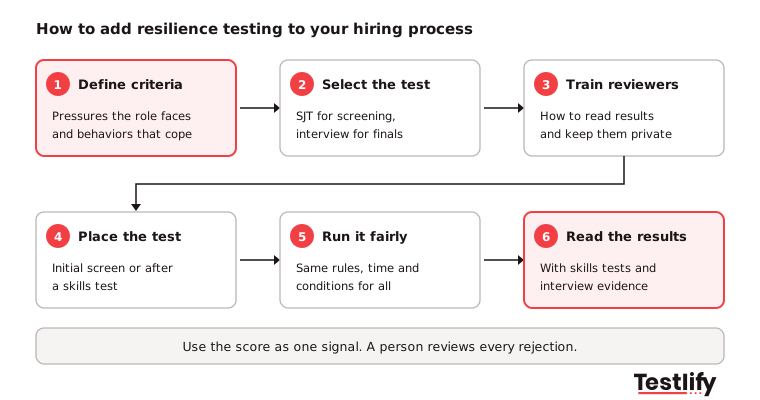
- Define objectives and criteria: List the pressures the role really faces, such as angry customers, tight deadlines or constant change, and the behaviors that show a person copes with them.
- Select the right assessment: Pick a format that fits the stage and volume. An SJT works for early screening, a behavioral interview for the final round. Check how each test is built and whether it fits the job. Teams often add a stress management test or an adaptability test for roles where one trait matters most.
- Train recruiters and hiring managers: Make sure everyone knows what the test measures, how to read results, how to give feedback and how to keep results confidential.
- Place the test in the funnel: Run it at the initial screen for volume roles, or after a skills test for specialist roles. Tell candidates up front that resilience testing is part of the process and why.
- Run it fairly and consistently: Same instructions, same time limit and same conditions for every candidate. Offer reasonable accommodations on request.
- Analyze and interpret results: Look at patterns and sub-scores, compare against the role's needs, and weigh the result with skills, experience and interview evidence.
Pro tip: Run the test on a few of your strongest current employees in the role first. Their scores give you a realistic benchmark, so you do not reject good candidates for missing an arbitrary cut-off.
What do resilience test questions look like?
Resilience test questions are usually short work scenarios with several possible responses, or interview prompts that ask about a real past setback. Strong answers show calm, ownership and a practical next step.
Weak answers blame others, freeze or give up.
Scenario or question | Strong answer shows | Red flag |
|---|---|---|
A major client rejects the proposal you spent two weeks on, one day before the quarter ends. What do you do first? | Asks for feedback, salvages what works, plans a fast follow-up | Blames the client or the team |
Your manager changes your top priority mid-sprint. | Clarifies the new goal, re-plans, flags trade-offs | Ignores the change or complains |
A customer is shouting about a billing error you did not cause. | Stays calm, acknowledges, fixes or escalates properly | Argues or hangs up |
Tell me about a time you failed at something important. | Specific story, what they learned, what they changed | No example, or the failure was "someone else's" |
Describe the most stressful week you have had at work. How did you handle it? | Prioritized, asked for help, kept quality up | Long list of complaints, no actions |
How do you read resilience test scores?
Resilience test scores are read against a benchmark for the role, not as pass or fail on their own. A high score suggests the candidate copes well with pressure and change.
A low score is a prompt to probe in the interview, not an automatic rejection.
- Look at sub-scores: A candidate can be strong on perseverance and weaker on adaptability. Match the profile to what the role demands.
- Compare with your benchmark: Use the scores of strong current employees in the same role as your reference point.
- Combine with other evidence: Weigh the score with skills tests, work samples and a structured interview.
- Probe gaps: Turn a low sub-score into a follow-up interview question about a real past setback.
Five signs of low resilience at work help you calibrate what a low score means: avoiding feedback, blaming others for setbacks, freezing or escalating under pressure, resisting change, and giving up after a first failure. Ask about these in the interview if the test flags a gap.
Key takeaway: Resilience testing works best as one signal in a structured process. The test spots the pattern, and the interview confirms it.
What are the challenges of resilience testing?
Resilience testing has five common challenges: choosing a reliable test, keeping conditions fair, interpreting results, handling candidate concerns and fitting the test into the hiring process. Each has a practical fix, and one legal rule applies to all of them.
- Choosing the right test: Many free resilience tests are wellbeing quizzes, not hiring tools. Fix: pick a test built for work scenarios and the role, and ask the vendor how it was developed and checked for bias.
- Keeping things fair: Uneven conditions give uneven results. Fix: set clear rules for everyone, train staff and keep instructions and time limits identical.
- Understanding the results: Scores without context mislead. Fix: use a structured approach, look at both numbers and answers, and compare against benchmarks.
- Dealing with candidate concerns: Some candidates worry the test invades privacy or is unfair. Fix: explain why you use it, how results are used and who sees them.
- Fitting the test into the process: An extra step can slow hiring. Fix: plan the stage, keep it short and send results to your ATS automatically.
The legal line is simple: test work behavior, never mental health. EEOC guidance on pre-employment medical exams says a psychological test is a medical exam if it provides evidence that would identify a mental disorder or impairment.
Employers cannot require medical exams before a job offer. A resilience test built on work scenarios stays on the right side of that line, but a clinical screening scale does not.
How does Testlify support resilience testing?
Testlify supports resilience testing with a ready-made resilience test and the tools to run it at scale. The resilience test is a 12-question situational judgment test that takes about 10 minutes and covers stress management, emotional intelligence, flexibility in change and creative problem solving.
- Pair it with other tests: Combine the resilience test with skills tests and related personality tests such as grit or emotional intelligence, from a library of 3,500+ tests.
- Add an AI interview: Follow up with video, voice or chat AI interviews that ask every candidate the same resilience questions and score each answer.
- Keep results honest: 20+ proctoring checks, including tab tracking, copy and paste blocking and AI assistance detection. Explore anti-cheating and proctoring features of Testify in detail.
- Fit your stack: Results sync to 100+ ATS and HRIS tools through Testlify integrations, and tests run in 15+ languages.
Ready to test for resilience?
Try the Testlify resilience test on your next high-pressure role. Start a 7-day free trial, no credit card required.
Want a walkthrough first? Book a demo and see a ranked shortlist with resilience scores next to skills results.
Frequently asked questions (FAQs)

People and Talent Partner
Arushi Shah runs day-to-day talent acquisition and candidate experience at Testlify. She writes on interviewing, structured hiring, and giving candidates a fair, fast process.
LinkedInRelated resources
View all
HR & recruitment
How project manager test helps you screen candidates

HR & recruitment
How Management test helps you screen candidates

HR & recruitment
How to incorporate Management test into your recruitment strategy

HR & recruitment
How to incorporate Sales test into your recruitment strategy

HR & recruitment
Video interviews for recruitment: a 202 guide for TA teams

HR & recruitment
How to incorporate project manager test into your recruitment strategy
Get started.
Hire on proof, not resumes.
Run your first skills-based assessment free — no credit card required.