
Testlify vs Evalart: A detailed comparison
Discover the perfect solution for evaluating your candidates’ skills with Testlify. Dive into our comprehensive Testlify vs Evalart…
 ChatGPT
 Gemini
 Claude
 Grok
Grok Perplexity
Testlify vs Evalart: the short answer
Testlify and Evalart both let you test candidates before you interview them, but they are built for different jobs. Testlify is a broad pre-hire assessment platform with a large role-based test library, layered proctoring and published pricing. Evalart is a leaner, lower-profile testing tool that quotes privately.
TL;DR:
- Pick Testlify if you hire across many role types and need one platform for coding, cognitive, personality and language testing.
- Pick Evalart if you run a smaller, mostly technical funnel and prefer a negotiated quote to a public price list.
- Testlify publishes its plans. Evalart does not, so budgeting means a sales call first.
- Proctoring is the sharpest split. Testlify documents a full integrity stack; Evalart documents webcam proctoring and cheat detection, and little beyond that publicly.
- Neither tool replaces your ATS. Both sit in front of it and feed it scored candidates.

What is the difference between Testlify and Evalart?
The difference is breadth and transparency. Testlify covers technical and non-technical hiring in one library, with role-specific assessments, layered proctoring, 100+ ATS integrations and public pricing. Evalart covers a narrower band, strongest in technical and sales testing, and keeps pricing behind a sales conversation.
That gap matters more than a feature checklist suggests. When a hiring team buys an assessment tool, it is usually buying a way to stop guessing from resumes. McKinsey research found that hiring for skills is five times more predictive of job performance than hiring for education, and more than twice as predictive as hiring for work experience. The tool only pays off if it covers the roles you actually hire for.
And the roles keep moving. The World Economic Forum's Future of Jobs Report 2025 found employers expect 39% of workers' core skills to change by 2030. A library that only measures what mattered three years ago ages badly.
Feature-wise comparison for Testlify vs Evalart
Compare the two side by side before you shortlist. A dash means the capability is not documented publicly by that vendor, which is not the same as the vendor lacking it. Only a check or a cross reflects something stated in public product documentation.
Features | Testlify | Evalart |
|---|---|---|
Test Library | ||
Role-specific tests | Yes, 3,500+ tests across 4,500+ roles | Yes (sales, leadership, customer service, languages, IT) |
Cognitive ability tests | Yes | Yes |
Programming tests | Yes | Yes |
No. of programming languages supported | 45+ | Not documented |
Situational judgment tests | Yes | Not documented |
Typing test | Yes | Not documented |
Software skills tests | Yes | Yes |
Non-technical tests | Yes | Yes |
Psychometric tests | Yes | Yes |
Personality tests | Yes | Yes |
Motivation test | Yes | Not documented |
Assessment templates | Yes | Yes |
Custom assessment creation | Yes | Yes |
Test recommendations by job role | Yes | Not documented |
Coding tests | Yes | Yes |
Assessments | ||
Custom assessment builder | Yes | Yes |
Custom coding questions | Yes | Not documented |
Multiple-choice questions | Yes | Yes |
Descriptive questions | Yes | Yes |
Video interview questions | Yes | Yes |
Assessments curated by I/O psychologists | Yes | Not documented |
Google Docs, Sheets and Slides tasks | Yes | Not documented |
Audio questions | Yes | Not documented |
Qualifier questions | Yes | Yes |
File upload questions | Yes | Yes |
Candidate experience | ||
Fully customizable email templates | Yes | Not documented |
Custom invitation and rejection email | Yes | Yes |
Mobile-friendly | Yes | Not documented |
Candidate support | Yes | Yes |
Instructions before assessment | Yes | Yes |
Average assessment length | 40-60 minutes | Not documented |
Assessment integrity | ||
Webcam snapshots and photo verification | Yes | Yes |
Cheat detection signals | Yes | Yes |
Session recording | Yes | Not documented |
Mouse and browser activity tracking | Yes | Not documented |
Copy-paste monitoring | Yes | Not documented |
AI assistance detection | Yes | Not documented |
Location and IP restriction | Yes | Not documented |
Randomized question sequence | Yes | Yes |
Time limit on tests | Yes | Yes |
Reporting and analytics | ||
Detailed candidate reports | Yes | Yes |
Per-category performance breakdown | Yes | Yes |
Shareable reports and scorecards | Yes | Not documented |
Exportable reports | Yes | Yes |
Recruiting analytics | Yes | Not documented |
Candidate benchmarking | Yes | Yes |
Enterprise and scale | ||
White label and custom branding | Yes | Yes |
ATS integrations | 100+ | Yes, via API |
User, role and access management | Yes | Yes |
Bulk candidate invite | Yes | Yes |
Public link invite | Yes | Yes |
Candidate pipeline management | Yes | Yes |
Multilingual assessments | Yes | Yes |
Campus hiring support | Yes | Not documented |
Dedicated account manager | Yes | Yes |
Support | ||
24/7 support | Yes | Not documented |
Email and on-call support | Yes | Yes |
Product demo | Yes | Yes |
Training and onboarding | Yes | Not documented |
Pro tip: ignore the row count. Count only the rows tied to a role you are hiring for this quarter. A platform that wins 40 rows you will never use loses to one that wins the six that decide your next shortlist.
How does Evalart work?
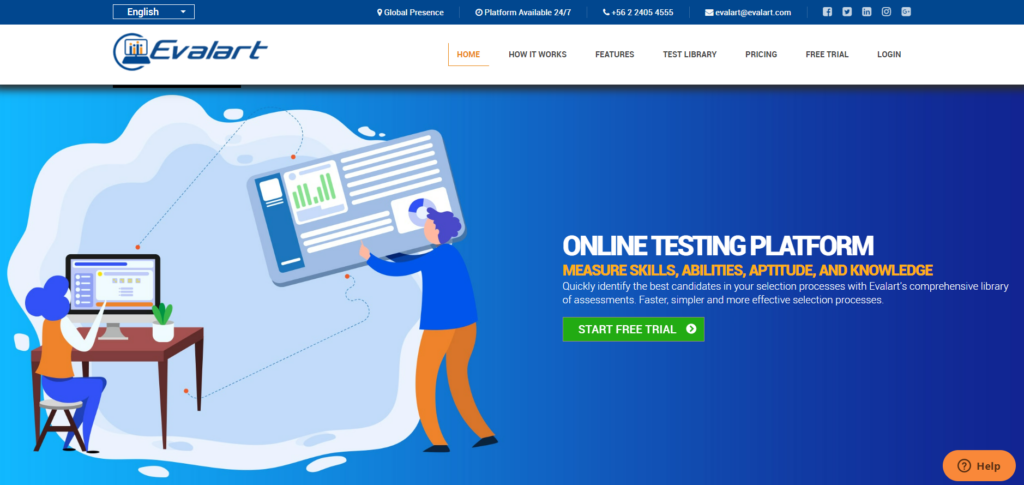
Evalart runs candidate evaluation in four steps. You pick or build a questionnaire from its library, invite candidates automatically or by hand, let them take the test online inside a time limit, then read scored results.
Reports break down total score, per-category performance and skill level, and they stay searchable by process, candidate or score. Its candidate database lets you compare performance over time, and tests, questions, candidate lists and reports can be imported and exported. For a team running one hiring process at a time, that is a tidy loop with very little to configure.
How much does Evalart cost?
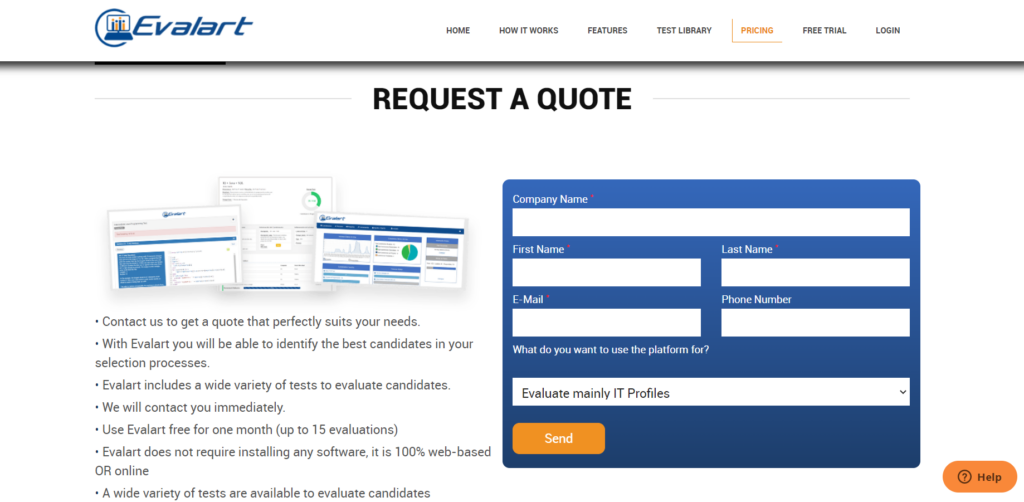
Evalart does not publish pricing. You contact their sales team for a quote, and there is a one-month free trial to test the platform first. Public directories describe it as inexpensive, but no plan tiers, per-seat rates or candidate limits are listed anywhere public.
Testlify lists its plans on the Testlify pricing page, billed monthly or annually. The practical difference is not the number, it is the timeline. Public pricing lets you model cost the same afternoon you find the tool. A quote-only vendor adds a sales cycle before you can even build a business case, which is a real cost when a role is already open.
Which platform is better for volume hiring?
Testlify, in most cases. Volume hiring breaks tools in three specific places: invite throughput, integrity at scale, and whether scores reach your ATS without a person retyping them. Testlify documents bulk invites, public link invites, 100+ ATS and HR software integrations, and a layered integrity stack.
Scale is not hypothetical right now. The U.S. Bureau of Labor Statistics reported 7.4 million job openings and 5.3 million hires in June 2026, with quits steady at 3.2 million. Those quits are backfills, and backfills arrive in batches. A tool that handles ten candidates comfortably and 400 badly will fail exactly when you need it.
Evalart can run volume, but you are relying on its API and a support relationship rather than a documented catalogue of prebuilt connectors. That is workable if you have engineering time. It is a problem if you do not.
When is Evalart the better fit?
Genuinely, sometimes it is. Three cases stand out.
- Your hiring is narrow and technical. If nearly every req is a developer or a sales rep, Evalart's smaller library stops being a limitation and starts being less noise to navigate.
- You want a negotiated price, not a list price. Some procurement teams prefer a quote they can push on. If your buying process runs through vendor negotiation anyway, quote-only pricing costs you nothing.
- You need very little configuration. Evalart's four-step loop is short. Teams that want testing without an implementation project can get value fast.
Where it gets harder is breadth and evidence depth. If you hire across engineering, support, finance and operations, you will hit the edge of a narrow library quickly. And if your assessments need to hold up to scrutiny, from a candidate or a regulator, documented integrity controls matter more than they look like they should on a feature grid.
How should you choose between them?
Stop comparing feature counts and start comparing evidence. The Testlify Multi-Signal Talent Evaluation Model is the frame worth borrowing here: a candidate should not move forward on one strong resume, one polished interview or one test score. They move forward when several independent, role-relevant signals point the same way. One signal is fragile. Several together create confidence.
Run the choice as four questions:
- Which competencies decide success in this role? Write them down before you look at any library.
- Which signals can actually measure each one? A coding assessment measures build ability. It says nothing about how someone handles an angry customer.
- Can the platform produce every signal you listed? This is where a narrow library shows up, not on a pricing page.
- Will you trust the result? Integrity controls and reviewer workflow decide whether a score survives a hiring debate.
Work through those four and the answer is usually obvious without a spreadsheet. If your list of required signals is short and technical, either tool clears the bar. If it spans several job families, breadth wins.
One caveat worth stating plainly: no assessment platform, Testlify included, makes the hiring decision. AI can score, summarize and flag. Humans decide, and stay accountable for the call. Any vendor implying otherwise is overselling. If you want the wider evidence base, the skills-based hiring statistics roundup collects the research behind this shift, and the Testlify test library shows what the signals look like in practice. For a wider field than these two tools, the Evalart alternatives comparison covers more options.
Hire on evidence, not guesswork
See how a role-specific assessment scores your shortlist before the first interview. Book a demo and walk through a real assessment built for a role you are hiring for right now.
Key takeaways
- Breadth is the real dividing line. Testlify spans technical and non-technical hiring in one library; Evalart is strongest in a narrower technical and sales band. If you hire across four or more job families, breadth stops being a nice-to-have and starts deciding whether you need a second tool.
- Pricing transparency changes your timeline, not just your budget. Testlify publishes plans, so you can model cost immediately. Evalart quotes privately, which adds a sales cycle before you can build a business case. When a role is already open, weeks matter more than percentage points.
- Integrity controls are the quiet differentiator. Both tools do webcam proctoring and cheat detection. Testlify documents more layers, including AI assistance detection and activity logging. That only matters if your assessments have to withstand challenge, but when it matters, it matters a lot.
- Skills evidence beats credentials, and the research is not close. Hiring for skills is five times more predictive of performance than hiring for education. Whichever tool you pick, the gain comes from testing rather than from the brand on the invoice.
- Your role mix should drive the decision. With 39% of core skills expected to shift by 2030, a library that only measures today's stack will need replacing sooner than the contract term.
- Neither platform replaces your ATS. Both feed it. Check integration depth against your actual stack before you sign, because retyping scores by hand cancels most of the time you just saved.
- Use several signals, not one. A single test score is a weak basis for a hire. Combine assessment data with structured interviews and reviewer feedback, and keep the final call with your team.
FAQs
Related resources
View all
Competitor Comparisons
Testlify vs HiPeople: A detailed comparison
Competitor Comparisons
Testlify vs REALCODERZ: A detailed comparison
Competitor Comparisons
Testlify vs HighMatch: A detailed comparison
Competitor Comparisons
Testlify vs BryQ: A detailed comparison
Competitor Comparisons
Testlify vs Crystal: A detailed comparison
Competitor Comparisons
Testlify vs Equalture: A detailed comparison
Get started.
Hire on proof, not resumes.
Run your first skills-based assessment free — no credit card required.