
6 Best proxies for recruitment intelligence in 2026
Explore the 6 best proxies for recruitment intelligence in 2026, with a provider comparison, key use cases, and tips for stable hiring-data collection.

Recruitment intelligence supports more than sourcing alone. Businesses use hiring data to track role demand, compare regional labor signals, monitor employer activity, and detect skill shifts earlier than standard recruiting reports show.
This work now sits inside a much larger HR technology stack. According to S&P Global (2026), the HR tech market reached $94 billion in 2025, while talent intelligence led growth at 17.9% CAGR. That growth matters because recruitment intelligence has become an always-on operating process, and stable data access now affects the quality of downstream hiring decisions.
 ChatGPT
 Gemini
 Claude
 Grok
Grok Perplexity
What Is Recruitment Intelligence?
Recruitment intelligence is the process of collecting and analyzing hiring-related data to support better talent decisions. It combines signals such as job postings, skill demand, hiring velocity, location trends, employer activity, and role requirements into a usable view for recruiting and workforce planning.
Key Data Signals
Recruitment intelligence usually includes vacancy volume, role repetition patterns, skill keywords, regional demand shifts, and employer hiring activity over time. Strong workflows also track update frequency because employers often change requirements, locations, and hiring volume within short cycles.

Why Does Recruitment Intelligence Need Proxies?
Recruitment intelligence relies on repeated data collection from job boards, career pages, and public talent sources across regions. Without proxy routing, one network quickly hits platform limits, which breaks rechecks, distorts local hiring signals, and lowers trend-data quality.
- Repeated Collection: Recruitment intelligence uses recurring checks because hiring data changes often.
- Regional Comparisons: This workflow needs location-matched results to compare demand, role visibility, and compensation signals by market.
- Source Coverage: Recruitment intelligence pulls data from many public sources, which raises request volume and filtering risk.
- Trend Reliability: Stable routing supports clean rechecks and preserves comparable snapshots over time.
- Data Quality: Proxy routing reduces missed pages, duplicate rows, and geo-mismatched records.
How to Choose Proxies for Recruitment Intelligence?
Proxy selection should match target difficulty, workflow shape, and refresh frequency. The right setup keeps access stable across repeated runs while preserving location accuracy and predictable operating cost.
Proxy Strength by Target Difficulty
Stricter hiring platforms and profile-heavy sources usually need higher-trust routing. Lower-risk pages can often run on lighter routing, which helps control cost without reducing data quality. This split lets teams assign stronger routes only where access friction is high instead of overspending across the whole pipeline.
Session Rules by Workflow Design
Multi-step flows need stable sessions, especially when the workflow includes filters, pagination, and repeated checks on the same source. Controlled rotation works better between tasks or across wider monitoring runs. Clear session rules also make collecting results easier to compare from one run to the next.
Validation Metrics Before Scaling
Teams should test with real collection patterns before scaling. The most useful checks are success rate, timeout frequency, geo accuracy, and how often retries produce incomplete or duplicate data. A short pilot with the final source mix usually shows routing problems earlier than synthetic tests.
Which Proxies Are the Best for Recruitment Intelligence in 2026?
Recruitment intelligence needs stable access, repeatable geo checks, and clean data collection across job boards, company pages, and hiring signal sources. The strongest proxy providers for this work support long collection runs, flexible session control, and tools that reduce manual cleanup.
Here are the six best proxy providers that support recruitment intelligence tasks in 2026.
Provider | Products | Tools for Recruitment Intelligence | Pricing |
|---|---|---|---|
1.Live Proxies | Rotating Residential Proxies, Rotating Mobile Proxies | Free Proxy Tester, session-based routing controls, private IP allocation for target-specific workloads | Rotating Residential: from $70 for 4GB (200 IPs, 30 Days). Rotating Mobile: from $70 for 4GB (50 IPs, 30 Days) |
2.SOAX | Residential Proxies, Mobile Proxies, US Datacenter Proxies, ISP Proxies, Web Data API | Web Data API, scraper APIs, AI-ready data collection workflows | Residential proxies: from $0.32/GB. Web Data API plans: from $0.90 per 1K requests |
3.Infatica | Residential, Mobile, Datacenter, Static ISP, IPv6 Residential, Web Scraper API products | Web Scraper, Scraping API, Data Collector, browser extension, dashboard controls | Pay-As-You-Go: from $4/GB, 25 GB for $96 ($3.84/GB) |
4.ProxyEmpire | Residential, Mobile, Datacenter, Static Residential, Sneaker, and Dedicated Mobile options, APIs | ProxyEmpire API, browser extension, proxy rotator, proxy validator, format converter | Rotating residential: from $7/GB, with promo pricing from $3.50/GB |
5.Rayobyte | Residential, Mobile, ISP, Datacenter Proxies, Web Scraping API, Web Unblocker | Web Scraping API, Web Unblocker, dashboard, and proxy management tools | Residential: from $0.90/GB. Mobile: from $0.50/GB |
6.Oxylabs | Residential, Mobile, ISP, Datacenter Proxies, Web Scraper API, Web Unblocker | Web Scraper API, Web Unblocker, proxy APIs, account control,s and enterprise support | Pay-As-You-Go: from $8/GB for residential and $9/GB for mobile proxies |
1. Live Proxies
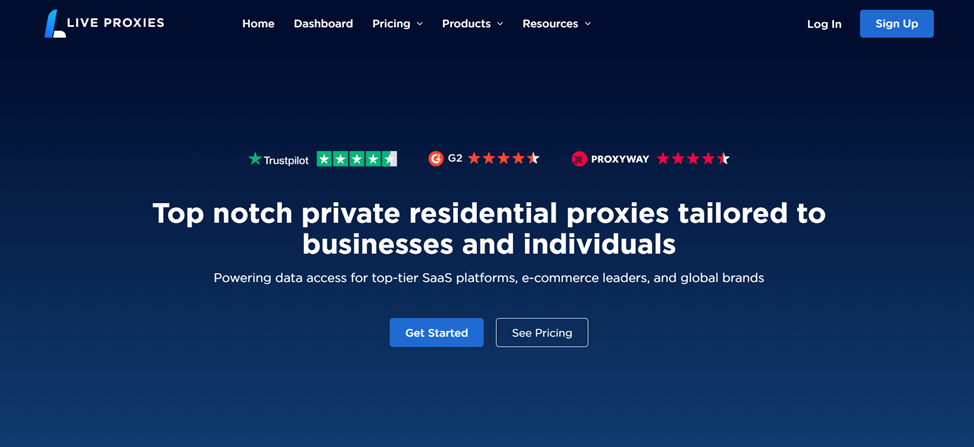
- Best For: Recruitment intelligence teams that run repeated collection cycles across hiring sources and need controlled routing for stable snapshots.
- Key Benefits: Free Proxy Tester for setup validation, Private IP allocation for separated traffic pools, and target-level exclusivity framing for cleaner source segmentation.
Why Live Proxies?
Live Proxies fit recruitment intelligence well when collection runs need long session continuity and a proxy with unlimited bandwidth setup for repeated checks. Provider supports sticky sessions up to 24h, which helps teams keep multi-step workflows stable when they revisit listings, company pages, and talent profiles on fixed schedules. Millions of IPs across 55+ countries make Live Proxies the perfect choice for regional hiring checks and market-by-market collection.
Provider also works well for structured monitoring programs because teams can split traffic by source group, region, or workflow stage instead of mixing everything into one route. That makes it easier to isolate issues during quality checks and keep recurring recruitment datasets consistent over time.
2. SOAX
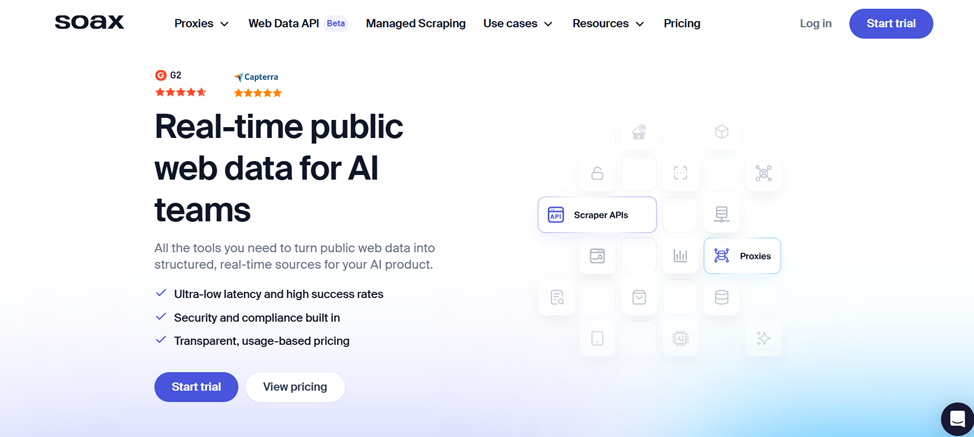
- Best For: Teams that need fine geo targeting and flexible rotation settings across many recruitment sources.
- Key Benefits: Included Web Data API access, customizable sticky and rotating sessions, and country, region, city, and ISP targeting.
Why SOAX?
SOAX stands out for recruitment intelligence when data collection depends on precise market segmentation. Its controls for geo targeting and session behavior help align collection routes with city-level hiring markets, regional compensation signals, and localized role demand.
The company offers a strong operations layer for recurring runs because the platform combines proxy access and Web Data API access in one environment. That setup helps teams mix standard proxy-based collection with API-driven extraction without splitting tools across vendors.
3. Infatica
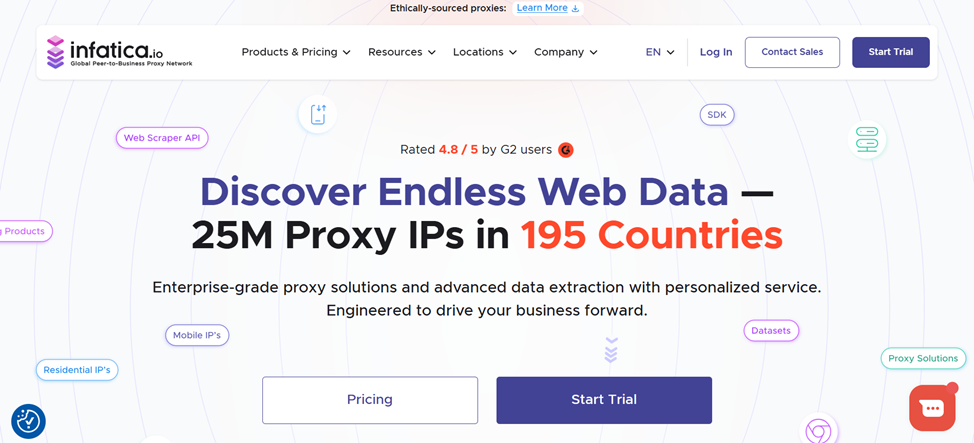
- Best For: Recruitment data teams that want both proxy traffic and scraping API options under one provider.
- Key Benefits: Residential, mobile, and datacenter products, API-based scraping options, and recurring collection support through dashboard controls.
Why Infatica?
Infatica is a practical option for recruitment intelligence when teams run mixed workflows. Some teams need raw proxy access for custom crawlers, while others need API-based collection for faster deployment. Infatica supports both models, which helps teams use one provider across different stages of hiring intelligence collection.
In practice, Infatica also fits gradual scaling. Teams can test collection quality on a narrow hiring niche first, then expand coverage into more regions or role categories without rebuilding the stack around a new vendor.
4. ProxyEmpire
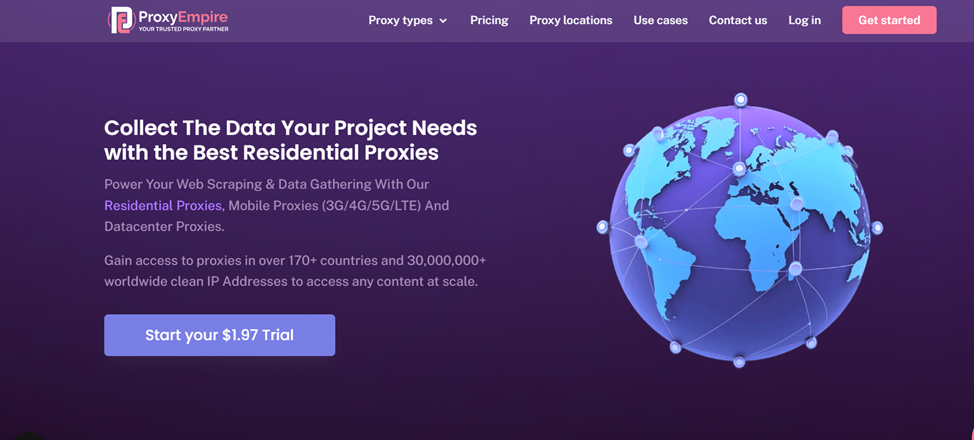
- Best For: Teams that need flexible rotation behavior and targeting options for market-level recruitment tracking.
- Key Benefits: Proxy Manager controls, sticky and forced rotation options, city and ISP targeting, and a low trial entry point.
Why ProxyEmpire?
ProxyEmpire works well for recruitment intelligence because it gives direct control over route behavior during recurring data checks. Teams can tune sticky sessions, natural rotation, and forced rotation intervals for different source types instead of using one rule for every platform.
It also supports cross-market hiring analysis with granular targeting and a setup that fits existing collection stacks. That makes it easier to add new countries and new source groups without heavy workflow changes.
5. Rayobyte
- Best For: Recruitment intelligence teams that want proxy infrastructure plus built-in scraping tools for different collection methods.
- Key Benefits: Proxy Pilot for management, Web Unblocker for harder targets, and Web Scraper API for simplified extraction workflows.
Why Rayobyte?
Rayobyte fits recruitment intelligence teams that want multiple collection options inside one ecosystem. Some hiring sources work well with direct proxies, while others need stronger anti-block handling. Rayobyte supports both paths through its proxy products and scraping tools, so teams can choose the right method for each source.
Provider reduces setup friction for operations teams that care about workflow control. Businesses can manage routing and adjustments through platform tooling instead of building every management layer from scratch.
6. Oxylabs
- Best For: Enterprise recruitment intelligence programs that need mature data collection products and advanced tooling.
- Key Benefits: Enterprise proxy stack, Web Unblocker, Web Scraper API, and strong product depth for complex collection pipelines.
Why Oxylabs?
Oxylabs is a strong choice for recruitment intelligence at enterprise scale because it offers a full product stack for difficult data collection environments. Teams can combine direct proxy infrastructure with managed scraping and unblocking tools when job platforms or company directories apply stronger anti-bot controls.
Oxylabs’ services are designed for large-scale hiring intelligence programs that operate multiple pipelines simultaneously. Teams can split infrastructure by workflow type, which helps keep sourcing data collection, labor market tracking, and employer intelligence more organized.
How Does a Proxy With Unlimited Bandwidth Help?
Unlimited traffic capacity supports recurring hiring-data collection without forcing teams to redesign workflows around GB limits. In recruitment intelligence, a proxy with unlimited bandwidth works well for scheduled rechecks, multi-region tracking, and high-volume monitoring where traffic spikes can interrupt collection mid-cycle.
Recurring Hiring Workloads
Recruitment intelligence usually runs as a recurring process. Teams collect snapshots, compare changes, and revalidate pages, so bandwidth limits can create blind spots during the periods when hiring activity changes fastest.
Operational Impact
Unlimited bandwidth does not, by itself, fix weak routing quality, but it removes a major operational limit. Teams can focus on session control, geographic accuracy, and request pacing instead of constantly adjusting workflows to meet traffic quotas.
What Recruitment Intelligence Tasks Do Proxies Help Solve?
Proxies help recruitment intelligence teams collect, compare, and refresh hiring data without breaking access during repeated checks. They support the daily tasks that turn public hiring signals into usable market, sourcing, and workforce insights.
- Job Posting Monitoring: Teams recheck job boards and career pages to detect new openings, removed roles, and changes in title, location, or requirements.
- Talent Market Mapping: Teams collect role demand by city, country, and region to compare where companies hire fastest and where skills cluster.
- Employer Hiring Activity Tracking: Teams monitor company hiring pages over time to spot expansion, hiring slowdowns, and department-level growth patterns.
- Compensation Signal Collection: Teams compare salary ranges and pay clues by source and region, where platforms show localized compensation data.
- Competitive Hiring Research: Teams track which companies hire for similar roles, which locations they target, and how often they refresh listings.
- Source Rechecks and Validation: Teams revisit the same URLs to confirm data quality, remove stale records, and verify changes before reporting.
- Multi-Region Data Collection: Teams run location-matched collection flows to avoid geo-mismatched results in global hiring analysis.
Conclusion
Proxy infrastructure supports the core mechanics of recruitment intelligence. It keeps repeated collection stable, improves regional accuracy, and helps teams maintain cleaner trend data across ongoing monitoring cycles.
The best provider depends on the workflow shape, source difficulty, and level of tooling the team needs. Some teams need stronger geo controls and API products, while others need simpler routing, flexible pricing, or tighter operational control for recurring hiring-data programs.

Wordpress Developer
Yash Patel is a Wordpress and SEO Specialist at Testlify with 3+ years of experience in technical SEO, on-page optimization, and content strategy. He works on improving Testlify's organic presence and produces content focused on hiring, talent assessment, and HR technology.
LinkedInRelated resources
View all
Skill assessment
What skills-based hiring data shows beyond the US and UK

HR & recruitment
AI across all stages of the hiring process in 2026

AI in recruitment
Best practices for hiring data analysts using assessments?

Candidate assessment
What tools support voice responses for language proficiency testing?

Candidate assessment
How do ATS-integrated assessments streamline hiring workflows?

Candidate assessment
How to assess financial modeling and accounting skills pre-hire?
Get started.
Hire on proof, not resumes.
Run your first skills-based assessment free — no credit card required.