
Best PEOs in Utah: Top partners for small usiness HR and Payroll in 2026
Top PEOs in Utah for small business HR & payroll in 2026 — trusted partners to streamline HR, benefits, and compliance.

PEO services in Utah hand a small business one contract for payroll, employee benefits, workers' compensation, and employment compliance. The provider becomes a co-employer, which means it runs payroll under its own tax ID and puts your staff on its group health plan. You still decide who gets hired, what they work on, and whether they stay.
Utah treats this arrangement seriously enough to license it. Any PEO doing business in the state has to hold a license from the Utah Insurance Department, and the department keeps a current roster of every licensed entity. That roster is the single most useful thing a Utah buyer can read before signing anything, and not one of the buying guides currently ranking for this query mentions it. This page uses it.
 ChatGPT
 Gemini
 Claude
 Grok
Grok Perplexity
TL;DR
- A PEO takes over payroll, benefits, workers' compensation and HR compliance through co-employment. It does not take over hiring decisions, and that distinction matters more than most buyers expect.
- Utah licenses PEOs under Utah Code Title 31A, Chapter 40. Checking the state roster takes two minutes and rules out anyone operating without a license.
- Five providers have a real Utah footprint and a current state license: Helpside, Stratus HR, Engage PEO (formerly Zamp HR), G&A Partners and Insperity.
- Group health is usually the reason the numbers work. With family coverage averaging $26,993 a year, a PEO's larger risk pool is often the only way a 30-person company gets big-employer pricing.
- The industry's favorite statistic, that PEO clients are 50 percent less likely to go out of business, comes from the trade association and shows correlation, not proof. Treat it as marketing, not a forecast.

What is a professional employer organization in Utah?
A professional employer organization is a company that becomes the co-employer of your staff. It handles payroll, payroll taxes, benefits administration, workers' compensation, and HR compliance under a contract called a client service agreement. In Utah, the arrangement is licensed and regulated by the state insurance regulator rather than left to private contract alone.
Co-employment sounds stranger than it is. Two companies share the legal duties of being an employer. The PEO owns the paperwork side: tax filings, benefit plans, insurance, employment records. You own the work side: what the job is, who does it, how well they do it, and whether they keep doing it. Nobody at the PEO decides who joins your team.
That split is why the model spreads fastest among companies between 20 and 200 employees. Below 20, the fees rarely beat a good payroll tool plus a broker. Above a few hundred, you can usually buy your own group plan at similar rates and want direct control of HR anyway.
What do PEO services in Utah actually cover?
PEO services in Utah cover five things: payroll and payroll tax filing, group health and retirement benefits, workers' compensation coverage, HR compliance and employment paperwork, and risk or safety support. What they do not cover is recruiting, interviewing, and deciding who to hire. Those stay with you.
The five blocks, in the order most buyers use them:
- Payroll and tax filing: Pay runs, direct deposit, W-2s, quarterly federal and Utah state filings, garnishments, and multi-state withholding if you have remote staff.
- Benefits: Access to the PEO's group medical, dental, vision, life and disability plans, plus a pooled 401(k). This is usually the line item that justifies the whole contract.
- Workers' compensation: Coverage through the PEO's master policy, along with claims handling and return-to-work management.
- HR compliance: Handbooks, I-9s, onboarding paperwork, termination documentation, leave tracking, and help when something goes wrong.
- Risk and safety: Site walkthroughs, OSHA support, and training. This matters far more in construction and manufacturing than in a software company.
Notice what is missing. A PEO will process the new hire flawlessly and has no view at all on whether that hire was a good one. Outsourcing the admin of employment is not the same as improving the quality of your employment decisions, and buyers conflate the two constantly.
How do the top Utah PEO providers compare?
Every provider below holds a current Utah license, checked in August 2026 against the Utah Insurance Department's current roster, which the department last updated in July 2025. The entity count matters more than it looks: national PEOs register many separate legal entities in Utah, so a long list of filings is a sign of scale, not of local presence.
Provider | Utah base | Entities on the Utah roster | Best for | Published pricing |
|---|---|---|---|---|
Helpside | Lindon, Utah | 6 | Utah-first service and in-person support | Not published |
Stratus HR | Sandy, Utah | 1 | Small teams wanting a named HR contact | Not published |
Engage PEO (formerly Zamp HR) | Lindon, Utah | 4 | Companies wanting a Utah team behind a national platform | Not published |
G&A Partners | Houston, with Utah offices | 2 | Multi-state growth beyond Utah | Not published |
Insperity | Houston, with Utah offices | 4 | Larger teams wanting deep benefits and HR bench | Not published |
Pro tip: none of the five puts a rate card on its website, and that is normal for the category. Two pricing models dominate: a percentage of total payroll, or a flat fee per employee per month. Ask which model a provider quotes, then ask what happens to the number when payroll rises 20 percent. The two models diverge sharply the moment you grow.
Which PEO companies in Utah should you shortlist?
Five providers are worth a call for a Utah company under about 300 employees. Three are Utah-headquartered and two are national firms with real offices in the state. The shortlist below weighs local presence, license status, benefits depth, and whether the provider serves companies of your size rather than tolerating them.
Helpside
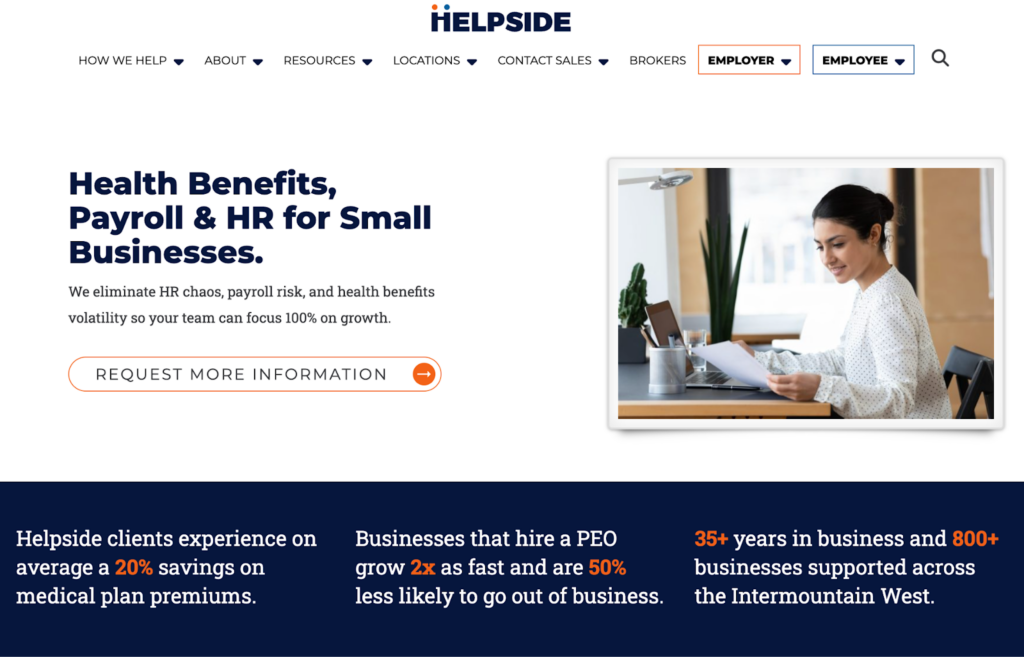
Helpside is the most Utah-rooted option on this list. It operates from Lindon and states more than 35 years in business with over 800 client companies across the Intermountain West. It carries six separate licensed entities on the Utah roster, which for a regional provider signals it has structured itself around the states it actually serves rather than around a national footprint.
Key features
Full payroll and tax filing, group medical and 401(k) administration, workers' compensation through a master policy, HR consulting, and safety and risk services. Support is delivered by people who can drive to your office, which sounds like a soft benefit until the first time a claim or a termination goes badly.
Best for
Utah companies between roughly 10 and 150 employees that want a provider who knows Utah employment rules cold and will show up in person. Construction, manufacturing, and trades companies in particular, where the risk and safety side earns its fee.
Pricing
Not published. Quotes are built per company from headcount, industry risk class and benefit selections.
Stratus HR
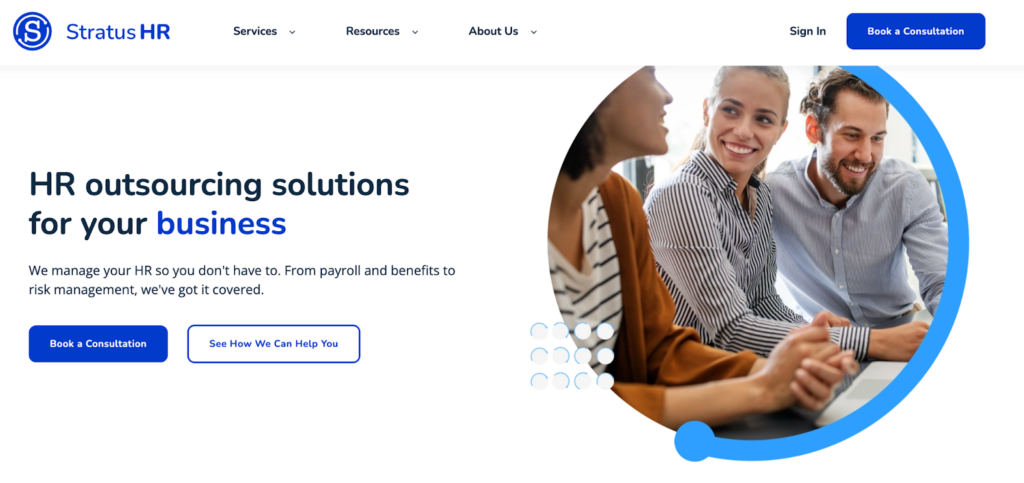
Stratus HR runs out of Sandy and was co-founded in 1999. It appears on the Utah roster as a single licensed entity, ISI HR, Inc. doing business as Stratus HR, which is the profile of a focused regional operator rather than a national roll-up.
Key features
Payroll administration, benefits including a pooled 401(k), workers' compensation management, and compliance support. The service model leans on assigning a named HR person to each client instead of routing everything through a ticket queue.
Best for
Small Utah companies, roughly 5 to 75 employees, that would rather call one person who already knows their situation than explain it again to whoever answers. Professional services firms fit this well.
Pricing
Not published. Expect a per-employee monthly fee quoted after a benefits and payroll review.
Engage PEO (formerly Zamp HR)
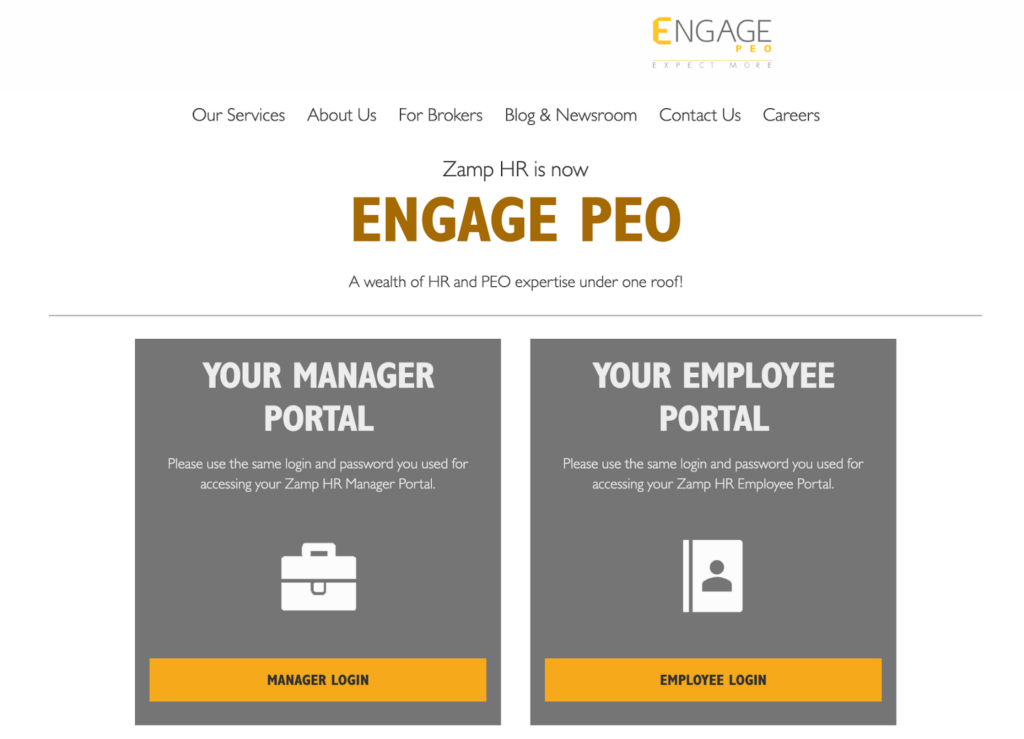
Zamp HR started in Orem in 2014 and merged into Engage PEO in 2023, keeping the Zamp name and its Lindon office as its operating base. Before the merger Zamp served more than 400 clients and over 12,000 worksite employees. The combined group carries four licensed entities on the Utah roster across the Engage and Zamp names.
Key features
Payroll, benefits, workers' compensation, and HR compliance, delivered with an in-house employment law bench, which is the part Engage markets hardest. The Utah team survived the merger intact, so local knowledge did not walk out the door.
Best for
Utah companies that want local people on the account but expect to add staff in other states within a couple of years, where a national platform stops being overkill and starts being the point.
Pricing
Not published. Quoted per company.
G&A Partners
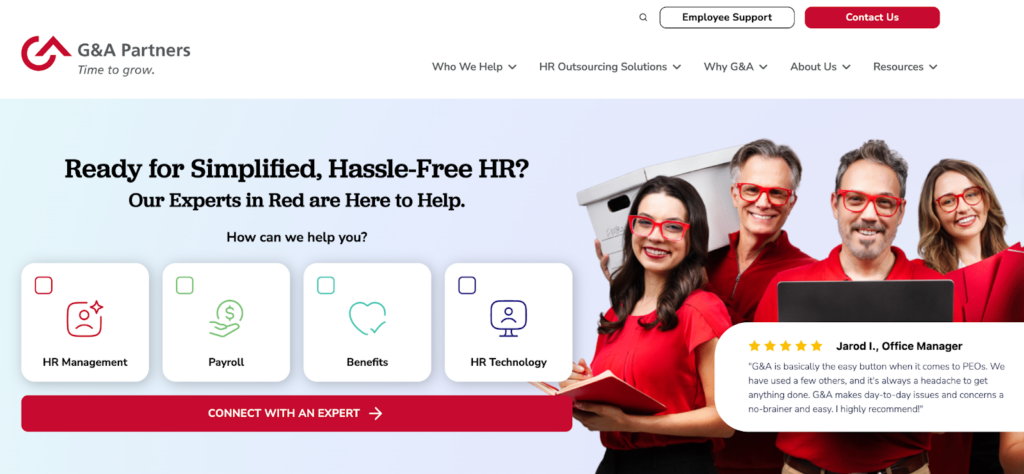
G&A Partners is headquartered in Houston and has operated in Utah for years with offices in the state. It appears twice on the Utah roster, as G & A Outsourcing, LLC and G&A Partners MSP, LLC. It sits in the middle of this list: bigger than the Utah-only providers, more hands-on than the largest nationals.
Key features
Payroll and tax administration, group benefits, workers' compensation, HR advisory, recruiting support and training. Multi-state payroll and compliance is the practical draw, since a Utah company that hires two people in Idaho and one in Texas inherits three sets of rules overnight.
Best for
Utah companies already operating in more than one state, or planning to within 12 months, that still want a named service team.
Pricing
Not published. Quoted per company on headcount and service mix.
Insperity
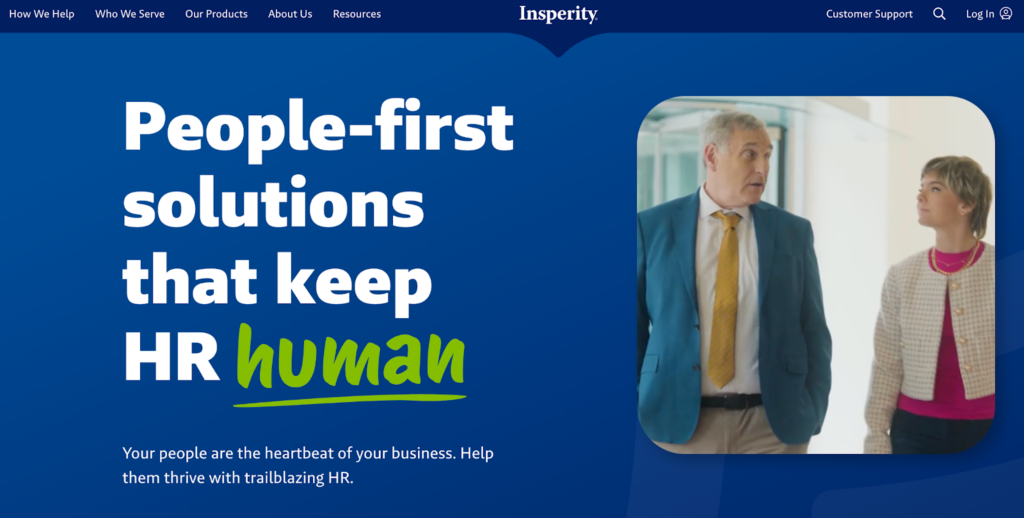
Insperity has been in the PEO business since 1986 and works from more than 70 US offices, including Utah. It shows up on the Utah roster under four entities, three of them still under the Administaff name it used before rebranding. It is the largest and generally the most expensive option here.
Key features
Payroll, a deep benefits menu including large-group medical, retirement, workers' compensation, performance management tooling, HR advisory and training. The benefits bench is the strongest argument: scale buys plan designs a 40-person company cannot reach alone.
Best for
Utah companies above roughly 75 employees that are competing for talent against much larger employers and need a benefits package that does not look small next to theirs.
Pricing
Not published, and typically at the higher end of the market.
What do PEO payroll services in Utah include?
PEO payroll services in Utah include running pay cycles, calculating and filing federal and Utah payroll taxes under the PEO's tax ID, handling garnishments and deductions, issuing W-2s, and managing withholding for employees in other states. The PEO carries the filing liability that a payroll tool leaves with you.
The difference from ordinary payroll processing is who is on the hook. A payroll application computes the numbers and files on your behalf, and the notice still arrives with your company's name on it. Under co-employment, the PEO is the reporting employer for those taxes. That single change is why finance teams stop losing days to state notices, and it is also why a PEO's own financial health is worth checking before you sign.
The Internal Revenue Service runs a voluntary certification program for this exact reason. A Certified Professional Employer Organization, certified under section 7705(a) of the tax code, has met IRS requirements on bonding and financial reporting, and the IRS keeps a public list of who holds the certification. Ask any shortlisted provider whether it is certified, and if not, why not.
What do payroll compliance services in Orem, UT cover?
Payroll compliance services in Orem, UT cover the same duties as anywhere else in the state: correct Utah income tax withholding, unemployment insurance filings, new hire reporting, wage and hour rules, and workers' compensation coverage. Utah County's concentration of fast-growing companies just means more employers hit these rules while scaling quickly.
Utah County is not incidental to this market. Zamp HR was founded in Orem, and both it and Helpside operate from Lindon, minutes up the road. The providers grew where the growth companies are.
The compliance work itself is unglamorous and expensive to get wrong. Misclassify a worker, miss a quarterly filing, or apply the wrong withholding to a remote employee, and the penalties arrive with interest. Companies usually reach for a PEO after the second or third such letter, not before. If your finance lead is spending more than a day a month on employment filings, the arithmetic has already tipped. Utah's own rules are worth reading either way, starting with a plain-language walkthrough of Utah employment and labor laws.
How good are PEO employee benefits in Utah?
PEO employee benefits in Utah are usually better than a small employer can buy alone, because the PEO pools thousands of worksite employees into one plan. For a company under about 50 people, this is normally the strongest financial argument for the whole arrangement, and often the only one that survives a spreadsheet.
The numbers explain why. Average annual premiums for employer-sponsored health coverage reached $26,993 for family coverage and $9,325 for single coverage in 2025, with family premiums up 6 percent in a year, according to KFF's 2025 Employer Health Benefits Survey. A 25-person company negotiating alone has no bargaining power against that curve. A pool of 20,000 lives does.
Retirement follows the same pattern. Among businesses with 10 to 49 employees, 52 percent of PEO users have a retirement plan against 23 percent of companies that do not use one, by the trade association's own count. That figure comes from the industry, so read it as directional. The mechanism behind it is real enough: joining an existing pooled 401(k) removes the setup cost and the fiduciary paperwork that stops small employers from starting one.
The catch is portability. Those benefits belong to the PEO's plan, not yours. Leave the PEO and every employee changes health plans, which is a genuinely rough thing to spring on people mid-year. Ask about the exit before you ask about the discount.
How many PEO firms in Utah serve small businesses?
The Utah Insurance Department's licensed PEO roster, updated July 2025, runs to seven pages and more than 400 entries. That is the honest answer to how many PEO firms operate in Utah, with one large caveat: those are licensed legal entities, not distinct companies, and the gap between the two is wide.
ADP TotalSource alone accounts for 18 entries. Paychex has 13. TriNet has 7, Helpside 6, Insperity 4. Strip out the duplicate filings from national groups, and the number of genuinely distinct providers is a small fraction of that. A buyer scanning that roster for the first time will badly overestimate how much choice exists.
Nationally, the picture is smaller than the Utah filing count suggests. The trade association counts more than 500 PEOs serving over 230,000 client businesses, on industry revenue of $414 billion. Utah's roster is long because national providers file per entity, not because 400 companies are competing for your account.
For scale on the other side of the market, Utah reported about 1.79 million nonfarm jobs and a 3.6 percent unemployment rate in July 2026, per the Bureau of Labor Statistics. It is a tight labor market in a state that keeps adding jobs, which is precisely when benefits packages start deciding who accepts an offer.
Do PEO clients really fail less often?
The industry's most repeated claim is that businesses using a PEO grow twice as fast, have 12 percent lower employee turnover and are 50 percent less likely to go out of business. The pages ranking for this query repeat it, mostly without saying where it comes from or what it can support.
It comes from NAPEO, the PEO industry's own trade association. That does not make it false. It does mean the figure is produced by a body whose purpose is to promote the category, and it compares companies that chose a PEO against companies that did not. Choosing a PEO costs money. Companies with the cash flow to buy one are already healthier than companies without it, so some of that 50 percent gap is the buyers, not the service.
The honest version: a PEO removes a class of expensive administrative failure, and better benefits genuinely help retention. Neither of those saves a company with a broken product or bad unit economics. If a salesperson leads with the 50 percent figure, ask what the comparison group was. The answer tells you plenty about how the rest of the conversation will go.
How do you choose a PEO service provider in Utah?
Choose a PEO service provider in Utah by checking its state license first, then its IRS certification, then the benefits plan your employees would actually join. Price comes fourth. A cheap quote on a thin health plan costs more in turnover than it saves in fees.
Four checks before you sign
1. Confirm the Utah license
Utah licenses PEOs under Title 31A, Chapter 40, administered by the Utah Insurance Department, and the department keeps a current roster of licensed entities. There are three license categories, including a small operation license for PEOs with no Utah office and no more than 50 employees employed or domiciled in Utah. Find your provider on the roster before the first meeting. If the legal entity on your contract is not the entity on the list, ask why.
2. Ask whether it is IRS-certified
CPEO status is voluntary, so plenty of sound providers do not carry it. But it is a clean, checkable signal on financial stability and bonding, and the answer takes one question.
3. Read the actual benefits plan
Not the summary, the plan. Network, deductible, out-of-pocket maximum, and which Utah hospital systems are in network. A plan that excludes the health system your employees already use will generate more complaints than the fee saving is worth.
4. Model the exit
Ask what happens on termination: notice period, what data you get back, in what format, and when. A provider that answers this crisply has done it before. One that gets vague is telling you something.
Then apply the same discipline to the decision the PEO will never make for you. The Testlify Human+AI Evidence-Based Hiring Framework combines AI-assisted evaluation with human judgment, using structured evidence instead of resumes, intuition or inconsistent interviews. A PEO makes employing people cheaper and safer. It does nothing about whether the person you employed can do the job, and a bad hire on a great benefits plan is still a bad hire, just a more expensive one to keep.
A worked example. A 60-person Utah manufacturer moving to a PEO cuts roughly two days a month of payroll and compliance admin and gets its people onto a large-group health plan. If that same company still screens by resume and a 30-minute chat, its cost per bad hire has not moved at all. Running a structured skills assessment first, then the same set of role questions for every candidate, is the part the PEO contract does not include, and the part that changes who ends up on the payroll it administers.
Hire with evidence, not guesswork
A PEO fixes the cost and risk of employing people. Testlify fixes the quality of who you employ. Assess candidates on the skills the role actually needs, compare them on the same evidence, and keep the final call with your hiring team. Book a demo and see what a structured shortlist looks like for a role you are hiring right now.
Key takeaways
- Check the state roster before the sales call. Utah licenses PEOs and keeps a current list of licensed entities, so verification costs two minutes. Any provider that is not on it, or is on it under a different legal entity than the one on your contract, is a conversation you want to have before signing rather than after a claim.
- The 400-plus entries on that roster are not 400-plus companies. ADP TotalSource files 18 entities, Paychex 13, TriNet 7. Real choice in the Utah market is a fraction of what the list implies, which means shortlisting five providers is thorough, not lazy.
- Group benefits are usually the whole financial case. With family coverage averaging $26,993 in 2025 and rising 6 percent a year, a small employer's own quote will not compete with a pooled plan. If a provider's benefits are mediocre, the rest of the pitch rarely rescues it.
- Treat the 50 percent survival claim as marketing. It comes from the industry's trade association and compares companies that could afford a PEO against companies that could not. The service helps, but that specific number is not evidence it prevents failure.
- Model the exit while you still have bargaining power. Benefits sit on the PEO's plan, so leaving means moving every employee to new coverage. Negotiate notice terms and data return at signing, when the provider still wants the deal.
- A PEO never improves your hiring. It administers employment, it does not evaluate candidates. Structured skills assessment is a separate decision, and it is the one that determines whether the payroll you are outsourcing is money well spent.
FAQs

Human Resources Lead
Snehi Parmar leads People at Testlify, owning hiring, culture, performance, and retention for a 90-person team. She writes on practical HR strategy and building people processes that scale.
Related resources
View all
Skill assessment
What skills-based hiring data shows beyond the US and UK

HR & recruitment
AI across all stages of the hiring process in 2026

AI in recruitment
Best practices for hiring data analysts using assessments?

Candidate assessment
What tools support voice responses for language proficiency testing?

Candidate assessment
How do ATS-integrated assessments streamline hiring workflows?
Candidate assessment
How to assess financial modeling and accounting skills pre-hire?
Get started.
Hire on proof, not resumes.
Run your first skills-based assessment free — no credit card required.