
How white label interview tools streamline enterprise talent pipelines
Discover how white-label interview tools help enterprises speed up hiring, reduce costs, and deliver a branded, compliant candidate experience.
A white-label AI interviewer lets you run AI-led interviews under your own brand. Candidates see your logo, colors, domain and emails, while the interview technology runs in the background.
That matters most when you hire for clients. Recruitment agencies, staffing firms, RPOs and consultancies can give candidates a consistent experience without sending them to a third-party interview platform.
But white labeling is more than removing a vendor logo. Once the interview carries your brand, you also need control over how the AI evaluates candidates, how humans review those results, and what evidence you can produce when a client or candidate asks how a hiring decision was made.
So the real question is not just "Can I put my brand on it?" It is "Can I run AI interviews under my brand without losing control of the hiring process?"
 ChatGPT
 Gemini
 Claude
 Grok
Grok Perplexity
TL;DR
- White-label AI interviewing puts your brand on the candidate-facing experience while the vendor runs the technology underneath. Branding is the easy half; accountability is the part that can cost you if you get it wrong.
- Agencies, consultancies and lean in-house teams get the most value because their brand is part of the product they sell to clients and candidates.
- Rebranding does not automatically shift compliance responsibilities. Who carries those obligations depends on the jurisdiction, the use case and the parties involved.
- Judge a platform on four things: interview formats, AI configurability, human oversight and whether its analytics show you how well your interview questions perform.
- Most white-label tiers are paid add-ons, not free toggles. Price the branding layer before building your business case around it.

What is a white label AI interviewer solution?
A white-label AI interviewer solution lets you offer AI-led interviews under your own brand. Candidates see your logo, domain, colors and communications, while the interview technology runs behind the scenes.
The setup can cover different interview formats, including asynchronous video, conversational AI interviews, voice interviews and AI phone interviews. Depending on the platform, you can also configure the interviewer's questions, persona, prompts, timing and evaluation criteria.
For agencies and consultancies, the distinction matters. You can deliver interviews as part of your own hiring service without sending candidates to a third-party platform. For in-house teams, white-labeling can create a more consistent candidate experience across the hiring process.
But white-labeling is more than removing a vendor logo. Before choosing a platform, check what control you have over the AI, how candidates are evaluated, whether humans can review and override results, and what interview data and analytics you can access.
That's the difference between a platform that simply looks like yours and one you can actually operate as your own.
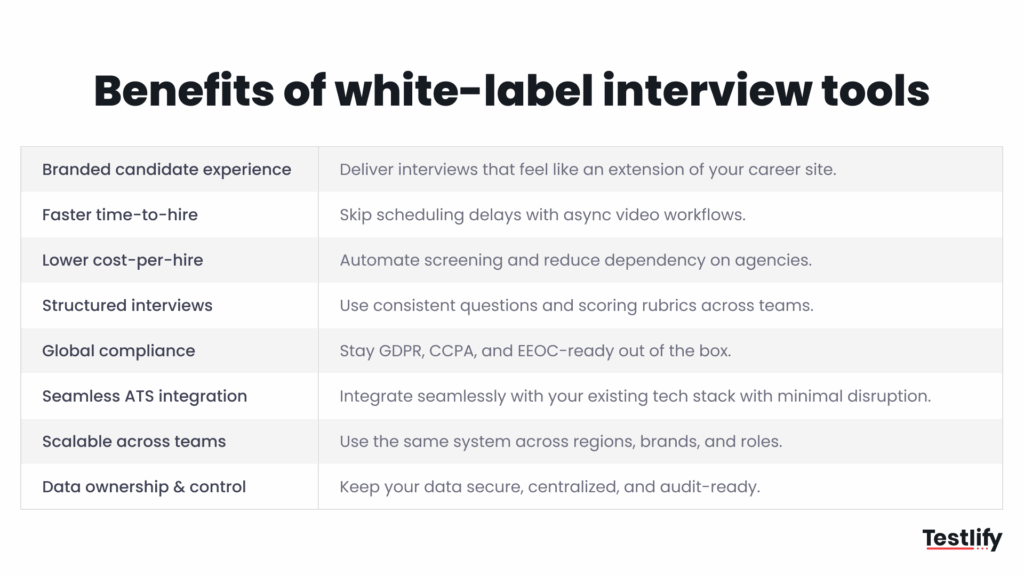
Where does branded interviewing actually break?
Not in the branding. In the handoffs around it. Four places, in the order teams usually hit them:
- Configuration: Can you control the questions, prompts, interview format, AI persona and evaluation criteria, or are you mostly changing the logo?
- Candidate experience: Does the interview actually feel like part of your hiring process, from the invitation and domain to the interview itself and follow-up?
- Human review: When the AI produces a score or recommendation, can a recruiter inspect the evidence, challenge the result and override it?
- Analytics: Can you tell whether your interview questions are producing useful signals, or are you just collecting more candidate data?
Pipeline stage | What usually breaks | What a branded AI interview changes |
|---|---|---|
First contact and scheduling | Calendar tag with candidates, days of dead time | An async interview link goes out immediately from your domain; candidates record when they can |
Screening and shortlisting | Phone screens queue behind whoever has time | Everyone answers the same configured questions; AI drafts a score a human confirms or overrides |
Team evaluation | Clips in one tool, notes in email, questions that vary by interviewer | One branded review surface with access control, structured rubrics, and a shared decision timeline |
Offer and handoff | Candidates bounce between a vendor-branded app and your careers site | Same brand end to end, with retention rules and audit trails your legal team can actually read |
What does an interview analytics platform show you?
An interview analytics platform shows you how candidates performed and, more usefully, how your questions performed. Score and time distributions, median and average score, percent attempted, percent correct, and the answer distribution per question. That second category is what separates analytics from a report export.
Testlify surfaces item-level psychometrics that normally live inside test-publishing software: a difficulty index, a discrimination index (how well a question separates strong candidates from weak ones), and a quality risk flag that marks questions with very low accuracy or high skip rates. You can scope any of it to one assessment, a workspace, or globally.
Why it matters for a white label buyer specifically: when the assessment carries your brand, a bad question is your bad question. A question with a poor discrimination index is not measuring skill, it is measuring noise, and it is filtering your clients' candidates on noise. Without item-level data you cannot tell the difference between a hard question and a broken one.
Benchmarking adds percentile, percentile rank, candidate rank, and comparison against other candidates and other reviewers. Reports export as PDF, ZIP or CSV, with granular show/hide controls on shareable reports, so a client sees exactly the AI insights and proctoring detail you intend and nothing else.
Pro Tip: Pull the discrimination index on your five most-used questions before you scale a branded assessment to a new client.
Who owns the compliance risk when you rebrand AI?
You do. This is the single most expensive misunderstanding in white label hiring tech, and it is worth being blunt about it.
In New York City, Local Law 144 prohibits employers and employment agencies from using an automated employment decision tool unless it has been through a bias audit within the past year, the audit summary is public, and candidates were notified. The Department of Consumer and Worker Protection requires that notice 10 business days before the tool is used. The obligation sits with the employer or agency running the tool. Your vendor's logo being invisible changes nothing about who the law names.
In the EU, Annex III of the AI Act classifies "AI systems intended to be used for the recruitment or selection of natural persons, in particular to place targeted job advertisements, to analyse and filter job applications, and to evaluate candidates" as high-risk. The European Commission's AI Act guidance is explicit on the category. High-risk brings duties, and Article 14 requires these systems to be built so they "can be effectively overseen by natural persons during the period in which they are in use," with operators able to interpret the output and override the decision.
Read those two together and the buying criteria write themselves. A white label AI interviewer that cannot produce evidence of how it scored someone, cannot be overridden by a human, and cannot export an audit trail is not a branding decision. It is a liability you have put your own name on.
The practical controls to demand: human override on every AI score, a toggle to keep AI scoring advisory, retention rules you can point at (Testlify deletes face verification data after 30 days and removes video and audio responses after 6 months, with warnings before deletion), and disqualification that is disclosed to the candidate rather than silent. Testlify's proctoring flags are deliberately evidence-first, with a yellow flag reading "Some behavior during the session wasn't ideal. A quick manual review is recommended" rather than an automatic rejection. Auto-termination exists but is separate and opt-in, with a threshold you set.
None of this is theoretical pressure. In the World Economic Forum's Future of Jobs Report 2025, 86% of employers expect AI and information processing technologies to transform their business by 2030. Regulators are writing rules for that transformation now, and hiring is the use case they named first.
How do you choose a white label interview tool?
Four questions, in priority order. Everything else is preference.
What to check | The question to ask a vendor | Why it decides the purchase |
|---|---|---|
Interview formats | Can I run one-way, two-way conversational AI, voice and phone in one product? | Buying two tools to cover async and live-style formats doubles the integration work and splits the candidate data |
AI configurability | Can I set the avatar, voice, persona, prompts, attempts, recording time and preparation time? | A fixed AI interviewer is a template. A configurable one adapts to a client's role and tone, which is the whole point of branding it |
Human override | Can a reviewer change any AI score, and can I hide the AI score entirely? | Required for defensibility under high-risk AI rules, and required for trust with clients who will ask |
Question analytics | Do I get difficulty and discrimination indices per question, not just candidate scores? | Without them you cannot prove your assessment measures skill, and you cannot improve it |
Then price it honestly. White labeling is commonly an add-on rather than an included feature, and Testlify is no exception: it runs $2,388 per year on the self-serve tiers, as do the 100+ ATS integrations, with both included on the Custom plan. Self-serve plans start at $139 per month billed annually for 100 assessment credits. Build your client quote on the real number, not the one on a features grid.
This is the Testlify applied to branded interviewing. It says a great assessment is not enough on its own: teams need a repeatable workflow that moves the right candidates forward with structure and speed. Define the role's competencies, build the assessment plan, invite automatically, assess, verify integrity, review AI-assisted insights, collect structured reviewer feedback, then decide with a named human accountable. White labeling changes what that workflow looks like to a candidate. It should not change a single step of what it proves.
Where it does not fit
Two honest limits. Testlify does not schedule live human interview panels, so if calendar coordination across four interviewers is the problem you are solving, this is the wrong tool for that job. And assessments run on Chromium desktop browsers; the mobile app is a capture fallback for recording audio and video, not a way to sit a full assessment on a phone. Across the teams we work with, both are easier to design around when they are known upfront than when they surface in week three of a rollout.
Hire on evidence, under your own brand
If you are running hiring for clients, or you are the founder who owns hiring alongside four other jobs, the fastest way to judge this is to configure one interview and take it yourself. Set the avatar, write the prompts, record an answer, then read what the analytics say about your own question. Book a demo and walk through the white label setup, or start with the white label assessment platform and see the candidate view before any of your clients do.
Key takeaways
- Branding is the easy half. Swapping a logo and a domain takes an afternoon. Deciding how an AI scores people, and who can overrule it, is the part that determines whether the tool survives a client's legal review. Budget your evaluation time accordingly, weighted toward the scoring model rather than the theme editor.
- You carry the compliance obligation, not the vendor. NYC Local Law 144 names the employer or employment agency, and the EU AI Act's high-risk regime attaches to the recruitment use case. Ask for the bias audit and the audit trail during evaluation, because you cannot ask for them after a complaint.
- Human override is a buying requirement, not a nice-to-have. Insist on the ability to keep AI scores advisory, hide them from reviewers, and route any question to a named human. A platform that cannot do this cannot be defended in front of a regulator or a client.
- Item-level analytics are how you improve, not just report. Difficulty and discrimination indices tell you whether a question measures skill or noise. Under your own brand, a broken question is your reputational problem, so check them before you scale to a new client.
- One product beats two. Covering async video, conversational AI video, voice and phone in a single platform keeps candidate data in one place and halves the integration work. Splitting formats across vendors is where branded experiences start to look unbranded.
- Price the add-on before you build the business case. White label tiers and ATS integrations are frequently paid extras, often a few thousand dollars a year each. Quoting a client off a features grid instead of the real contract is how margin disappears.
Frequently asked questions (FAQs)

B2B SaaS Content Writer
Rishav Kumar is a B2B SaaS content writer with 4 years of experience. He loves crafting engaging content. Always exploring fresh ideas, he's passionate about helping businesses grow through impactful writing.
LinkedInRelated resources
View all
HR & recruitment
How AI interviewers are reducing time-to-hire across industries

HR & recruitment
Best Alternatives to Traditional Interviews for Modern Hiring

HR & recruitment
AI interviewer vs human interviewer: Who makes better hiring?

HR & recruitment
Why remote companies are leaning on AI interviews for global hiring

HR & recruitment
HR in the higher education industry

HR & recruitment
Why AI powered phone screening is smarter for recruiters
Get started.
Hire on proof, not resumes.
Run your first skills-based assessment free — no credit card required.