
Testlify vs Thomas International: A detailed comparison
Discover the perfect solution for evaluating your candidates’ skills with Testlify. Dive into our comprehensive Testlify vs Thomas…
The best Thomas International alternative for most hiring teams is a platform that measures more than psychometrics. Thomas International is a solid behavioral and aptitude specialist. It does not test coding, software skills, or role-specific job knowledge, so teams hiring across technical and non-technical roles usually end up buying a second tool to cover the gap.
This page compares both platforms on what actually decides the purchase: test coverage, pricing transparency, proctoring depth, and how each one fits a structured hiring process. Where Thomas is the better choice, that is said plainly.
TL;DR
- Thomas International runs four well-known instruments covering behaviour, aptitude, personality, and emotional intelligence. That is its strength and also its ceiling.
- Testlify covers the same psychometric ground and adds coding, software, language, typing, and role-specific testing, so one platform can screen a developer and a warehouse supervisor.
- Thomas does not publish pricing. Testlify lists a Starter plan at $139 per month and a 7 day free trial, so you can budget before you talk to sales.
- Proctoring is the sharpest split: Testlify ships session recording, snapshot capture, and copy-paste lockdown, which matters for remote and high-volume hiring.
- Pick Thomas if you want a small set of deeply established profiling instruments for development and coaching. Pick Testlify if hiring decisions have to span many role types.
 ChatGPT
 Gemini
 Claude
 Grok
Grok Perplexity
Which is the best Thomas International alternative?
Testlify is the best Thomas International alternative for teams that hire across mixed role types. It keeps the psychometric coverage Thomas is known for, then adds coding, software skills, language, and role-specific tests in the same assessment, so one shortlist can be scored on job-relevant evidence instead of personality data alone.
That said, Thomas International earns its reputation. Its instruments are long-established, widely used for development and coaching, and easy for a line manager to read. If your use case is understanding people you have already hired, rather than screening people you have not, Thomas is a reasonable place to stay. The switch argument only gets strong when the same team also needs to test whether a candidate can write SQL, handle a spreadsheet, or work in French.

What makes Testlify different from Thomas International?
The difference is breadth of evidence. Thomas measures traits. Testlify measures traits plus demonstrated skill, which is what most hiring managers argue about when a shortlist is disputed. A candidate can profile beautifully on a behavioral questionnaire and still not be able to do the job.
Testlify's library covers these areas, each testable inside a single assessment:
- Role-specific tests for marketing, sales, finance, engineering, and operations roles, so the assessment matches the job rather than a generic profile.
- Situational judgment tests that put candidates in realistic work scenarios and score how they decide.
- Engineering skills tests across chemical, civil, mechanical, and electrical disciplines.
- Cognitive ability tests covering problem solving, logical reasoning, and decision making.
- Psychometric assessments including Big Five, DISC, 16PF, and enneagram profiles.
- Blue collar hiring tests for drivers, contractors, site supervisors, and service staff.
- Coding tests across 45+ programming languages, with live coding and custom questions.
- Software skills tests for Microsoft Office, Google Workspace, Figma, and Adobe tools.
- Typing speed tests measuring both speed and accuracy.
- Language proficiency tests across major languages at several proficiency levels.
Testlify publishes 3,500+ tests, 180k+ validated questions, 25+ custom question types, and 100+ ATS integrations on its plan and pricing page. Thomas works from a much smaller, deliberately narrow instrument set.
Pro Tip: run the behavioral test and the skills test in the same invite, not as two stages. Splitting them adds a week to the loop and gives candidates two reasons to drop out. Scoring both before the first call is what actually shortens time to shortlist.
Testlify vs Thomas International: feature comparison
The table below sticks to what both vendors state publicly. Where a capability is not published, it says so rather than guessing.
Capability | Testlify | Thomas International |
|---|---|---|
Behavioral and personality profiling | Yes | Yes |
Cognitive and aptitude testing | Yes | Yes |
Emotional intelligence testing | Yes | Yes |
Coding tests | Yes, 45+ languages | Not offered |
Software skills tests | Yes | Not offered |
Typing tests | Yes | Not offered |
Language proficiency tests | Yes | Not offered |
Role-specific job knowledge tests | Yes | Not offered |
Situational judgment tests | Yes | Not published |
Custom assessment builder | Yes | Not published |
Custom question types | 25+ | Not published |
One-way video interview questions | Yes | Not offered |
Total test library size | 3,500+ tests | 4 core instruments |
Validated question bank | 180k+ questions | Not published |
Session recording | Yes | Not published |
Snapshot capture | Yes | Not published |
Copy-paste lockdown | Yes | Not published |
IP address tracking | Yes | Not published |
Question randomization | Yes | Yes |
White label and custom branding | Yes | Not published |
ATS integrations | 100+ | Yes |
Bulk candidate invites | Yes | Not published |
Public pricing | Yes, from $139 per month | Quote only |
Free trial | 7 days, no card required | Not published |
GDPR compliance | Yes | Yes |
What assessments does Thomas International offer?
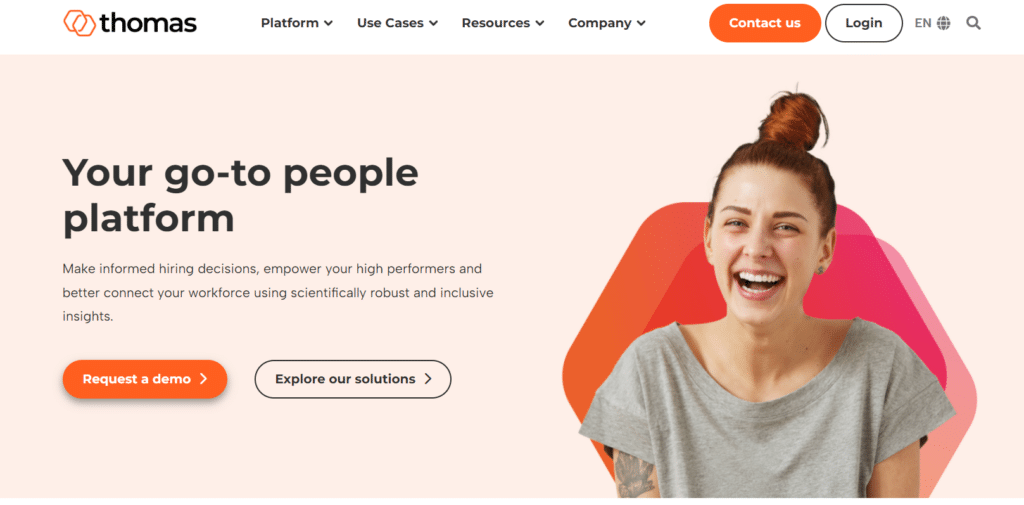
Thomas International runs four core instruments. Each is short, well documented, and aimed at profiling a person rather than testing a skill.
- PPA (Personal Profile Analysis): a behavioral questionnaire of 24 items that takes about 8 minutes and describes how someone prefers to work and communicate.
- GIA (General Intelligence Assessment): an aptitude test measuring how quickly a person learns and processes new information.
- HPTI (High Potential Trait Indicator): a 78 item personality questionnaire reporting six traits linked to leadership potential, including conscientiousness, curiosity, and risk approach.
- TEIQue (Trait Emotional Intelligence Questionnaire): a measure of 15 emotional traits and how a person handles work situations.
Read that list as a strategy, not a gap. Thomas chose depth on a few instruments over breadth. For succession planning, coaching, and team development, four well-understood profiles beat a library nobody has time to configure. The trouble starts at the hiring stage, where a behavioral profile cannot tell you whether the candidate can actually build the thing.
Thomas International software alternatives compared
Most Thomas International software alternatives fall into two camps. One camp copies the psychometric model and competes on report design. The other camp treats profiling as one signal among several and adds skills testing around it. The second camp is the one worth shortlisting if the tool has to support hiring decisions, because it is the only way to compare a candidate's stated experience against demonstrated ability in the same scorecard.
How much does Thomas International cost?
Thomas International does not publish pricing. You request a quote and pricing is set per organization, which makes a like-for-like cost comparison impossible before a sales conversation. For a small team trying to size a budget in an afternoon, that is a real friction point.
Testlify publishes its pricing. The Starter plan is $139 per month, billed at $1,668 per year, and includes 3 users and 100 candidate credits, with extra seats at $15 per seat per month. There is a 7 day free trial and no card is required to start. Whatever you choose, insist on seeing the per-candidate cost, because that is the number that scales with hiring volume.
Who are Thomas International's competitors?
Thomas International competes with two different groups, and confusing them is how teams end up with the wrong tool. The first group is other psychometric publishers selling behavioral and aptitude profiling. The second group is modern assessment platforms that fold profiling into a wider skills-testing suite.
Buying from the first group when the real problem is hiring volume gets you a better report and the same bottleneck. The honest test is to ask which decision the tool has to support. Developing an existing manager is a profiling problem. Choosing between 200 applicants for a support role is a screening problem, and screening needs job-relevant evidence.
Best alternatives to Thomas International
Rank the shortlist on four things: how many role families the test library covers, whether proctoring is strong enough to trust a remote score, whether pricing is published, and how cleanly results land in your ATS. A tool that wins on report design but forces a second vendor for skills testing has not replaced Thomas, it has added to the stack.
How should you choose an assessment platform?
Start from the decision, not the feature list. The research here is unusually clear, and it does not favour any single instrument.
A 2022 reanalysis of personnel selection research placed structured interviews among the strongest predictors of job performance, while years of education and general work experience ranked among the weakest. The debate over exact validity numbers is still live, but the ranking is the useful part: structure beats credentials. A meta-analysis of selection decisions also found that combining assessment data by a set formula predicts outcomes at least as well as experts re-weighing the same evidence by judgment. Consistency, not intuition, is what moves accuracy.
The context keeps shifting too. The World Economic Forum reports that employers expect 39% of workers' core skills to change by 2030, down from 44% in 2023. And people move: median employee tenure was 3.9 years in January 2024, the lowest since 2002. A profile of who someone is today ages faster than a measure of what they can do.
This is the thinking behind the Testlify Multi-Signal Talent Evaluation Model, which combines several role-relevant signals rather than leaning on one. Assessments, structured interview feedback, simulations, and reviewer scoring each add context, and a candidate advances when the signals agree. AI assists the review. People still make the call.
The caveat is real: more signals cost candidates more time. Three well-chosen tests beat seven, and a 90 minute assessment will cost you good applicants. Pick the two or three signals that genuinely predict the role, then stop.
Ready to see how this works on your own roles? Book a Testlify demo and walk through a live assessment built for a role you are hiring right now, or start the 7 day free trial and build one yourself. For a wider view of the market, the Thomas International alternatives roundup covers the other options, and the skills-based hiring data shows where the practice is heading.
Key takeaways
- Thomas International is a profiling specialist, not a screening platform. Its four instruments measure behaviour, aptitude, personality, and emotional intelligence well, which is why it works for coaching and development. It matters because buying it for high-volume hiring means paying for depth you will not use and still needing skills tests, so scope the decision before the demo.
- Test breadth is the deciding factor for mixed hiring. A platform covering coding, software, language, and role knowledge alongside psychometrics scores one shortlist on one scale. That removes the second tool, the second invite, and the second week of the loop, so consolidate if you hire more than one job family.
- Published pricing is a buying signal. Thomas quotes per organization while Testlify lists $139 per month and a 7 day trial. Budget owners can plan without a sales call, so ask any shortlisted vendor for per-candidate cost in writing before you commit.
- Structure beats credentials, according to the research. Selection studies rank structured methods above years of education or general experience. That means a defined scoring rubric is worth more than a longer resume screen, so write the rubric before you run the first assessment.
- Proctoring is not optional for remote hiring. Session recording, snapshot capture, and copy-paste lockdown are what make a remote score defensible. Without them a strong result is hard to trust, so check the integrity feature list before signing.
- Fewer, better signals win. Combining two or three role-relevant signals improves confidence, but every added test costs completion rate. Cap the assessment at a length real candidates will finish, and drop any test that does not change the decision.
FAQs
Related resources
View all
Competitor Comparisons
Testlify vs Indeed Hiring Platform: A detailed comparison
Competitor Comparisons
Testlify vs HireQuotient: A detailed comparison
Competitor Comparisons
Testlify vs Testwise: Comparison guide for recruiters
Competitor Comparisons
Testlify vs Symphony Talent: Which Is Better in 2026?
Competitor Comparisons
Testlify vs TestTrick: Which skills assessment platform is best for recruiters?
Competitor Comparisons
Testlify vs CodeSignal: Which Talent Assessment Platform is Best for You?
Get started.
Hire on proof, not resumes.
Run your first skills-based assessment free — no credit card required.