
Testlify vs TalentChaser: A detailed comparison
Discover the perfect solution for evaluating your candidates’ skills with Testlify. Dive into our comprehensive Testlify vs TalentChaser…
Talent Chaser and Testlify get compared a lot, and they are not really the same kind of product. Talent Chaser (some directories write it as TalentChaser, one word) is an evidence-based recruitment and performance-management suite that scores applicants against how your current people actually perform. Testlify is a pre-hire assessment platform that tests whether a candidate can do the job. Pick the wrong category and no feature checklist will save the decision.
TL;DR
- Talent Chaser screens with a 20-minute Performance Profile Questionnaire keyed to your own performance ratings. Testlify screens with role-relevant skills, coding, cognitive and language tests plus AI interviews.
- Check the vendor's current status before you shortlist Talent Chaser: talentchaser.com now redirects to its parent site, and the product Features page footer still reads 1979 to 2019.
- Testlify publishes its price. Talent Chaser publishes none, and the only route in is a consultation request.
- On predictive strength, job-relevant evidence beats a general behavioral profile, and structured interviews now outrank cognitive tests in the revised research.
- If a tool ranks or filters applicants, New York City and the EU both attach duties to it. That is a buying question, not a legal footnote.
 ChatGPT
 Gemini
 Claude
 Grok
Grok Perplexity
What is Talent Chaser?
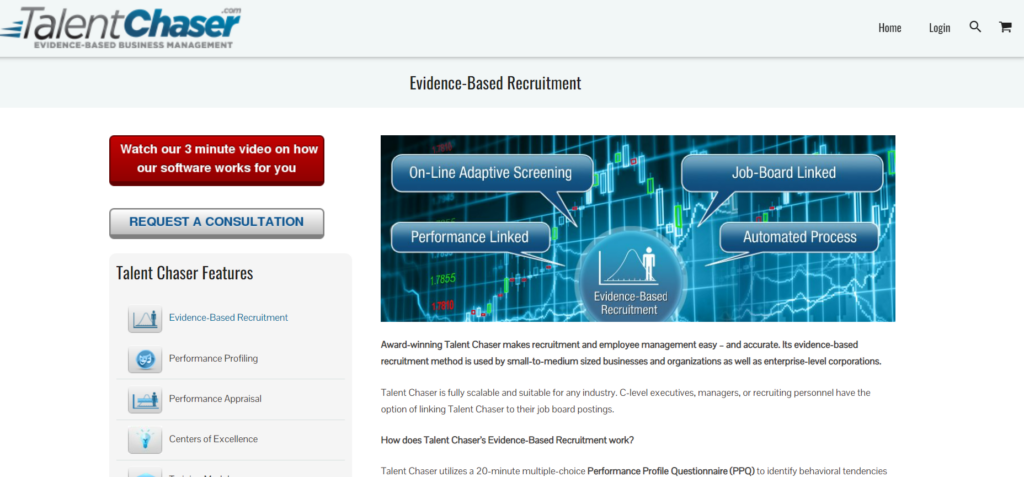
Talent Chaser is a recruitment and employee-management platform built around what its maker calls evidence-based recruitment. Candidates take a 20-minute multiple-choice Performance Profile Questionnaire (PPQ). The vendor compares those answers against performance ratings for the same role inside your company, then uses the result as a screening filter, per its own product documentation.
Around that sit six more modules: Performance Profiling, Performance Appraisal, Centers of Excellence, a Training Module, a Data Repository and a Meeting Manager. So the shape of it is a small talent-management suite with a screening front door, not a test library. The company behind it is The Cambridge Don, and the PPQ is positioned against personality testing rather than as another version of it, which is a more careful claim than most vendors in this space make.

Is Talent Chaser still an active product?
It is still reachable, and it is worth ten minutes of checking before you build a shortlist around it. The root domain talentchaser.com now returns a permanent redirect to The Cambridge Don, which markets AI shortlisting. Product pages under the old path still load, and the Features page footer still carries a copyright line running 1979 to 2019.
Two more signals point the same way. Software directories that carry a Talent Chaser profile show no user reviews to score, and there is no trial, no price and no self-serve signup anywhere on the vendor's site. The only path forward is a consultation request. None of that proves a product is winding down. It does mean the questions you would normally answer from a pricing page have to be answered by a salesperson, and that a procurement team should ask for a current customer reference and a support SLA in writing.
Pro tip: before any assessment vendor reaches your shortlist, check three things a demo will not show you: whether the pricing is published, when the product documentation was last updated, and whether the company will name a customer running the same volume you do.
How does evidence-based recruitment work?
Talent Chaser's loop runs in four steps. Managers rate the performance of people already in a role. Those same people complete the PPQ, which produces a behavioral profile of what your strong performers look like. New applicants take the same 20-minute questionnaire and get compared against that internal benchmark. As more performance data lands, the screen re-keys itself.
The logic is sound and genuinely different from a generic personality test. A profile keyed to your own outcomes is criterion-referenced, which is a real methodology with decades behind it. But it carries two costs a buyer should price in. First, it needs enough people in the role, with enough rating quality, to build a stable benchmark. A team of six customer-success reps with inconsistent review scores will not produce one. Second, it measures how someone tends to behave, not what they can do. A candidate can match the behavioral profile of your best data analyst and still not be able to write the SQL.
Testlify vs Talent Chaser: feature comparison
The old version of this page carried a 79-row tick grid that marked Talent Chaser absent on dozens of features it never claimed, with nothing to back the marks. That table is gone. What follows uses only dimensions checkable against each vendor's own published material, and says "Not published" where a vendor documents nothing rather than scoring it as a gap.
Dimension | Testlify | Talent Chaser |
|---|---|---|
What it primarily measures | Job-relevant skills, coding, cognitive ability, language, personality | Behavioral tendencies keyed to internal performance ratings |
Test library | 3,500+ validated tests across 5,000+ roles | Not published |
Coding and technical tests | Yes | Not published |
AI interviews | Yes, chat, audio and video | Not published |
Assessment integrity | Identity checks, proctoring controls, session evidence | Not published |
Post-hire modules | No, Testlify is pre-hire only | Yes: appraisal, training, data repository, meeting manager |
ATS integrations | 100+ | Job board posting stated, integration count not published |
Published pricing | Yes, Standard $139 per month or $1,668 per year | Not published |
Free trial | 7 days, no credit card | Not published |
Self-serve signup | Yes | No, consultation request only |
Vendor web status | Active product site and docs | Root domain redirects to parent; product footer dated to 2019 |
Which approach better predicts performance?
Job-relevant evidence wins, and the margin is bigger than most vendors admit. In the revised meta-analytic estimates published by Sackett and colleagues, structured interviews sit at .42, empirically keyed biodata at .38, and general mental ability tests at .31. Cognitive testing is no longer the strongest single predictor, and general personality measures sit well below all three.
Read that table carefully before using it as a stick. A PPQ keyed to your own performance data is closer to empirically keyed biodata (.38) than to an off-the-shelf personality inventory, so the honest framing is that Talent Chaser's method is respectable, not that it is weak. The catch is what happens next. That .38 is a ceiling for a well-built, well-maintained key, and re-keying it needs performance ratings you trust. Most companies do not have those. Manager ratings drift, inflate around review season, and vary more by manager than by employee.
Which is why the Testlify Multi-Signal Talent Evaluation Model treats no single score as the decision. It combines role-relevant signals (a skills test, a coding exercise or work simulation, an interview, reviewer scoring) so one weak signal cannot carry a hire on its own. One signal is fragile. Several pointing the same way is a decision you can defend, and the tooling only assists it: people still make the call.
There is a workforce argument underneath this too. The World Economic Forum's Future of Jobs Report 2025 puts skill instability at 39%, meaning employers expect 39% of the skills a job needs today to change by 2030. A behavioral benchmark built on how your current team works says little about whether a candidate can pick up what the role will need in three years. A skills assessment can be rewritten the week the role changes.
What do the compliance rules require?
Any tool that scores, ranks or filters applicants now carries duties, and they attach to the buyer, not only the vendor. Three rules matter most for either platform.
- New York City. Under Local Law 144, an automated employment decision tool cannot be used unless it has had a bias audit within the past year, the audit summary is public, and candidates get notice. The city's enforcement guidance sets that notice at 10 business days before the tool is used.
- European Union. The EU AI Act lists AI used to filter applications or evaluate candidates in recruitment as high risk under Annex III, which pulls in documentation, human oversight and logging duties.
- United States, federal. The Uniform Guidelines on Employee Selection Procedures (29 CFR Part 1607) still govern any selection procedure that produces adverse impact, and they expect evidence of validity for the job in question.
Here is the practical read. A screen keyed to internal performance ratings inherits whatever bias sits in those ratings, so the audit question is sharper for that design, not softer. Ask any vendor, this one included, for their most recent bias audit summary and their validation evidence for the role you are hiring. A vendor who cannot produce either in a week is telling you something.
How much does each platform cost?
Testlify publishes its plan pricing: the Standard plan is $139 per month or $1,668 per year, which includes 100 candidate credits and 3 user seats, with extra seats at $15 per month. There is a 7-day free trial with no card, a 30-day money-back guarantee, and a custom tier for higher volume. ATS integration and white labeling are add-ons.
Talent Chaser publishes nothing. Software directories quote estimated ranges, but those are the directory's own estimates rather than vendor figures, so treat them as noise. Budget instead for a sales cycle, an implementation conversation, and a per-seat or per-employee model you will only see under a quote. For a 40-person hiring plan, that difference is not academic: one path lets you run a paid pilot this week, the other starts with a calendar invite.
Which tool fits your hiring problem?
Choose Talent Chaser if the problem you are solving is post-hire: you have performance data you trust, you want appraisal and training in the same system, and you are hiring steadily into roles that already have a bench of current performers to key against.
Choose Testlify if the problem is pre-hire screening quality. Say a 900-person logistics company hires 60 warehouse leads and 15 analysts a year, and screening eats a recruiter's week for every 200 applicants. Skills tests scored before the first call cut that pile to a ranked shortlist, and the analyst roles get a coding or spreadsheet task rather than a behavioral profile. That is a different job from measuring who resembles your current team.
One honest caveat: if you want appraisal, training records and hiring in one place, Testlify will not give you that. It is pre-hire only and integrates with the rest of the stack rather than replacing it. Buying a screening platform to solve a performance-management problem fails the same way buying a performance suite to test SQL does.
Hire on evidence, not on a hunch
Run a real role through both approaches before you sign anything. Put your next open req through a Testlify assessment, compare the shortlist against the one your current process produced, and see which candidates you would actually have missed. Start with the library of validated skills tests, or book a demo and have someone build the assessment with you. Still weighing the category, the roundup of talent assessment tools worth shortlisting is the wider view.
Key Takeaways
- They are different categories. Talent Chaser is a talent-management suite with a behavioral screen at the front; Testlify is a pre-hire assessment platform. Deciding which problem you are solving, screening quality or post-hire management, settles the choice faster than any feature list.
- Check product status first. The redirect to the parent site, product pages footered to 2019, no public reviews and no published price are four signals that belong in your procurement notes before a demo, not after.
- Behavioral profiling has a real ceiling. Empirically keyed instruments land near .38 in the revised validity estimates, and only when the performance ratings behind them are trustworthy. If manager ratings in your company are inconsistent, that ceiling drops.
- Skills evidence ages better. With 39% of job skills expected to change by 2030, a benchmark built on today's team predicts less each year, while a skills assessment can be rewritten as the role changes.
- Compliance duties attach to you. A bias audit within the year, public audit summary and 10 business days of candidate notice apply in New York City; EU rules class recruitment filtering as high risk. Ask for the audit summary and validation evidence in writing.
- Published pricing is a real difference. $139 per month with a 7-day trial lets you test the tool this week. A consultation-only vendor turns evaluation into a procurement project, and that cost is worth naming out loud.
FAQs
Related resources
View all
Competitor Comparisons
Testlify vs Sales Candidate Assessment: A detailed comparison
Competitor Comparisons
Testlify vs Assess Candidates: A detailed comparison
Competitor Comparisons
Testlify vs Assessio: A detailed comparison
Competitor Comparisons
Testlify vs Assess Hub: A detailed comparison
Competitor Comparisons
Testlify vs EmployTest: A detailed comparison
Competitor Comparisons
Testlify vs AQai: A detailed comparison
Get started.
Hire on proof, not resumes.
Run your first skills-based assessment free — no credit card required.