
Testlify vs RecruitPack: A detailed comparison
Discover the perfect solution for evaluating your candidates’ skills with Testlify. Dive into our comprehensive Testlify vs RecruitPack…
 ChatGPT
 Gemini
 Claude
 Grok
Grok Perplexity
Looking for RecruitPack alternatives?
Testlify and RecruitPack are both pre-employment assessment tools, and the choice between them comes down to how much of the hiring stage you want one platform to cover. Testlify suits teams that need role-specific tests, coding assessments, one-way video interviews and proctoring in a single tool. RecruitPack covers a narrower band, and it does not publish pricing publicly.
The feature grid further down is the detailed answer. Before that, here is the part most comparison pages skip: what actually separates a useful assessment tool from an expensive one, and how to tell which side of that line a platform sits on.
TL;DR
- Testlify covers a wider testing surface than RecruitPack on the feature set compared below: coding tests, typing tests, personality and motivation tests, custom assessment building and one-way video interviews.
- RecruitPack overlaps on the basics. Cognitive ability, situational judgment, psychometric and multiple-choice testing appear on both sides.
- Pricing is the sharpest practical difference. Testlify publishes plans; RecruitPack quotes on request, which slows down any budget-led shortlist.
- No single test type predicts performance well on its own. The strongest research puts even the best method around r = .42, so combining signals beats picking a favorite.
- Score platforms on role coverage, evidence quality, integrity controls, workflow fit and pricing transparency, in that order. Test-library size is the weakest signal of the lot.

What makes Testlify different from RecruitPack?
Breadth of evidence, mostly. Testlify is built to collect several kinds of signal on the same candidate: a skills test, a coding exercise, a personality measure, a recorded video answer, then a scored report a hiring team reviews together. On the comparison below, RecruitPack concentrates on a smaller group of test types and leaves the rest of the screening stage to other tools.
That difference matters more than a feature count suggests. A platform that only measures one thing forces the rest of the decision back onto resumes and unstructured conversation, which is where most bad hires actually come from.
Worth being straight about scope: Testlify is an assessment platform, not an applicant tracking system, not a sourcing tool and not an HRIS. It integrates with the ATS a team already runs. Any comparison that implies an assessment vendor replaces the whole hiring stack is selling something.
Feature-wise comparison for Testlify vs RecruitPack
The grid below is the feature comparison as previously published on this page. Testlify's column reflects the current product. Treat the RecruitPack column as a starting point for your own checks, because vendors change their feature set without announcing it.
Features | Testlify | RecruitPack |
|---|---|---|
Test Library | ||
Role-specific tests | Yes | No |
Cognitive ability tests | Yes | Yes |
Programming Tests | Yes | No |
No. of programming languages supported | 45+ | No |
Situational judgment tests | Yes | Yes |
Typing test | Yes | No |
Software skills tests | Yes | No |
Non-technical tests | Yes | No |
Psychometric tests | Yes | Yes |
Personality tests | Yes | No |
Motivation test | Yes | No |
Assessment templates | Yes | No |
Custom assessments creation | Yes | No |
Test recommendations for different job roles | Yes | No |
Coding tests | Yes | No |
Assessments | ||
Custom assessment builder | Yes | No |
Custom coding questions | Yes | No |
Multiple-choice questions | Yes | Yes |
Descriptive questions | Yes | No |
Video interview questions | Yes | No |
Assessments curated by I/O psychologists | Yes | Yes |
Google doc | Yes | No |
Google sheets | Yes | No |
Google slides | Yes | No |
Audio questions | Yes | No |
Qualifier questions | Yes | No |
File upload questions | Yes | No |
Quality check | Extensive process incl. peer reviews, sample testing, review by psychometrician and more | Not stated |
Video interview questions | ||
One-way video interview | Yes | No |
Custom video questions creation | Yes | No |
Candidate's recording attempts per question | Yes | No |
Live video interview | No | No |
Candidate experience | ||
Fully customizable email templates | Yes | No |
Custom invitation and rejection email | Yes | Yes |
Mobile-friendly | Yes | Not stated |
Candidate support | Yes | Not stated |
Instructions before assessment | Yes | Yes |
Average assessment length | 40-60 minutes | Not stated |
Anti-cheating features | ||
Session recording | Yes | No |
Snapshot capturing | Yes | No |
Mouse tracking | Yes | No |
Copy-paste disabled | Yes | No |
Microphone and camera access | Yes | No |
Location access | Yes | No |
IP address tracking | Yes | No |
Randomization of question sequence | Yes | No |
Time limit on tests | Yes, typically 10 minutes | No |
Reporting and analytics | ||
Detailed reports | Yes | Yes |
Easy to share reports and scorecards | Yes | No |
Exportable/downloadable reports | Yes | Yes |
Recruiting analytics | Yes | Yes |
Candidate benchmarking | Yes | No |
Completion rate and response insights | Yes | No |
Enterprise friendly | ||
White label feature | Yes | No |
Custom branding | Yes | Yes |
ATS integration | Yes | Yes |
User, role, and access management | Yes | Yes |
Bulk candidate invite | Yes | No |
Share public link invite to candidates | Yes | No |
Candidate pipeline management | Yes | Yes |
Internationalization | Yes | Yes |
Campus hiring support | Yes | No |
Dedicated account manager | Yes | No |
GDPR compliant | Yes | No |
Multilingual abilities | Yes | No |
Customer support | ||
24/7 support | Yes | No |
On-call support | Yes | Not stated |
Email support | Yes | Not stated |
Product demo | Yes | No |
Training and onboarding tour | Yes | No |
How does RecruitPack work?
RecruitPack works the way most screening tools do. A recruiter picks or builds a test, sends candidates an invitation link, candidates complete the assessment in their browser, and the platform returns scored results the team reviews before deciding who reaches an interview. Its published coverage centers on cognitive ability, situational judgment and psychometric testing.
The mechanics are not the interesting part. Nearly every tool in this category follows that same invite, test, score, review loop. What separates them is what gets measured, how hard the result is to fake, and how much of the review a hiring team can do without exporting to a spreadsheet.
Testlify vs RecruitPack: Pricing
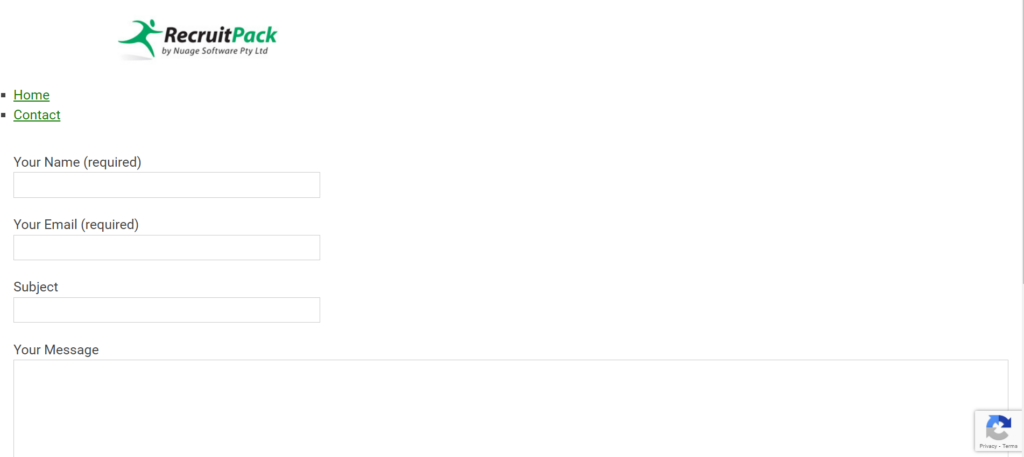
Testlify publishes its plans, billed monthly or annually. RecruitPack does not list pricing on its site, so a quote request is the only way to get a number.
RecruitPack Pricing
Pricing is not available publicly. You contact the vendor for a quote.
Quote-only pricing is not automatically a red flag, and plenty of enterprise vendors do it. But it does have a cost you should plan around: it adds a sales cycle before you can even rank options on budget, and it makes side-by-side comparison across three or four shortlisted tools slow. If procurement needs numbers this quarter, weight that.
How should you evaluate an assessment tool?
Score every platform on five things, in this order: role coverage, evidence quality, assessment integrity, workflow fit and pricing transparency. Test-library size belongs last. A library of 1,000 tests is worth nothing if none of them measure the competency that actually predicts success in the role you are filling.
Start with role coverage. Write down the three roles you hire most, then check whether the platform can measure the core skill for each without you building the test from scratch. A tool that covers your sales roles but leaves your engineering roles to a generic logic test has solved a third of your problem.
Evidence quality is next, and it is the one buyers skip. Ask what each test is meant to predict and how the vendor knows. Vague answers here are informative.
Then integrity. A remote test that anyone can complete with a second browser open is not evidence, it is a formality.
Workflow fit decides whether the tool survives its first quarter. If results do not land in the ATS your recruiters already live in, adoption drops off fast, no matter how good the assessments are.
The volume behind these decisions is real. The U.S. Bureau of Labor Statistics recorded 5.3 million hires in June 2026, against 7.4 million open roles and 3.2 million quits. And SHRM benchmarking puts the average cost per hire at $4,129. At that volume and that unit cost, a screening stage that lets weak candidates through is expensive in a way that shows up on a budget line, not just in a hiring manager's mood.
Pro Tip: Before any demo, send the vendor one real job description from your own pipeline and ask them to build the assessment they would recommend for it. You learn more from the assessment they produce in twenty minutes than from an hour of slides.
Do skills tests predict job performance?
Yes, but less dramatically than assessment marketing implies, and no single method wins outright. A 2022 re-analysis of the personnel selection literature by Sackett and colleagues, summarized by the Society for Industrial and Organizational Psychology, revised the long-standing rankings and put structured interviews at the top.
Selection method | Operational validity (Sackett et al., 2022) |
|---|---|
Structured interviews | .42 |
Job knowledge tests | .40 |
Empirically keyed biodata | .38 |
Work sample tests | .33 |
Cognitive ability | .31 |
Read those numbers honestly. The top method explains a minority of the variation in job performance, and the researchers themselves note that structured interview validities vary quite a bit around that .42 average. Anyone quoting a single test as a near-perfect predictor is overselling.
The practical read is not "pick the highest number". It is that these methods measure different things, so they stack. That is the logic behind the Testlify Multi-Signal Talent Evaluation Model, which combines several role-relevant signals (assessments, interviews, simulations, references and reviewer feedback) rather than resting a decision on one score. One signal is fragile. Several pointing the same direction is a decision you can defend to a hiring manager six months later.
Structure is doing a lot of the work in that top row. The U.S. Office of Personnel Management notes that interviews with higher degrees of structure show higher validity, better rater agreement and less adverse impact, because a structured format limits how much an individual interviewer can improvise. The same principle applies to tests: a standardized, role-mapped assessment beats an ad hoc one for the same reason a structured interview beats a chat.
How do you keep remote test results honest?
With layered controls, not one silver bullet. Remote assessment integrity comes from stacking weak signals into a picture: identity checks at the start, a locked-down test window, snapshot capture, tab and copy-paste monitoring, question randomization and a time limit tight enough that looking every answer up costs more time than it saves.
Testlify's proctoring set covers session recording, snapshot capture, mouse tracking, disabled copy-paste, microphone and camera access, location and IP tracking, and question randomization, with a typical per-test limit of 10 minutes. On the grid above, RecruitPack's listed feature set does not extend into this area.
Here is the caveat vendors leave out. A proctoring flag is not proof of cheating. A candidate glancing off-screen may be reading the question on a second monitor, or may be looking at a child in the room. Treat flags as prompts for a human to review the recording, never as an automatic rejection. Auto-rejecting on flags produces false positives that fall hardest on candidates testing from shared or noisy homes, which is a fairness problem and a legal one.
Which platform fits your hiring team?
Testlify fits teams hiring across mixed role types who want one place to run technical and non-technical screening, with proctoring and structured reporting built in. It fits campus and volume hiring too, where bulk invites and public assessment links matter more than they do for a handful of senior roles.
A narrower tool can be the right call. If you hire for one role family, already run technical screening elsewhere, and only need cognitive and psychometric measures, paying for breadth you will not use is a waste. That is the honest case for a smaller platform.
Role requirements are also moving, which argues for coverage you can extend. The World Economic Forum's Future of Jobs Report 2025 found that employers expect 39% of key skills to change by 2030, with 59% of the workforce needing training over the same period. A test library that matches your 2026 roles and cannot follow them is a shorter-lived purchase than it looks.
If you are still building a shortlist, it is worth reading across other RecruitPack alternatives and the wider set of assessment platform comparisons before booking demos, and checking whether your priority roles are already covered in the role-specific test library.
Ready to see how a real assessment scores your candidates? Book a demo and bring one of your own job descriptions. Testlify will build the assessment for it live, so you can judge the output on your own roles rather than a canned example.
Key takeaways
- Breadth is the real difference. On the feature set compared here, Testlify measures more kinds of signal than RecruitPack, including coding, typing, personality and video responses. That matters because every gap in coverage pushes part of the decision back onto resumes and unstructured conversation, which is where hiring mistakes concentrate.
- No test is a silver bullet. The strongest method in the Sackett et al. 2022 re-analysis reaches .42, and even that varies. Plan for a stack of signals, not a single score, and be skeptical of any vendor claiming predictive certainty.
- Structure beats sophistication. A standardized, role-mapped assessment reviewed consistently outperforms a fancier tool used loosely, for the same reason structured interviews beat unstructured ones on validity and adverse impact.
- Integrity controls only work in layers. One anti-cheat feature is theatre. Identity checks, monitoring, randomization and tight time limits together make a remote score worth trusting, and a flag should always trigger a human review rather than an automatic rejection.
- Quote-only pricing has a schedule cost. RecruitPack's pricing is not public, which adds a sales cycle before you can rank options on budget. Factor that in if you need to decide this quarter.
- Buy for the roles you will hire next. With 39% of key skills expected to change by 2030, a library that only fits today's org chart dates quickly. Weight extensibility over raw test count.
- Workflow fit decides adoption. If scores do not reach the ATS your recruiters already work in, usage fades within a quarter regardless of assessment quality.
FAQs
Related resources
View all
Competitor Comparisons
Testlify vs Remote Interview: A detailed comparison
Competitor Comparisons
Testlify vs Safety Quotient Assessment: A detailed comparison
Competitor Comparisons
Testlify vs SoftSkillLab: A detailed comparison
Competitor Comparisons
Testlify vs TalentChaser: A detailed comparison
Competitor Comparisons
Testlify vs Sales Candidate Assessment: A detailed comparison
Competitor Comparisons
Testlify vs Assess Candidates: A detailed comparison
Get started.
Hire on proof, not resumes.
Run your first skills-based assessment free — no credit card required.