
Candidate sourcing and screening: 17 platforms to use in 2026
The sourcing, screening and technical screening tools TA teams use in 2026, what each does best, and how to build a stack that fits.

Candidate sourcing and screening is the first half of hiring: sourcing finds and engages people who could do the job, and screening checks which of them actually can before a hiring manager spends time on interviews. Most teams need two to four platforms to cover both, and the right mix depends on where candidates get stuck.
TL;DR:
- Candidate sourcing and screening platforms split into four groups: sourcing tools, screening tools, technical screening tools and all-in-one suites.
- For sourcing, LinkedIn Recruiter is the default for professional roles, Indeed for hourly volume, and SeekOut or hireEZ for hard-to-find technical talent.
- For screening, pair an AI resume screener with skills tests or AI interviews so every shortlist rests on evidence, not on how a CV reads.
- For engineering roles, technical screening tools such as Testlify coding tests, HackerRank, Codility and CoderPad verify skills before the live round.
- Buy by bottleneck: too few applicants needs sourcing, too many needs screening, and bad hires from good shortlists need skills tests.
- Check ATS write-back, AI-cheating detection and a current bias audit before you sign. NYC Local Law 144 requires a yearly audit for automated screening tools.
 ChatGPT
 Gemini
 Claude
 Grok
 Perplexity
What is candidate sourcing and screening?
Candidate sourcing and screening covers everything from finding a potential candidate to deciding they deserve an interview. Sourcing is proactive: recruiters search databases and networks, then reach out to people who have not applied. Screening is evaluative: resumes, short questionnaires, skills tests and first-round interviews filter applicants against the job's requirements.
The two halves need different tools because they solve different problems. A sourcing tool is judged on reach and response rates. A screening tool is judged on whether the people it passes turn out to be good hires.
Candidate sourcing | Candidate screening | |
|---|---|---|
Goal | Fill the pipeline with relevant people | Decide who moves to interviews |
Starts with | A role brief and a search | A pool of applicants or sourced leads |
Typical tools | LinkedIn Recruiter, Indeed, SeekOut, Gem, hireEZ | AI resume screeners, skills tests, AI or video interviews |
Main metric | Response rate, qualified leads per role | Pass-through rate, quality of hire |
Common failure | Lots of profiles, few replies | Fast shortlists that still miss the skills |
For a deeper look at the first half, see the candidate sourcing guide.

How do sourcing and screening platforms work together?
Sourcing and screening platforms work as a chain of five stages: find, engage, screen, verify skills and decide. Sourcing tools own the first two stages, screening tools own the last three, and the applicant tracking system (ATS) holds the record at every hand-off so recruiters never re-type candidate data.
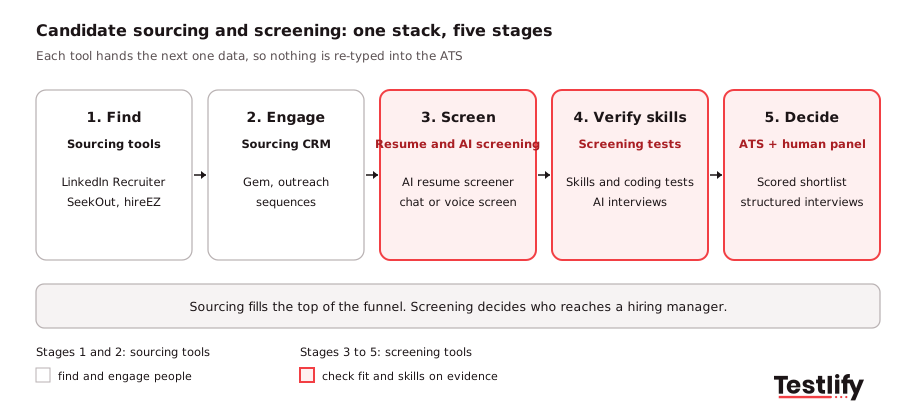
- Find: A sourcing tool searches profiles by skill, title, location and company, and saves matches to a project.
- Engage: A sourcing CRM sends personalized outreach sequences and tracks replies.
- Screen: An AI resume screener or a short chat screen checks applicants against must-have requirements.
- Verify skills: Skills tests, coding tests or structured AI interviews show whether the candidate can do the work.
- Decide: Scores sync back to the ATS, and a hiring panel interviews a ranked shortlist.
Teams already use AI across this chain. LinkedIn's Future of Recruiting 2025 found that 37% of organizations are integrating or experimenting with generative AI in hiring, up from 27% a year earlier. Those teams save about 20% of their work week, and 35% put that time back into candidate screening.
Pro tip: Map your current tools to the five stages before you buy anything. Most teams discover one stage with two overlapping tools and another with none.
Which candidate sourcing and screening platforms should you compare?
The 17 platforms below are the ones that appear most often in 2026 shortlists for candidate sourcing and screening, grouped by the stage they cover best. Use the table to narrow the list to two or three per stage, then read the entries that follow.
Platform | Stage | Best for | Standout | Pricing model |
|---|---|---|---|---|
LinkedIn Recruiter | Sourcing | Professional and leadership roles | Largest professional network, InMail | Per seat, yearly |
Indeed | Sourcing | Hourly and entry-level volume | Resume search plus job posting reach | Pay per post or resume access |
SeekOut | Sourcing | Technical and hard-to-find talent | Deep filters, diversity and cleared talent search | Per seat, quote |
Gem | Sourcing | Outbound programs at growing companies | Sourcing CRM with ATS-linked analytics | Quote |
hireEZ | Sourcing | Open-web search | Profiles pulled from many public platforms | Per seat |
Juicebox | Sourcing | Small teams that want plain-English search | Natural-language search | Quote |
Testlify | Screening | Skills-first screening for tech and non-tech roles | 3,500+ tests, AI interviews, AI resume screener | Credit-based, free trial |
HireVue | Screening | Enterprise video interviewing | One-way video plus assessments | Quote |
SHL | Screening | Large enterprises with formal selection programs | Cognitive and behavioral tests at scale | Quote |
Predictive Index | Screening | Team and manager fit | Behavioral and cognitive assessments | Quote |
Hogan Assessments | Screening | Leadership and executive hiring | Personality and derailer reports | Quote |
Paradox | Screening | High-volume hourly hiring | Conversational AI assistant for screening and scheduling | Quote |
HackerRank | Technical screening | High-volume coding assessments | Large coding challenge library | Tiered plans |
Codility | Technical screening | Enterprise engineering programs | Coding tests plus live interviews | Quote |
CodeSignal | Technical screening | Comparable scores across candidates | Standardized coding assessments | Quote |
CoderPad | Technical screening | In-house live coding interviews | Collaborative coding pad | Tiered plans |
Karat | Technical screening | Teams short on engineer interview time | Outsourced expert technical interviewers | Per interview |
Prices change often, so confirm the current model with each vendor during the trial.
What are the best candidate sourcing tools?
The best candidate sourcing tools in 2026 are LinkedIn Recruiter, Indeed, SeekOut, Gem, hireEZ and Juicebox. LinkedIn Recruiter and Indeed give the widest reach; SeekOut and hireEZ find people other databases miss; Gem turns sourcing into a repeatable outbound program; Juicebox suits small teams that want plain-English search.
1. LinkedIn Recruiter
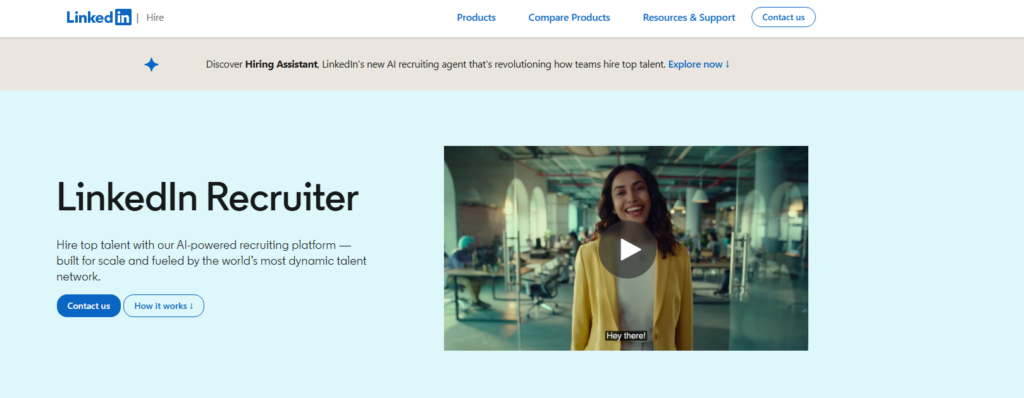
LinkedIn Recruiter searches the LinkedIn member network with filters for skills, title, company, location and years of experience, and lets recruiters message passive candidates through InMail. AI-assisted search suggests similar profiles and drafts outreach.
- Strength: No other database covers professional, technical and leadership talent as broadly.
- Watch out for: Seat costs add up fast, and generic InMail gets low reply rates. Personalize every message.
- Best for: Mid-market and enterprise teams sourcing professional, technical and leadership roles.
2. Indeed
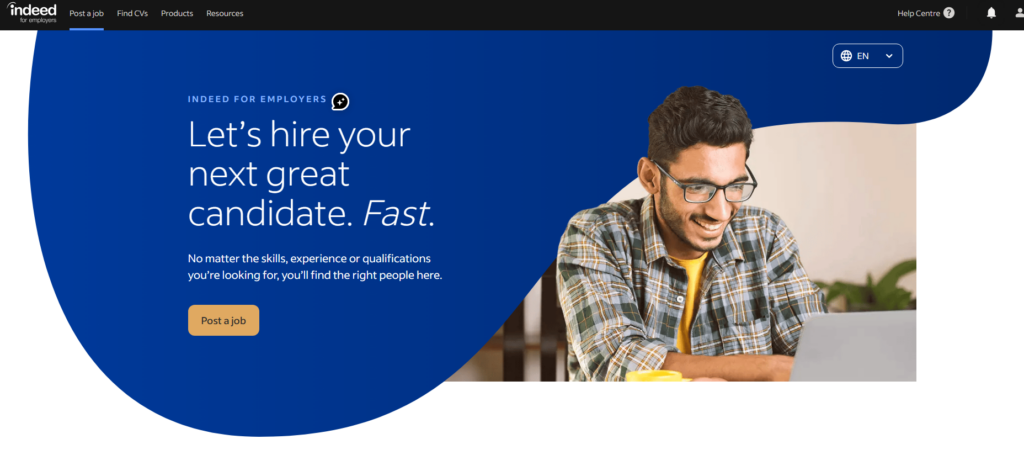
Indeed combines job posting reach with a searchable resume database, filtered by location, job title, education and skills. Sponsored posts and screener questions help teams handle large applicant flows.
- Strength: Reach for hourly, entry-level and frontline roles in customer service, logistics, healthcare and retail.
- Watch out for: Volume brings noise, so pair Indeed with a strong screening step.
- Best for: High-volume hourly and entry-level recruiting.
3. SeekOut
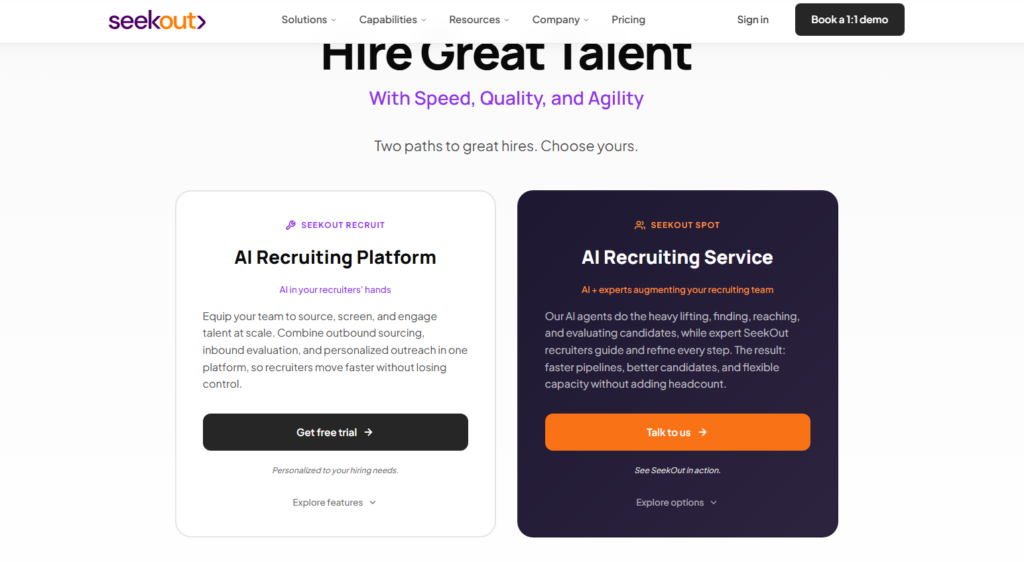
SeekOut searches profiles from professional networks, code repositories, patents and publications, with detailed filters for technical skills, diversity and security clearances.
- Strength: Finds engineers, researchers and cleared talent who are thin on LinkedIn.
- Watch out for: Enterprise pricing; smaller teams may not use its depth.
- Best for: Technical recruiting and teams with active diversity hiring goals.
4. Gem
Gem is a sourcing CRM: recruiters save candidates from any source, run multi-step email sequences, and report on pipeline and outreach results alongside their ATS data.
- Strength: Turns one-off sourcing into a nurtured talent pool you can reuse for future roles.
- Best for: Growing companies running a steady outbound sourcing program.
5. hireEZ
hireEZ searches the open web, pulling candidate profiles from many public platforms into one search, then adds contact details and outreach.
- Strength: Broad coverage outside a single network.
- Best for: Teams that source across many channels and want contact data in the same place.
6. Juicebox
Juicebox lets recruiters describe the person they want in plain English and returns ranked profiles, which lowers the skill bar for Boolean search.
- Strength: Fast to learn and quick to a first shortlist.
- Best for: Lean TA teams and hiring managers who source part-time.
What are the best candidate screening tools?
The best candidate screening tools in 2026 are Testlify, HireVue, SHL, Predictive Index, Hogan Assessments and Paradox. Each one checks a different signal: Testlify covers resumes, skills tests and AI interviews in one place, HireVue covers video, SHL and Predictive Index cover cognitive and behavioral fit, Hogan covers leadership risk, and Paradox covers high-volume chat screening.
For a wider comparison of testing vendors alone, see our list of talent assessment tools.
7. Testlify
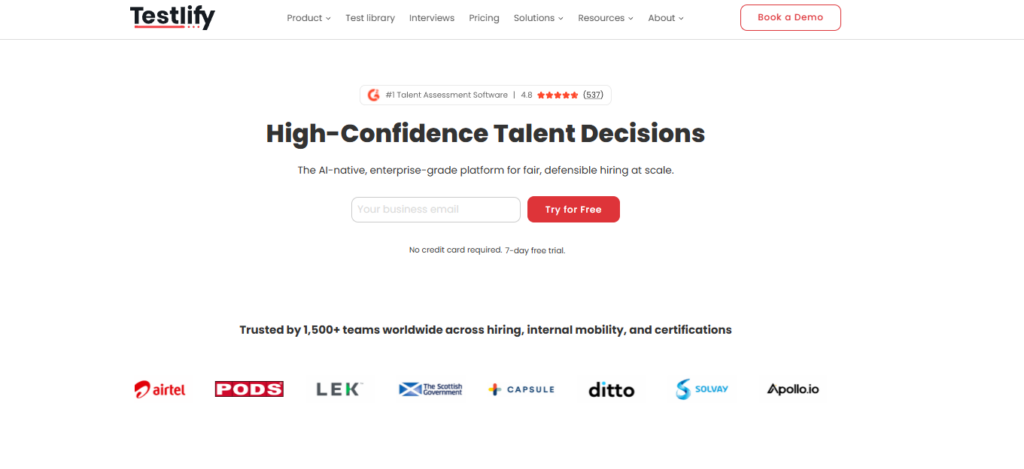
Testlify is an AI-native skills assessment and interviewing platform. It turns a job description into a role-specific assessment, runs structured AI interviews, scores every response and ranks candidates, with explainable results and a person reviewing the decision.
- Test library: 3,500+ tests across role-specific, software, coding, cognitive, situational judgment, language and personality skills, plus custom tests built on request.
- AI resume screener: Pulls resumes from the ATS, gives each an explainable match score with High, Medium or Low fit labels, and syncs results back. AI resume screener
- AI interviews: Video AI, Voice AI and Chat AI interviews ask role-based questions and score every answer against the same criteria.
- Question formats: 25+ question types, including coding, video, audio, file upload and Microsoft Office or Google Workspace tasks.
- Integrity: 20+ proctoring checks, including AI assistance detection, tab and copy-paste tracking, and webcam snapshots. anti-cheating and proctoring
- ATS fit: 100+ ATS and HRIS integrations with two-way sync, including Workday, Greenhouse, Lever and SmartRecruiters.
- Best for: Mid-market and enterprise teams that want resume screening, skills tests and first-round interviews in one platform, for tech and non-tech roles.
8. HireVue
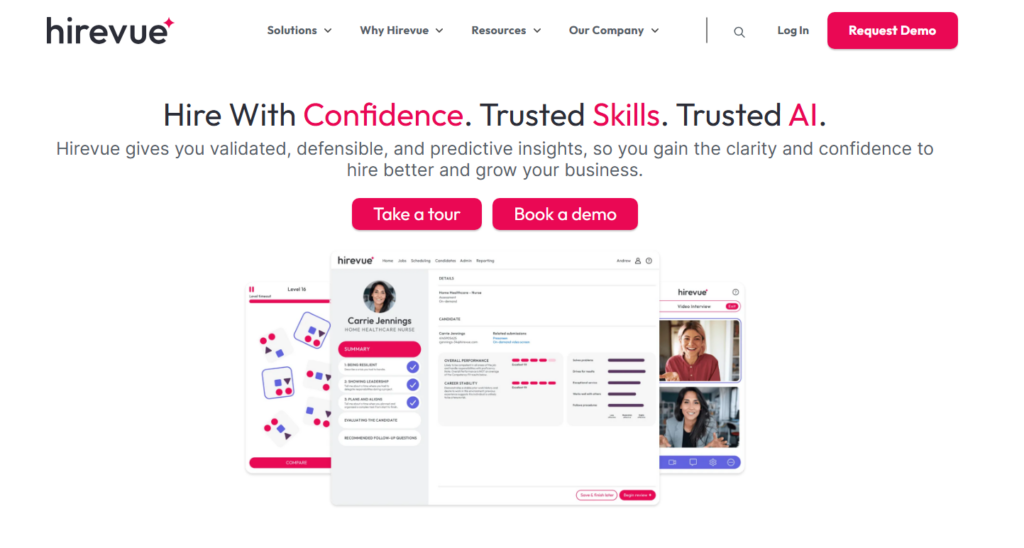
HireVue records structured one-way video interviews, adds assessments and scheduling, and helps reviewers compare answers to the same questions.
- Strength: Mature enterprise video interviewing with a long track record.
- Watch out for: Candidates on mobile or slow connections may find video-first screening heavy.
- Best for: Enterprises screening high volumes for customer-facing and communication-heavy roles.
9. SHL
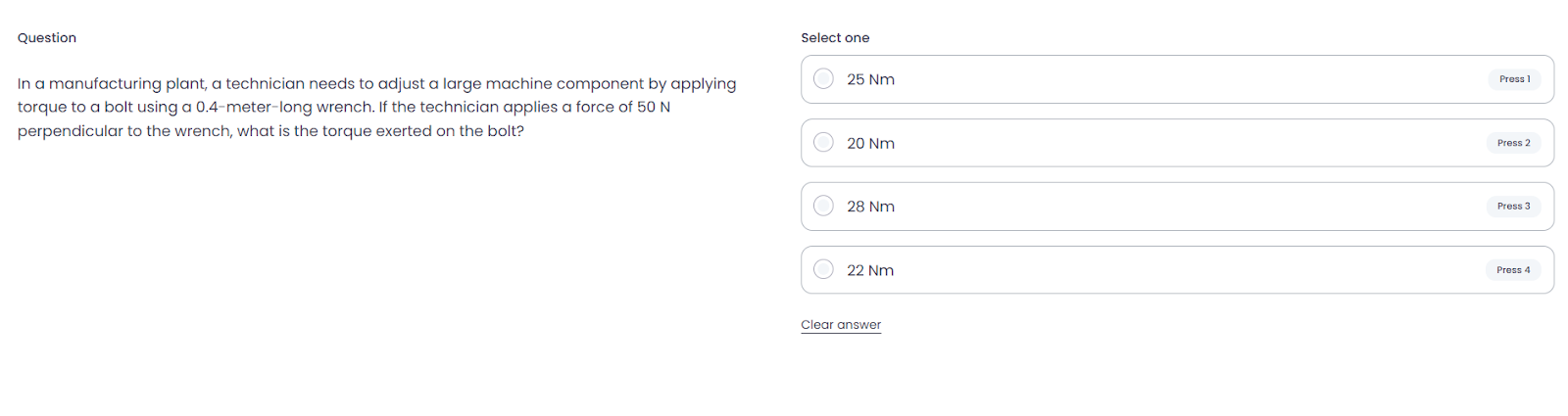
SHL offers cognitive tests, behavioral questionnaires and job simulations used by large employers in formal selection programs.
- Strength: Long history and broad norm groups for graduate and enterprise programs.
- Best for: Large enterprises that run structured graduate and high-stakes hiring programs.
10. Predictive Index
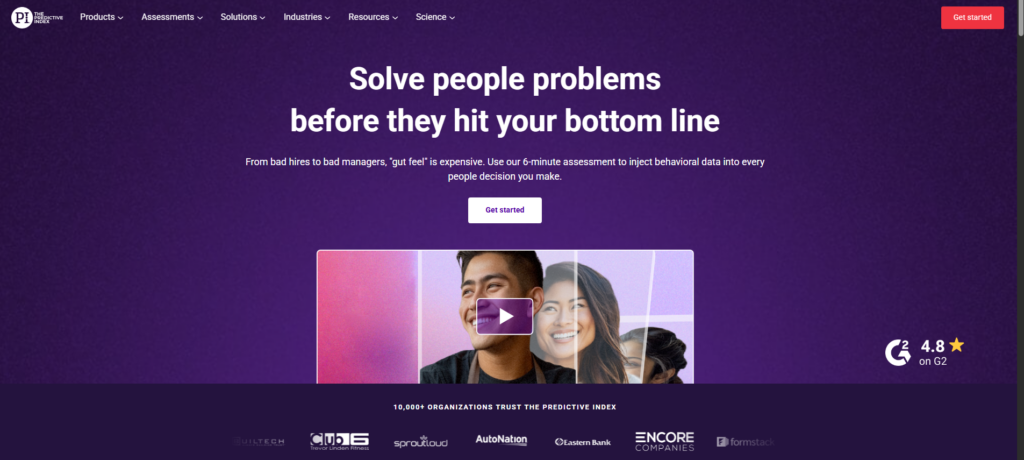
Predictive Index measures behavioral drives and cognitive ability, then compares candidates against a target profile for the role and the team they will join.
- Strength: Links hiring to team fit and manager coaching after the hire.
- Best for: Teams that weigh behavioral fit alongside hard skills, especially for managers.
11. Hogan Assessments
Hogan Assessments reports on everyday personality, the risk behaviors that show up under pressure, and core values.
- Strength: Detailed leadership reports that skills tests do not cover.
- Best for: Executive hiring and leadership pipelines where derailment risk is costly.
12. Paradox
Paradox uses a conversational AI assistant to answer applicant questions, ask screening questions by chat or text, and book interviews automatically.
- Strength: Removes scheduling back-and-forth for hourly hiring at scale.
- Best for: Retail, hospitality, logistics and other high-volume hourly employers.
What are the best technical screening tools?
The best technical screening tools in 2026 are Testlify coding tests, HackerRank, Codility, CodeSignal, CoderPad and Karat. Technical screening tools check coding and engineering skills before a live interview, either with automated coding tests or with structured technical interviews, so engineers only meet candidates who can already do the work.
Technical screening needs one check that general screening tools often skip: whether the candidate used an AI assistant or a second person. Ask every vendor how its proctoring flags pasted code, tab switching and AI help. For the concepts behind this step, see the technical screening guide.
- Testlify coding tests: Coding tests and a live coding environment in 45+ programming languages, inside the same platform as non-technical tests and AI interviews, with 20+ proctoring checks. Testlify coding tests
- 13. HackerRank: A large library of coding challenges for high-volume developer hiring and campus programs.
- 14. Codility: Coding tests and live interviews for enterprise engineering programs.
- 15. CodeSignal: Standardized coding assessments that give comparable scores across candidates.
- 16. CoderPad: A collaborative coding pad for live technical interviews run by your own engineers.
- 17. Karat: Outsourced expert interviewers who run structured technical interviews for you.
Pro tip for engineering roles: Use three steps: an automated technical screen, a live coding session with your engineers, then a final panel. Each step checks something the previous one cannot.
Should you buy an all-in-one platform or a stack of specialist tools?
Buying an all-in-one platform makes sense when one team hires similar roles at high volume and values fewer logins over depth. A stack of specialist tools makes sense when roles vary widely, because the best sourcing tool for engineers is rarely the best screening tool for sales or support hires.
All-in-one suites such as Findem, Eightfold AI and Paradox cover sourcing, screening and scheduling in one system. Specialist stacks combine a sourcing tool, a screening platform and the ATS through integrations.
Factor | All-in-one suite | Specialist stack |
|---|---|---|
Setup | One contract, one rollout | Two or three tools to connect |
Depth per stage | Good enough at each stage | Strongest tool at each stage |
Role mix | Similar roles at volume | Tech and non-tech, many job families |
Switching cost | High, everything moves together | Low, replace one piece at a time |
Data | One record by default | Depends on ATS write-back |
Most mid-market teams land on a hybrid: one sourcing tool, one screening platform that covers resumes, skills tests and AI interviews, and an ATS that holds the record.
How do you choose candidate sourcing and screening platforms?
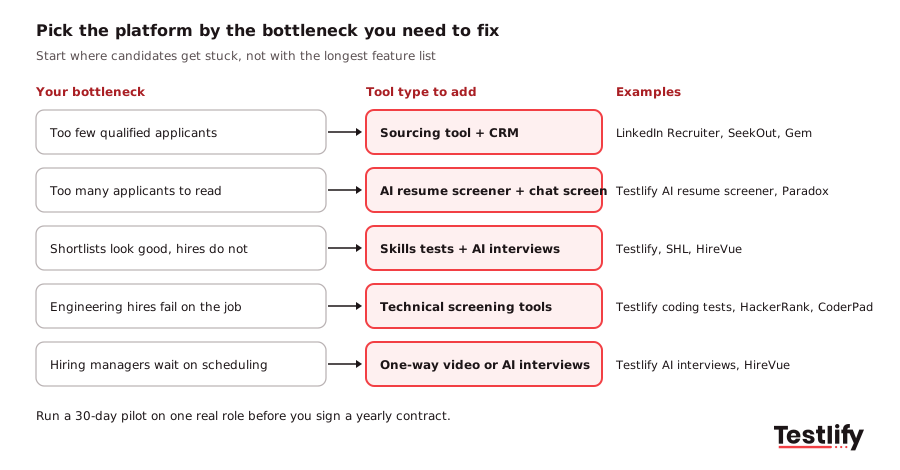
Choosing candidate sourcing and screening platforms starts with your biggest bottleneck: too few qualified applicants points to a sourcing tool, too many applicants points to screening, and weak hires from strong-looking shortlists point to skills tests. Then test each shortlisted tool on one real role against six criteria.
The pressure to pick well is real. SHRM's 2025 Talent Trends found that 69% of organizations still struggle to recruit for full-time roles, and that AI use in HR tasks rose to 43% in 2025 from 26% in 2024.
- ATS write-back: Do candidate data, scores and notes sync back to your ATS automatically, both ways?
- Evidence behind every score: Can a recruiter see the answer, test result or profile data behind each ranking?
- Cheating and AI-help detection: Does the tool flag AI-assisted answers, tab switching and impersonation?
- Candidate experience: Can candidates finish on mobile, in their language, in the time you promise?
- Bias audit and compliance: Does the vendor have a current independent bias audit you can share?
- Pricing model: Do you pay per seat, per candidate or per credit, and what happens to unused capacity?
Run a 30-day pilot before signing a yearly contract: pick one open role, send it through the old process and the new tool in parallel, and compare time-to-shortlist, pass-through rates and hiring manager ratings.
Key takeaway: The best platform is the one that fixes your slowest stage and sends clean data back to your ATS. Feature counts matter less than evidence behind every score.
What rules apply to AI sourcing and screening tools?
AI sourcing and screening tools fall under hiring-discrimination and privacy rules wherever you hire, and some places add specific rules for automated decisions. New York City's Local Law 144 is the clearest example: employers cannot use an automated employment decision tool without a yearly bias audit and candidate notice.
- New York City: Under Local Law 144, the tool needs a bias audit within one year of use, a public summary of the results, and notice to candidates 10 business days before use. Enforcement started on July 5, 2023.
- Privacy and consent: Sourcing tools collect contact data candidates never gave you. Have a lawful basis, a privacy notice and a retention limit, especially for candidates in the EU and UK.
- Human review: Keep a person accountable for every rejection. Treat AI rankings as evidence for a recruiter, not as the decision.
Testlify's matching model completed a third-party bias audit under Local Law 144 on June 16, 2023. NYC bias audit
How does Testlify fit a sourcing and screening stack?
Testlify fits the screening half of the stack, after your sourcing tool and alongside your ATS. Resumes flow in from the ATS, the AI resume screener ranks them, skills tests and AI interviews verify the shortlist, and scores sync back, so the hiring manager sees a ranked list with evidence.
- One platform for three screening stages: AI resume screening, 3,500+ tests and Video AI, Voice AI and Chat AI interviews.
- Works with your sourcing tools: 100+ ATS integrations mean candidates sourced in LinkedIn Recruiter or Gem reach Testlify through your ATS. integrations
- Built for global teams: Assessments in 15+ languages, and invites and reminders by email or WhatsApp.
- Proof: 1,500+ companies use Testlify, and it holds a 4.7 rating on G2.
Ready to screen your next shortlist on skills?
Build a role-specific assessment from your own job description and see a ranked, evidence-backed shortlist on a real role. Browse the Testlify test library, start a 7-day free trial with no credit card, or book a demo to see how Testlify fits your ATS and sourcing tools.
Frequently asked questions

Wordpress Developer
Yash Patel is a Wordpress and SEO Specialist at Testlify with 3+ years of experience in technical SEO, on-page optimization, and content strategy. He works on improving Testlify's organic presence and produces content focused on hiring, talent assessment, and HR technology.
LinkedInRelated resources
View all
HR & recruitment
Communication channels formula: how to calculate n(n-1)/2

HR & recruitment
How does a behavioral assessment impact hiring decisions?

HR & recruitment
Conflict Resolution Skills: What They Are and How to Build Them

HR & recruitment
5 effective workplace conflict resolution strategies

HR & recruitment
Glass ceiling: How unconscious bias holds women back (2026)

HR & recruitment
How to Attract Top Talent: 9 Techniques for 2026
Get started.
Hire on proof, not resumes.
Run your first skills-based assessment free — no credit card required.