
45 research analyst interview questions to ask job applicants
Interview questions for research analyst candidates, grouped by skill, with sample answers, a research task, a scorecard and red flags.

The best research analyst interview questions test five things: how a candidate frames a vague business question, how they find and check sources, which methods and tools they use, how they handle data that does not agree, and how clearly they turn findings into a recommendation. This list gives you 45 questions grouped by those skills, sample answers to the six that matter most, a short research task and a scorecard, so every interviewer judges candidates the same way.
TL;DR:
- Ask research analyst candidates about framing the question, source quality, methods, tools and communication. A polished CV tells you little about any of them.
- Decide which kind of research analyst you need first. Equity, policy, clinical, UX and data-focused roles share a core, but each needs three to five domain questions of its own.
- Strong answers name a method, a data source, a check they ran and a decision that changed. Weak answers stop at "I analyzed the data and presented it".
- Always add a short research task: a brief, a small dataset and 60 to 90 minutes. It shows judgment that no interview question can.
- Score every candidate on the same six skills with set weights. LinkedIn's 2025 recruiting report found only 25% of TA pros feel highly confident they can measure quality of hire.
- Put a skills test before the first live round. Testing research, data interpretation and critical thinking first shortens the shortlist and frees panel time for the task.
 ChatGPT
 Gemini
 Claude
 Grok
 Perplexity
What does a research analyst do?
A research analyst collects information, checks it, analyzes it and turns it into a clear answer that someone can act on. The answer might be a market sizing, a policy brief, an investment note, a trial data summary or a customer insight report. The common thread is the same: start from a question, find evidence, test it and explain what it means.
That is why "research analyst" covers so many jobs. A search for the title on O*NET OnLine, the US Department of Labor's occupation database, returns operations research analysts, statisticians, data scientists, survey researchers, economists, financial quantitative analysts and market research analysts, among others. Your interview should test the shared core and then the skills of your specific variant.
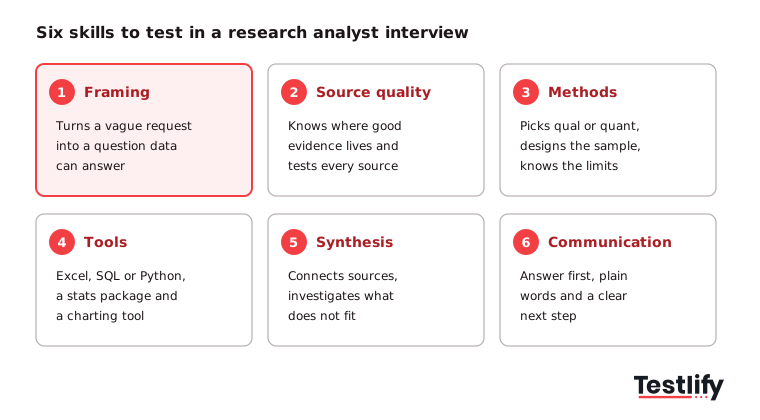
The shared core is six skills:
- Framing: turns "why are sales down?" into a question that data can answer.
- Source quality: knows where good evidence lives and how to tell a weak source from a strong one.
- Methods: picks between quantitative and qualitative research, designs a sample and knows the limits of each.
- Tools: works fluently in Excel and usually SQL, a statistics package or Python, and a charting tool.
- Synthesis: connects findings from several sources into one view, including what does not fit.
- Communication: writes and presents a clear recommendation for people who will not read the appendix.

Which type of research analyst are you hiring?
The type of research analyst you are hiring decides which questions matter most. Agree the variant with the hiring manager before you write the interview plan, then add three to five domain questions to the core list below.
Variant | Main output | Extra skills to test | Example domain question |
|---|---|---|---|
Business or strategy research | Market sizing, competitor and trend reports | Desk research, estimation, synthesis | How would you size the market for a product we have never sold? |
Equity or investment research | Company and sector notes, models | Financial statements, valuation, compliance rules | Walk me through how you would value a company with no profits yet. |
Policy or public sector research | Briefs, evaluations, consultations | Reading legislation, survey data, neutral writing | How do you write a brief for a minister who disagrees with the evidence? |
Clinical or healthcare research | Trial data summaries, outcome reports | Data privacy, protocols, regulated data | How do you handle a dataset with missing patient records? |
UX or customer research | Interview findings, personas, usability reports | Interviewing, coding qualitative data | How do you stop a stakeholder's favorite idea from biasing your interview guide? |
Data-focused research | Dashboards, analyses, experiments | SQL, statistics, experiment design | How would you check whether an A/B test result is real? |
If the role is mostly survey work, brand tracking and consumer studies, use our separate list of market research analyst interview questions instead. For close cousins of this role, see our data analyst interview questions, business analyst interview questions and policy analyst interview questions.
What are the best research analyst interview questions?
The best research analyst interview questions ask for a real project with a method and a result. If you only have time for ten, use these:
- Walk me through a research project you owned from the first question to the final recommendation.
- How do you decide whether a source is credible enough to use?
- When do you choose qualitative research over quantitative research?
- Tell me about a time two data sources disagreed. What did you do?
- Which tools do you use most, and what did you last build with them?
- How do you check your own analysis for errors before you share it?
- Describe a finding that surprised you and how you tested it.
- How do you explain a complex result to someone with five minutes?
- Tell me about a recommendation that stakeholders did not like.
- How do you use AI tools in research, and how do you check what they give you?
The full list below goes deeper on each skill. Pick two or three questions per section so the interview stays under an hour, and ask every candidate the same ones. A structured interview with a fixed question set makes candidates easier to compare and the decision easier to defend.
What general and background questions should you ask a research analyst?
General and background questions show the range of a candidate's experience: the subjects they have researched, the kinds of output they have produced and why they want this job. They also work well for junior candidates and recent graduates.
- What kinds of research have you done, and for whom?
- Which piece of research are you proudest of, and why?
- What does a typical week look like in your current role?
- Which outputs have you produced most often: reports, models, dashboards or briefs?
- What drew you to research work rather than a pure data or consulting role?
- Which part of our business would you most like to research first, and why?
- What do you read or follow to stay current in your field?
- What feedback on your work has changed how you research?
What research methodology and data quality questions should you ask?
Research methodology and data quality questions show whether a candidate has a repeatable process or just follows the data they are handed. Listen for a clear sequence and for the checks they build in.
- How do you turn a vague request from a manager into a research question?
- Walk me through how you plan a research project before collecting any data.
- How do you decide which sources to trust, and which to drop?
- How do you choose between primary research and existing secondary data?
- How would you design a survey so the questions do not lead respondents?
- How do you decide how large a sample needs to be?
- What steps do you take to clean a dataset before you analyze it?
- How do you document your sources and method so someone else can repeat your work?
- How do you separate correlation from causation in your findings?
What technical and tools questions should you ask a research analyst?
Technical questions test the tools and statistics a candidate uses every day. Match them to the variant: a data-focused analyst needs SQL and statistics, a business research analyst needs strong Excel and desk research, and an equity analyst needs financial modeling.
- Which tools do you use for analysis, and which one would you pick for a 2 million row dataset?
- In Excel, how would you combine two tables that share a customer ID?
- When would you use a LEFT JOIN instead of an INNER JOIN in SQL?
- When would you report the median instead of the mean?
- How would you check whether a difference between two groups is significant?
- How do you handle missing values and outliers?
- Which charts do you use for trends, comparisons and parts of a whole, and which do you avoid?
- How have you used Python, R or a statistics package such as SPSS in your work?
- How would you estimate a number that no source publishes, such as the number of dentists in a city?
What behavioral and situational questions should you ask a research analyst?
Behavioral and situational questions show how a candidate behaves when the research gets messy: conflicting data, tight deadlines, pushback and ambiguity. Ask for a specific example and follow up on what they did, not what the team did. Our guide to the behavioral-based interview covers the follow-up questions that get past rehearsed stories.
- Tell me about a time two reliable sources gave you different answers.
- Describe a finding that went against what leadership expected. How did you handle it?
- Tell me about a mistake you found in your own analysis after you had shared it.
- Describe a time you had a week of research to do in two days. What did you cut?
- Tell me about a project where the question changed halfway through.
- Describe a time you had to work with data you did not trust.
- Tell me about a recommendation you made that was not adopted. What happened next?
- Describe a time you had to explain a technical result to a non-technical audience.
- Tell me about a time you disagreed with a colleague about a method.
- If a manager asked you to find data that supports a decision already made, what would you do?
- If you had two days to brief us on a market you know nothing about, how would you spend them?
What should you ask senior research analysts?
Senior research analysts set the research agenda, review other people's work and influence decisions, so the questions shift from doing the research to deciding what is worth researching.
- How do you decide which research requests to say no to?
- How do you review a junior analyst's work, and what do you look for first?
- How do you build a research plan for a quarter with a fixed budget?
- How do you show a business leader the value of a research function?
- Tell me about a time your research changed a major decision.
- How do you keep research neutral when a senior stakeholder wants a certain answer?
- Which research tools or data sources would you add or drop in your first year?
- How should a research team use AI tools, and where should it not?
What do good answers to research analyst interview questions sound like?
Good answers to research analyst interview questions name a question, a source, a method, a check and a result. The sample answers below show what a strong response sounds like for six key questions. Use the "look for" notes to score answers, not to expect the exact words.
1. Walk me through a research project you owned from the first question to the final recommendation.
Look for: a clear sequence (question, plan, sources, analysis, checks, recommendation), the business decision behind it, and a result.
Sample answer: "Our head of sales wanted to know why win rates in one region had dropped. I turned that into a narrower question: which deal types were we losing, and to whom? I pulled 18 months of CRM data, read 30 lost-deal notes and spoke to five account managers. The data showed we were losing mid-size deals on implementation time, not price. I recommended a faster onboarding package for that segment, and win rates in that region recovered over the next two quarters."
2. How do you decide whether a source is credible enough to use?
Look for: specific tests (who published it, how the data was collected, sample size, date, conflicts of interest) and the habit of cross-checking key numbers.
Sample answer: "I ask four things: who produced it and why, how they collected the data, how recent it is, and whether anyone else reports something similar. A government dataset with a published method beats a vendor press release every time. If a key number appears only in one place, I either find a second source or label it clearly as a single-source estimate in the report."
3. Tell me about a time two data sources disagreed. What did you do?
Look for: investigation before choosing, a root cause, and transparency with stakeholders about the limits.
Sample answer: "Our product analytics showed 40,000 active users, but finance reported 31,000 paying accounts. Before picking one, I checked how each team defined 'active'. Product counted anyone who logged in during the month, including free trials. Once I matched the definitions, the numbers lined up. I added a short definitions note to every report after that, so nobody compared the two again."
4. How do you check your own analysis for errors before you share it?
Look for: a routine, not good intentions. Strong analysts sense-check totals, re-run key numbers a second way and ask someone else to review.
Sample answer: "I keep a short checklist. I check that totals match the source, re-calculate the three most important numbers a different way, look at the extremes for anything odd, and read the summary as if I were the reader. For anything going to leadership, I ask a colleague to review the method, not just the slides."
5. How do you explain a complex result to someone with five minutes?
Look for: answer first, one clear chart, plain words and a recommended next step.
Sample answer: "I lead with the answer and what I think we should do, then give one chart and two supporting points. For a pricing study, I opened with 'Raising the starter plan price by 10% is low risk; fewer than one in twenty customers said it would make them leave.' The method and caveats went in an appendix for anyone who wanted them."
6. How do you use AI tools in research, and how do you check what they give you?
Look for: practical use with clear checks, and awareness of accuracy, confidentiality and company policy.
Sample answer: "I use AI to summarize long documents, draft survey questions and suggest angles I might have missed. I never use a number or a quote from an AI tool without finding it in the original source. I do not paste client data or internal documents into public tools, and I note in my method section where AI helped."
How do you score a research analyst interview?
A research analyst interview is scored best with a short scorecard: six skills, a weight for each and a 1 to 5 scale with examples of what a 1, 3 and 5 look like. Every interviewer scores alone before the debrief, so the loudest opinion does not decide the hire. Our guide to the interview scorecard shows how to set one up.
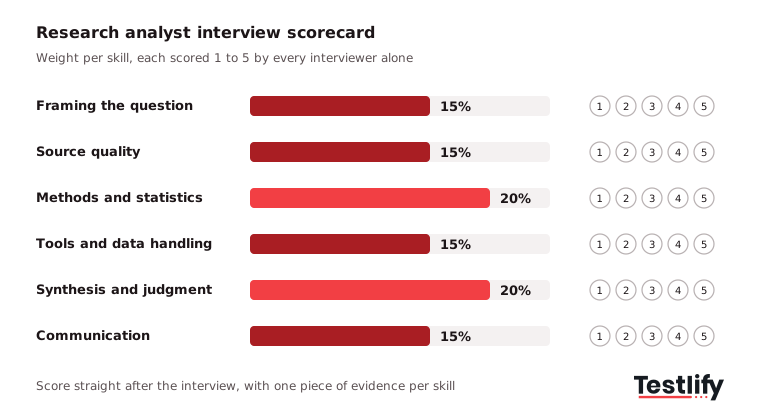
Skill | Weight | Questions to use | A strong answer shows |
|---|---|---|---|
Framing the question | 15% | 9, 10, 31 | Turns a vague request into a specific, answerable question |
Source quality | 15% | 11, 12, 27 | Clear tests for credibility; cross-checks key numbers |
Methods and statistics | 20% | 13, 14, 17, 21, 22 | Right method for the question; knows its limits |
Tools and data handling | 15% | 15, 18 to 20, 23 | Fluent in the tools the role needs; cleans data before analysis |
Synthesis and judgment | 20% | 28, 32, 36, research task | Connects sources, investigates surprises, stays neutral |
Communication | 15% | 34, task write-up | Answer first, plain words, a clear next step |
Adjust the weights to the role. A data-focused analyst needs more weight on tools and statistics. A strategy or policy analyst needs more weight on framing and communication.
Consistent scoring matters because quality of hire is hard to prove later. The LinkedIn Future of Recruiting 2025 report found that companies with the most skills-based searches are 12% more likely to make a quality hire, and that only 25% of TA professionals feel highly confident measuring quality of hire at all.
Pro tip: Write down the score and one piece of evidence for each skill straight after the interview. Scores written the next day drift toward the overall impression and lose the detail that separates two good candidates.
What research task should you give research analyst candidates?
A research task asks the candidate to answer a small, real-looking business question with a short brief and a dataset, and it is the closest preview of the actual job you will get. Consulting firms such as Cornerstone Research build a case discussion into each interview round for this reason. Keep the task to four steps and 60 to 90 minutes.
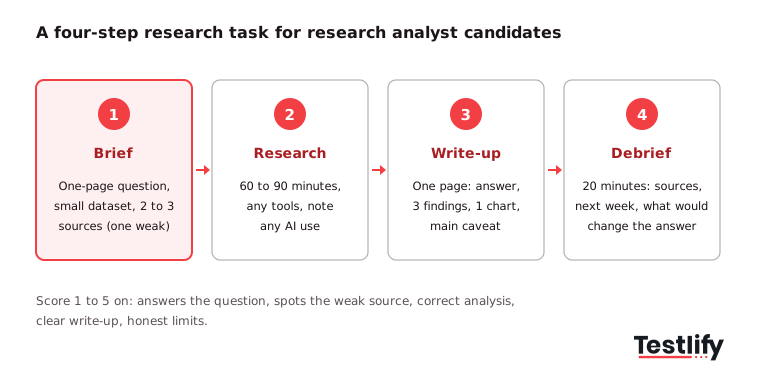
- Brief: send a one-page question from your own business (for example, "Should we expand our product into Germany next year?"), a small dataset of a few hundred rows and two or three source documents, one of them weaker than the others.
- Research: give the candidate 60 to 90 minutes. Allow any tools and web search, and ask them to note any AI use.
- Write-up: ask for a one-page answer: the recommendation, three supporting findings, one chart and the main caveat.
- Debrief: spend 20 minutes on the write-up. Ask why they trusted or dropped each source, what they would do with another week, and what would change their recommendation.
Score the task on five points, each from 1 to 5: did they answer the actual question, did they spot the weak source, is the analysis correct, is the write-up clear, and did they state the limits honestly. A candidate who misses the weak source in a 90-minute task will miss it on a real project too.
What are the red flags in research analyst interview answers?
The biggest red flags in research analyst interview answers are vague methods, no checks and findings that never led to a decision. Watch for these patterns:
- Tools without purpose: a long list of software but no example of what the candidate found with it.
- No source tests: the candidate uses whatever comes up first and cannot say why a source is reliable.
- Ignores surprises: odd results get dropped or explained away instead of investigated.
- Confuses correlation and causation: "customers who used feature X stayed longer, so feature X keeps customers" with no further test.
- Answers to please: the candidate would happily find data to support a decision already made.
- No result: every story ends with "I presented it to the team", never with a decision that changed.
Key takeaway: A good research analyst talks about the question, the evidence and the decision. A weak one talks about the tools and the slides.
How do skills tests help you hire a research analyst?
Skills tests help you hire a research analyst by checking research, data interpretation and reasoning before you spend panel time on interviews and the research task. A short test stage means the people who reach the task can already read data accurately and spot weak arguments.
A typical test stage for this role combines three or four of these:
- The research analysis skills test for research design, source evaluation and analysis.
- The data interpretation test for reading tables and charts correctly under time pressure.
- The critical thinking test for judging arguments and assumptions.
- The attention to detail test for catching errors in text and numbers.
- A tools test that matches the variant, such as SQL, Excel for data analysts or statistical modeling.
For a broader screen, the aptitude test for research analysts combines numerical, verbal and logical reasoning in one assessment.
Testlify's library has 3,500+ tests and 25+ question types, including file upload and open-ended questions, so you can also run a short version of the research task inside the assessment and collect the write-up in one place. Results come back scored, with a per-skill breakdown, and sync to 100+ ATS and HRIS tools such as Workday, Greenhouse and SAP SuccessFactors. Hiring teams use the test stage to cut a long applicant list to a shortlist of five or six, then spend live interview time only on the questions and the task above. Read more on skills-based hiring and why it beats resume screening for analytical roles.
Ready to hire your next research analyst?
Build a test stage for your research analyst role from the Testlify test library, add a short research task, and share a ranked shortlist with your hiring manager. Start a 7-day free trial with no credit card, or book a demo to see how other teams run analyst hiring.
Frequently asked questions about research analyst interviews

Wordpress Developer
Yash Patel is a Wordpress and SEO Specialist at Testlify with 3+ years of experience in technical SEO, on-page optimization, and content strategy. He works on improving Testlify's organic presence and produces content focused on hiring, talent assessment, and HR technology.
LinkedInRelated resources
View all
HR & recruitment
50 Inside Sales Representative interview questions to ask job applicants

HR & recruitment
50 Business Consultant interview questions to ask job applicants

HR & recruitment
50 Employer Branding Specialist interview questions to ask job applicants

HR & recruitment
50 Quality Assurance Manager interview questions to ask job applicants

HR & recruitment
45 Digital marketing interview questions to ask job applicants

HR & recruitment
45 Data Modeling interview questions to ask job applicants
Get started.
Hire on proof, not resumes.
Run your first skills-based assessment free — no credit card required.