
Virtual recruiting: how to hire and assess skills remotely
How virtual recruiting works, the challenges that trip teams up, and how to assess skills, stop cheating and keep candidates engaged online.

A candidate nails the video interview, accepts the offer and then cannot do the job. Worse, the person on camera is not the one who shows up on day one.
Done well, virtual recruiting is faster and fairer than office-based hiring. This guide shows how the process works, where teams go wrong and how to test skills remotely.
Virtual recruiting is hiring without meeting candidates in person. Employers attract, screen, assess, interview and onboard people online, using an applicant tracking system (ATS), skills tests, video or AI interviews and virtual events.
TL;DR:
- Virtual recruiting runs every hiring step online: sourcing, screening, skills tests, interviews, offers and onboarding.
- 22.6% of US workers teleworked in March 2026 (BLS), and 79% of remote-capable US employees work hybrid or fully remote (Gallup, August 2026), so remote hiring is now a default, not a stopgap.
- The biggest risks are fake or AI-assisted candidates, weak soft-skill signals and drop-off. Gartner predicts 1 in 4 candidate profiles worldwide could be fake by 2028.
- Test skills before interviews, with a short role-based assessment, then use structured video or AI interviews on the shortlist.
- Protect integrity with proctoring, identity checks and clear candidate notice. AI scoring in New York City needs a yearly bias audit.
- Keep one human round before any offer. Gartner found 62% of candidates are more likely to apply when a role includes an in-person interview.
 ChatGPT
 Gemini
 Claude
 Grok
 Perplexity
What is virtual recruiting?
Virtual recruiting is the process of finding, evaluating and hiring candidates entirely or mostly online, with no required in-person step. The term is used interchangeably with virtual recruitment and virtual hiring, and it covers both remote roles and office roles that are filled through remote steps.
Virtual recruiting is not only video interviews. A full virtual process replaces every in-person touchpoint: career fairs become virtual events, paper applications become ATS forms, whiteboard tests become online assessments, and first-day paperwork becomes digital onboarding.
The scale is real. The US Bureau of Labor Statistics reports that 22.6% of US workers teleworked or worked at home for pay in March 2026, a rate that has held between 21.5% and 23.0% over the past year.
Teams that hire for those jobs rarely meet candidates before day one.

How does the virtual recruiting process work?
The virtual recruiting process works in six stages: attract, screen, assess, interview, decide and onboard. Each stage swaps an in-person step for an online one, and each hands structured data to the next, so the hiring team decides on evidence rather than on a single video call.
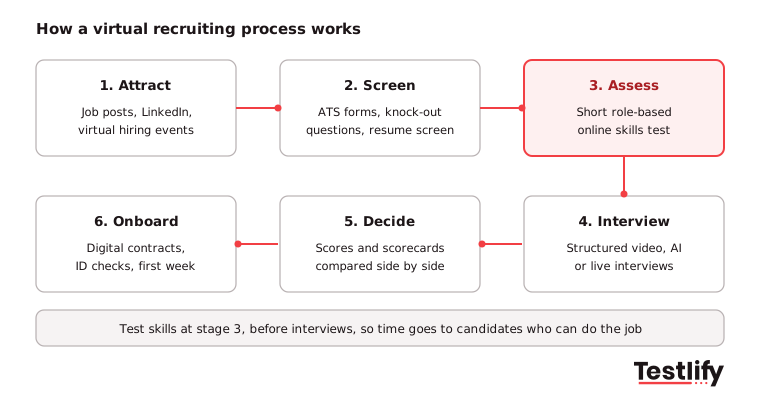
- Attract: Job posts, careers pages, LinkedIn outreach and virtual hiring events bring in applicants from any location.
- Screen: The ATS collects applications. Knock-out questions and resume screening sort the pile against the must-have requirements.
- Assess: Candidates take a short, role-based online test before anyone spends time on interviews. This is where you check real ability, not claimed ability.
- Interview: Shortlisted candidates do structured one-way video, AI or live video interviews with the same questions for everyone.
- Decide: The hiring team compares test scores, interview scorecards and references side by side, then makes an offer.
- Onboard: Contracts, ID checks, equipment and the first-week plan are handled digitally.
Pro tip: Put the skills test before the first interview, not after. Testing early cuts interview hours on people who cannot do the job, and it gives quieter candidates a fair shot before camera presence starts to count.
Why do companies use virtual recruiting?
Companies use virtual recruiting to reach more candidates, hire faster and spend less per hire, while giving every applicant the same process. For distributed teams there is often no alternative: the candidate and the hiring manager may never be in the same city.
Work patterns explain most of the shift. Gallup's hybrid work indicator found that, as of August 2026, 54% of US employees with remote-capable jobs work hybrid, 25% work fully remote and 21% work on-site.
When four in five of those employees are not in an office every day, an office-only hiring process makes little sense.
The main benefits of virtual recruiting are:
- Wider talent pool: Location stops limiting who you can hire, which matters most for scarce technical and specialist roles.
- Faster time-to-hire: No travel or room booking. One-way interviews and online tests run around the clock and across time zones.
- Lower cost per hire: Fewer travel claims, fewer interviewer hours and no venue costs for hiring events.
- More consistent decisions: The same test and the same questions for every candidate make scores comparable and easier to defend.
- Continuity: Hiring keeps going through office closures, travel limits or a sudden spike in volume.
What are the biggest virtual recruiting challenges?
The biggest virtual recruiting challenges are verifying who the candidate is, judging soft skills and culture add through a screen, testing hands-on technical skills, keeping candidates engaged, avoiding technical glitches and staying compliant when AI scores people. Each one has a practical fix.
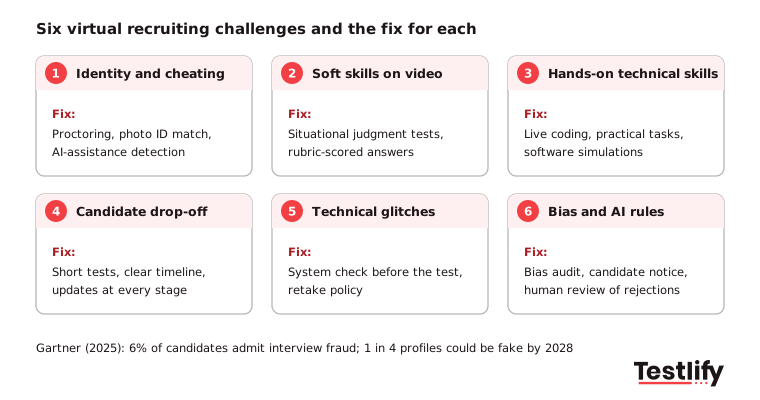
Candidate fraud is the newest and fastest-growing problem. A Gartner survey of 3,000 job candidates, published in July 2025, found that 6% of candidates admitted to interview fraud, either posing as someone else or having someone pose as them.
About 4 in 10 candidates used AI during their applications. Gartner predicts that by 2028 1 in 4 candidate profiles worldwide could be fake.
Challenge | Why it is harder online | Practical fix |
|---|---|---|
Identity and cheating | No one sees who is at the keyboard | Webcam proctoring, photo ID match, AI-assistance detection |
Soft skills and culture add | Body language and team chemistry are hard to read on video | Situational judgment tests, structured behavioral questions, a team chat round |
Hands-on technical skills | No whiteboard or shared desk | Live coding, practical tasks, software simulations |
Candidate engagement | Candidates feel ignored and drop out | Clear timelines, short tests, status updates at every stage |
Technical glitches | Bad internet or browser issues ruin a test | System check before the test, retake policy, support contact |
Bias and compliance | AI scoring and recordings bring legal duties | Bias audits, candidate notice, a human review of every rejection |
The same survey found that 62% of candidates were more likely to apply for a role that includes an in-person interview. Fully virtual processes need to earn trust, which is one more reason to keep at least one live conversation before an offer.
How do you assess skills in virtual recruiting?
Assessing skills in virtual recruiting means matching each skill the role needs to an online format that shows it in action. Knowledge checks suit multiple-choice questions, but coding, writing, selling and judgment need tasks that mirror the work.
A short, role-based test before interviews gives every candidate the same chance to prove ability.
A good remote skills assessment keeps to 30 to 60 minutes, mixes two or three test types and is scored the same way for everyone. Use this table to pick formats by skill type:
Skill type | Example roles | Online format that works | What to watch |
|---|---|---|---|
Technical | Developer, data analyst | Coding tests in a live IDE, practical tasks | AI-generated code, copy and paste |
Software and tools | Finance, operations, admin | Excel, Google Sheets or Word simulations | Real files, not theory questions |
Soft skills | Sales, support, managers | Situational judgment tests, video answers | Score against a rubric, not on charisma |
Language and communication | Contact center, global teams | Audio answers, written tasks, CEFR-level tests | Accent is not a skill gap |
Cognitive ability | Graduate and entry-level roles | Timed reasoning tests | Keep it short to avoid drop-off |
Soft skills deserve extra care, because they are where remote hiring most often falls back on gut feel. Scenario questions and recorded answers scored against a written rubric give far steadier results than an unstructured video chat.
The Testlify guide on how to assess soft skills covers rubrics in more detail, and the coding tests page shows how technical tasks run in the browser.
How do you keep virtual assessments fair and secure?
Virtual assessments stay fair and secure when integrity checks, accessibility and legal notice are built in from the start rather than bolted on after a cheating scare. The goal is a result you can trust and defend, without making honest candidates feel like suspects.
- Proctoring: Use webcam snapshots, tab and full-screen tracking, copy and paste blocking and AI-assistance detection. Tell candidates in advance what is monitored.
- Identity checks: Match a photo ID to the candidate's face at the start of the test and again in the interview round.
- Question design: Randomize questions and use practical tasks, which are much harder to look up or outsource than trivia.
- Accessibility: Offer extra time, screen-reader support or another format when a candidate asks for an accommodation.
- AI and bias rules: In New York City, Local Law 144 lets employers use an automated employment decision tool only if it had a bias audit within the past year, the audit summary is public and candidates get notice. Enforcement began on July 5, 2023.
- Human review: Let a person confirm every rejection and every proctoring flag before it counts against a candidate.
Run a system compatibility check before the test so a weak connection is not mistaken for a weak candidate.
Which virtual recruiting tools do you need?
Virtual recruiting tools fall into five groups: an ATS to manage the pipeline, sourcing and event tools to attract candidates, an assessment platform to test skills, an interview tool for video or AI interviews, and onboarding software. Most mid-market and enterprise teams already own an ATS, so the gap is usually assessment and interviews.
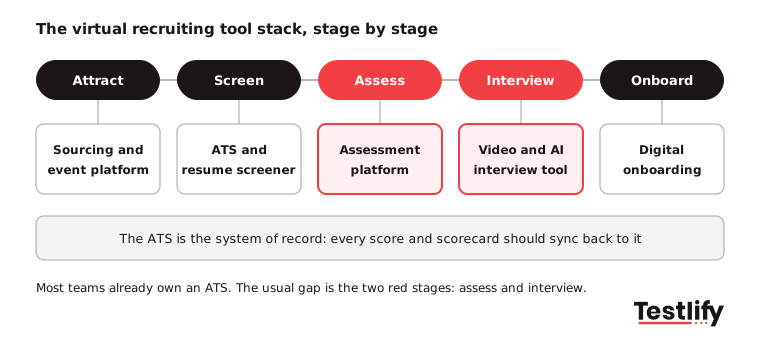
Tool | What it does | You need it when |
|---|---|---|
ATS | Stores applications, moves candidates through stages | Always; it is the system of record |
Sourcing and virtual event platform | Job ads, outreach, virtual career fairs | Campus, volume or new-market hiring |
Assessment platform | Role-based tests, proctoring, scoring | You need proof of skill before interviews |
Video and AI interview tool | One-way, live or AI interviews with scorecards | You interview more than a few people per role |
Scheduling and messaging | Self-booking, reminders, SMS or WhatsApp updates | Candidates drop out between stages |
Digital onboarding | Contracts, ID checks, first-week tasks | Every hire, especially remote ones |
Pick tools that sync with your ATS, so scores and interview notes land on the candidate record without manual export. Set up the process and the tech before you need them, not mid-search.
What are the best practices for virtual recruiting?
The best practices for virtual recruiting are to define the skills before you post, test early, structure every interview, communicate often and measure the funnel. Each habit removes a reason good candidates drop out or bad hires get through.
- Define success first: List the 4 to 6 skills that matter for the role and agree on how each will be tested and scored.
- Test before you talk: Send the assessment right after screening, and keep it under an hour.
- Structure interviews: Ask everyone the same questions and score answers on a shared scorecard.
- Show the job and the team: Share a day-in-the-life video, a realistic job preview or a short chat with a future teammate.
- Over-communicate: Give a timeline at the start and an update at every stage, even when the answer is no.
- Train interviewers for video: Cover camera etiquette, note-taking and how to avoid rewarding confidence over competence.
- Measure and fix: Track completion rate, time-to-hire and candidate feedback per stage, then fix the stage that loses the most people.
Key takeaway: Virtual recruiting works when skills evidence comes before impressions. Test early, structure every interview and keep one human conversation before the offer.
How does Testlify support virtual recruiting?
Testlify supports virtual recruiting as an AI-native skills assessment and interviewing platform, covering the assess and interview stages in one place and syncing results back to your ATS. Hiring teams can turn a job description into a role-specific assessment, run AI interviews and get a ranked shortlist with the evidence behind each score.
- Role-based tests: Choose from 3,500+ validated tests and 25+ question types, including coding, simulations, audio and video answers. Browse the test library to find tests for your role.
- Interviews: Run one-way video interviews, or use Video AI, Voice AI and Chat AI interviews that score every answer, all through the video interviewing tool.
- Integrity: Comes with 20+ proctoring features, including AI-assistance detection, face detection, optional photo ID face match and more.
- Global and connected: Test candidates in 15+ languages and connect results to your ATS or HRIS with 100+ integrations and two-way sync.
- Audited: The Testlify matching model completed a third-party NYC bias audit under NYC Local Law 144 on June 16, 2023.
Ready to run your next hire remotely?
Build a role-based assessment from your own job description and see a ranked shortlist before your first interview. Start a 7-day free trial of Testlify, no credit card required, or book a demo to see the full virtual recruiting workflow.
Frequently asked questions (FAQs)

Human Resources Lead
Snehi Parmar leads People at Testlify, owning hiring, culture, performance, and retention for a 90-person team. She writes on practical HR strategy and building people processes that scale.
Related resources
View all
HR & recruitment
Virtual attention to detail tests: Adapting to remote hiring

HR & recruitment
7 Challenges of using cognitive ability tests in recruitment (and how to fix each One)

HR & recruitment
The role of aptitude tests in assessing efficiency

HR & recruitment
Freelance hiring best practices: a step-by-step guide for HR teams

HR & recruitment
How to increase diversity in hiring: why hiring assessments matter

HR & recruitment
The role of hiring assessments in decision making
Get started.
Hire on proof, not resumes.
Run your first skills-based assessment free — no credit card required.