
Administrative Leave
Administrative leave is a temporary, usually paid removal from duty while an employer investigates or deals with a workplace issue.
 ChatGPT
 Gemini
 Claude
 Grok
 Perplexity
Administrative leave is a temporary period in which an employer removes an employee from their normal duties, usually with full pay and benefits, while it deals with a workplace issue. The most common reason is an investigation into alleged misconduct. Administrative leave is not a punishment and not a finding of guilt. It is a neutral, time-limited step that protects the people and the process involved.
Why does administrative leave matter for enterprise HR?
Administrative leave matters because it is one of the few tools HR can use to act quickly on a serious complaint without deciding the outcome in advance. Used well, administrative leave protects the complainant, the accused employee, the evidence and the company. Used badly, administrative leave looks like a punishment, invites claims of unfair treatment or retaliation, and leaves work uncovered for weeks.
The cost also adds up fast. According to a September 2026 report by the US Government Accountability Office (GAO-26-108477), federal agencies' use of paid administrative leave rose 435% from 2023 to 2025, from about 4 million workdays to 21.6 million. GAO estimates the salary cost at about $9.5 billion in 2025, six times the 2023 level, with about $6.7 billion tied to the deferred resignation program. Average use per employee grew from about 5 workdays to about 24.
Private employers do not report on this scale, but the lesson carries over: every day of paid leave is salary spent with no work delivered, so leave needs a reason, an owner and an end date.
For a CHRO or HR director, administrative leave touches four areas at once: employee relations, wage and hour compliance, security of systems and data, and workforce coverage.
What are the types of administrative leave?
Administrative leave covers several situations. The most common types are listed below; most employers use the first two far more than the rest.
Investigative leave
Investigative leave removes an employee from the workplace while HR or an outside investigator looks into an allegation such as harassment, fraud, theft or workplace violence. Investigative leave gives investigators room to interview witnesses and review records without pressure on anyone involved.
Safety and security leave
Safety and security leave is used when keeping the employee at work could put people, data or property at risk, for example after a threat, a data access concern or a serious safety incident.
Notice leave before a separation
Notice leave covers the period between telling an employee that their role is ending and their last day. Some employers prefer that the person does not keep working on sensitive tasks during notice.
Civic and community leave
Civic and community leave is paid time off for duties such as jury service, voting, blood donation or approved volunteering. In the US federal government, OPM's administrative leave fact sheet lists uses such as voting (generally up to 3 hours), blood donation (typically up to 4 hours) and military spouse relocation (up to 5 days).
Closure and restructuring leave
Closure and restructuring leave covers time when the employer cannot provide work, such as a site closure or the notice period before a reduction in force. Federal weather and safety closures now sit under a separate leave category.
For federal employees, administrative leave has firm limits. According to the US Office of Personnel Management, under 5 U.S.C. 6329a and rules that took effect on 16 January 2025, administrative leave for investigations is capped at 10 workdays per calendar year (80 hours for a full-time schedule). Longer investigations move to a separate investigative leave category with its own reviews.
Is administrative leave paid?
Administrative leave is paid in most cases, and HR teams should treat paid leave as the default. Pay signals that no decision has been made, which reduces the risk of discrimination and wage claims while the facts are still unproven. Unpaid leave tends to look like discipline before the investigation has finished.
In the US, pay rules depend on the employee's classification under the Fair Labor Standards Act:
Employee type | Pay rule during administrative leave |
|---|---|
Non-exempt (hourly) | Generally paid only for hours worked, so unpaid leave is allowed unless a contract, policy or state law says otherwise. Time spent in investigation interviews must be paid. |
Exempt employee (salaried) | Must get the full weekly salary for any week in which they do any work. Unpaid full-day suspensions are allowed only for workplace conduct rule breaches under a written policy applied to everyone. |
Unionized | The collective agreement often sets pay, length and notice rules. |
US federal | Administrative leave is paid by definition and does not reduce pay or leave balances. |
The exempt employee rule comes from the US Department of Labor salary basis regulation at 29 CFR 541.602, which gives examples such as a three-day unpaid suspension for breaking a written harassment policy. Outside the US, local law and the employment contract decide the question, and UK guidance from Acas says a suspended employee should keep their normal pay and contractual benefits, warning that cutting pay could lead to legal action even where the contract seems to allow it.
Pro tip: If an exempt employee answers even one work email during an unpaid week, the full salary for that week is likely owed. Cut system access on day one and tell the employee not to work.
How do you place an employee on administrative leave?
Placing an employee on administrative leave works best as a short, documented process with one HR owner. The steps below fit most private employers and follow guidance from SHRM and Acas.
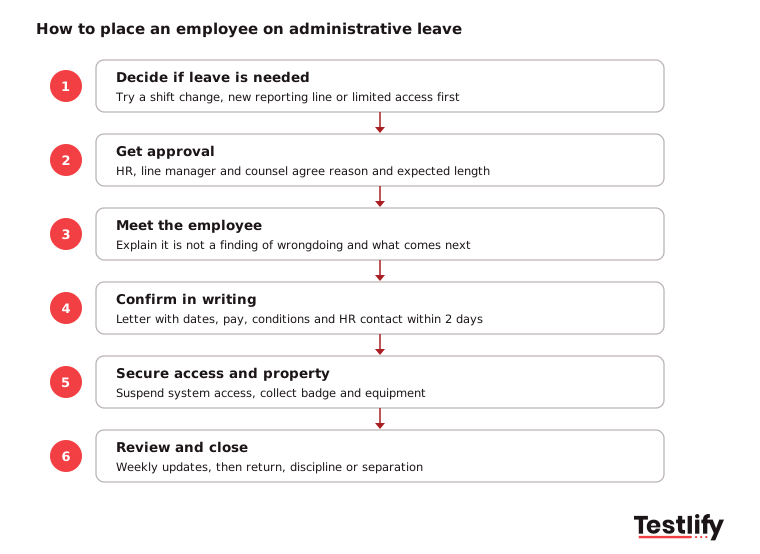
- Decide whether leave is needed: Check alternatives first: a shift change, a different reporting line, remote work or limited system access may be enough.
- Get approval: HR, the line manager and, for senior roles or legal risk, employment counsel agree on the reason and the expected length.
- Meet the employee: Explain that administrative leave is not a finding of wrongdoing, what happens next and who their contact is.
- Confirm it in writing: Send a letter the same day or within two working days.
- Secure access and property: Suspend system access, collect badges and equipment, and protect records the investigation needs.
- Review and close: Set a review date, update the employee at least weekly, and end the leave with a clear outcome: return to work, disciplinary action, or separation.
A clear administrative leave letter usually includes:
- The start date and expected length, with a review date
- Pay and benefits status during leave
- Conditions: no work, no contact with named colleagues or clients, stay off site
- The requirement to stay available for interviews during working hours
- The HR contact for questions and support, including any employee assistance program
- A reminder that the leave is not discipline and that retaliation against anyone involved is prohibited
What is the difference between administrative leave and suspension?
Administrative leave and suspension differ mainly in purpose and timing. Administrative leave is a neutral step taken before the facts are known, usually with pay. A suspension is often a disciplinary penalty applied after misconduct is proven, and it is frequently unpaid. In the UK, the word "suspension" is also used for the neutral, paid version, which is why the Acas guidance on suspension during an investigation stresses that suspension does not mean the employee has done anything wrong.
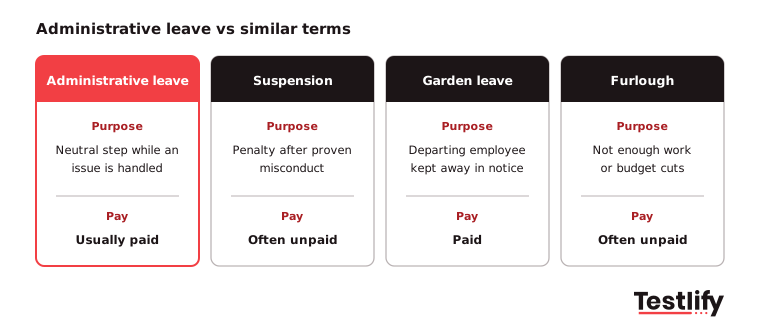
Term | Purpose | Usually paid? | Typical trigger |
|---|---|---|---|
Administrative leave | Neutral removal from duty while an issue is handled | Yes | Investigation, safety concern, civic duty |
Disciplinary suspension | Penalty for proven misconduct | Often no | Finding after an investigation |
Keep a departing employee away from work and clients during notice | Yes | Resignation or dismissal with notice | |
Cut labor costs when there is not enough work | Often no | Budget cuts, shutdowns, low demand |
What are the best practices for administrative leave?
Administrative leave best practices focus on speed, consistency and records. Five habits make the biggest difference:
- Write a policy and apply it the same way every time: Consistency is the strongest defense against claims that one employee was treated worse than another.
- Default to paid leave: Paid leave keeps the step neutral and avoids exempt salary problems.
- Set a time limit and review date: Open-ended leave costs money, hurts morale and suggests the outcome was decided early. Many employers aim for 1 to 3 weeks.
- Keep it confidential: Tell colleagues only what they need to know, for example that the person is "out of the office", to limit defamation risk and gossip.
- Plan coverage on day one: Name who picks up the work, and decide early whether a temporary or permanent hire may be needed.
Key takeaway: Administrative leave protects everyone only when it is short, paid, documented and handled the same way for every employee.
When a leave ends in a separation, the team usually has to fill a role it did not plan to replace. A fast, fair backfill starts with knowing which skills the role really needs. Skills-based hiring helps here: a role-specific assessment from the Testlify test library lets hiring teams compare candidates on the same job-related tasks, so the replacement decision rests on evidence rather than a rushed resume screen.
Frequently asked questions
Administrative leave does not mean an employee is getting fired. Administrative leave is a neutral step that lets the employer investigate or resolve an issue, and many employees return to their jobs once the review ends. The final outcome depends on what the investigation finds.
Cite this page
Copy a ready-made citation for this page in your preferred style.
- APA
Testlify. (2026). Administrative Leave. https://testlify.com/hr-glossary/administrative-leave/
- MLA
"Administrative Leave." Testlify, 28 October 2026, https://testlify.com/hr-glossary/administrative-leave/.
- Chicago
Testlify. "Administrative Leave." Testlify. Last modified October 28, 2026. https://testlify.com/hr-glossary/administrative-leave/.
- HTML link
<a href="https://testlify.com/hr-glossary/administrative-leave/">Administrative Leave</a>, Testlify (2026)
Related terms
Administrative Services Only (ASO)
Administrative Services Only (ASO) refers to a type of insurance arrangement in which an insurer provides administrative services to a self-insured group, but does not assume any risk for claims.
Adverse Action Notice
A notice telling a candidate or employee that a decision went against them partly because of a consumer report, such as a background check.
Adverse Impact
Adverse impact refers to a negative or disproportionate effect on a particular group of people, such as a minority group or women.
Affective Events Theory (AET)
Affective Events Theory (AET) is a theory that explains how emotions and moods influence work behavior and decision-making.
Affirmative Action
Affirmative action refers to policies and initiatives that aim to correct for past discrimination and promote diversity and inclusion, often in education and employment.
After-Acquired Evidence
After-acquired evidence is new evidence that is discovered after a legal decision has been made, which may affect the outcome of the case.
Get started.
Hire on proof, not resumes.
Run your first skills-based assessment free — no credit card required.