
Adverse Action Notice
A notice telling a candidate or employee that a decision went against them partly because of a consumer report, such as a background check.
 ChatGPT
 Gemini
 Claude
 Grok
 Perplexity
One missed step in a background check can cost an employer $100 to $1,000 per candidate. An adverse action notice is the message that keeps your team on the right side of that line.
An adverse action notice is the written, oral or electronic message an employer must send after it rejects, fires or demotes someone based in whole or in part on a consumer report, such as a background check. Under the US Fair Credit Reporting Act (FCRA), it names the screening company and explains the person's right to a free copy of the report and to dispute it.
This page covers what the notice must include and how to send it in the right order, with a focus on employment. To understand the wider screening process, explore our guide to pre-employment screening.
Why does an adverse action notice matter for enterprise HR?
An adverse action notice matters because missing or mistimed notices are one of the most common grounds for FCRA class actions against employers. The law applies to every hire, promotion or termination decision that uses a report from a background screening company, so a single broken step repeats across hundreds or thousands of candidates.
The exposure is easy to calculate. For a willful violation, the FCRA's civil liability section lets each affected person recover actual damages or statutory damages of $100 to $1,000, plus punitive damages and attorney fees.
A volume hiring program that skipped the pre-adverse step for 5,000 applicants faces $500,000 to $5 million in statutory damages before legal costs.
The notice also matters beyond legal risk:
- Fairness: Background reports contain errors, such as a record that belongs to someone with the same name. The notice gives the candidate a real chance to correct the file before the decision is final.
- Candidate experience: A clear, respectful notice protects your employer brand with people who may apply again or talk about the process publicly.
- Audit trail: Dated notices show regulators and courts that your team followed a consistent process for every applicant.
For TA operations teams, the notice is a process control, not paperwork. It belongs in the same workflow as the background check that triggers it.
What are the core components of an adverse action notice?
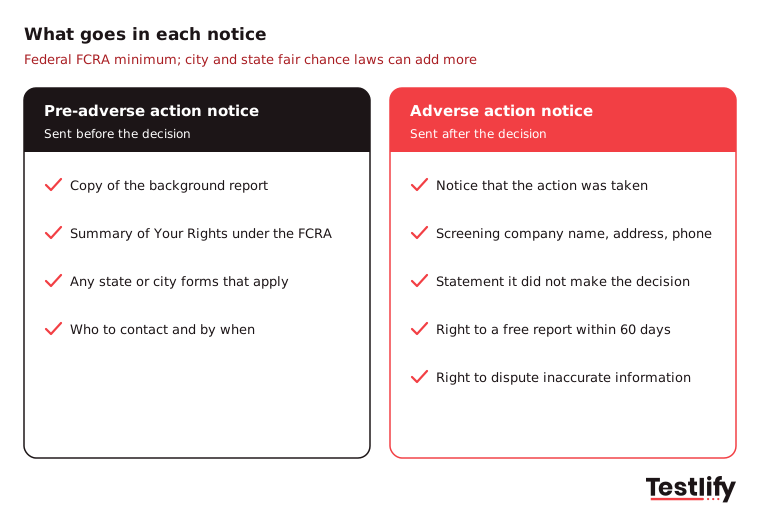
An adverse action notice has five core parts under federal law, and it only makes sense alongside the pre-adverse notice that comes before it. The FTC's guidance for employers using consumer reports lists both sets of requirements.
Notice that adverse action was taken
The final notice tells the person the decision: the offer is withdrawn, the application is rejected, or the promotion is denied. The FCRA allows the notice orally, in writing or electronically, though written or emailed notices are far easier to prove.
Screening company contact details
The notice gives the name, address and phone number of the consumer reporting agency that supplied the report. A company that keeps files nationwide must also list its toll-free number.
Statement that the screening company did not decide
The notice states that the background screening company did not make the decision and cannot explain the specific reasons for it. The employer owns the decision.
Right to a free report within 60 days
The person can ask the screening company for a free copy of the report within 60 days of the notice.
Right to dispute inaccurate information
The notice explains that the person can dispute the accuracy or completeness of any information in the report directly with the screening company.
Local fair chance additions
Some cities and states add content. New York City and California, for example, require the employer to share its written assessment of a conviction record and give the candidate time to respond with evidence of rehabilitation before the final decision.
How do you send an adverse action notice?
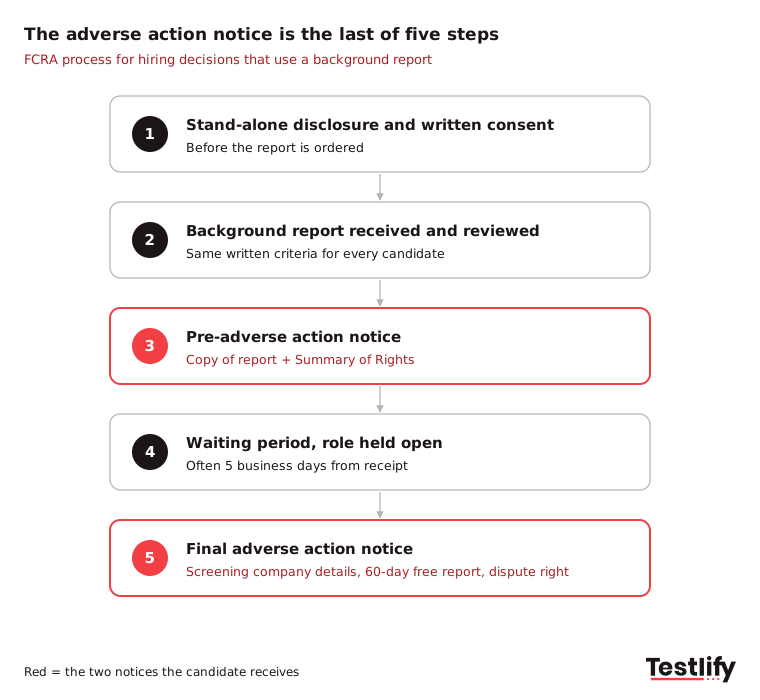
An adverse action notice is sent in a fixed order that starts before the background check is ordered. Skipping or reordering a step is what turns a defensible decision into a claim.
- Get stand-alone consent: Give the candidate a clear written disclosure, on its own document, that you may get a consumer report, and collect written authorization. The disclosure cannot sit inside the job application.
- Review the report against the job: Apply the same written criteria to every candidate. Consider how serious the record is, how long ago it happened and whether it relates to the duties of the role.
- Send the pre-adverse action notice: Before any final decision, send a copy of the report and the Consumer Financial Protection Bureau's "A Summary of Your Rights Under the Fair Credit Reporting Act". Add any state or city forms that apply.
- Wait and keep the role open: The FCRA sets no fixed number of days, but five business days is the common benchmark among employers and screening companies.
- Consider the response: If the candidate disputes the report or shares context, review it honestly and record the outcome.
- Send the final adverse action notice: Include the five components above. Log the send date and delivery method.
- Keep and dispose of records properly: Keep hiring records for at least one year, according to EEOC and FTC joint guidance on background checks, then destroy reports securely.
Pro tip: Count the waiting period from the day the candidate receives the pre-adverse notice, not the day you send it. Courts have questioned five-day waits that shrank because of mail delays or holidays.
Adverse action notice vs pre-adverse action notice
An adverse action notice and a pre-adverse action notice are two halves of one process. The pre-adverse notice warns the person that a decision may go against them, and the adverse action notice confirms the decision once it is made.
Aspect | Pre-adverse action notice | Adverse action notice (final) |
|---|---|---|
When it is sent | Before the decision is final | After the decision is made |
Purpose | Let the person review and dispute the report | Confirm the decision and explain their rights |
Must include | Copy of the report, Summary of Rights | Screening company contact, statement that it did not decide, 60-day free report right, dispute right |
FCRA section | 15 U.S.C. 1681b(b)(3) | 15 U.S.C. 1681m(a) |
Timing rule | Sent before any adverse action | Sent after a reasonable wait, often five business days |
Credit adverse action notices follow a different clock. According to the Consumer Financial Protection Bureau's Regulation B rules under the Equal Credit Opportunity Act, a lender generally has 30 days after a completed application to send its notice.
Employment notices have no single federal deadline, which is why local rules and internal policy matter so much.
What are the best practices for adverse action notices?
Adverse action notices hold up best when the process around them is written down, owned and measured. These practices cover the gaps that show up most often in employment claims:
- Use one approved template per jurisdiction: Legal reviews a federal version plus city and state versions, so recruiters never write notices from scratch.
- Separate the decision maker from the sender: A hiring manager decides; TA operations sends the notice and logs it. The split keeps the timeline clean.
- Record receipt, not just sending: Email read receipts or portal acknowledgements prove the candidate had time to respond.
- Apply written criteria to every record: Consistent rules reduce the risk of adverse impact against protected groups and make each decision explainable.
- Ask for consent after the offer where local law requires it: Ban the box and fair chance laws often move criminal history checks after a conditional offer.
- Write in plain language: A candidate who understands the notice is more likely to fix a real error than to file a complaint.
Key takeaway: The notice protects you only if the steps before it were followed. Audit the consent form, the pre-adverse notice and the wait before you worry about wording.
Ready to see skills-based screening in action?
Screening for job-relevant skills earlier means fewer, better-matched finalists reach the background check stage. Book a demo to see how Testlify's 3,500+ skills role-specific tests help you identify top talent quickly
Frequently asked questions (FAQs)
An adverse action notice is a legal notice, not a general rejection letter. Employers send one only when a consumer report played a part in the decision, and it must carry the FCRA content. A standard candidate rejection email covers every other case.
Cite this page
Copy a ready-made citation for this page in your preferred style.
- APA
Testlify. (2026). Adverse Action Notice. https://testlify.com/hr-glossary/adverse-action-notice/
- MLA
"Adverse Action Notice." Testlify, 28 October 2026, https://testlify.com/hr-glossary/adverse-action-notice/.
- Chicago
Testlify. "Adverse Action Notice." Testlify. Last modified October 28, 2026. https://testlify.com/hr-glossary/adverse-action-notice/.
- HTML link
<a href="https://testlify.com/hr-glossary/adverse-action-notice/">Adverse Action Notice</a>, Testlify (2026)
Related terms
Adverse Impact
Adverse impact refers to a negative or disproportionate effect on a particular group of people, such as a minority group or women.
Affective Events Theory (AET)
Affective Events Theory (AET) is a theory that explains how emotions and moods influence work behavior and decision-making.
Affirmative Action
Affirmative action refers to policies and initiatives that aim to correct for past discrimination and promote diversity and inclusion, often in education and employment.
After-Acquired Evidence
After-acquired evidence is new evidence that is discovered after a legal decision has been made, which may affect the outcome of the case.
Age Discrimination in Employment Act (ADEA)
The Age Discrimination in Employment Act (ADEA) is a federal law that prohibits discrimination against employees who are 40 years of age or older.
Ageism
Ageism is prejudice or discrimination against a particular age group, typically older people. It can take many forms, including stereotypes and discriminatory practices.
Get started.
Hire on proof, not resumes.
Run your first skills-based assessment free — no credit card required.