
Garden leave meaning: pay, rules, and key benefits
Learn about garden leave, its legal aspects, benefits, challenges, and impact on company culture. Find out how it supports smooth transitions and compliance.
In 2026, not every employee who resigns should remain active until their last working day. For roles involving sensitive information, strategic projects, or key client relationships, employers may choose garden leave to reduce risk during the notice period.
Garden leave is a paid stretch of a notice period when an employee who has quit or been given notice is kept away from work, off the premises and off live projects, while staying on the payroll until their contract ends.
In this guide, you’ll learn what garden leave means, how it works, the rules employers typically follow, how pay is handled, and the key benefits for both employers and employees.
TL;DR
- Garden leave is a paid notice period spent away from work, so a departing employee cannot walk clients, data, or momentum straight to a rival.
- The person stays on payroll and keeps their benefits, but loses access to systems, colleagues, and current projects.
- It is not a plain notice period (you might still work that) and not a non-compete (that starts after you leave and is usually unpaid).
- Length is set by the employment contract, most often somewhere between one and 12 months.
- For the employer, the real cost is a paid empty desk, so the smart play is to use the window to line up and assess a replacement.
 ChatGPT
 Gemini
 Claude
 Grok
Grok Perplexity
What is garden leave?
Garden leave is a period inside a notice period when an employer tells a resigning or departing worker to stop working but keeps paying them in full. The employee is still legally employed, still draws salary and benefits, and is still bound by the contract, but they are kept away from the office, clients, and any live work until their end date.
In the United Kingdom, the UK government confirms an employer can ask you not to come in during your notice if your contract allows it. That one rule, contract permission plus continued pay, is what separates garden leave from being suspended or simply let go. So what does garden leave mean for the person on it? You are employed, you are paid, and you are benched.
Common situations where garden leave is used
Garden leave is not used in every departure. Employers usually reserve it for situations where keeping an employee away from work protects confidential information, client relationships, or business interests while the notice period runs. The most common situations include resignations and certain terminations.
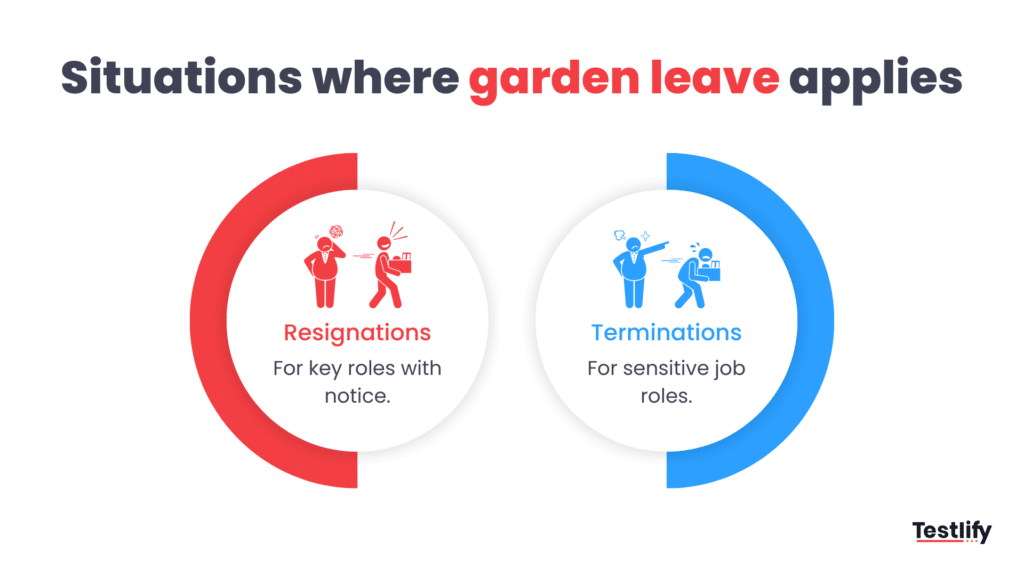
Resignations
Garden leave most often applies when an employee resigns from a senior client-facing role. Instead of working through the notice period, the employee remains on the payroll but stays away from the workplace until their employment officially ends.
Terminations
In some cases, employers also use garden leave during terminations, particularly for employees with access to confidential information or key business relationships. The employee continues to receive their salary and benefits but does not perform work during the notice period.

How does garden leave work?
Garden leave begins as soon as the employer activates the garden leave clause after notice is given. The employee stops working, returns access to company systems, and remains employed until the notice period ends. During this time, salary and benefits continue, but the employee must still follow the terms of their employment contract.
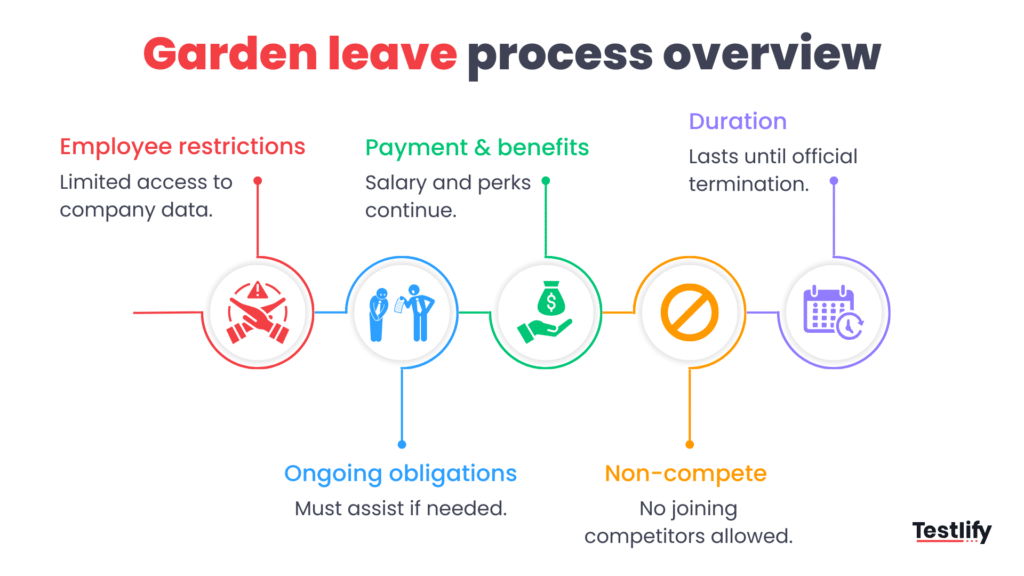
Employee restrictions
Once garden leave starts, employees are usually asked to return company property and lose access to internal systems, confidential documents, and client accounts. They are not expected to perform their regular duties unless specifically instructed by the employer.
Ongoing obligations
Although employees are away from the workplace, their employment contract remains in effect. They may still need to answer reasonable questions, assist with a handover, or support the business if requested during the notice period.
Pay and benefits
Employees continue to receive their regular salary and contractual benefits throughout garden leave. This may include bonuses, pension contributions, health insurance, and other benefits, depending on the terms of the employment contract.
Non-compete restrictions
In many cases, employees cannot start working for a competitor while they are on garden leave. Since they are still employed by their current employer, they must continue to comply with any contractual restrictions, including confidentiality and non-compete clauses where they are legally enforceable.
Duration
Garden leave usually lasts until the employee’s notice period ends and their employment officially terminates. The length depends on the notice period stated in the employment contract, which can range from a few weeks to several months.
Garden leave vs notice period: what’s the difference?
A notice period is simply the gap between the day someone resigns or is dismissed and their final day of employment, and its length depends on the contract and how long they have worked there, as Acas sets out.
Garden leave is one way to spend that notice: at home, not working, still paid. On a normal notice period you keep showing up and doing the job; on garden leave you do the opposite. Every garden leave is a notice period, but not every notice period is garden leave.
Feature | Garden leave | Standard notice period | Non-compete clause |
|---|---|---|---|
Are you paid? | Yes, in full | Yes, in full | Usually no |
Are you working? | No | Yes, normally | No, you have left |
When it applies | During notice | During notice | After employment ends |
Typical length | 1 to 12 months | 1 week to 3 months | 6 to 24 months |
Main purpose | Freeze access, protect data | Hand over work | Block future competition |
Garden leave vs a non-compete: which is stronger?
Garden leave and non-compete clauses both help employers protect confidential information, client relationships, and business interests. The difference is when they apply and how they work.
Garden leave keeps an employee away from work while they are still employed and receiving full pay. A non-compete restricts where an employee can work after their employment ends, which can make it harder to enforce in some jurisdictions.
Feature | Garden leave | Non compete |
|---|---|---|
When it applies | During the employee’s notice period | After employment ends |
Employment status | Employee remains employed | Employment has already ended |
Salary and benefits | Continue throughout the leave period | Usually no salary unless separately agreed |
Work obligations | Employee stops regular work but remains bound by the employment contract | No work obligations to the former employer |
Joining a competitor | Not allowed until employment officially ends | Restricted only if the non-compete clause is valid and enforceable |
Purpose | Protects confidential information, client relationships, and business continuity during the notice period | Prevents employees from joining competitors or starting competing businesses after leaving |
Legal enforceability | Generally easier to enforce because the employee continues to receive pay | Often subject to stricter legal scrutiny and may be limited or unenforceable depending on local laws |
Typical duration | Lasts for the contractual notice period | Varies by contract and applicable employment laws |
Which is stronger?
In practice, garden leave is often the stronger and more practical option because the employee remains on the payroll while staying away from the business. Since the employer continues to pay salary and benefits, courts in many jurisdictions are generally more willing to uphold reasonable garden leave provisions than broad post-employment restrictions.
By contrast, non-compete clauses face increasing legal scrutiny. In the United States, the Federal Trade Commission attempted to ban most non-compete agreements in 2024.
Although a federal court later blocked the rule nationwide and the FTC dropped its appeal in 2025, the dispute highlighted growing concerns about how broadly non-competes restrict employee mobility. At the time the rule was proposed, an estimated 30 million U.S. workers, roughly one in five, were covered by a non-compete agreement.
For many employers, garden leave offers a more balanced approach. It protects confidential information and client relationships during the notice period while the employee continues to receive full pay, making it a more proportionate and often more defensible way to safeguard legitimate business interests.
Benefits of garden leave
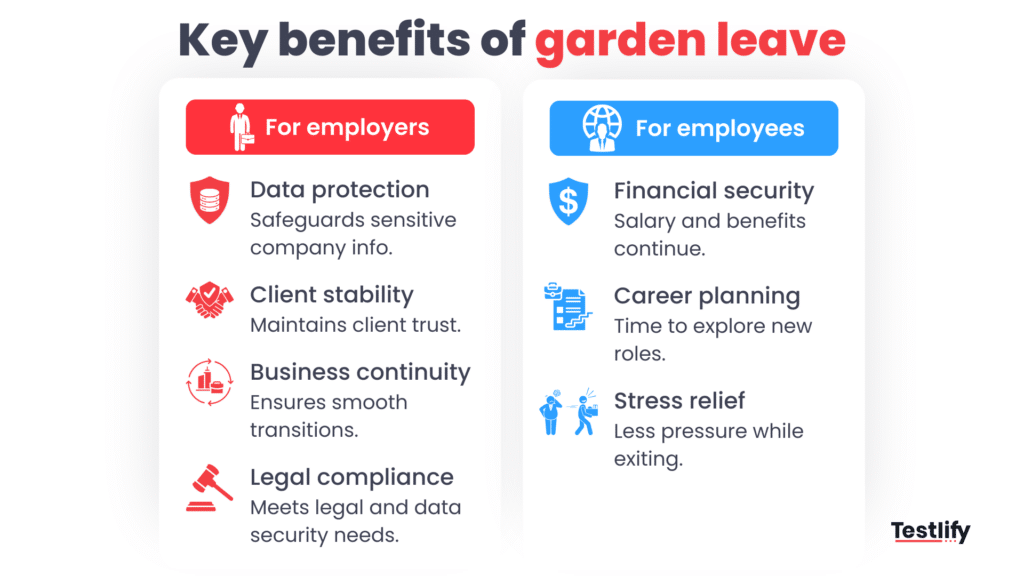
Garden leave benefits both employers and employees during the notice period. For employers, it protects the business while ensuring a smooth transition. For employees, it provides financial stability and time to prepare for their next opportunity without immediately leaving the payroll.
- Protect data and clients: A benched employee cannot copy the pipeline or call the top accounts on their way out.
- Cool down a competitive move: Six months on the sidelines means the person joins a rival with stale information, not live deals.
- Buy time to hand over: The role can be documented and reassigned without the leaver steering it.
- Keep the exit calm: Removing someone from day-to-day work reduces friction with the team they are leaving.
There is a workforce backdrop here too. Median employee tenure in the United States was just 3.9 years in January 2024, according to the U.S. Bureau of Labor Statistics, about 4.2 years for men and 3.6 years for women, and 22 percent of workers had been in their job a year or less.
People move often, and every senior move is a chance for knowledge and relationships to walk out the door. Garden leave is one lever for controlling that moment, which ties directly to the cost of losing talent.
The downside of garden leave
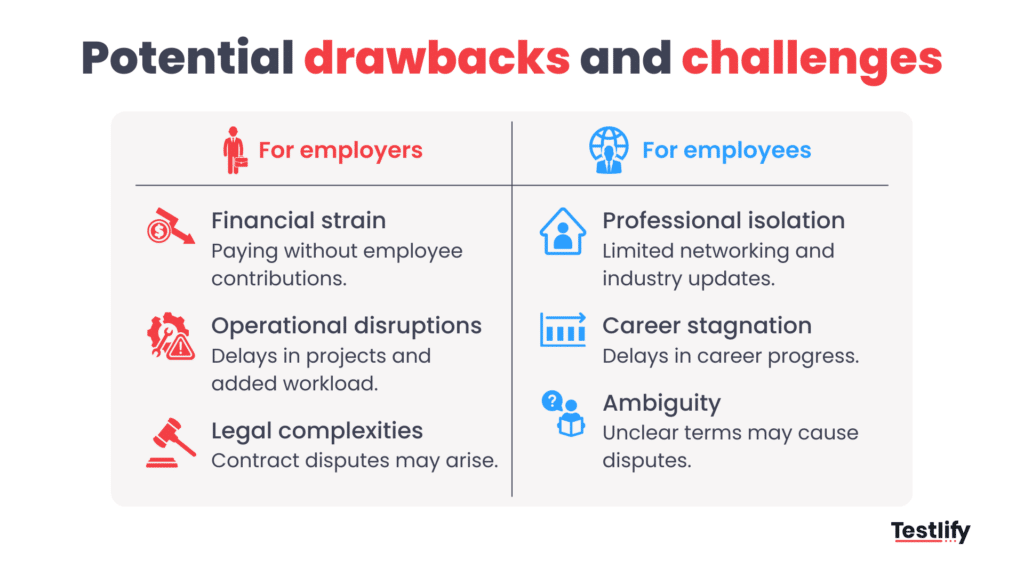
Garden leave is not free, and it is not always the right call. The obvious cost is money: you are paying a full salary for zero output, sometimes for months. There are quieter costs too.
- Paid idleness: A 6-month garden leave for a director on a six-figure salary is a large, output-free line item.
- Skills and morale drift: Long benches can leave the person rusty, and the remaining team stretched covering the gap.
- Resentment: Handled coldly, it can feel like a punishment and sour an otherwise fine relationship.
- Enforceability limits: If the clause is missing or overbroad, a court may not back it, and the employee could walk.
Impact of garden leave
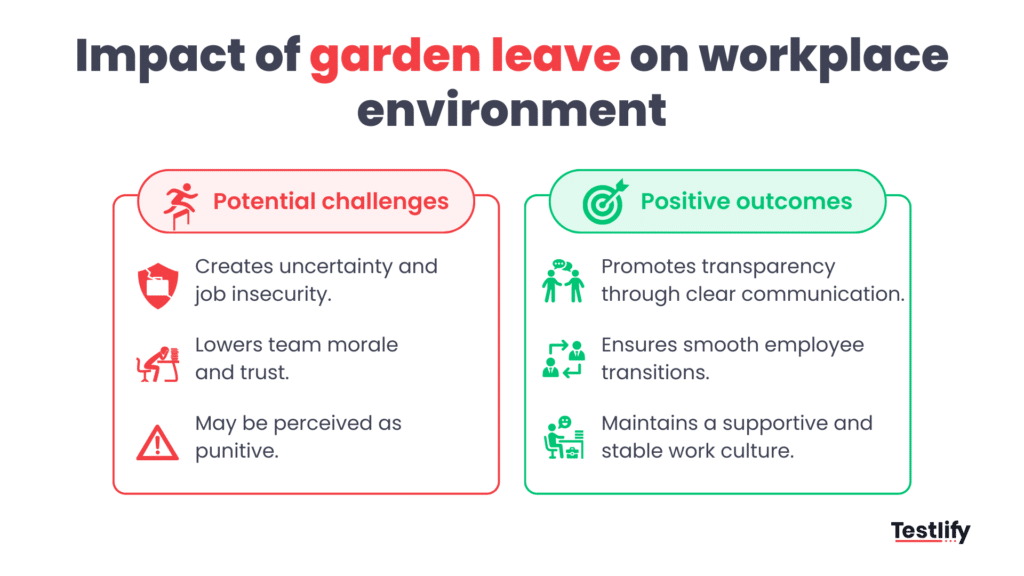
Garden leave does more than protect confidential information. It also shapes how employees view the organization during periods of change. When managed well, it creates a smooth transition that reassures teams and protects business continuity. When handled poorly, it can lead to uncertainty and unnecessary speculation.
Impact: Workplace uncertainty
Challenge: When an employee suddenly stops coming to work, colleagues may speculate about the reason, creating uncertainty and concerns about job security.
How to overcome it: Communicate the transition clearly without sharing confidential information. Explain changes to responsibilities, reassure employees about business continuity, and encourage managers to address questions promptly.
Impact: Team morale
Challenge: Remaining employees may feel pressured by redistributed workloads or perceive the departure negatively, affecting morale and trust.
How to overcome it: Reassign work fairly, provide regular check-ins, and recognize employees who take on additional responsibilities. Open communication helps maintain confidence across the team.
Impact: Employee perception
Challenge: If garden leave is viewed as a punishment rather than a standard business practice, it can damage trust in leadership and the organization’s culture.
How to overcome it: Apply garden leave consistently and explain its purpose as a way to protect business interests during the notice period. Treat departing employees respectfully throughout the offboarding process.
Impact: Business continuity
Challenge: Key projects, customer relationships, and operational knowledge may be affected when an employee leaves active duties.
How to overcome it: Use the notice period to complete handovers, document processes, and hire or onboard a replacement. A structured transition minimizes disruption and helps maintain stability.
How to hire a replacement during garden leave?
One of the biggest advantages of garden leave is that it gives employers time to recruit without rushing. Because the departing employee remains employed but is no longer involved in day to day operations, the organization can focus on finding and preparing a replacement before the official exit date.
Start the hiring process early
The notice period creates a valuable hiring window. Employers can advertise the role, screen candidates, conduct interviews, and make an offer before the position becomes vacant, reducing time to fill.
Use the transition period for knowledge transfer
If needed, the employee on garden leave can still assist with reasonable handover activities permitted under their contract. This helps document key processes, transfer responsibilities, and ensure the incoming hire starts with the information they need.
Reduce disruption to the business
Having a replacement identified before the employee’s departure minimizes productivity gaps and helps maintain continuity for customers, colleagues, and ongoing projects.
Assess candidates for long-term success
If you’ve identified a replacement, evaluate every candidate using the same hiring process. Use structured interviews, skills assessments, and job simulations to measure job-relevant abilities instead of relying on assumptions or familiarity.
This approach also applies to boomerang employees. If a former employee applies for the role, assess them using the same criteria as every other applicant. Previous experience with the company can provide useful context, but the hiring decision should still be based on current skills, role fit, and business needs.
Pro tip: Write the garden leave clause and the backfill trigger into the same policy. The day notice is served, the assessment for the replacement role should auto-send. Tying the two together turns a paid empty desk into a running head start, and it stops the classic mistake of only starting the search once the leaver has already gone.
Turn the garden leave window into a hire
The moment someone senior gives notice, the race to backfill starts. Testlify lets you assess a shortlist on real, role-specific skills and sign the right person before the paid window closes.
Key takeaways
- Garden leave keeps employees on the payroll while removing them from active work during the notice period.
- It protects confidential information, client relationships, and business continuity during employee departures.
- Garden leave is a paid notice period, unlike a non-compete, which applies after employment ends.
- Employers should use garden leave to complete handovers and hire a replacement, not simply pay for inactive time.
- Clear communication and respectful offboarding help maintain trust and minimize workplace disruption.
- Structured hiring and skills-based assessments help employers make better replacement decisions.
Frequently Asked Questions (FAQ)

Human Resources Lead
Snehi Parmar leads People at Testlify, owning hiring, culture, performance, and retention for a 90-person team. She writes on practical HR strategy and building people processes that scale.
Related resources
View all
HR & recruitment
SEO for recruitment : The role of AI in talent search

HR & recruitment
What is DEI: Definition, why it matters & tips
HR & recruitment
Top 6 hard-core tips to hire top IT specialists
HR & recruitment
4 simple ways to measure training effectiveness
HR & recruitment
Employee Pulse Surveys: What They Are, How They Work, and Why They Matter in 2026
HR & recruitment
The science behind picOCEAN: How image personality test work
Get started.
Hire on proof, not resumes.
Run your first skills-based assessment free — no credit card required.