
How to evaluate email marketing skills in candidates
A 6-step way to evaluate email marketers: skills by level, a short test, a timed work sample, structured questions and a scoring rubric.

A polished email marketing resume tells you very little about who can run your list. Plenty of strong-looking applicants have never owned a segment plan, a flow or a deliverability fix.
Resumes are a weak filter for this role. LinkedIn reported in January 2025 that 73% of HR professionals say fewer than half of the applications they receive meet all the listed criteria, and 63% see a gap between job seekers' skills and what their organization needs.
Knowing how to evaluate email marketing skills in candidates comes down to one shift: judge what people can do with a real list, brief and dashboard. The 6 steps below check strategy, copy, automation, analytics and deliverability the same way for every candidate, then score each skill on a shared rubric.
TL;DR:
- To evaluate email marketing skills in candidates, map 5 to 6 skills for the level, screen with a 30 to 45 minute skills test, set one timed work sample, run a structured interview and score everyone on a 1 to 4 rubric.
- The five skills to check are strategy and segmentation, copy, automation, analytics and testing, and deliverability with compliance.
- A work sample built from your own brief is the strongest single signal. Keep it to 60 to 90 minutes so good candidates do not drop out.
- Ask about clicks, conversions and revenue, not open rates alone. Apple Mail Privacy Protection makes opens an unreliable main metric.
- Since February 2024, Gmail expects bulk senders to use SPF, DKIM and DMARC, offer one-click unsubscribe and keep spam complaints under 0.30%. A senior hire should know this cold.
- Advance candidates at a weighted 3.0 or above with no skill area scored 1.
 ChatGPT
 Gemini
 Claude
 Grok
 Perplexity
What email marketing skills should you evaluate in candidates?
Email marketing skills fall into five areas you can test: strategy and segmentation, copy and content, automation and tools, analytics and testing, and deliverability with compliance. The last two are the hardest to see in a portfolio of good-looking campaigns, so test them directly.
- Strategy and segmentation: Plans each send around a goal and an audience, builds segments from behavior and lifecycle stage, and knows when not to email a segment at all.
- Copy and content: Writes subject lines, preheaders and body copy with one clear call to action, in the brand voice, and edits ruthlessly for mobile.
- Automation and tools: Builds welcome, nurture, abandoned cart and win-back flows with triggers, timing and branch logic in tools like Mailchimp, HubSpot, Braze or Marketo.
- Analytics and testing: Reads click rate, conversion rate, revenue per email and unsubscribe rate, runs A/B tests that change one variable, and explains what changed because of the result.
- Deliverability and compliance: Understands sender reputation, list hygiene, bounces, SPF, DKIM and DMARC, consent and opt-out rules.
Soft skills still count. An email marketer works with design, product, sales and legal, so look for clear written feedback and the ability to defend a decision with data.
For a deeper list of skill-area tips, see our guide on tips to evaluate email marketing skills.

Which email marketing skills matter at each level?
Email marketing skills matter differently by level: a coordinator must execute cleanly, a specialist must own campaigns and automation end to end, and a manager must set strategy, own the numbers and lead others. Test the level you are hiring for, not every skill at maximum depth.
Skill area | Coordinator (0 to 2 years) | Specialist (2 to 5 years) | Manager (5+ years) |
|---|---|---|---|
Strategy and segmentation | Follows a segment plan | Builds segments and a calendar | Sets channel strategy and targets |
Copy and content | Writes to a brief | Writes and tests variants | Sets voice and reviews others |
Automation and tools | Builds simple sends in one tool | Builds multi-branch flows | Chooses tools, audits flows |
Analytics and testing | Reports opens and clicks | Runs A/B tests, reads conversion | Owns revenue, attribution and forecasts |
Deliverability and compliance | Knows opt-out basics | Manages hygiene and bounces | Owns authentication, consent and audits |
HTML and CSS | Edits templates | Fixes rendering issues | Reviews, rarely codes |
Demand for this skill set is steady. The US Bureau of Labor Statistics projects 7% growth for advertising, promotions and marketing managers from 2025 to 2035, with about 36,300 openings a year.
With that much demand, a slow or unclear process makes it easy to lose good candidates to faster employers.
If you are still writing the role, start from an email marketing manager job description and cut the skills list to what the first year of the job really needs.
How to evaluate email marketing skills in candidates in 6 steps
The process below works for coordinators through managers. Change the depth of each step, not the order.
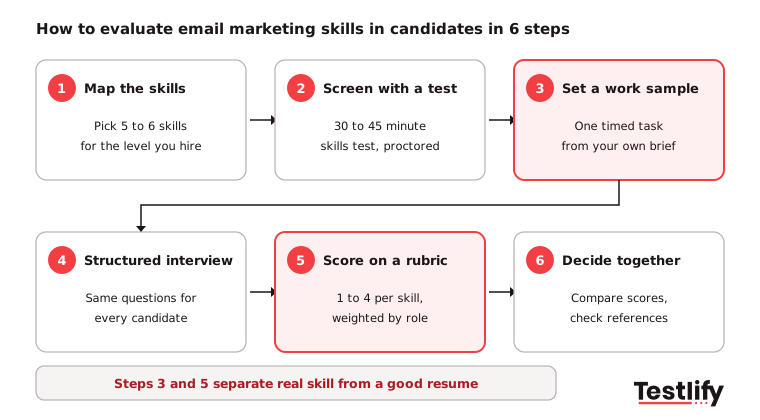
- Map the skills: Pick 5 to 6 skills from the table above for the level. Write one sentence for what "good" looks like in each, in the context of your list size, tools and goals.
- Screen with a skills test: Send a 30 to 45 minute test to every applicant who meets the basics. It replaces resume guesswork with a score on email knowledge, analytics and copy, and it is fair because everyone gets the same questions.
- Set a work sample: Give the top scorers one timed task built from your own brief, such as a campaign plan or a flow design. This is where you see real judgment.
- Run a structured interview: Ask every candidate the same questions about past campaigns, metrics and trade-offs, and score answers as you go. A structured interview keeps the comparison fair.
- Score on a rubric: Rate each skill 1 to 4 with clear anchors and apply the weights for the role. Do this before the debrief so the loudest opinion does not set the score.
- Decide together: Compare weighted scores, review the work sample side by side, then check references on the one or two skills that stayed uncertain.
Pro tip: Write the work sample brief and the rubric before you open applications. If you write them after meeting candidates, the rubric quietly bends toward the person you already like.
Which skills tests should you use for email marketers?
Skills tests for email marketers work best as a short stack: one role test plus one or two tests for the tools and skills your team depends on. A single 30 to 45 minute stack screens a large pool quickly and gives you a ranked shortlist before anyone spends time on interviews.
What you need to check | Test to use | Best for |
|---|---|---|
Core email marketing knowledge | All levels | |
Reading campaign data | Specialist, manager | |
Building flows | Specialist | |
Template edits | Coordinator, specialist | |
Writing | All levels | |
Your platform | Teams tied to one tool |
Keep the stack under 45 minutes. Longer screens lose strong candidates who are interviewing elsewhere, and the work sample in the next step covers depth anyway.
What work sample should you give email marketing candidates?
A work sample for email marketing candidates should mirror one real task from the first 90 days, use your own brief and data, and take 60 to 90 minutes. Pick one of the three tasks below by level rather than setting all three.
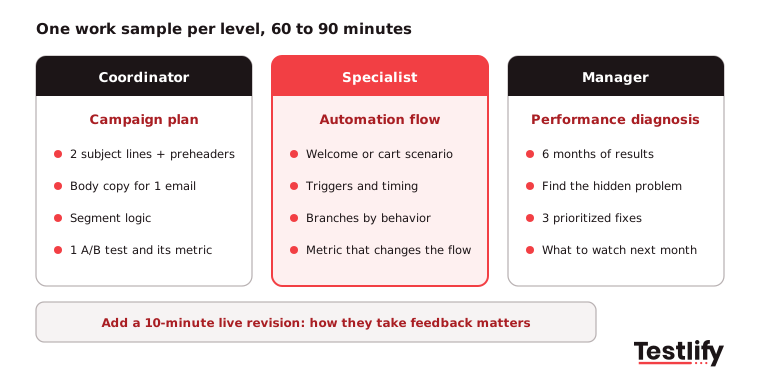
- Campaign plan (coordinator and specialist): Share a product launch brief, two audience segments and brand rules. Ask for two subject lines with preheaders, the body copy for one email, the segment logic and one A/B test with the metric that decides it.
- Automation flow (specialist): Describe a welcome or abandoned cart scenario. Ask for a flow with triggers, timing, branches by behavior, the goal of each email and the metric that would make them change the flow.
- Performance diagnosis (manager): Share six months of anonymized results with a hidden problem, such as clicks falling on one segment while opens rise, or complaints climbing after a list import. Ask for the likely cause, three prioritized fixes and what they would watch over the next month.
Then add a short live follow-up. Give one piece of feedback and ask the candidate to revise a single element on the spot. How someone takes feedback in 10 minutes tells you more about day-to-day work than a polished take-home.
Key takeaway: Score the reasoning, not the polish. A plain plan with sound segment logic and a clear test beats a beautiful mockup with no measurement plan.
What interview questions reveal real email marketing skill?
Interview questions that reveal real email marketing skill ask for one specific past campaign, the candidate's exact part in it, the numbers before and after, and what they would do differently. Generic "what is segmentation" questions only test vocabulary, which the skills test already covers.
- Walk me through one campaign you owned. What was the goal, what did you send, and what changed in clicks, conversions or revenue?
- Your open rate rose 15% but clicks fell. What do you check first?
- How would you segment a list of 200,000 contacts for a product launch, and who would you leave out?
- Tell me about an A/B test that surprised you. What did you change afterwards?
- A sales leader wants to email the whole list, including people inactive for two years. What do you say?
- Complaints jumped after a send. Walk me through your first hour.
- How do you decide when an automated flow needs to be rebuilt rather than tweaked?
- Which three numbers would you report to leadership every month, and why those three?
Strong answers name real numbers, describe trade-offs and admit a mistake. Weak answers stay at the level of best practice.
For a longer bank by role, use our email marketing specialist interview questions.
How should you score email marketing candidates?
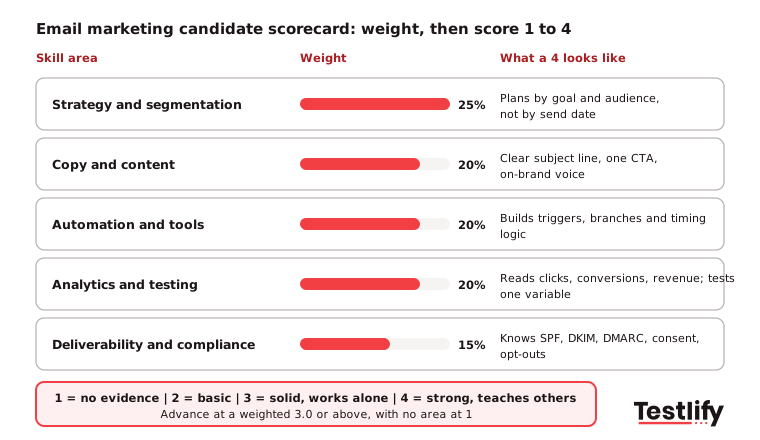
Email marketing candidates should be scored on a weighted 1 to 4 rubric across the five skill areas, with anchors written before interviews begin. A 4-point scale forces a decision: there is no safe middle score to hide in.
Score | Meaning | Example (analytics and testing) |
|---|---|---|
1 | No evidence | Talks about opens only, cannot name a test they ran |
2 | Basic | Reports clicks and opens, tests subject lines only |
3 | Solid, works alone | Tests one variable at a time, ties results to conversions |
4 | Strong, teaches others | Links email to revenue, designs a test plan for the team |
Change the weights by role. A lifecycle specialist might put 30% on automation; an email manager might put 30% on strategy and analytics.
Our guide to the interview scorecard shows the layout.
Advance candidates at a weighted 3.0 or above with no area at 1. Record a line of evidence next to every score, so the hiring decision rests on comparable notes.
How do you check compliance and deliverability knowledge?
Compliance and deliverability knowledge is best checked with two or three scenario questions and one line in the work sample, because a single mistake here can put a whole domain in the spam folder. Senior candidates should explain the rules in plain words; junior candidates should at least know they exist.
- CAN-SPAM: The FTC's CAN-SPAM compliance guide requires truthful headers and subject lines, a physical postal address, a clear way to opt out and opt-outs honored within 10 business days. Each violating email can draw penalties of up to $53,088.
- Mailbox provider rules: According to Google's email sender guidelines, since February 1, 2024 anyone sending more than 5,000 messages a day to Gmail accounts must set up SPF, DKIM and DMARC, support one-click unsubscribe and keep reported spam rates below 0.30%.
- Consent outside the US: For EU and UK lists, ask how they collect and record consent, and how they handle a request to stop.
A good scenario: "We bought a list from an event partner. Can we email it next week?" The right answer is a clear no, followed by what they would do instead.
What red flags should you watch for when evaluating email marketers?
Red flags when evaluating email marketers are mostly about measurement and judgment, not creativity. Watch for these during the test, task and interview.
- Open rate as the headline metric: Apple Mail Privacy Protection inflates opens, so a candidate who measures success only by opens is reading a broken number.
- No deliverability vocabulary: Unable to explain a hard versus soft bounce, sender reputation or why a list needs regular cleaning.
- "Send to everyone" instincts: No hesitation about emailing inactive or purchased contacts.
- Consent shortcuts: Treats pre-ticked boxes as consent. The European Data Protection Board's 2026 consent summary is clear that silence, pre-ticked boxes or inactivity do not count as consent.
- Vague ownership: Uses "we" for every result and cannot say what they personally did.
- Polish with no plan: A beautiful work sample with no segment logic, test or success metric.
How does Testlify help you evaluate email marketing skills?
Testlify helps you evaluate email marketing skills by running the screening, the work sample and the scoring in one place, so every candidate gets the same test and the same rubric. The point for a TA team is a ranked shortlist from objective scores instead of a pile of similar resumes.
- Ready tests and custom builds: Pick from 3,500+ tests, including the email marketing, analytics, automation, copywriting and platform tests above, or let the AI test builder create a role-specific assessment from your job description in under a minute.
- Work samples inside the test: 25+ question types include practical tasks, file uploads, open-ended answers and one-way video, so the campaign plan or flow design can sit in the same invite as the skills test.
- Fair, checkable results: 20+ proctoring checks, including copy and paste tracking and AI assistance detection, help you trust that the work is the candidate's own. Explore the platform's anti-cheating and proctoring features.
- Scores you can compare: Automated scoring, weighted scoring and benchmarking rank candidates on the skills you set, with per-skill breakdowns for the debrief.
- Fits your stack: 100+ ATS and HRIS integrations, including Greenhouse, Lever, Workday and SmartRecruiters, send invites and push scores back, and candidates can take tests in 15+ languages.
Ready to hire an email marketer on proof?
Build your email marketing screen by picking a role test, adding one work sample task and setting the weights for your rubric. Every candidate then gets the same test and the same rubric.
Start a 7-day free trial with no credit card, or book a demo to see the email marketing tests with your team.
Frequently asked questions (FAQs)

Director of Marketing
Akash Patange is the Director of Marketing at Testlify, where he works closely with HR leaders and recruiters to help organizations improve hiring outcomes. He writes about talent assessment, recruitment technology, and data-driven hiring practices.
LinkedInRelated resources
View all
Skill assessment
How to evaluate strategic thinking in candidates

Skill assessment
How to evaluate candidates’ skills with a numerical reasoning assessment

Skill assessment
How to evaluate candidates’ skills with a conflict management assessment

Skill assessment
How to evaluate candidates’ skills with an adaptability assessment

Skill assessment
How to assess business judgment in candidates: a 2026 guide for hiring teams

Skill assessment
How to evaluate candidates skills with a Ruby assessment
Get started.
Hire on proof, not resumes.
Run your first skills-based assessment free — no credit card required.