
Testlify vs HiPeople: A detailed comparison
Discover the perfect solution for evaluating your candidates’ skills with Testlify. Dive into our comprehensive Testlify vs HiPeople…
Testlify and HiPeople both screen candidates before anyone books an interview, but they solve different halves of the problem. Testlify is a pre-hire skills assessment platform built around a large test library, coding tests and proctoring. HiPeople is an AI screening platform whose strongest piece is automated reference checking, with assessments layered on top. Pick on that difference, not on a checkmark count.
Both tools are credible. The question worth answering is which kind of evidence your roles actually need, and that is what this comparison is built around.
 ChatGPT
 Gemini
 Claude
 Grok
Grok Perplexity
TL;DR: Testlify vs HiPeople at a glance
- Testlify runs deeper on assessment breadth: 3,500+ tests across 12 categories, including coding, engineering skills, typing, simulation and blue-collar roles.
- HiPeople runs deeper on references and conversational screening: automated reference checks and AI screening calls in 113 languages.
- Both have coding tests, custom questions, video questions, cognitive and personality tests, and ATS integrations. Older comparisons (including the earlier version of this page) claimed HiPeople had none of these. That was wrong.
- Testlify publishes its pricing. HiPeople does not, so budget comparisons need a sales call.
- If you need proctored skill evidence at volume, Testlify fits better. If your bottleneck is chasing references, HiPeople fits better. Some teams run both.

What is the difference between Testlify and HiPeople?
Testlify measures what a candidate can do through validated skills, coding and cognitive tests under proctoring. HiPeople gathers signal about how a candidate has worked before, mainly through automated reference checks and AI-led screening conversations. One verifies demonstrated ability. The other verifies reputation and fit. They overlap on assessments, and they diverge sharply everywhere else.
That distinction matters more than it sounds. Selection research keeps finding that job-relevant evidence beats general impressions, and the ranking is not the one most vendor pages assume. In the corrected meta-analysis by Sackett and colleagues, structured interviews correlate .42 with job performance and work samples .33, with cognitive ability at .31. No single signal carries a role on its own. That is the whole argument for combining them.
How was this comparison checked?
Every row in the table below was re-verified against each vendor's own live product and pricing pages in August 2026. Nothing was carried over from the previous version of this page, and nothing was taken from a directory listing or a review aggregator, because those inherit vendor-supplied feature grids that go stale quietly.
Three rules governed the rewrite. A capability counts as present only if the vendor documents it publicly. A price counts only if the vendor publishes it. And where a claim could not be confirmed at source, the row says "not published" instead of "no", because absence of evidence is not evidence of absence. Those three rules rewrote eight of the thirteen rows below. Across the comparison pages we maintain, that is the failure mode we keep finding: a feature grid built once, then quietly inherited for years.
Which platform covers more of the hiring process?
Here is the corrected side-by-side.
Capability | Testlify | HiPeople |
|---|---|---|
Test library size | 3,500+ tests, 180,000+ questions | 400+ tests, 1,000+ job-specific assessments |
Role-specific assessments | Yes, 5,000+ roles | Yes |
Coding and technical tests | Yes, dedicated coding and engineering categories | Yes, including Python, Java, SQL and AWS |
Cognitive ability tests | Yes | Yes |
Personality and culture tests | Yes | Yes |
Custom questions and assessment builder | Yes | Yes |
Video and async interview questions | Yes, one-way video | Yes, plus AI screening calls in 113 languages |
AI resume screening | Yes | Yes |
Automated reference checks | Yes | Yes, a core product, results in about 24 hours |
Proctoring and assessment integrity | Yes, full proctoring suite across identity, environment and browser lockdown | Fraud detection, screen limits and video identity checks |
Typing, simulation and blue-collar tests | Yes | Not published |
ATS integrations | Yes | Yes |
Published pricing | Yes, from $139 per month | No, contact sales |
Pro Tip: When a vendor comparison shows one column full of crosses, treat it as a red flag about the comparison, not the competitor. Check three rows against the other vendor's live product pages before you trust any of it, and check the ones that would change your mind, not the ones you already agree with.
What is HiPeople used for?
Key strengths
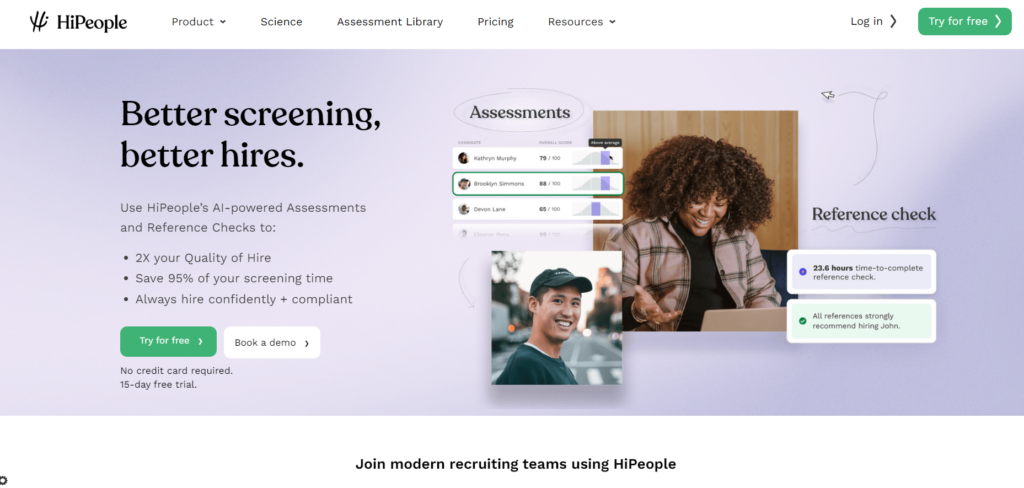
HiPeople is used to screen and verify candidates early, without a recruiter running each step by hand. Reference checking is the standout: invites, reminders, follow-ups and a finished report, typically inside a day. For teams that lose offers while waiting on a hiring manager to phone two referees, that is a real bottleneck removed.
Its assessment side is broader than most comparison pages admit. HiPeople's library covers 400+ tests and 1,000+ job-specific assessments spanning hard skills, soft skills, personality and culture, cognitive abilities and languages. The AI screening calls run around the clock in 113 languages, which suits high-volume and multi-country funnels.
Where it fits best
Best for talent teams whose main pain is verification speed and reference chasing, or who screen large multilingual candidate pools and want a consistent first conversation for everyone. Teams hiring mostly senior or trust-sensitive roles, where a referee's account carries real weight, get the most from it.
What does Testlify do best?
Key strengths
Testlify goes deep on demonstrated skill. The test library spans 3,500+ tests and 180,000+ validated questions across 12 categories, covering ground most assessment tools skip: typing, work simulations, engineering skills and blue-collar competencies alongside the usual cognitive and personality batteries.
The other half is integrity. Proctoring covers identity checks, environment monitoring, browser lockdown and session evidence, and it is configurable by role rather than all-or-nothing. That matters when a test result has to survive scrutiny, whether from a hiring manager who disagrees with it or an auditor asking how a decision was made.
Where it fits best
Best for teams hiring across technical and non-technical roles who need proctored, defensible skill evidence at volume, and who want published pricing they can budget against without a sales cycle.
Does HiPeople offer coding or technical tests?
Yes. This is the single biggest correction to the earlier version of this page, which claimed HiPeople had no programming tests at all. HiPeople's assessment library lists coding and technical tests including Python, Java, C#, C++, SQL, MongoDB, Angular and Bash, plus AWS cloud engineering, Figma, AutoCAD and financial modeling in Excel.
Testlify still covers more technical ground, with dedicated coding, programming and engineering-skills categories and role coverage across 5,000+ roles. But "more" and "none" are very different claims, and only one of them was true.
How much do Testlify and HiPeople cost?
Testlify pricing
Testlify publishes its rates. The Standard plan is $139 per month, billed at $1,668 per year, with 100 candidate credits included (about $16.68 per candidate), 3 user seats, unlimited assessments, AI interviews and proctoring. Extra seats are $15 per month, extra credits $21 each. A Custom plan covers organizations assessing 25,000+ candidates a year and adds advanced proctoring, ID verification, SSO and regional data storage. There is a 7-day free trial with no credit card.
HiPeople pricing
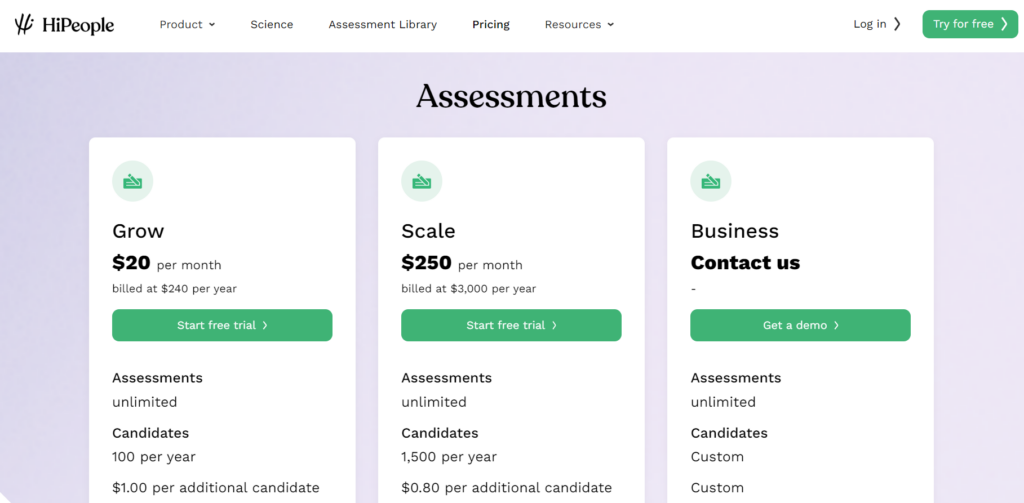
HiPeople does not publish plan pricing on its site, so any figure quoted elsewhere is second-hand and worth confirming directly. Reporting on its model describes credit-based consumption, where each AI action draws down credits at different rates. Treat published third-party numbers as indicative only and get a written quote before you compare budgets.
Worth putting those numbers next to the cost of getting the decision wrong. SHRM's 2025 benchmarking data puts the average cost per hire at $5,475 for nonexecutive roles and $35,879 for executive roles. Against that, the gap between two assessment subscriptions is rounding error. Buy the one that improves the decision.
How to choose between Testlify and HiPeople
Start from the role, not the tool. The Testlify Multi-Signal Talent Evaluation Model combines multiple role-relevant signals, including assessments, interviews, simulations, references and reviewer feedback, so a decision rests on several independent pieces of evidence rather than one. Once you list the signals a role genuinely needs, the vendor choice usually answers itself.
A support role hiring at volume needs a language test, a situational judgment test and a consistent first conversation. A senior finance hire needs a work sample, a structured interview and a real referee conversation. Those are different shopping lists, and neither platform wins both.
Two caveats worth naming. First, reference checks are the weakest link in most stacks because candidates choose their own referees; automating them makes them faster, not more honest. Second, a bigger test library only helps if someone maps tests to competencies. A team that fires off a generic cognitive test at every candidate gets no more signal from 3,500 tests than from 40.
The skills question is not going away either. Employers expect 39% of workers' core skills to change by 2030, which means whatever you validate at hire has a shorter shelf life than it used to. Buying for how a platform lets you re-map assessments to changing competencies beats buying for today's feature grid. Sackett and colleagues make a related point about designing selection systems around corrected validity estimates rather than inherited assumptions.
What can neither platform do for you?
Both vendors sell screening, and screening is one slice of hiring. Neither is an applicant tracking system, a sourcing tool, an HRIS, a payroll system or a background-check provider. Both integrate with those; neither replaces them. If a shortlist is stalling because the ATS workflow is a mess, a better assessment will not fix it.
Neither tool decides for you either, and that is deliberate rather than a gap. AI can summarize evidence, flag inconsistencies and rank candidates against a scorecard. A person still has to own the call, explain it to a hiring manager and defend it if someone asks why candidate B was cut. Any vendor implying otherwise is selling you a compliance problem.
The unglamorous work also stays yours. Someone has to define what good looks like for each role, pick the tests that map to it, set the cut score and check whether the people who passed actually performed a year later. Skip that and the platform becomes an expensive way to generate numbers nobody trusts. Screening and interviewing already run about 8 to 9 days each in the SHRM benchmark data cited above, so pointing them at the wrong competencies costs weeks per role, not minutes.
See Testlify against your own roles
The fastest way to settle this is to run one real role through both. Pick a job you are hiring for now, build the assessment, and look at whether the shortlist changes. Testlify's 7-day free trial needs no credit card, or you can book a demo and have someone map your competencies to tests before you spend a credit. If reference checking is your actual bottleneck, say so on the call; it is a fair reason to look elsewhere or to run both. For a wider field than these two, our roundup of HiPeople alternatives covers the rest of the category.
FAQs
Related resources
View all
Competitor Comparisons
Testlify vs REALCODERZ: A detailed comparison
Competitor Comparisons
Testlify vs HighMatch: A detailed comparison
Competitor Comparisons
Testlify vs BryQ: A detailed comparison
Competitor Comparisons
Testlify vs Crystal: A detailed comparison
Competitor Comparisons
Testlify vs Equalture: A detailed comparison
Competitor Comparisons
Testlify vs Moodle: A detailed comparison
Get started.
Hire on proof, not resumes.
Run your first skills-based assessment free — no credit card required.