
Employer of record in South Africa: what it costs and how to choose one
An EOR lets you hire in South Africa without a local entity. See typical costs, statutory rules and how to pick a provider.

Hiring one strong person in South Africa should not mean months of setting up a local company. An employer of record in South Africa is a local entity that legally employs your staff and runs their payroll and statutory filings.
Below are the typical fees, the statutory costs and the checks that separate a safe provider from a risky one.
TL;DR:
- An employer of record (EOR) in South Africa legally employs staff for a foreign company, handling the employment contract, payroll and statutory filings so the company does not need its own local entity.
- Typical EOR fees for South Africa run roughly $300 to $600 per employee per month, on top of the employee's gross salary and statutory costs.
- South Africa's statutory employer costs are relatively low compared with many markets: there is no employer social security contribution, but employers still owe unemployment insurance, a skills development levy and workers' compensation contributions.
- According to the South African Government, the national minimum wage rose to R30.23 an hour from March 2026, and the UIF (Unemployment Insurance Fund) earnings ceiling sits at R17,712 a month, both figures to check before setting a role's pay.
- The clearest sign a provider will cause problems is weak compliance scope: confirm who actually files PAYE, UIF and the skills levy, not just who signs the contract.
- Testlify does not offer EOR services, but once a South African hire is onboarded, the same job-specific, validated skills tests used anywhere else work the same way there.
 ChatGPT
 Gemini
 Claude
 Grok
 Perplexity
What is an employer of record?
An employer of record is a third party that becomes the legal employer of a worker in a given country, so the company that actually directs the work does not need its own registered entity there.
A company typically needs an EOR in South Africa when it wants to hire one or a handful of people quickly, is testing the market before committing to a local entity, or is hiring a specialist role where incorporating a South African subsidiary does not make sense yet.
Global recruitment often runs into this exact tradeoff: speed to hire versus the cost and time of setting up locally.

How much does an employer of record cost in South Africa?
EOR providers serving South Africa generally charge a flat monthly fee per employee, commonly reported in the $300 to $600 range. This sits on top of the employee's gross salary, statutory contributions and any setup fee.
The fee covers the EOR's own compliance work: running payroll, filing PAYE and UIF, maintaining the employment contract, and staying current on South African labor law changes.
Beyond the EOR fee, the statutory add-on cost in South Africa is comparatively light. Data from a detailed public breakdown puts the add-on at roughly 1.5% of gross salary once unemployment insurance, the skills development levy and workers' compensation contributions are totaled.
Estimates from different providers vary depending on what they include. Ask any EOR you evaluate for an itemized breakdown rather than a single bundled number.
Cost component | What it covers | Typical range |
|---|---|---|
EOR monthly fee | Local employment, payroll run, compliance filings | $300 to $600 per employee per month |
Unemployment insurance (UIF) | Employer and employee contributions, 1% each | Capped around R2,125 a year per employee |
Skills development levy | Employer-only, funds workforce training | 1% of payroll, no cap |
Workers' compensation (COIDA) | Injury-on-duty insurance, rate varies by industry risk | Around 0.18% for lower-risk roles like professional services |
Setup or onboarding fee | One-time cost to open the employment file | Varies by provider; confirm before signing |
In the EOR evaluations I have seen companies run, the quotes that fall apart later almost always bundled the statutory add-on into one flat number instead of breaking it out, so there was nothing to check it against once rates changed.
Pro tip: ask for the breakdown of the statutory add-on as a percentage of gross salary, not a flat number. South Africa's unemployment insurance has an annual cap, so the effective rate on a higher salary is lower than on a lower one.
What statutory rules does an employer of record in South Africa have to follow?
An employer of record operating in South Africa has to run payroll against a specific set of statutory obligations each month, filed with SARS through the EMP201 return.
Four items make up most of the monthly statutory load:
- PAYE: Pay-as-you-earn income tax withheld from the employee's salary.
- UIF: Unemployment insurance, split between employer and employee.
- Skills development levy: An employer-only charge that funds workforce training.
- COIDA: Workers' compensation for injury on duty, with the rate set by industry risk class.
South Africa has no employer-funded state pension or general social security contribution, which is why its statutory add-on is lower than in markets that require one.
The national minimum wage rose to R30.23 an hour from March 2026, and the UIF earnings ceiling, the salary level above which UIF contributions stop accruing, sits at R17,712 a month. Both numbers move most years, so an EOR quote based on last year's figures is worth double-checking before you sign.
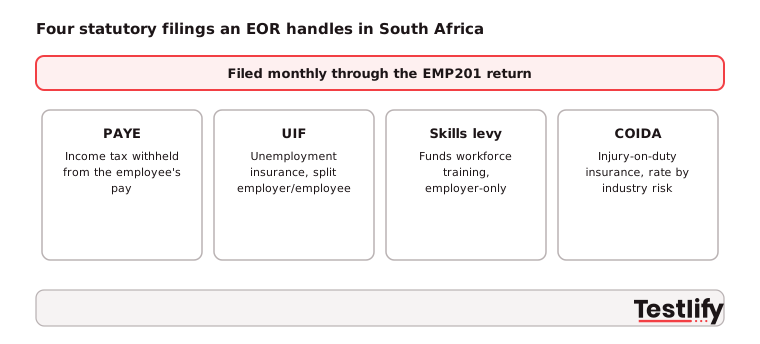
Key takeaway: South Africa's statutory employer cost is lower than many markets because there is no employer social security or state pension contribution, but PAYE, UIF, the skills levy and COIDA still have to be filed correctly every month.
What should you check before choosing an employer of record in South Africa?
The clearest red flags are around compliance depth, not price. A provider that only handles the employment contract and leaves PAYE or UIF filings vague is passing real exposure back to you if something goes wrong.
Before signing, confirm five things:
- PAYE and UIF filings: Ask who actually files them each month: the EOR directly, or a third-party payroll partner they use.
- Local entity: Ask whether the EOR has its own registered South African entity or works through a local partner. A partner-only model adds risk if that relationship ends.
- Data protection: Check how data about your employee is protected under South Africa's POPIA data-protection law.
- Disputes: Ask what happens if an employment dispute goes to the CCMA (South Africa's labor dispute body).
- Fee scope: Confirm whether the quoted monthly fee includes statutory contributions or adds them separately.
How do you compare employer of record providers for South Africa?
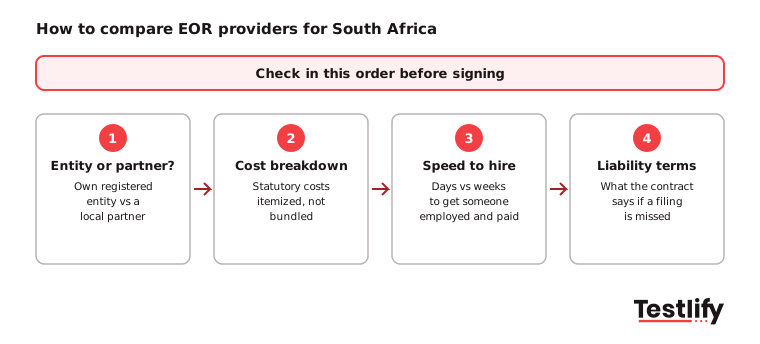
Compare providers on four things, in this order:
- Local entity: Check whether the provider has its own registered South African entity or works through a partner.
- Cost clarity: Check how clearly it breaks out statutory costs from its own fee.
- Speed to hire: Ask how fast it can get someone employed and paid. Some EORs quote days, others weeks.
- Liability: Read what the contract says about liability if a filing is missed.
Across the teams we have seen run this comparison, the fastest way to separate a strong provider from a weak one is asking for a sample payslip and EMP201 filing from an existing South African employee, not just a sales deck.
A lower headline fee from a provider working through an unnamed local partner is not necessarily cheaper once you account for the extra risk of that arrangement breaking down mid-contract.
The tradeoffs of hiring globally go beyond the EOR decision itself, into how a distributed team actually gets evaluated and managed once people are hired. Once someone is onboarded through an EOR in South Africa, the hiring bar should not drop just because the paperwork lives somewhere else.
Hiring in South Africa through an EOR and want a consistent skills bar across every market? Book a Testlify demo to see how it works, or browse the Testlify test library to find what you need to get started.
Frequently asked questions (FAQs)

People and Talent Partner
Arushi Shah runs day-to-day talent acquisition and candidate experience at Testlify. She writes on interviewing, structured hiring, and giving candidates a fair, fast process.
LinkedInRelated resources
View all
Global Recruitment
How to create fair and objective hiring assessments for diverse candidates?

Global Recruitment
Employer of Record in the Netherlands: 5 Best EOR Services for 2026

Global Recruitment
How Testlify helps in skills assessment for global recruitment?

Global Recruitment
ROI of recruitment software: formula, example and metrics

Global Recruitment
Global recruitment: Advantages and disadvantages

Interview questions
30 Selenium interview questions to ask and what strong answers sound like
Get started.
Hire on proof, not resumes.
Run your first skills-based assessment free — no credit card required.