
Candidate experience and employer branding: how your hiring process builds your brand
Your hiring process is your employer brand in action. See where candidates judge you most, and how to make assessments a brand asset.

Candidate experience and employer branding are two sides of the same promise. Your employer brand is what you tell people it is like to work for you. Candidate experience is the first proof they get. Every job ad, assessment, interview and rejection email either confirms the story on your careers page or quietly breaks it.
TL;DR / Key Takeaways
- Candidate experience is the part of your employer brand that candidates live through, so a slow, unfair or silent hiring process undoes good brand marketing.
- Candidate resentment hit a record 15% in North America in 2025, according to Survale's CandE Benchmark, and those candidates say they will not engage with the employer again.
- The assessment stage asks the most of candidates, which makes it the stage that shapes your brand most, for better or worse.
- Short, job-related tests with clear instructions, a stated time limit and some feedback turn assessments into proof that you hire fairly.
- Only 6% of rejected candidates got assessment feedback in 2025. Even a short score summary sets you apart.
- Measure drop-off, fairness ratings, candidate NPS and time to decision at each stage, not just once at the offer.
 ChatGPT
 Gemini
 Claude
 Grok
 Perplexity
How are candidate experience and employer branding connected?
Candidate experience and employer branding are connected because candidates judge your brand by how you treat them, not by what you publish. Employer branding sets the expectation before someone applies. Candidate experience either meets it or breaks it, and candidates then share that verdict with friends, on review sites and in referrals.
Think of it in two halves:
- Employer brand: Your employer brand is your reputation as a place to work: your values, culture, pay and growth story, as told on your careers site, in job ads and by your people.
- Candidate experience: Candidate experience is how a person feels about every step of your hiring process, from the job ad to the offer or the rejection.
The two meet in public. Survale's 2025 CandE Benchmark found that company career sites were the top research channel for candidates (46%), and 26% also read employer review sites. What people read there is mostly what earlier candidates and employees went through.

Why does candidate experience matter for your employer brand?
Candidate experience matters for your employer brand because it decides who accepts, who withdraws and what everyone says afterwards. A good experience wins offers and referrals. A poor one costs you hires today and applicants later, because rejected candidates far outnumber hires and each of them leaves with a story.
The data from the last two years is clear:
- Offers: CareerPlug's 2025 Candidate Experience Report found that 66% of candidates say a positive experience influenced their decision to accept an offer, while 26% declined an offer in 2024 because of a poor experience.
- Withdrawals: Survale reports that the top reason candidates withdraw is disrespect of their time during interviews and appointments (32% of those who withdrew).
- Resentment: Candidate resentment, the share who say they will not engage with an employer again after a poor experience, reached a record 15% in North America and 17% in EMEA in 2025.
The pressure on hiring teams makes this worse, not better. SHRM's 2025 Talent Trends found that 69% of organizations still struggle to fill full-time roles and 41% say candidates ghost them during interviews. When applicants are scarce, every one you lose to a bad experience is expensive.
Where does the hiring process shape your employer brand?
The hiring process shapes your employer brand at five moments: the job ad, the application, the assessment, the interview and the decision. Each one sends a signal about how you treat people. Most teams polish the first and neglect the rest, which is where the brand promise usually breaks.
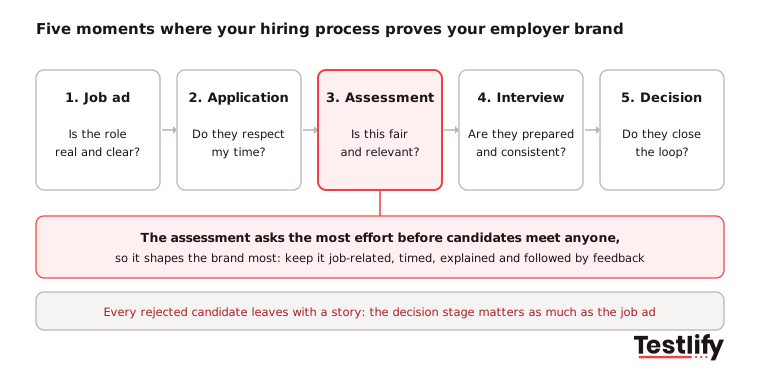
Stage | What candidates judge | Common brand risk | Quick fix |
|---|---|---|---|
Job ad | Is this role real and clear? | Vague duties, no pay range | List the 4 to 6 skills you will test and the salary range |
Application | Do they respect my time? | Long forms, duplicate resume fields | Keep it under 15 minutes, auto-fill from the resume |
Assessment | Is this fair and relevant? | Generic tests, hours of unpaid work | Job-related tasks, stated time limit, clear purpose |
Interview | Are they prepared and consistent? | Interviewers off script, no prep info | Structured questions, send prep notes |
Decision | Do they close the loop? | Ghosting, "do-not-reply" rejections | Decide within days, give a reason and a next step |
Pro tip: Walk through your own process as a candidate once a quarter, on a phone, for one high-volume role. Time each step and note every place you had to guess what happens next.
Why is the assessment stage the biggest brand moment?
The assessment stage is the biggest brand moment because it asks candidates for the most effort before they have met anyone. A test that feels relevant and fair tells candidates you hire on merit. A test that feels generic, long or opaque tells them you do not value their time.
Assessments are now standard, so candidates compare them. Survale found that 53% of employers used pre-employment assessments in 2025, with job-specific skills tests the most common type (54%). The same research found that CandE award winners rated 23% higher on assessment fairness than all other employers combined.
Hiring teams want assessments for good reasons. LinkedIn's Future of Recruiting 2025 found that 93% of talent acquisition professionals say accurately assessing skills is crucial to improving quality of hire. The question is not whether to test, but how to test in a way that also builds your brand. That is what a skills assessment for employer branding comes down to: the same test that ranks candidates should leave every one of them feeling the process was worth it.
How do you use assessments to strengthen your employer brand?
Assessments strengthen your employer brand when they are job-related, short, explained up front, accessible and branded as your own. Each of those choices tells candidates something about your culture. Together they make the test feel like a preview of the job rather than a hurdle.
- Test the job, not trivia: Build the test from the role's real tasks and the skills in your job ad. If you need a primer on formats, see this guide to the skills assessment and how it works. The EEOC's guidance on employment tests also expects tests to measure skills relevant to the role and to be kept current as the job changes.
- Respect their time: Keep early-stage tests to 30 to 45 minutes, state the time limit in the invite, and never ask for unpaid project work before an interview.
- Explain why and what next: Tell candidates what the test measures, how it is scored, who sees the results and when they will hear back.
- Make it accessible: Offer the test in the candidate's language where you can, make it work on mobile, and give a clear route to request accommodations.
- Put your brand on it: Use your logo, colors and a short welcome from the hiring manager, so the test feels like part of your company, not a third-party gate.
- Check fairness over time: Compare pass rates across groups and fix questions that screen people out for reasons unrelated to the job. Testlify explains how it does this in reducing bias in hiring.
Key takeaway: Candidates forgive a hard test. They do not forgive an irrelevant one, a surprise time limit or silence afterwards.
How should you share assessment feedback with candidates?
Assessment feedback works best as a short, specific note on what the candidate did well and where they fell short, sent with the decision. Candidates rarely get it, so even a brief score summary sets your employer brand apart and makes rejected candidates more likely to reapply and refer others.
The gap is large. Survale found that 56% of rejected candidates received no feedback at all in 2025, and only 6% received assessment or test feedback. Yet specific feedback raised candidates' willingness to refer others by 69%.
A practical approach for busy teams:
- Everyone gets a decision: Send it within days of the test, from a named person where you can, not a "do-not-reply" address.
- Finalists get specifics: Share the two or three skill areas where they scored highest and lowest, using the per-skill breakdown from the report.
- Keep it factual: Describe the result, not the person, and avoid promises about future roles you cannot keep.
For wording, use these tips on giving constructive feedback to candidates.
How do you keep AI and proctoring from hurting candidate trust?
AI scoring and proctoring keep candidate trust when candidates know what is checked, why, and that a person reviews the result. Hidden monitoring or unexplained AI decisions feel unfair, even when they are accurate. Clear notice, light-touch checks and human review protect both the integrity of the test and your brand.
Candidates are wary. CareerPlug found that 40% of job seekers are uncomfortable with AI in the hiring process. In New York City, Local Law 144 requires a bias audit within one year of using an automated employment decision tool, public audit results and notice to candidates.
- Say what you check: List the proctoring settings in the invite, for example full-screen mode or webcam snapshots, and why you use them.
- Match checks to risk: Use lighter settings for early screening and stronger ones for final, high-stakes tests.
- Keep a person in the loop: Treat scores and flags as evidence for a reviewer, never as an automatic rejection.
How do you measure candidate experience and employer branding?
Candidate experience and employer branding are measured with a few stage-level numbers: drop-off at each step, candidate satisfaction or NPS after key stages, perceived fairness of the assessment and interview, and time from application to decision. Track them per role and per stage, then fix the worst stage first.
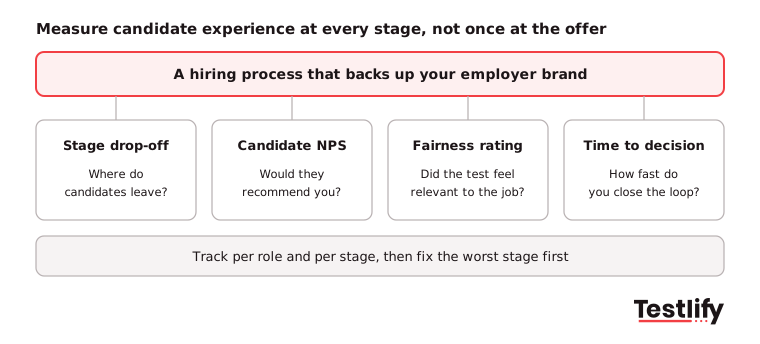
Metric | How to collect it | Healthy signal |
|---|---|---|
Stage drop-off | ATS and assessment completion data | Completion rate steady across roles and devices |
Candidate NPS | One-question survey after the assessment and after the decision | Rejected candidates still positive |
Fairness rating | "The test felt relevant to the job" on a 1 to 5 scale | Most candidates agree or strongly agree |
Time to decision | Days from test completion to decision | A decision within a week |
Brand signals | Review site themes, referral and reapply rates | Fewer complaints about silence or irrelevant tests |
Ask for feedback before the offer as well as after. Survale found that candidates asked for feedback before their start date rated their relationship with the employer 130% higher, but only 30% were asked.
How does Testlify support a candidate-friendly assessment stage?
Testlify supports a candidate-friendly assessment stage by keeping tests role-specific, branded, accessible and explainable. The platform builds an assessment from your job description, runs it in your colors, and gives reviewers a per-skill report they can turn into feedback, so candidates get a fair test and a real answer.
- Role-specific tests: 3,500+ validated tests and 25+ question types, including job simulations, or a custom assessment generated from your job description.
- Your brand, not ours: Basic logo and colors on every plan, and full white label with your own domain as an add-on.
- Accessible: Tests in 15+ languages, with candidate-side question translation.
- Fair and secure: 20+ proctoring checks you can tune per test, with honesty agreements and custom violation tolerance. See anti-cheating and proctoring. Testlify's matching model also completed a third-party NYC bias audit on June 16, 2023.
- Feedback and data: Per-skill score breakdowns, candidate feedback collection and a multi-assessment drop-off report to spot the stage where candidates leave.
Testlify reports a 94% candidate satisfaction rate. For real examples, browse the customer success stories.
Ready to make your assessment stage a brand asset?
See how a role-specific, branded assessment feels from the candidate's side. Start a 7-day free trial of Testlify, no credit card required, or book a demo to review your current hiring process with our team.
Frequently asked questions
Related resources
View all
Employer branding
The importance of employer branding in talent acquisition

Employer branding
How to scale your business with automated solutions

Employer branding
Building a strong employer brand: A five-step approach

Employer branding
How Testlify is Empowering Businesses Through Effective Pre-Hiring Assessments

Employer branding
17 social media recruiting tips for hiring teams in 2026

Employer branding
What platforms offer white-labeling for talent assessments?
Get started.
Hire on proof, not resumes.
Run your first skills-based assessment free — no credit card required.