
Sales Assessment Tests for Hiring: What Works Best in 2026
Sales pre-hire assessments focus on identifying candidates with strong negotiation skills, customer relationship management expertise, and the ability to achieve targets.

Sales is one of the hardest seats to fill and the fastest to empty. Harvard Business Review has put annual turnover among US salespeople as high as 27%, about twice the rate of the overall labor force. Every empty seat resets the ramp clock and drops the quota on the floor.
Most of that churn is set the day the offer goes out. Teams still screen on resumes and gut feel, then watch the new rep miss quota or quit by month six. That gamble is not cheap: SHRM puts the average cost per hire near $4,700, and a sales mis-hire adds lost pipeline and a manager’s coaching time on top.
The resume made a weak signal even weaker in 2026, because AI now drafts most of them. Polished writing no longer separates a strong seller from a strong prompter. A good sales assessment fixes that by scoring the skills and traits that predict quota before you extend an offer.
So what works best for sales roles? The strongest pre-hire sales assessments stack four proven methods: a sales aptitude or personality test, situational judgment tests, a short cognitive ability test, and a work simulation or structured, AI-assisted interview. This guide breaks down each type, maps the right stack to every sales role, and shows how to score candidates on evidence instead of pedigree.
 ChatGPT
 Gemini
 Claude
 Grok
Grok Perplexity
TL;DR
- A sales assessment scores selling skills and traits before the offer, so you hire on evidence, not a resume an AI probably wrote.
- The best sales stack combines four methods: aptitude or personality, situational judgment, cognitive ability, and a work simulation or structured interview.
- Peer-reviewed research ranks structured interviews and cognitive ability tests among the strongest predictors of performance, while experience and credentials predict very little.
- Match the stack to the role. An SDR needs drive and call volume. An enterprise account executive needs strategic reasoning and stakeholder skill.
- Run assessments early, before recruiter calls, and validate scores against six-month quota and 12-month retention.
- Assessments narrow the field and structure the interview. People still make the hire.

What is a sales assessment test?
A sales assessment test scores a candidate’s selling potential before you extend an offer. It blends psychometric tests, work simulations, and structured interviews into one decision-grade signal you can compare fairly across every applicant, instead of ranking gut reactions to five different resumes.
Psychometric tests measure stable traits such as drive, resilience, and conscientiousness. Work simulations recreate the actual job in miniature and show performance, not pedigree. Modern platforms score both automatically and benchmark each candidate against your top performers, so a hiring manager reads one clear report rather than guessing.
Which pre-hire assessments work best for sales hiring?
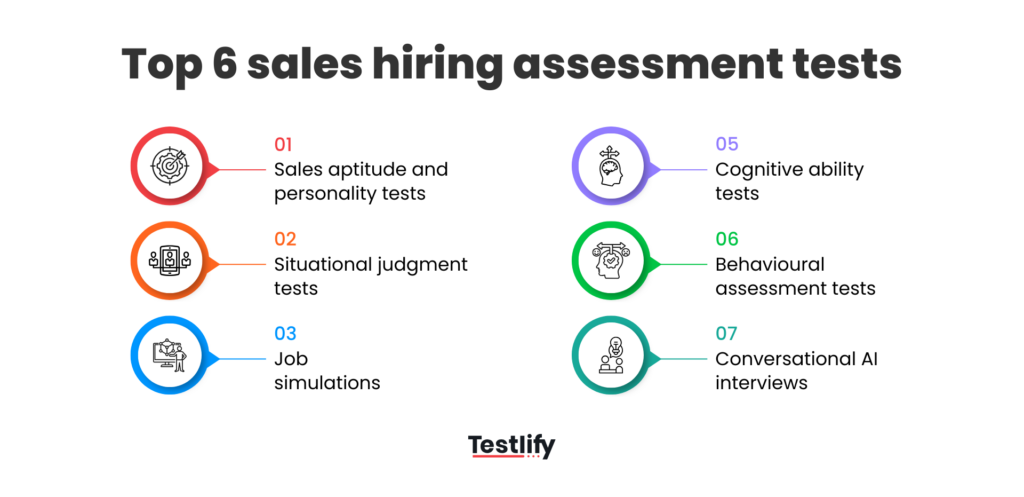
Six assessment types deliver the strongest predictive power for sales roles, and each measures a different layer of selling ability. Used together, two or three of them catch the blind spots a single test or one interview would miss.
Sales aptitude and personality tests
These score the traits that separate people who enjoy selling from people who tolerate it: drive, persuasion, resilience, and coachability. A rep who scores high on grit tends to survive the cold-call grind that pushes low-drive hires out by month three.
Situational judgment tests
A situational judgment test drops the candidate into a realistic sales moment (a stalled deal, a price objection, a silent buyer) and asks what they would do next. It reveals real-world judgment that a personality score alone cannot, and it maps cleanly to your own sales methodology.
Job simulations
Simulations are the closest thing to a test drive. A mock discovery call, a written follow-up email, or a short role-play shows whether the candidate can actually sell, not just talk about selling. This is where confident interviewees who cannot execute get filtered out.
Cognitive ability tests
Cognitive ability measures how fast someone learns a product, reads a room, and adjusts a pitch. It is one of the most reliable predictors of how quickly a new rep ramps to quota. Keep it short, 10 to 15 minutes, so strong candidates do not drop out of a long funnel.
Behavioral assessments
Behavioral assessments score how a candidate works: collaboration, stress tolerance, and how they handle a manager’s feedback. For team-based or enterprise selling, this predicts whether a rep strengthens the pod or quietly drains it.
Conversational AI interviews
An AI-assisted interview runs a consistent first-round conversation with every applicant and scores clarity, discovery questions, and objection handling. It makes a structured interview affordable at the top of a high-volume funnel. The AI structures and scores the evidence. A recruiter still reviews it and decides.
Why do sales assessments outperform resumes?
Because they measure what a resume only claims. A resume lists where someone worked. An assessment shows whether they can do the job. Decades of selection research back this up, and the gap has widened now that AI writes the resume too.
A 2022 re-analysis of the personnel-selection research, summarized by the Society for Industrial and Organizational Psychology, ranks structured interviews and cognitive ability tests among the strongest predictors of on-the-job performance. Years of experience and education, the two things a resume shouts loudest, sit near the bottom. Skills also keep shifting under everyone’s feet: the World Economic Forum expects 39% of core work skills to change by 2030, so a five-year-old title on a resume says even less about today’s job.
An assessment also standardizes the comparison. Every candidate faces the same tasks and is scored on the same scale, which strips out the halo effect that a confident talker or a familiar logo triggers in an unstructured screen. The practical payoff is speed: a screening loop that once ran 30 days can close in about 10 once the shortlist is scored before the first call. For a deeper walkthrough, read the Testlify guide on how to assess sales skills.
Which assessments fit different sales roles?
There is no single best sales test, because a transactional SDR and a consultative enterprise seller succeed on different skills. The fix is to match the assessment stack to the sales motion. The table below maps common roles to the assessment that carries the most signal for each.
Sales role | Primary assessment | Add next | Best for | Signal that predicts quota |
|---|---|---|---|---|
Sales Development Representative (SDR) | Sales aptitude & personality | Cognitive ability | High-volume outbound prospecting | Drive, resilience, call volume |
Inside Sales Representative | Situational judgment | Job simulation | Handling objections and qualifying leads | Objection handling, follow-through |
Account Executive | Job simulation | Cognitive ability | Managing complex deals | Discovery skill, deal reasoning |
Enterprise Sales Representative | Cognitive ability | Behavioral assessment | Multi-stakeholder B2B sales | Strategic thinking, stakeholder management |
Field Sales Representative | Behavioral assessment | Situational judgment | Territory management | Autonomy, territory ownership |
Sales Manager | Cognitive ability | Situational judgment | Leading and coaching sales teams | Coaching judgment, data literacy |
Read the table as a starting stack, not a rule. A high-velocity SaaS SDR team leans on drive and speed. An enterprise pod hiring one account executive a quarter can afford a longer simulation, because the cost of a wrong senior hire dwarfs the extra 20 minutes of assessment time.
How should you score sales talent?
The strongest hiring teams treat assessments as a system, not a checkbox. Five practices separate the top quartile from the rest.
- Tailor the stack to the sales motion. A transactional SaaS SDR needs grit and call volume. A consultative enterprise seller needs strategic thinking and stakeholder management. One test template for both hides the traits that matter.
- Combine personality with skill-based testing. Personality alone misses execution. A skills test alone misses whether the person will stick. Together they predict both quota and tenure.
- Score motivation, resilience, and curiosity. These three traits track tenure and quota attainment more reliably than years on a resume, especially in roles where rejection is daily.
- Assess early, not late. Run the test in the first 48 hours of the application to filter the funnel before recruiter time gets spent. AI-led scoring makes early-stage volume affordable.
- Validate against your own data. Track assessment scores against six-month quota attainment and 12-month retention, then recalibrate the cutoffs every 90 days so the model reflects your team, not a generic benchmark.
Pro Tip: Before you buy any test, write down the three competencies that actually predict success on your team, then pick the assessment that produces evidence for each one.
How do you choose a sales assessment platform?
Once the competencies are clear, judge platforms on a short list of criteria rather than feature counts. The right tool covers every sales role you hire for, validates its tests, and drops the score straight into the workflow your recruiters already use.
- Role coverage: ready-made tests for SDR, inside sales, account executive, field sales, and sales manager, not one generic sales test stretched across all of them.
- Validated content: tests built to psychometric standards, so a score means the same thing for every candidate and holds up if a rejected applicant challenges it.
- Structured and AI-assisted interviews: a consistent first-round conversation scored on the same rubric for everyone, so people make the final call on shared evidence.
- Anti-cheating controls: proctoring and integrity signals that keep a remote result trustworthy.
- Workflow fit: ATS integration and automated invites, so assessment is a step in hiring, not a detour out of it.
Testlify was built for this stack. It carries validated sales tests across the full range of roles, adds cognitive, behavioral, and AI-assisted interview scoring, and pushes results into your assessment library and ATS. For the interview layer, pair the scores with a structured interview so every rep is judged on the same evidence.
Key takeaways
- The resume is now the weakest signal you have. AI drafts most of them, and selection research already ranked experience and credentials near the bottom for predicting performance. Screening on them means screening on noise, so move the real decision to an assessment.
- Stack methods; do not rely on one test. Aptitude predicts drive, cognitive predicts ramp speed, and a simulation proves execution. Two or three together catch the blind spots any single measure leaves open, which is why the strongest teams combine them.
- Match the stack to the motion. An SDR and an enterprise account executive fail for different reasons, so testing them the same way wastes both the candidate’s time and yours. Start from the role’s real competencies, then pick the evidence.
- Assess early to protect recruiter time. Scoring in the first 48 hours filters a large funnel cheaply and hands interviewers evidence to probe, instead of burning screening calls on candidates a short test would have ranked out.
- Keep humans on the decision. Assessments narrow the field and structure the interview, but a person owns the hire. That keeps the process fair, explainable to a rejected candidate, and defensible if anyone asks how the call was made.
- Validate against your own outcomes. A score only earns trust once it tracks six-month quota and 12-month retention on your team. Recalibrate the cutoffs every 90 days so the model follows your results, not a vendor’s average.
Frequently asked questions (FAQs)

Content Writer
Yashika Khandelwal is a Content Writer with 3+ years of experience creating research-backed content on hiring, talent assessment, and HR technology. She is a registered Organizational Psychologist and subject matter expert who combines behavioral science with practical recruitment insights to produce accurate, evidence-based content.
LinkedInRelated resources
View all
Candidate assessment
Pre-hire assessments for call centers

Candidate assessment
Creating a consistent candidate experience with white labeled talent assessments

Candidate assessment
Exploring the benefits of skills-based hiring strategies for your organization

Candidate assessment
The benefits of using hiring assessments in the recruitment process

Candidate assessment
How to use assessment tools to improve your hiring process

Candidate assessment
Big Data engineer hiring: understanding the process
Get started.
Hire on proof, not resumes.
Run your first skills-based assessment free — no credit card required.