
Testlify vs Assess Hub: A detailed comparison
Discover the perfect solution for evaluating your candidates’ skills with Testlify. Dive into our comprehensive Testlify vs AssessHub…
Testlify and AssessHub both sell pre-hire assessments, but they're built for different buyers. AssessHub is an India-first platform for volume hiring in sales, service and frontline roles, priced in rupees from 1,50,000 INR a year. Testlify is a self-serve skills-assessment and AI-interview platform with 3,500+ tests, coding and Office-app tasks, and plans from $139 a month. This comparison walks through what each one actually ships, what each one costs in both currencies, and which team should pick which.
TL;DR
- AssessHub is strongest for high-volume sales, customer-service and campus hiring in India, with tests in Indian languages, business simulations and a recruitment chatbot called SuperBot.
- Testlify covers far more ground per plan: 3,500+ tests across 12 categories, coding in a real browser editor, Google and Microsoft Office tasks, and AI interviews over video, voice and phone.
- On price, AssessHub's cheapest plan is about $1,585 a year for 200 credits but caps you at 1 seat and 3 job roles. Testlify's Starter plan is $1,668 a year for 100 credits with 3 seats and no role cap on the pricing page.
- Proctoring is where the two differ most: Testlify adds a phone-as-second-camera mode, ID-to-face matching and AI-tool detection at any tier, and keeps the final call human.
- Pick AssessHub if you hire hundreds of frontline staff a year in India and want an outsourced-feeling setup. Pick Testlify if you hire across roles and countries and want to start today on a trial.
 ChatGPT
 Gemini
 Claude
 Grok
Grok Perplexity
What is AssessHub (also written Assess Hub)?
AssessHub is an AI-powered online assessment platform for hiring sales, service and frontline roles at scale, priced in rupees and built around Indian industries. It sells three products: AssessHub Hire for pre-employment tests, AssessHub Develop for assessment centres and leadership pipelines, and SuperBot, a recruitment chatbot that handles outreach, screening and onboarding conversations. All three run on what the company calls its SuperBrain platform.
The positioning is specific, and that's a point in its favour. The homepage names BFSI, retail, FMCG, BPO and logistics as its industries, and the pricing page bills in rupees with a demo-first sales motion. Its site reports 127 customers across 15 countries and a little over a million assessments delivered. That's a mid-sized, focused vendor, not a global generalist.
So if you're a team lead at a bank or a BPO in Mumbai staffing a 400-seat contact centre, AssessHub was designed with you in mind. If you're a 60-person agency in Austin or Dubai hiring a designer, two account managers and a data analyst this quarter, most of what AssessHub optimises for won't apply.

What does an AssessHub test look like?
An AssessHub test is drawn from a library of 140+ ready-to-use assessments organised by industry, job role and experience level, with the heaviest coverage in customer-facing work. The formats are functional skills tests, psychometric and competency tests, aptitude and reasoning, situational judgement, soft-skills tests, business simulations and automated video or audio interviews.
The test library filters by industry (aviation, banking, BPO and KPO, cement, chemicals, construction and so on), by role (customer service, engineering, finance, IT, production, sales) and by level (fresh graduate, junior executive, mid-management). Sample tests on the public page include emotional intelligence, time management, leadership, customer service and human resources.
Two honest observations from reading that library. First, the public catalogue doesn't list coding or programming tests, and it doesn't list language-proficiency tests as a separate category either. Second, the depth is in behavioural and functional assessment for volume roles, which is exactly what a bank hiring 300 relationship managers wants and exactly what a software agency hiring one backend engineer doesn't.
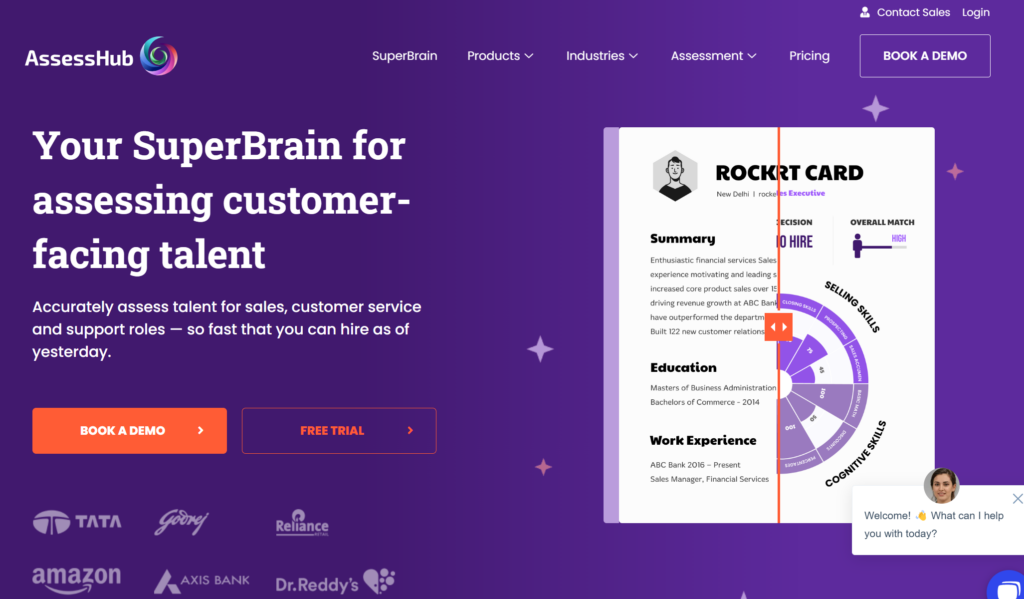
Proctoring ships under the ProctorVision name, with image and web proctoring, geotagging, randomisation and IP locking. On the pricing page, web and photo proctoring start on the Micro plan, "advanced AI proctoring" starts on Growth, IP restriction on Growth 360, and geo-tagging plus AI face matching on Enterprise. Reports come in individual, group, ranking, consolidated and assessment-centre formats, and the company's LocalLingo layer delivers tests in Indian and foreign languages.
What is Testlify?
Testlify is a pre-hire skills assessment and AI interviewing platform with a library of 3,500+ tests across 12 categories, 25+ question types, and plans you can start on a 7-day trial without a card. It's built for teams that hire across many different roles rather than one role at volume, and it sells mostly self-serve, with enterprise controls available on the higher tiers.
The breadth is the point. The Testlify test library covers role-specific, cognitive ability, software skills, programming, coding, engineering, personality and culture, language, situational judgement, typing, blue-collar and simulation tests. Coding questions open a VS Code editor in the browser with up to 20 visible or hidden test cases, and there's a "vibe coding" option where candidates direct AI tools to a working solution instead of typing syntax, which is a fair test of how developers actually work in 2026.
Office-app questions are bound to the real products: candidates complete tasks in Google Docs, Sheets and Slides or in Microsoft Word, PowerPoint and Excel. Add typing tests scored on a configurable mix of accuracy and speed, file-upload and practical questions, and a real-time translation option that renders a test in the candidate's preferred language, and you have a library that can screen an accountant, a Java developer and a warehouse picker from one account.
Testlify also ships a simple built-in ATS for teams that don't run one yet: job requisitions, an application form, job-board publishing and an applied-to-shortlisted pipeline. Teams that already run Greenhouse, Workday or Lever keep that system of record and connect Testlify through its 100+ ATS and HR integrations.
Testlify vs AssessHub: feature comparison
Every row below comes from the two vendors' own pages or product interface, not from a checkbox grid. Where AssessHub's public pages don't state something, the cell says so rather than guessing.
Area | Testlify | AssessHub |
|---|---|---|
Test library | 3,500+ tests across 12 categories | 140+ ready-to-use tests, organised by industry, role and level |
Coding tests | Yes: browser VS Code editor, up to 20 test cases per question, multi-file projects, vibe coding | Not listed in the public test library |
Office-app tasks | Google Docs, Sheets, Slides; Microsoft Word, PowerPoint, Excel | Not listed |
Video and AI interviews | One-way video, two-way conversational AI video, voice questions, AI phone interviews at $0.18 per minute | Automated video and audio interviews |
Simulations and assessment centres | Simulation and situational-judgement categories | Business simulations, virtual assessment centres, 360 feedback (AssessHub Develop) |
Proctoring | Standard, Strict and Custom presets; phone as a second camera; ID-to-face match; AI-tool detection; screen and camera recording | ProctorVision: image and web proctoring, geotagging, IP locking, randomisation; face matching on Enterprise |
Candidate languages | Real-time translation into the candidate's preferred language | Indian and foreign languages via LocalLingo |
ATS integration | 100+ integrations, sold as a $2,388 a year add-on on self-serve tiers, included on Custom | Two-way API on Growth 360 and above; no ATS names listed |
SSO and provisioning | SAML SSO, SCIM provisioning, SSO group-to-role mapping (add-on on self-serve tiers) | SAML 2.0 SSO on Enterprise |
Recruitment chatbot | Not offered; Testlify is not a sourcing tool | SuperBot, sold separately from 3,00,000 INR a year |
Entry plan | Starter: $139 a month billed annually ($1,668 a year), 100 credits, 3 seats | Micro: 1,50,000 INR a year (about $1,585), 200 credits, 1 seat, 3 job roles |
Trial and refund | 7-day free trial, no card; 30-day money-back guarantee | Book a demo; no free trial listed |
How do the AI interviews compare?
Both platforms record asynchronous video answers, but Testlify goes further with a two-way conversational AI interviewer that asks follow-ups, an outbound AI phone interview, and per-question controls for attempts, preparation time and recording length. AssessHub's public pages describe automated video and audio interviews as part of its Hire product without detailing the configuration.
The Testlify side is worth spelling out, because "video interview" hides a lot of range. You pick an AI avatar and voice, write the persona and context, and set how many attempts a candidate gets, how long they can prepare, and how long each answer can run (up to 5 minutes per video). During a live AI voice interview the candidate is muted while the AI speaks, so it's real turn-taking, not a recorded prompt. Transcripts are generated automatically in whatever language the candidate spoke, for any recording over 30 seconds. Phone interviews are metered at $0.18 a minute.
Then the part that matters for compliance. AI scoring is advisory by design: the product carries the line "AI scores and insights are for guidance only. Use human judgment for final decisions," and an admin can leave AI scores out of the final average entirely. That framing isn't cosmetic. The EU's Artificial Intelligence Act lists AI systems used to recruit, screen or evaluate candidates as high-risk (Annex III, point 4(a)), so a hiring team in or selling into Europe needs to show that a human, not a model, made the decision. A vendor whose scoring can't be switched to advisory makes that harder to prove.
Which platform catches cheating better?
Testlify runs the deeper integrity stack: three proctoring presets, a dual-device mode that turns the candidate's phone into a second camera, photo-ID verification with a face match against the ID, AI-tool and browser-extension detection, and a three-tier flag that tells the recruiter whether a session needs a manual look. AssessHub's ProctorVision covers image and web proctoring, geotagging, randomisation and IP locking, with face matching reserved for its Enterprise tier.
Why this decides deals now rather than later: Gartner surveyed 3,000 job candidates in the second quarter of 2025 and 6% admitted to interview fraud, meaning they posed as someone else or had someone else pose as them. The same release predicts that by 2028 one in four candidate profiles worldwide will be fake. Six in a hundred sounds small until you run 500 candidates through a funnel and realise 30 of them may not be who they say.
The Testlify Assessment Integrity Framework is the way to read the two feature lists. It separates identity assurance (is this the right person), environment control (what's around them), behaviour monitoring (what did they do), AI-assistance detection, reviewable evidence, and configurable strictness. AssessHub covers the first three at the higher tiers. Testlify covers all six at any tier (ID verification is metered at $0.50 an attempt), and the dual-device camera is the one feature no mainstream rival matches: the candidate can't start until the phone feed is live, and disconnecting it is logged and reported.
The flag logic is the bit hiring teams get wrong. A yellow flag in Testlify reads "some behavior during the session wasn't ideal, a quick manual review is recommended," and auto-termination is a separate, opt-in setting with a recruiter-chosen threshold. Evidence goes to a human; the platform doesn't reject anyone on its own. Face-verification data is deleted after 30 days and candidates can withdraw consent, which is the kind of line a privacy officer asks about on day one.
Pro tip: Match strictness to the role, not to your anxiety. Run the Standard preset for a first-round cognitive test and save the dual-device camera and ID match for the final technical or work-sample round. Candidates drop out of over-proctored screening rounds, and you lose good people before you've seen any evidence.
How does the pricing compare?
AssessHub prices in Indian rupees on four annual tiers that meter credits, seats and job roles, starting at 1,50,000 INR (about $1,585) for 200 credits. Testlify prices in dollars on monthly or annual plans that meter credits and seats only, starting at $139 a month billed annually. Which one is cheaper depends almost entirely on how many distinct roles you hire for.
The rupee figures are converted at the U.S. Treasury reporting rate of 94.66 rupees to the dollar as of June 30, 2026, so a buyer outside India can read both columns. Your bank's rate will differ a little.
AssessHub pricing
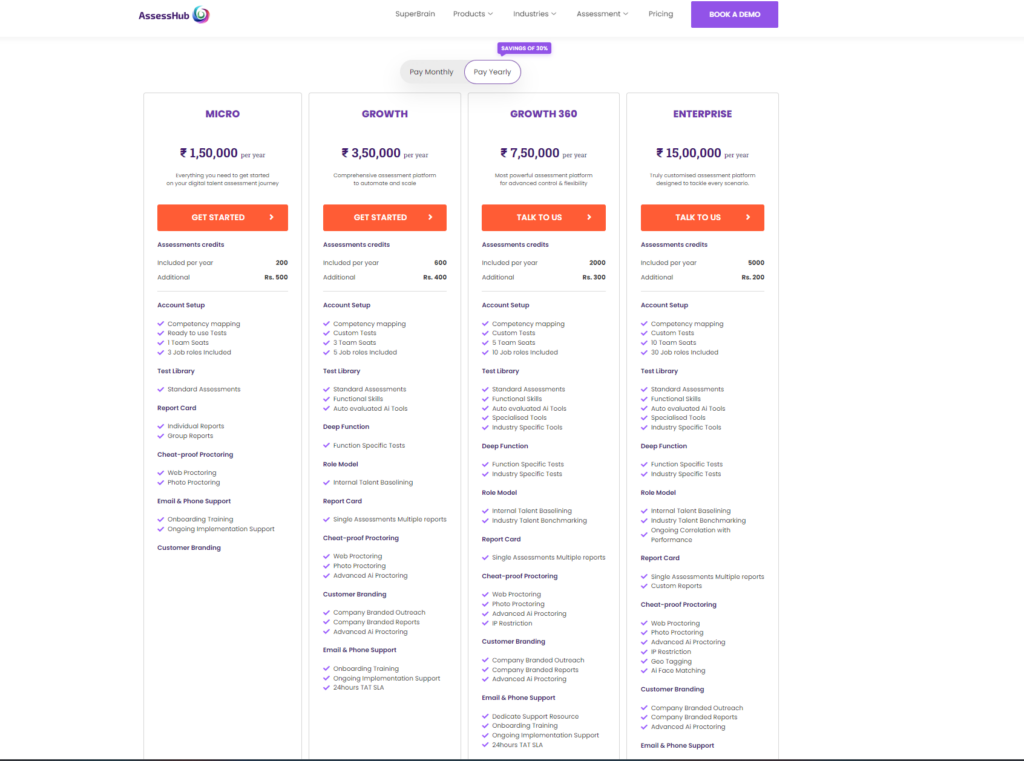
From the AssessHub pricing page, the Hire product has four plans, all billed yearly:
- Micro: 1,50,000 INR a year (about $1,585) for 200 assessment credits, 1 team seat and 3 job roles. Extra credits cost 500 INR each. Includes standard tests, web and photo proctoring, and email or phone support.
- Growth: 3,50,000 INR a year (about $3,700) for 600 credits, 3 seats and 5 job roles. Adds custom tests, advanced AI proctoring, branded outreach and reports, and 24-hour SLA support. Extra credits 400 INR.
- Growth 360: 7,50,000 INR a year (about $7,920) for 2,000 credits, 5 seats and 10 job roles. Adds industry benchmarking, IP restriction and two-way API integration. Extra credits 300 INR.
- Enterprise: 15,00,000 INR a year (about $15,850) for 5,000 credits, 10 seats and 30 job roles. Adds geo-tagging, AI face matching, performance-correlation tracking, SAML 2.0 SSO and a dedicated support resource. Extra credits 200 INR.
SuperBot, the recruitment chatbot, is a separate product with its own four tiers from 3,00,000 INR a year. There's no free trial listed; the call to action is a demo.
Testlify pricing
From Testlify's current plans, billed annually: Starter at $139 a month ($1,668 a year) for 100 credits and 3 seats, Basic at $279 a month ($3,348 a year) for 300 credits and 5 seats, and Business at $699 a month ($8,388 a year) for 1,000 credits and 10 seats. Premium (3,000 credits), Enterprise (10,000) and Custom (25,000+) are quoted by sales. Monthly billing exists at higher per-credit prices, starting at $198 a month for 10 credits. Extra seats are $15 a seat a month on every tier, extra credits run $21 down to $10 depending on tier, and there's a 7-day free trial, a 30-day money-back guarantee and a 24-month price lock.
Two add-ons matter for a fair comparison: white labelling and the 100+ ATS integrations are each $2,388 a year on the self-serve tiers and included on Custom, and SAML SSO with 2FA is also an add-on below Custom. A credit is one started assessment by a qualified candidate, and unused credits expire at the end of the cycle.
A worked example: a 12-role agency screening 200 candidates
Take a 60-person marketing agency that fills about 12 different roles a year and wants to screen 200 candidates. On AssessHub, the Micro plan has the credits (200) but caps you at 3 job roles, Growth caps you at 5, and Growth 360 is the first tier with room for 12 roles: 7,50,000 INR, about $7,920, with 1,800 credits you'll never use. On Testlify, Basic annual at $3,348 gives 300 credits and 5 seats with no role cap on the pricing page, or Starter at $1,668 plus 100 extra credits at $21 each comes to $3,768.
Flip the scenario and AssessHub wins. A bank hiring 200 relationship managers into one role a year fits Micro perfectly at about $1,585, cheaper than Testlify's Basic at $3,348 for the same 200 candidates, and the Indian-language tests and rupee invoice are worth more to that buyer than a coding editor. The pricing model tells you who each product is for: AssessHub is priced for depth in a few roles, Testlify for breadth across many.
Integrations and enterprise controls
Testlify connects to Workday, SAP SuccessFactors, Lever, Greenhouse, BambooHR, Workable, UKG Pro Recruiting, SmartRecruiters, Fountain, Pinpoint, Teamtailor and Manatal among its 100+ integrations, with a documented REST API and real-time webhooks. Most connect in under five minutes without engineering. On the security side there's SAML SSO with group-to-role mapping, SCIM provisioning, 2FA, OAuth tokens with rotation, custom roles with granular permissions, and audit logs on Enterprise and above that can stream to your SIEM in real time.
AssessHub's pricing page lists two-way API integration from Growth 360 and SAML 2.0 SSO on Enterprise, and its product pages don't name specific ATS partners. That's not a knock; a vendor selling into Indian banks and BPOs is often integrating with an in-house HRMS on a services basis. But if your team runs a US or European ATS and expects candidates to move stages automatically when they clear a cut-off score, ask AssessHub to demonstrate that flow before you sign.
Is Testlify a good AssessHub alternative?
Yes, for teams that hire across many roles, hire outside India, or want to start on a trial this week rather than after a sales cycle. Testlify covers the same behavioural and situational ground as AssessHub and adds coding, Office-app, typing and simulation tests, a configurable AI interviewer, and proctoring that keeps a human in charge of every rejection. AssessHub remains the better pick in four situations.
Pick AssessHub when:
- You hire hundreds of people a year into a handful of sales, service or frontline roles in India and want tests delivered in Indian languages.
- You want assessment centres, 360 feedback and leadership-pipeline work in the same vendor (AssessHub Develop).
- You want a recruitment chatbot to run outreach, screening and onboarding conversations over web and social channels (SuperBot).
- Your procurement team needs a rupee invoice and a services-led onboarding rather than a self-serve account.
Pick Testlify when:
- You hire a designer, a developer, an accountant and a support lead from the same account and need the library to cover all four.
- You need coding tests with real test cases, or Office-app tasks that run inside Excel and Google Sheets.
- You want two-way conversational AI interviews, phone screens and transcripts with human override on scoring.
- Your candidates are anywhere, and your integrity requirements include ID matching and a second camera.
- You're under 200 people, may not run an ATS yet, and want a trial today with a money-back window.
One caveat that cuts against Testlify: candidates must sit assessments on a Chromium desktop browser (Chrome or Edge). The mobile app is a fallback for recording audio and video, not a way to complete a whole test on a phone. A frontline hiring funnel where most applicants only have a phone is a real reason to pilot both vendors on your own candidate pool before you commit.
Whichever you choose, run the evaluation the same way. The Testlify Multi-Signal Talent Evaluation Model combines multiple role-relevant signals, including assessments, interviews, simulations, references and reviewer feedback, so that no candidate advances on one strong score or one polished interview. The research backs the model: Sackett and colleagues' 2022 reanalysis of selection validity places structured interviews among the strongest predictors of job performance and years of education and general experience among the weakest, and Kuncel and colleagues' 2013 meta-analysis found that combining assessment scores by a fixed rule predicts outcomes as well as or better than experts re-weighting the same scores by feel. Weighted, mechanical scoring with a human sign-off at the end is the setup both platforms can support; Testlify exposes the weights (x0 to x5 per test) directly in the assessment builder.
Key takeaways
- AssessHub is a specialist, and that's its strength. It's built for volume hiring into sales, service and frontline roles in India, with Indian-language tests, business simulations and a recruitment chatbot. If that's your funnel, it deserves a serious look, because a generalist library adds cost you won't use.
- Testlify is a generalist with unusual depth. 3,500+ tests, a real coding editor, Office-app tasks and AI interviews over video, voice and phone mean one account can screen a developer, an accountant and a picker. That breadth is what an agency or a growing company under 200 people actually needs.
- Pricing tells you who each product is for. AssessHub meters job roles as well as credits and seats, so cost climbs with role variety; Testlify meters credits and seats only. A 12-role agency pays about half as much on Testlify; a one-role bank pays about half as much on AssessHub.
- Integrity is the biggest feature gap. With 6% of candidates admitting to interview fraud in Gartner's 2025 survey, ID-to-face matching, a second camera and AI-tool detection matter more than another 50 tests in a library.
- Human override is a compliance feature, not a preference. The EU AI Act classifies candidate-screening AI as high-risk, so advisory AI scoring with a documented human decision is the safer default wherever you hire.
- Test the browser constraint before you buy. Testlify needs a Chromium desktop browser; if your applicants are phone-only, pilot both vendors on 20 real candidates before committing a year's budget.
Hire on evidence: try Testlify on one open role
The fastest way to settle this comparison is to run one live role through Testlify this week. Start a free trial, build an assessment from the 3,500-test library or from your own job description, add a conversational AI interview, and compare the shortlist to the one your team would have built from resumes. If you'd rather see the proctoring and integration setup walked through on your own hiring stack, book a demo and bring the roles you're struggling to fill. You can also see how Testlify stacks up in other head-to-head comparisons and in this roundup of talent assessment tools.
FAQs
Related resources
View all
Competitor Comparisons
Testlify vs EmployTest: A detailed comparison
Competitor Comparisons
Testlify vs AQai: A detailed comparison
Competitor Comparisons
Testlify vs Aon: A detailed comparison
Competitor Comparisons
Testlify vs AccuRecruiter: A detailed comparison
Competitor Comparisons
Testlify vs the English Quiz: A detailed comparison
Competitor Comparisons
Testlify vs Talentoday: A detailed comparison
Get started.
Hire on proof, not resumes.
Run your first skills-based assessment free — no credit card required.