
Top 4 talent assessment tools available in German
German-language talent assessment tools evaluate skills effectively, ensuring candidates align with job requirements and language needs.

Talent assessment tools available in German fall into four groups: CEFR-aligned language tests, role and skills assessments delivered in German, cognitive and personality tests written for German speakers, and AI interviews that can handle spoken German. Pick the group that matches the risk in the role, not the one with the longest feature list.
That choice matters more in a cooling market than it did two years ago. The Federal Statistical Office counted 45.48 million people in work in Germany in July 2026, down 223,000 (0.5%) on the year before, and the Institute for Employment Research put open positions at around 1 million in the second quarter of 2026, 129,800 fewer than the quarter before. Fewer openings means more applicants per opening. The screening decision gets harder, not easier.
TL;DR
- German-language assessment splits into four tool types, and most teams only need two of them.
- A CEFR level (A1 to C2) is the only shared vocabulary for "how much German" a role needs. Put it in the job ad, then test against it.
- Translating a test is not the same as running it in German. Check whether the instructions, the questions, the candidate interface and the report are all German.
- Written German and spoken German are different skills. A candidate can pass a reading test and still stall on a phone call.
- From 2 December 2027, recruitment AI used in the EU carries high-risk obligations, so keep a human in the scoring loop now.
- Small German firms usually get further with one platform that covers language plus role skills than with two narrow tools.
 ChatGPT
 Gemini
 Claude
 Grok
Grok Perplexity
What does German support in a hiring test mean?
German support means four separate things, and vendors rarely say which ones they have. First, the test content itself is written in German. Second, the candidate interface and instructions are German, so nobody fails on navigation. Third, the scoring handles German grammar properly. Fourth, the report reaches the hiring manager in German.
Plenty of platforms have the first and call it done. A candidate then reads a German question inside an English shell, which quietly tests their English instead. For a warehouse or care role where the job ad asks for B1, that is the difference between a usable score and a misleading one.
Pro tip: ask any vendor for a candidate-side preview link in German before you buy. Two minutes in the candidate view tells you more than a feature grid. If the buttons are still English, the test is translated, not localised.

How do you check a candidate's German before hiring?
Set the CEFR level the role genuinely needs, put that level in the job ad, then run a German test that reports against the same scale. Follow it with a short spoken task if the job involves phone or counter work. Reading and writing scores do not predict how someone handles a customer who is annoyed and talking fast.
The order matters. Teams that test first and define the level afterwards end up arguing about what "good German" meant, usually after the offer.
How should you evaluate a German assessment tool?
Four criteria separate the usable tools from the demo-friendly ones. They are worth writing down before the first sales call.
- Coverage: does it test the German you need (reading, writing, listening, speaking) or only the cheap half?
- Scale alignment: does it report CEFR levels, or a private score that means nothing to the hiring manager?
- Evidence quality: can you see the actual answer, not just a number?
- Data handling: where is candidate data stored, how long is it kept, and can a candidate withdraw consent?
That last one gets skipped and then becomes a problem. German candidates ask, and works councils ask harder.
1. German language tests aligned to CEFR levels
The Common European Framework of Reference sorts language ability into six levels, A1 and A2 for basic users, B1 and B2 for independent users, C1 and C2 for proficient users. It is the only scale a German hiring manager, a candidate and a training provider will all read the same way.
Use these where the language itself is the job requirement: customer service, care work, logistics coordination, anything client-facing. Testlify's library carries them as discrete tests, from a German A1 starter test through to C2 for proficient speakers, plus a combined German CEFR assessment when you want one score across levels.
The trap is over-specifying. Asking for C1 on a role that needs B1 shrinks the applicant pool for no gain, and in a market with a million open positions that is a self-inflicted wound.
2. Role and skills assessments delivered in German
These test whether someone can do the job, with the questions presented in German. A bookkeeper sits an accounting test in German. A support agent handles a written ticket in German. The language is the delivery medium, not the thing being scored.
This is where translation quality gets load-bearing. Testlify handles it with real-time translation of tests and custom questions into the candidate's preferred language, and the product says plainly that quality may vary slightly depending on the language pair. That caveat is the honest version. Any vendor claiming perfect machine translation across every subject is selling something.
For a technical role, check whether code and office tasks survive translation intact. A spreadsheet task that translates its own formula names is worse than useless.
3. Cognitive and personality tests in German
Cognitive ability and personality tests predict performance across roles, which makes them attractive for teams hiring into many different jobs at once. They carry the heaviest localisation burden, because a reasoning item that is subtly harder in German is no longer measuring reasoning.
Treat personality output differently from skills output. Testlify flags this in the product itself: personality and cultural tests are qualitative and carry no total score. A tool that hands you a single personality number for ranking candidates is doing something the science does not support.
4. AI interviews that work in German
This is the newest group and the one where capability varies most. A usable German AI interview needs three things: it asks in German, it transcribes German accurately, and a human can check the transcript against the recording.
Testlify runs one-way and two-way conversational AI interviews across video, audio and phone, with selectable AI avatars and voices, custom prompts, attempt limits, recording-time limits and preparation time before recording starts. Transcripts are automatic and multilingual: the AI detects the spoken language and generates the transcript to match, for recordings of at least 30 seconds. Pronunciation insights break a spoken answer into accuracy, fluency and prosody, which is genuinely useful when the role is a phone role and "sounds fine" is otherwise the whole assessment.
The boundary worth knowing: Testlify does not schedule live human interview panels. It assesses and interviews; calendar coordination for a panel of people stays in whatever tool you already use for that.
Which tool type fits which hiring need?
Tool type | What it measures | Best for | Watch out for |
|---|---|---|---|
CEFR language test | German reading, writing, listening, speaking against A1 to C2 | Customer-facing, care, logistics, admin roles | Asking for a level above what the job needs |
Role and skills assessment in German | Job ability, with German as the delivery language | Finance, support, technical and trade roles | Translation drift on technical or numeric items |
Cognitive and personality test | Reasoning, problem-solving, work behaviour | High-volume and graduate hiring | Ranking candidates on a personality score |
AI interview in German | Spoken German, communication under light pressure | Phone, counter and client-facing roles | Transcripts nobody reviews before a rejection |
Which CEFR level should the job actually require?
B1 covers most operational roles where someone handles routine conversations and written instructions in German. B2 is the honest floor for client-facing work that involves negotiation or complaints. C1 belongs in roles where someone writes German that customers or regulators read without an editor in between.
A1 and A2 are still worth testing rather than ignoring. For a warehouse role with a safety briefing in German, knowing a candidate sits at A2 rather than A1 changes the onboarding plan, and that is a cheaper answer to find in week zero than in month three.
Where does Testlify fit?
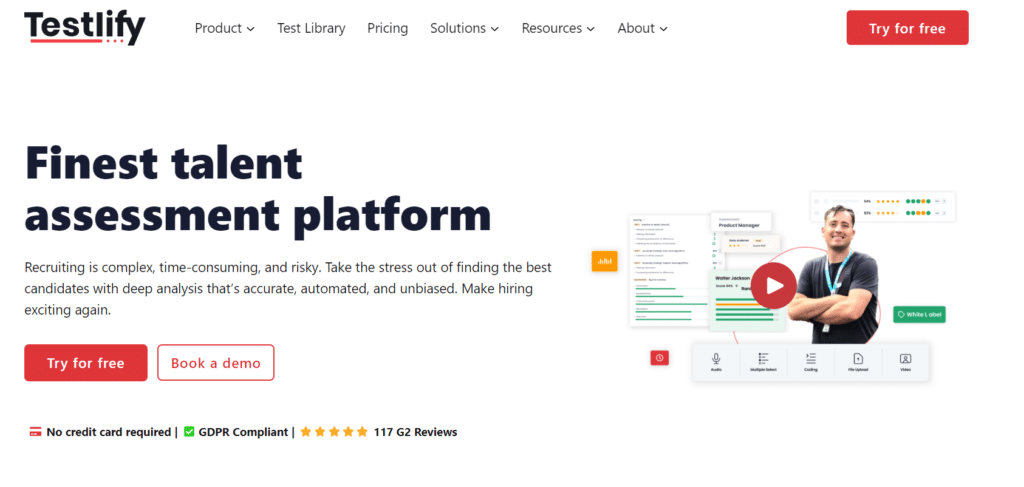
Testlify is a pre-hire assessment and interviewing platform, so it covers all four tool types in one place rather than asking a five-person team to run two subscriptions. German tests sit in the same library as the role-specific ones, and the same assessment can chain a language section to a skills section, which is the setup most German SMBs actually need.
Practical detail rather than positioning. The library spans more than 25 question types, including coding with an embedded editor, and Microsoft Office and Google Workspace tasks bound to the real products. Proctoring runs on three presets, standard, strict and custom, and reports a green, yellow or red session flag where yellow reads "a quick manual review is recommended" rather than an automatic rejection. Face verification data is deleted after 30 days and candidates can withdraw consent at any time.
Pricing is a credit model rather than a seat ladder. Annual billing starts at $139 a month for 100 credits on Starter, $279 for 300 on Basic and $699 for 1,000 on Business, with one credit per started assessment and a 7-day free trial before any card. ATS integrations are a paid add-on on the self-serve tiers rather than a bundled feature, which is worth pricing in early if you already run Greenhouse or Lever. Teams with no applicant tracking system at all can use the simple built-in pipeline instead of buying one.
The honest constraints: assessments run on Chromium desktop browsers (Chrome or Edge), and the mobile app is a fallback for recording video and audio, not a way to sit a whole test on a phone. For a German warehouse or field-service hire where candidates apply from a phone, plan for that.
This is the Testlify Competency-to-Evidence Matrix in practice: start from the role, list the competencies that decide success in it (including the German level), then attach each competency to one piece of evidence you can actually show a hiring manager. A language score, a work sample and a recorded spoken answer beat a resume line that says "fluent German".
What does the EU AI Act change for German hiring?
The European Commission lists AI tools for employment and worker management, naming CV-sorting software for recruitment, among its high-risk AI categories, with strict obligations applying from 2 December 2027. Any German employer using AI to screen or rank candidates is in scope, whichever vendor supplied the model.
The practical move is to keep humans in the decision now, so the process does not need rebuilding later. Testlify ships that stance in the product: the interface states that AI scores and insights are for guidance only and that human judgment should make the final call, and an admin can switch off whether AI scores appear to reviewers or count toward the final average. A question can also be routed to a named reviewer for manual scoring.
Context for how tight the market is: Eurostat reported that 2.1% of EU jobs were vacant in the first quarter of 2026, 2.3% across the euro area. Compliance work and hiring speed are competing for the same small team, which is the argument for buying the controls rather than building them.
Hire German speakers on evidence, not guesswork
Set the CEFR level, test against it, and keep a person reading the transcripts. If that sounds like the next thing to fix in your process, the Testlify test library has the German assessments to start with, and a 30-minute walkthrough covers the setup for your roles. Related reading: multilingual assessment options and how CEFR testing works for hiring.
Key takeaways
- Four tool types, not one market. Language tests, role assessments in German, cognitive and personality tests, and AI interviews solve different problems. Buying the wrong one produces a confident score about something you did not need to know, which is worse than no score at all.
- CEFR is the shared language. A1 to C2 is the only scale your hiring manager, your candidate and your training provider read identically. A private vendor score forces a translation step every time somebody asks what it means.
- Localised beats translated. German questions inside an English interface test English navigation as much as German ability. Ask for the candidate-side preview, in German, before you sign anything.
- Written and spoken German are separate skills. For phone and counter roles, a reading score alone will put people in seats who cannot handle a difficult call, so add a short spoken task and have someone listen to it.
- Keep a human in the scoring loop now. High-risk obligations for recruitment AI apply from 2 December 2027, and a process built around human sign-off today needs no rebuild later. Advisory AI scoring is the safer default.
- Right-size the level. Demanding C1 where B1 does the job shrinks a candidate pool that is already tight, and it costs weeks per role in a market where open positions fell by roughly 11% in a single quarter.
FAQs

Wordpress Developer
Yash Patel is a Wordpress and SEO Specialist at Testlify with 3+ years of experience in technical SEO, on-page optimization, and content strategy. He works on improving Testlify's organic presence and produces content focused on hiring, talent assessment, and HR technology.
LinkedInRelated resources
View all
HR & recruitment
Top 4 talent assessment tools available in Spanish

HR & recruitment
Top 4 talent assessment tools available in French

HR & recruitment
Top 4 talent assessment tools available in Dutch

HR & recruitment
Top 8 Employee Recognition tools

HR & recruitment
Top 10 Compensation Management Tools for Enterprise HR Teams (2026)

HR & recruitment
Top 5 Employee Engagement tools
Get started.
Hire on proof, not resumes.
Run your first skills-based assessment free — no credit card required.