
50 retail store manager interview questions to ask in 2027
Fifty store manager interview questions grouped by skill, with what to listen for, sample answers, red flags and a simple 1 to 5 scorecard.

Retail store manager interview questions are the questions a hiring team asks to check whether a candidate can run a store: keep stock and cash accurate, hit sales and labor targets, hire and coach a team, and make good calls when the floor gets busy. The best ones ask for real numbers and real events, not opinions.
This list gives you 50 questions grouped by skill, what a strong answer contains, five full sample answers, the red flags to watch for and a scorecard you can copy.
TL;DR:
- Good retail store manager interview questions ask for real numbers and real events: shrink cut, schedules built to traffic, people coached, complaints solved.
- Cover five areas: store operations, sales and KPIs, people management, customer experience and judgment under pressure.
- Ask every candidate the same questions and score each answer from 1 to 5 against written criteria, then decide on the scorecard.
- A wrong hire is expensive: NACS data puts the cost of hiring and training a store manager at about $6,800, and a new manager takes 112 days on average to reach full productivity.
- Test retail knowledge, maths and judgment before the interview, so interview time goes to behavior and fit.
- Top red flags: no numbers, "we" with no "I", blaming the team, and no view on labor cost or shrink.
 ChatGPT
 Gemini
 Claude
 Grok
 Perplexity
What does a retail store manager do?
A retail store manager runs one store as a small business. The role covers sales targets, the store budget and labor plan, stock and loss prevention, hiring and training staff, customer service standards, safety and compliance with company policy. Most store managers report to a district or area manager and lead assistant managers, keyholders and sales associates.
The role is big and common. The O*NET profile for first-line supervisors of retail sales workers counts 1,419,800 people in these jobs in the US in 2025, with a median pay of $48,520 a year and about 113,500 openings a year projected through 2035.
Its top listed tasks are supervising staff on sales, inventory and cash reconciliation, handling customer complaints and checking that merchandise is priced and displayed correctly.
Before you interview, write down what your store manager will own. The store manager job description template is a good starting point. If you are hiring the deputy role, use the assistant store manager job description instead and scale the KPI questions down.

Which skills should retail store manager interview questions test?
Retail store manager interview questions should test five skills, each tied to a number the manager will be measured on. If a question does not connect to one of these, cut it.
Skill | What to probe | Store KPI it moves |
|---|---|---|
Store operations | Inventory counts, opening and closing, audits, compliance | Shrink %, stock accuracy, audit scores |
Sales and KPIs | Reading daily reports and acting on them | Conversion rate, average transaction value, sales vs target |
People management | Hiring, scheduling, coaching, hard conversations | Labor cost as % of sales, staff turnover |
Customer experience | Service standards, complaint handling | Customer satisfaction, repeat visits, reviews |
Judgment under pressure | Callouts, peak days, safety and theft calls | Incidents, peak-day sales, escalations |
Pro tip: Weight the skills before the first interview. A high-volume store with known theft problems might weight operations at 30%, while a premium store might weight customer experience higher.
How should you run a store manager interview?
A store manager interview works best as five short steps, with a skills test before the first conversation and a store walk near the end. The steps keep every candidate on the same track and stop the decision from resting on one friendly chat.
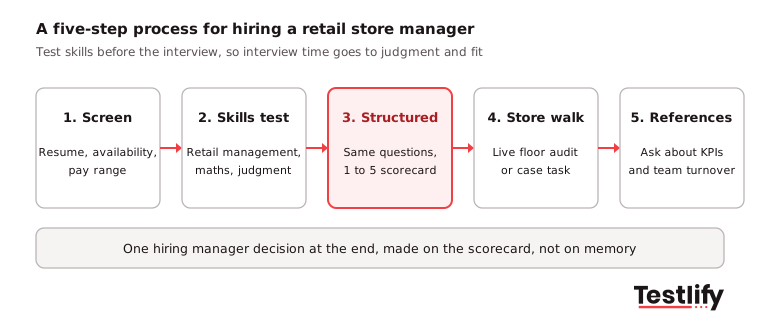
- Screen: Check availability for weekends and peak season, pay range and the size of store the candidate has run.
- Skills test: Send a short retail management, maths and situational judgment test so you only interview people who clear the basics.
- Structured interview: Use the same retail store manager interview questions for every candidate, scored on a 1 to 5 scorecard. A structured interview is easier to compare and easier to defend.
- Store walk or case task: Walk the floor together for 20 minutes and ask what they would fix first, or hand over a one-page store report and ask for a plan.
- References: Ask past managers about KPIs, team turnover and how the candidate handled a bad week.
The stakes justify the effort. NACS data from its State of the Industry Talent Insights Dashboard puts the cost at about $1,800 to hire and $5,000 to train a store manager, and says a new store manager takes 112 days on average to reach full productivity.
What general retail store manager interview questions should you ask?
General retail store manager interview questions open the conversation and show the size and type of store a candidate has run. Use these interview questions for retail store manager candidates in the first 10 minutes.
- Walk me through the last store you managed: size, annual sales, team size and the KPIs you owned.
- What does a normal day look like for you, from opening to close?
- Which three numbers do you check first every morning, and why those?
- What made you move into store management, and what do you still find hardest?
- How would your last district manager describe your strengths and your weak spots?
- What did you change in your first 90 days in your last store?
- Why this store and this brand, and what do you know about how we sell?
- What would you want to achieve in your first 30, 60 and 90 days here?
What to look for: Specific numbers without being asked twice, a clear daily rhythm and a 90-day plan that starts with listening to the team before changing things.
Which store operations questions show real experience?
Store operations questions show whether a candidate has actually run inventory, cash and compliance or only watched someone else do it. Good candidates answer with process steps and results.
- How do you run an inventory count, and what accuracy rate did your last store hit?
- What was your store's shrink rate, and what did you do to bring it down?
- How do you tell internal theft from external theft or paperwork errors?
- Talk me through your opening and closing checklist. What do you never skip?
- How do you handle a cash variance at the end of the day?
- How do you keep visual merchandising and planograms to brand standard when the store is busy?
- What do you do when a delivery arrives short or wrong?
- How do you make sure your team follows health, safety and company policy when you are not on the floor?
What to look for: Named systems or routines (cycle counts, daily cash sign-off, zone ownership), a shrink figure the candidate knows by heart and a fix that addressed the cause, not just more cameras.
Which sales and KPI questions test commercial skill?
Sales and KPI questions test whether a candidate can read store numbers and turn them into action. A store manager who cannot explain conversion or labor cost will struggle with any target you set.
- Which KPIs matter most in a store like ours, and how do they connect to each other?
- Your conversion rate is down 3 points this month while traffic is flat. What do you check first?
- How have you raised average transaction value without pushing customers away?
- How do you build a weekly schedule that matches traffic and stays inside the labor budget?
- Tell me about a month you missed your sales target. What happened and what did you change?
- How do you set daily targets for your team, and how do you share progress during the day?
- How much control did you have over your store's P&L, and which lines did you manage?
- What would you do in a week where sales are 15% under plan and payroll is already set?
What to look for: The candidate links traffic, conversion and transaction value, talks about labor as a share of sales and gives examples with before-and-after figures.
What people management questions should you ask a store manager?
People management questions should come first in your weighting, because a store manager's team does most of the selling. Gallup reported that manager engagement fell from 30% to 27% in 2024, the sharpest drop of any group in its State of the Global Workplace findings, so ask how candidates keep themselves and their teams going.
- How do you hire sales associates, and what do you look for in a 15-minute interview?
- How do you train a new hire in their first two weeks?
- Tell me about an underperformer you coached. What did you do and what happened?
- Have you ever had to let someone go? Walk me through how you handled it.
- How do you handle last-minute callouts and no-call no-shows on a busy Saturday?
- How do you deal with two team members who will not work together?
- What was staff turnover in your last store, and what did you do about it?
- How do you develop an assistant manager or keyholder to take over from you?
- How do you handle a long-serving associate who refuses a new process?
- How do you recognize good work when there is no budget for rewards?
What to look for: A clear coaching sequence (set the standard, observe, give feedback, follow up), fair and documented handling of dismissals and a turnover figure with a reason behind it.
Which behavioral retail manager interview questions work best?
Behavioral retail manager interview questions work best when they ask for one specific past event and the candidate's own actions. Ask the candidate to use the STAR structure: situation, task, action and result.
- Tell me about a time you turned around a store or department that was underperforming.
- Describe the most difficult customer complaint you handled personally.
- Tell me about a time you had to deliver a company change your team did not like.
- Describe a decision you made with incomplete information. How did it turn out?
- Tell me about a time you got a peak period or holiday season wrong. What did you learn?
- Describe a time you disagreed with your district manager. What did you do?
- Tell me about a promotion or in-store event you planned. What were the results?
- Describe a safety incident or emergency in your store and how you handled it.
What to look for: "I" more than "we", a result with a number or a clear outcome and an honest lesson when things went wrong.
What situational retail management interview questions test judgment?
Situational retail management interview questions test judgment by giving the candidate a realistic problem and asking what they would do now. They suit first-time managers, who may not have a past example yet.
- It is 10 a.m. on Black Friday, two associates have called out and the queue is 15 people long. What do you do in the next 30 minutes?
- You see a well-liked associate put a store item in their bag. What happens next?
- A customer is shouting at a new cashier about a refund outside policy. How do you step in?
- Head office sends a new promotion that you think will hurt margin. How do you respond?
- Your stock count shows a $4,000 gap in one category. Where do you start?
- Your best associate tells you they have a job offer elsewhere. What do you say?
- You are 20% over labor budget at mid-month. What do you change?
- A customer slips on a wet floor near the entrance. Walk me through your actions.
What to look for: Safety and customers first, then the team, then the numbers; a calm order of actions; and knowing when to escalate to the district manager, HR or loss prevention.
What do strong answers to store manager interview questions sound like?
Strong answers to store manager interview questions are specific, owned and measured. Here are five sample answers to the questions that separate candidates most, with what to look for and the red flag in each.
What was your store's shrink rate, and what did you do to bring it down?
Look for: A known figure, a root-cause split and a fix with a result.
Strong answer: "Shrink was 2.4% when I took over, against a company target of 1.5%. I split it by category and day and found most of it was in cosmetics on late shifts, plus paperwork errors on transfers. I moved high-risk items into view of the till, added a closing check on that aisle and retrained two keyholders on transfers. Within two quarters we were at 1.6%."
Red flag: "Shrink is just part of retail" or a fix that only adds cameras.
Your conversion rate is down 3 points this month while traffic is flat. What do you check first?
Look for: A logical check order and action on the floor, not only reports.
Strong answer: "First the schedule: are we short at peak hours? Then stock: are best-sellers out or in the wrong place? Then the floor: are associates greeting and helping or stuck on tasks? I would stand on the floor for two peak shifts, fix coverage and replenishment that week and set a daily conversion goal per shift."
Red flag: Blaming the weather or head office without checking store-level causes.
Tell me about an underperformer you coached. What did you do and what happened?
Look for: A fair, documented sequence and a clear outcome either way.
Strong answer: "A sales associate was at 60% of the team's average sales per hour. I sat down with them, shared the numbers and asked what was getting in the way. They were unsure about our loyalty sign-up, so I paired them with our top seller for three shifts and checked in weekly. After six weeks they were at 90% of average. I keep notes for every check-in, so if it had not worked the next step would have been clear."
Red flag: Going straight to a warning, or never giving feedback at all.
Describe the most difficult customer complaint you handled personally.
Look for: Listening, owning the fix within policy and following up with the team.
Strong answer: "A customer's custom order arrived damaged two days before a wedding. I apologized, called two nearby stores and found a replacement the same afternoon, then had it delivered. Afterwards I added a damage check at delivery to our receiving routine so it would not happen again."
Red flag: A story where the candidate gives in to anything, or one where the customer is simply wrong.
It is 10 a.m. on Black Friday, two associates have called out and the queue is 15 people long. What do you do?
Look for: Quick, ordered actions that protect customers and the team.
Strong answer: "I open another till myself, move one floor associate to bagging and ask a keyholder to call the backup list. I put fitting rooms on self-service with one check every 15 minutes and pause replenishment until the queue clears. Once covered, I log the callouts and review the backup plan before the next peak day."
Red flag: Hiding in the back office to solve staffing by phone while the queue grows.
How do you score store manager candidates fairly?
Store manager candidates are scored fairly when every interviewer asks the same questions, rates each answer from 1 to 5 against written criteria and fills in the scorecard right after the interview. Compare candidates on the scores, then discuss. Our guide to the interview scorecard shows how to set one up.
Score | What the answer shows |
|---|---|
5 | Specific event, clear personal actions, measurable result, lesson applied since |
4 | Specific event and actions, result described but not measured |
3 | Reasonable approach, but general or partly hypothetical |
2 | Vague, mostly "we", no clear result |
1 | No example, wrong approach or a red flag |
Keep every question tied to the job. The EEOC guidance on prohibited employment practices explains why questions about age, family plans, religion, disability or national origin create legal risk. Ask about availability for the shifts the job needs, not about childcare or personal life.
Key takeaway: The scorecard is the decision. A candidate who is likeable but scores 2s on operations and KPIs is a risk for a store you need to run well from week one.
What red flags should you watch for in a store manager interview?
Store manager interview red flags are patterns that show a candidate has not owned results or people. Watch for these:
- No numbers: Cannot name their shrink rate, labor cost or sales against target.
- Only "we": Every story is about the team, never about their own actions.
- Blame: Missed targets are always head office, the weather or "bad staff".
- No labor view: Treats scheduling as filling shifts, not as a cost to manage.
- Avoids hard talks: Has never coached someone out or given tough feedback.
- Customer at all costs: Breaks policy to please every customer, with no thought for margin or staff.
- Weak 90-day plan: Wants to change everything in week one before learning the store.
Where do skills tests fit when hiring a store manager?
Skills tests fit before the structured interview, so you only spend interview time on candidates who know retail basics. A short store manager test checks store operations, visual merchandising, retail marketing, sales and distribution, and customer service in about 10 minutes.
Pair it with tests that match the other skills in your scorecard:
- Numbers: The numerical reasoning test for margins, discounts and stock maths.
- Leadership: The leadership test for team direction and decision-making.
- Customers: The customer service aptitude test for complaint handling and service judgment.
- Stock: The inventory management test for counts, ordering and accuracy.
Then use the interview questions above to probe the areas where each candidate scored lowest. Hiring above store level? The same approach applied to multi-site leadership is in our interview questions for retail operations managers, which covers shrink, labor planning and P&L across a region.
Hire your next store manager with Testlify
Testlify lets you build a store manager assessment from your job description, choose from 3,500+ tests and add AI interviews, then rank candidates on one scorecard. Credits are used only when a candidate starts an assessment, and you can try it with a 7-day free trial, no credit card needed.
See how it works for store teams on our retail hiring page, or book a demo if you hire store managers across many locations.
Frequently asked questions (FAQs)

Human Resources Lead
Snehi Parmar leads People at Testlify, owning hiring, culture, performance, and retention for a 90-person team. She writes on practical HR strategy and building people processes that scale.
Related resources
View all
HR & recruitment
50 public relations manager interview questions to ask in 2026

HR & recruitment
60 Customer Relationship Manager interview questions to ask job applicants

HR & recruitment
60 Project coordinator interview questions to ask job applicants

HR & recruitment
60 Key Account Manager interview questions to ask job applicants

HR & recruitment
60 Category Manager interview questions to ask job applicants

HR & recruitment
60 Data Analyst interview questions to ask job applicants
Get started.
Hire on proof, not resumes.
Run your first skills-based assessment free — no credit card required.