
40 public relations specialist interview questions to ask job applicants
Interview questions for PR specialist candidates, grouped by skill, with sample answers, a writing work sample, a scorecard and red flags.

Public relations specialist interview questions test whether a candidate can earn media coverage, write clean copy fast, protect a reputation under pressure and prove that their work moved a business number. The 40 questions below are grouped by the skill they test, with answer guides, a scorecard, a short writing work sample and the red flags that separate a real PR professional from someone who only lists placements.
TL;DR / Key takeaways
- The best public relations specialist interview questions test six skills: media relations, writing, crisis communication, measurement, digital and social, and stakeholder judgment.
- Ask every candidate the same questions and score each answer from 1 to 5 against anchors your panel writes before the first interview.
- Ask how they measure PR. A strong candidate talks about share of voice, message pull-through and business outcomes, not only impressions.
- Ask how they use AI. Muck Rack's State of PR 2025 found 77% of PR professionals already use AI tools, so the real test is how they check facts and disclose AI use.
- Use a 60-minute work sample: a press release plus a three-line pitch. It shows more than any answer about "strong writing skills".
- Put a short skills test before the interview so live time goes on judgment, not on basic writing and PR knowledge.
 ChatGPT
 Gemini
 Claude
 Grok
 Perplexity
What does a public relations specialist do?
A public relations specialist builds and protects an organization's reputation through earned media, written content, social channels and direct work with journalists and stakeholders. The US Bureau of Labor Statistics puts the median pay for public relations specialists at $74,750 a year (May 2025), counts 314,500 jobs in 2025 and expects about 23,000 openings a year to 2035.
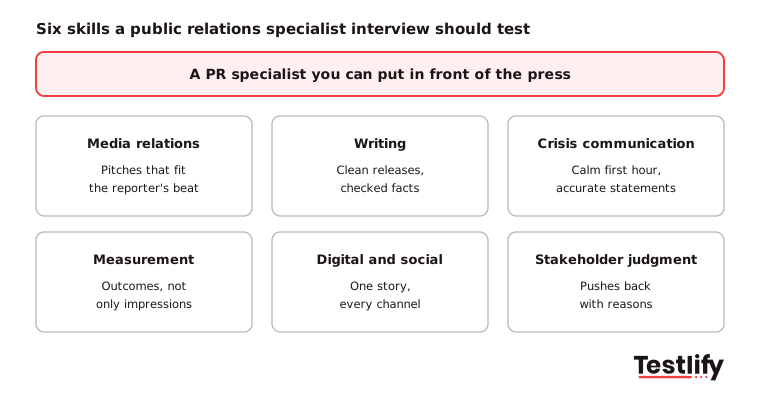
Day to day, the role means writing press releases and media materials, pitching reporters, answering media requests, preparing executives for interviews, monitoring coverage and social conversation, and reporting results. In-house specialists focus on one brand. Agency specialists juggle several clients and tighter billing targets.
The role sits close to two others. A PR manager owns the strategy, budget and team, so their questions focus on leadership; see our public relations manager interview questions for that level. A public affairs specialist works on policy, government relations and public sector audiences; if that is the job, use our public affairs interview questions instead. For a role summary to share with the hiring manager, start from the public relations specialist job description.

What are the best public relations specialist interview questions?
The best public relations specialist interview questions ask for a specific campaign, a specific number and a specific decision. If you only have 30 minutes, use these 10:
- Walk me through your best campaign: the business goal, the plan, the coverage and the result.
- How do you build a media list for a new announcement, and how do you decide who gets the story first?
- Pitch our latest product to a reporter in 60 seconds.
- Take me through how you write a press release, from brief to approval.
- How do you measure whether a PR campaign worked?
- A customer's angry post about us is going viral. What do you do in the first hour?
- Tell me about a time a reporter got a story wrong. What did you do?
- How do you use AI tools in your PR work, and where do you never use them?
- Tell me about a time you pushed back on an executive's message.
- What would you want to learn about our company and our coverage in your first 30 days?
What general and experience questions should you ask a PR specialist?
General PR specialist questions confirm the scope of past work: in-house or agency, industries, media tiers, and the tools the candidate used every day. Keep this section short and use it to decide which skill sections need more time.
- Have you worked in-house, at an agency, or both? What changed in how you worked?
- Which industries and beats have you pitched, and which reporters know you by name?
- What mix of national, trade, regional and broadcast media have you worked with?
- Which media database, monitoring and social listening tools have you used, and for what?
- How many campaigns or clients did you handle at the same time in your last role?
- Who were your main internal partners: marketing, legal, product, the executive team?
- What part of PR work do you enjoy most, and what part do you find hardest?
- How do you explain the difference between PR and marketing to a new colleague?
Which questions test media relations and pitching?
Media relations questions test the core of the role: getting a busy reporter to care. The job is harder than it was. In Muck Rack's State of PR 2025, 72% of PR professionals blamed low reporter response rates for harder placements and 62% cited shrinking media lists, so a strong candidate has a method, not just a contact list.
- How do you research a reporter before you pitch them?
- How do you personalize a pitch, and how much of it do you change for each reporter?
- What makes a story newsworthy to a trade reporter versus a national one?
- How do you follow up on a pitch without damaging the relationship?
- When do you offer an exclusive, and how do you handle the other outlets afterward?
- Tell me about a story you placed that started as a "no". What changed?
For more on judging spoken and written skills in a structured way, see our guide on how to evaluate communication skills.
Which questions test writing skills?
Writing questions matter because PR is a writing job first. Press releases, pitches, statements, talking points, blog posts and social copy all pass through the specialist, often under deadline and through several rounds of approval.
- Walk me through how you write a press release, from the brief to the final approved version.
- How do you write a headline and first paragraph that a reporter will read?
- How do you adapt one announcement for a press release, a LinkedIn post and an internal email?
- How do you handle edits from legal or an executive that weaken the story?
- Which style guide do you follow, and how do you check facts and quotes before release?
Which questions test crisis communication?
Crisis communication questions show how a candidate thinks when the facts are incomplete and the clock is running. A strong candidate talks about speed and accuracy together, names who they would bring in, and knows when to say less.
- What should a crisis communication plan include, and have you built or used one?
- A customer's angry post about us is going viral. What do you do in the first hour?
- How do you write a holding statement when you do not have all the facts yet?
- How do you keep employees, customers and media hearing the same message during a crisis?
- How do you decide when a crisis is over and what to review afterward?
Our guide on how to evaluate crisis management skills covers more ways to test this skill.
Which questions test PR measurement?
PR measurement questions separate candidates who report activity from candidates who prove impact. "We got 50 placements" or "2 million impressions" is a weak answer on its own. A strong answer layers outputs (coverage and message pull-through), outtakes (share of voice, sentiment, awareness) and outcomes (website visits from earned media, branded search, leads or hiring interest).
- How do you measure whether a PR campaign worked?
- Which metrics do you report to leadership, and which do you track only for yourself?
- What is your view on advertising value equivalency (AVE) as a PR metric?
- Tell me about a time data made you change a campaign while it was running.
- How would you set a measurement baseline in your first 90 days here?
Which questions test AI use and ethics in PR?
AI and ethics questions are now part of every PR interview. Muck Rack's State of PR 2025 found that 77% of PR professionals use AI tools such as ChatGPT and 59% expect AI and automation to grow in importance over the next five years. The question is not whether a candidate uses AI, but whether they use it with care.
- Which AI tools do you use in your PR work, and for which tasks?
- Which tasks would you never hand to an AI tool, and why?
- How do you check an AI-assisted draft for wrong facts or invented quotes before it goes out?
- Tell me about an ethical dilemma you faced in PR. What did you decide?
Listen for the values in the PRSA Code of Ethics, such as honesty, disclosure of information and avoiding conflicts of interest. A candidate who can explain where honesty limits what they will say for a client is safer to put in front of the press.
Which behavioral and situational questions work best for a PR specialist?
Behavioral and situational questions work best when they recreate real PR pressure: a hostile reporter, a nervous executive, three deadlines on one day. Ask candidates to use the structured interview format your panel agreed on, with the STAR method (situation, task, action, result), and push for the numbers behind each result.
- Tell me about a time you pushed back on an executive's message. What happened?
- Describe a week with a launch, a media request and a crisis at the same time. How did you prioritize?
- Tell me about a campaign that missed its goal. What would you do differently?
- Our CEO wants a press release for news that is not newsworthy. What do you do?
What should you ask a senior public relations specialist?
A senior public relations specialist should be tested on strategy, influence and planning, not only on execution. These questions suit candidates who will lead campaigns, mentor junior staff or brief executives directly.
- How would you build a 90-day communications plan for this role?
- How do you prepare an executive for a tough media interview?
- Tell me about a time your advice changed a business decision, not just the way it was announced.
LinkedIn's public relations interview question guide groups similar questions into hard skills, behavioral and soft skills, which is a useful check that your own list covers all three.
What do good answers to public relations specialist interview questions sound like?
Good answers to public relations specialist interview questions name the audience, the method and the outcome. Use these five sample answers as calibration for your panel. They show the level of detail to expect, not scripts to match word for word.
Question 1: Walk me through your best campaign.
Look for: A business goal first, a clear plan and a result tied to more than reach.
Sample answer: "We launched a payroll feature for mid-size companies and the goal was demo requests from HR leaders. I built a list of 25 HR trade and business reporters, offered one exclusive with customer data, and prepared our CFO for interviews. We got 14 stories, three in our top target outlets. Demo requests from earned media links were up 40% over the previous launch, and our share of voice against two rivals moved from 18% to 31% that quarter."
Question 5: How do you measure whether a PR campaign worked?
Look for: Goals set before the campaign, layered metrics, honesty about limits.
Sample answer: "I agree the goal with the business owner before we start. Then I track three layers: coverage and whether our key message appeared, share of voice and sentiment against competitors, and the outcome we agreed, such as website visits from earned media or sign-ups. I do not report AVE. If a result is hard to attribute, I say so and show the trend instead."
Question 6: A customer's angry post is going viral. What do you do in the first hour?
Look for: Calm triage, the right people involved, and accuracy before speed.
Sample answer: "First I check the facts with customer support: is the complaint accurate and how far has the post spread? I bring in support, legal and the executive owner, and I contact the customer privately to fix the issue. If the post is gaining real traction, we publish a short, honest reply that says what we are doing. I log everything so we can review what caused it."
Question 8: How do you use AI tools in your PR work?
Look for: Specific uses, clear limits and a fact-check habit.
Sample answer: "I use AI to summarize coverage, find angles in research and draft first versions of social copy. I never use it for attributed quotes, crisis statements or anything with numbers I have not checked against the source. Every AI-assisted draft gets a line-by-line fact check, and I follow our company's disclosure policy."
Question 7: Tell me about a time a reporter got a story wrong.
Look for: Respect for the reporter, a fix based on facts, and a relationship that survived.
Sample answer: "A trade reporter quoted an old price for our product. I called rather than emailed, sent the current pricing page and asked for a correction, without arguing about the angle. The correction ran the same day. Six months later the same reporter called us first for a feature."
How do you score a public relations specialist interview?
A public relations specialist interview is best scored with a weighted scorecard that every interviewer fills in alone before the debrief. Agree on the weights and on what a 1, 3 and 5 look like for each skill before the first interview, so scores reflect evidence and not the loudest voice in the room. Our guide to the interview scorecard explains how to set one up.
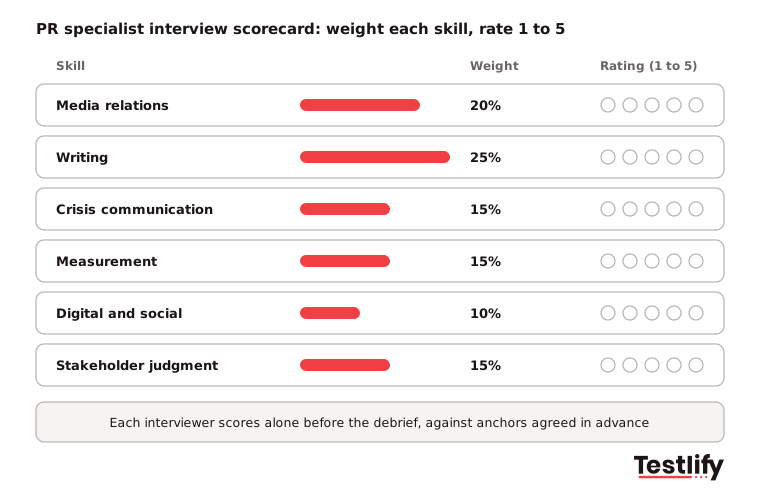
Adjust the weights to the role. For an agency specialist with many clients, raise writing and media relations. For an in-house specialist who will brief executives, raise stakeholder judgment.
Pro tip: Write anchors for a 1, a 3 and a 5 on each skill using real examples from your own past campaigns. Panels that agree on anchors first argue less in the debrief and hire faster.
What work sample should you give a public relations specialist?
A press release and pitch work sample is the most useful test for a public relations specialist, because it shows how the candidate writes and thinks under time pressure. Give it as a 60-minute exercise before the final interview, or live with a panel.
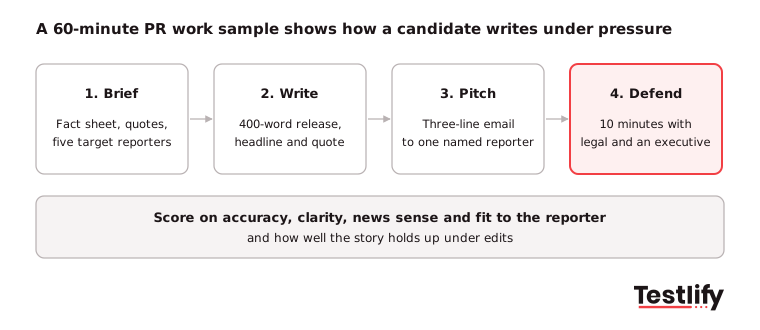
- Brief: Share a one-page fact sheet for a real or realistic announcement, two customer quotes and a list of five target reporters with their recent stories.
- Write: Ask for a press release of about 400 words with a headline, a first paragraph that works on its own, and one executive quote.
- Pitch: Ask for a three-line email pitch to one named reporter, explaining why this story fits their beat.
- Defend: Give them 10 minutes with a "legal reviewer" and an "executive" on your panel who ask for changes that weaken the story.
Score it on accuracy, clarity, news sense, fit to the reporter and how well they hold the story together under edits. Testlify's press release practice interview is a ready-made starting point for this stage.
What are the red flags in PR specialist interview answers?
The biggest red flags in PR specialist interview answers are vanity metrics, vague stories and loose handling of facts. Watch for these patterns:
- Only vanity metrics: every result is impressions, reach or AVE, with no link to a business goal.
- No named reporters or outlets: "I have great media relationships" with no examples.
- Spin over accuracy: they describe hiding facts from reporters as a win.
- AI without checks: they publish AI drafts without a fact check or cannot say where they draw the line.
- No failures: every campaign worked, which usually means they did not measure.
- Talks down to reporters: they treat journalists as opponents rather than people with a job to do.
Key takeaway: A strong PR specialist explains why a story worked and how they know. A weak one only tells you it "got great coverage".
How do skills tests help you hire a public relations specialist?
Skills tests help you hire a public relations specialist by checking PR strategy, writing, crisis judgment and communication before the interview. Candidates who reach the panel already know the basics, so live time goes on the work sample and the judgment questions above.
A typical test stage for this role combines three or four of these:
- The public relations strategy test for campaign planning, media relations and PR principles.
- The crisis management test for decisions under pressure.
- The strategic communication test for message planning across audiences.
- The business communication test for clear, professional writing.
- The social media management test for channel and community skills.
- The PR lead test for senior candidates who will lead campaigns.
Testlify's library has 3,500+ tests and 25+ question types, including file upload and video questions, so candidates can upload their press release or record a 60-second pitch inside the assessment. Results come back scored with a per-skill breakdown and sync to 100+ ATS and HRIS tools such as Workday, Greenhouse and SAP SuccessFactors.
We have seen hiring teams use a test stage like this to cut a long applicant list to a shortlist of five or six, then spend panel time only on the work sample and the judgment questions.
Ready to hire your next public relations specialist?
Build a test stage for your PR specialist role from the Testlify test library, add the press release work sample as a file upload question, and share a ranked shortlist with your hiring manager.
Start a 7-day free trial with no credit card, or book a demo to see it set up for a communications role. Hiring for the rest of your communications team too? See our media relations specialist interview questions and media relations coordinator interview questions.
Frequently asked questions about public relations specialist interviews

Wordpress Developer
Yash Patel is a Wordpress and SEO Specialist at Testlify with 3+ years of experience in technical SEO, on-page optimization, and content strategy. He works on improving Testlify's organic presence and produces content focused on hiring, talent assessment, and HR technology.
LinkedInRelated resources
View all
Interview questions
60 interview questions to ask while hiring for project coordinator

Interview questions
60 Customer Insights Analyst interview questions

Interview questions
60 Budget Analyst interview questions to ask job applicants

Interview questions
60 Sales Trainer interview questions to ask job applicants

Interview questions
60 Compliance Specialist interview questions to ask job applicants

Interview questions
60 Pricing Analyst interview questions to ask job applicants
Get started.
Hire on proof, not resumes.
Run your first skills-based assessment free — no credit card required.