
Office coordinator interview questions: 55 with sample answers
55 office coordinator interview questions with sample answers, red flags to spot and a simple rubric to score every candidate the same way.

Good office coordinator interview questions test three things: whether a candidate can juggle competing priorities without dropping any, communicate clearly with every department, and keep an office running when the day goes sideways. The strongest questions ask for a specific past situation or a realistic scenario, not an opinion about teamwork.
Below are 55 office coordinator interview questions, grouped by what each one reveals, with sample answers, red flags and a 1 to 4 scoring rubric so two interviewers reach the same shortlist. They also work for office services coordinator and service coordinator roles, with a short set of extra questions for each.
TL;DR:
- The best office coordinator interview questions ask for evidence: "Tell me about a week when three deadlines collided" beats "Are you organized?" every time.
- Test five skills: prioritization, communication, tool fluency, attention to detail and composure under pressure.
- Mix question types: role-specific questions for knowledge, behavioral questions for past behavior and situational questions for judgment.
- Score every answer on the same 1 to 4 scale, right after the interview, and compare candidates on scores, not likeability.
- Watch for red flags such as "we" answers with no personal action, no system for tracking tasks and careless talk about confidential data.
- Run a short skills test before the interview so the conversation goes to judgment and fit, not typing speed or Excel basics.
- Plan 8 to 12 scored questions for a 45-minute interview, the same core set for every candidate.
 ChatGPT
 Gemini
 Claude
 Grok
 Perplexity
What does an office coordinator do?
An office coordinator keeps the day-to-day of an office running: scheduling, supplies, vendors, front-desk flow, meeting and event logistics, onboarding setup and the small problems nobody else owns. The role sits between administrative support and office management, so the person needs hands-on organization plus enough judgment to make a call without waiting for a manager.
The US Bureau of Labor Statistics groups the job with secretaries and administrative assistants: 3,515,600 jobs in 2025, a median pay of $48,310 in May 2025 and about 314,400 openings a year to 2035, even as total employment is projected to dip 2%, per the BLS Occupational Outlook Handbook. Most openings come from replacing people who leave, so most teams hire this role again and again. A repeatable interview pays off.
For the full list of duties to put in the posting, see the office coordinator job description template.

What skills should office coordinator interview questions test?
Office coordinator interview questions should test five skills: prioritization, clear written and verbal communication, tool fluency, attention to detail and composure under pressure. Coordination is a skills job, not a credentials job, so what someone can actually do matters more than the job titles on a resume.
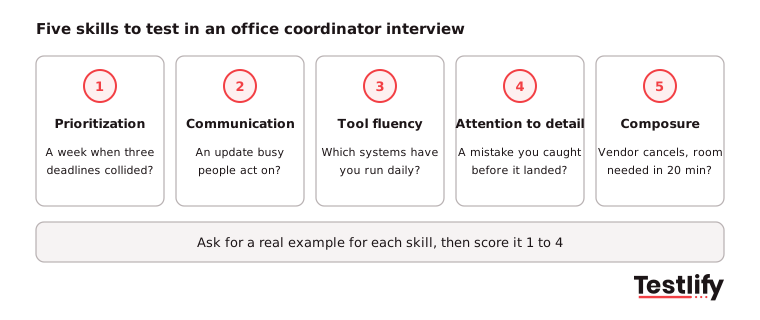
- Prioritization: deciding what waits when three people all need something "now".
- Communication: writing a clear update, running a calm handoff, saying no without friction.
- Tool fluency: calendars, shared docs, expense and ticketing systems, Microsoft Office or Google Workspace, basic spreadsheet work.
- Attention to detail: catching the wrong meeting room or the duplicate order before it costs anyone time.
- Composure: staying steady when a vendor cancels and the CEO needs the room in 20 minutes.
Roles keep changing under the people who hold them. The SHRM 2025 Talent Trends survey found that 69% of organizations still struggle to fill full-time roles and 47% are updating existing roles to include new skills. Hire for how fast someone picks up a new tool, not only for the tools already on the resume.
What general and role-specific questions should you ask?
General and role-specific office coordinator interview questions check how a candidate runs the job day to day: supplies, vendors, tools, confidential paperwork and the first weeks in a new office. Use them to open the interview and to test knowledge a coordinator should have on day one.
- Can you describe your experience coordinating office services and facilities?
- Walk me through how you would set up your first two weeks in a new office. What do you learn first?
- How do you keep track of recurring tasks, like supply orders or vendor renewals, so nothing slips?
- Describe your approach to keeping inventory and ordering office supplies.
- Which calendar, document and ticketing tools have you run day to day, and how deep does that go?
- How do you handle confidential information, like payroll paperwork or a signed contract?
- How do you manage shared calendars and avoid double bookings?
- How do you prep a room, an agenda and the logistics for a leadership meeting?
- Have you handled several phone lines or a busy front desk at once? How did you keep it under control?
- Describe your approach to managing vendor relationships and contracts.
- When a policy changes, how do you roll it out so people actually follow it?
- How do you keep routine work, like expense reports and records, accurate?
- Do you prefer front-of-house work with visitors or back-office work with systems, and why?
Pro tip: Ask question 2 early. Strong candidates name people, systems and open requests to learn first. Weak ones describe only tidying their desk.
Which behavioral questions reveal a strong office coordinator?
Behavioral questions reveal a strong office coordinator by asking for a real past situation, the action the person took and the result. The US Office of Personnel Management notes that behavioral questions rest on the idea that past behavior predicts future behavior. Listen for all three parts. A vague "I'm just really organized" is not an answer.
- Tell me about a week when several deadlines collided. How did you decide what came first?
- Describe a time you caught a mistake before it became a problem. How did you spot it?
- Tell me about a challenging office service request. How did you approach it, and what was the outcome?
- Give an example of a project where you worked with several departments to reach one goal.
- Tell me about a process you improved. What was broken, and what did you change?
- Describe a time you cut costs in office operations. What did you do, and what did it save?
- Tell me about a conflict with a coworker or between two teams. How did you resolve it?
- Describe a moment you had to say no to a senior person. What did you say?
- Walk me through a time you dropped a ball. What did you do next?
- Tell me about an emergency in the office, such as a power cut or a medical issue. How did you keep people safe and work moving?
- Describe an office event, move or renovation you coordinated. How did you plan it, and what went wrong?
- Tell me about a time you had to adapt to a new office system or tool. How did you get up to speed?
- Describe a time an employee complained about office services. How did you resolve it?
Which situational questions test judgment under pressure?
Situational questions test judgment under pressure by putting the candidate in a realistic scenario and asking what they would do next. They work well for candidates with little coordinator experience, because the answer shows reasoning, not history.
- Two executives book the same room at the same time and both refuse to move. What do you do?
- A shipment of supplies is late and a team runs out mid-week. Walk me through your next hour.
- You are covering the front desk, the phone is ringing and a delivery needs a signature. What are your priorities?
- A new hire starts Monday and nobody set up their desk or accounts. How do you catch up?
- Your manager is out and a vendor demands a decision today. How far do you go on your own?
- The printer, the coffee machine and a leadership lunch all break on the same morning. What is your order of attack?
- A visitor demands to see an employee who is in a meeting. What do you say?
- Supplies are running low but the budget is spent for the quarter. What do you do?
- You notice a colleague ignoring an office policy. How do you raise it?
Which questions test communication, ownership and fit?
Communication, ownership and fit questions show how a candidate keeps people informed and how they treat the office as their own. As an employer, use a few of them to probe how the person works with others, not just which tasks they can do.
- How do you write a status update so busy people read it and act on it?
- How do you keep a shared calendar or tracker clean when everyone edits it?
- A team keeps missing your emails. What do you change?
- How do you close the loop so a request does not fall into a black hole?
- How do you document a process so the next person can run it without you?
- How do you build good working relationships with colleagues and stakeholders?
- How do you stay focused when you switch tasks every few minutes?
- How do you help create a welcoming office for new and existing employees?
- What made you good at your last coordinator job that would not show up on a resume?
- What do you want from a manager so you can do your best work?
- Six months in, how would we know you were the right hire?
What do strong answers to office coordinator interview questions sound like?
Strong answers to office coordinator interview questions name a specific system, a real example and a result. Below are sample answers to six of the most common questions, with what to look for in each. Use them as a benchmark, not a script: a candidate's own words with real detail beat a polished copy.
"How do you prioritize and manage multiple tasks and deadlines?"
- Look for: a clear rule for ranking work, a tracking tool and a habit of telling people when plans change.
- Sample answer: "I sort requests by business impact and deadline, and anything that blocks other people goes first. Everything lives in one task list with due dates, and I check it at the start and end of each day. When two requests clash, I tell both people what is happening and when they will get theirs."
"Describe your approach to keeping inventory and ordering office supplies."
- Look for: records, reorder points and some use of past data, not "I order when we run out".
- Sample answer: "I keep a simple stock sheet with a reorder level for each item and check it every Friday. I order against last quarter's usage plus any planned events, and I compare two suppliers once a year. At my last job that ended the mid-week shortages on printer paper and coffee."
"Tell me about a time you found an inefficiency and fixed it."
- Look for: what was broken, the specific change and a measurable result.
- Sample answer: "Supply orders went through email, so requests got lost and we often over-ordered. I set up a shared request form with automatic reorder reminders and worked with procurement on approvals. Shortages stopped and we cut waste on duplicate orders."
"How do you handle a conflict between two teams over office space?"
- Look for: listening to both sides, a fair process and a clear outcome.
- Sample answer: "Two departments both claimed the same meeting room every Tuesday. I met each lead separately, then together, with the booking data. We agreed on alternating weeks and a second room for overflow, and I posted the schedule so nobody had to remember it."
"Describe a high-priority project with a tight deadline."
- Look for: a plan broken into steps, dependencies, regular updates and calm problem-solving.
- Sample answer: "We had five weeks to move 60 people to a new floor. I built a plan with IT, facilities and HR, set weekly checkpoints and sent a short Friday update. When the furniture delivery slipped, we moved the desk-heavy teams last. The move finished on schedule with no lost workdays."
"How do you handle confidential information?"
- Look for: specific habits and an understanding of who should see what.
- Sample answer: "Payroll and contracts stay in locked cabinets or restricted folders, never on my desk or in shared drives. I lock my screen when I step away and check identity before I share personal details with anyone who calls. If I am unsure whether someone should see a document, I ask HR first."
What should you ask an office services or service coordinator?
Office services coordinators and service coordinators need a few extra questions on top of the core set. An office services coordinator leans toward facilities, health and safety, and moves. A service coordinator or service delivery coordinator leans toward clients, providers and service-level commitments, so shift some questions that way.
Office services coordinator:
- How do you make sure the office meets health and safety rules?
- How would you handle an employee who needs a workplace accommodation or adjustment?
- How do you stay current on office technology and facilities tools?
Service coordinator and service delivery coordinator:
- Walk me through how you track a service request from intake to closed, and how you confirm it is actually done.
- Tell me about a time you kept a service running when a provider missed a commitment.
- How do you handle a disagreement with a service provider without damaging the relationship?
- A service-level target is about to be missed. What do you do in the next hour, and who do you tell?
- How do you plan a delivery schedule when three clients want the same window?
- How do you capture feedback after a service closes and turn it into a change?
Hiring across several coordinator roles? The same approach works for administrative coordinator interview questions and facilities coordinator interview questions, so your whole operations team hires the same way.
How do you structure and score an office coordinator interview?
An office coordinator interview works best when every candidate gets the same questions in the same order, scored against anchors written before the first interview. The US Office of Personnel Management describes structured interviews this way and recommends that each interviewer scores alone before the panel discusses big gaps.
- Pick the competencies: use the five skills above, weighted to what your office needs most.
- Map one or two questions to each: take them from the lists above.
- Write the anchors: decide what a 1, 2, 3 and 4 sound like for each competency.
- Score right after each interview: one row per competency, while it is fresh.
- Compare on scores: discuss gaps of 2 points or more between interviewers.
Competency | Sample question | What a strong answer shows |
|---|---|---|
Prioritization | "A week when three deadlines collided: how did you choose?" | A clear rule for ranking, not just "I worked late". |
Communication | "How do you write an update busy people act on?" | Short, specific, action-first writing habits. |
Tool fluency | "Which systems have you run day to day?" | Named tools plus how deep the hands-on use goes. |
Attention to detail | "A mistake you caught before it became a problem?" | A concrete catch and the check that surfaced it. |
Judgment under pressure | "Manager out, vendor wants a decision today. How far do you go?" | Owns the call, knows where the line is, tells people. |
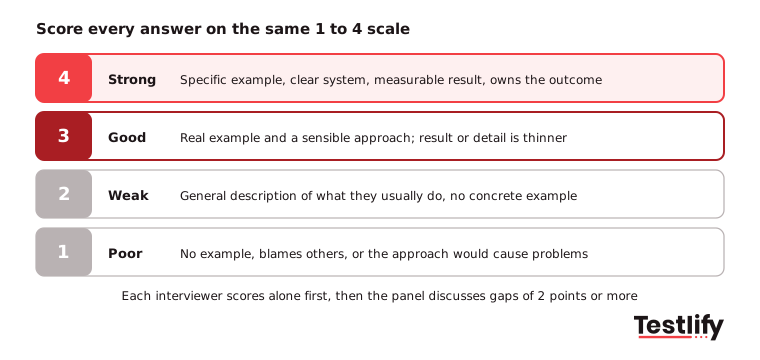
Keep it fair with two habits. Ask every candidate the same core questions, and separate what someone did from how they told the story, so a confident talker with a thin example does not outscore a quieter person with a strong one. A shared interview scorecard makes the debrief faster, and this guide to the structured interview covers panel setup.
Key takeaway: Write the scoring anchors before you interview, not after. Interviewers who agree on the anchors up front argue far less about candidates later.
What red flags should you watch for in answers?
Red flags in office coordinator interviews are signs that the candidate has no real system, avoids ownership or is careless with information. One red flag is a reason to probe, not to reject; a pattern of them usually is.
- "We" with no "I": the story never says what the candidate personally did.
- No tracking system: "I just remember everything" or "I work late until it is done".
- Blame: every past problem was a vendor's, a manager's or a coworker's fault.
- Loose talk about confidential details: naming people or sharing salary or HR details from a past employer.
- Vague tool claims: "I'm good with Excel" with no example of what they built or fixed.
- No questions about the office: no curiosity about the team size, sites or systems they would run.
Which skills tests should you run before the interview?
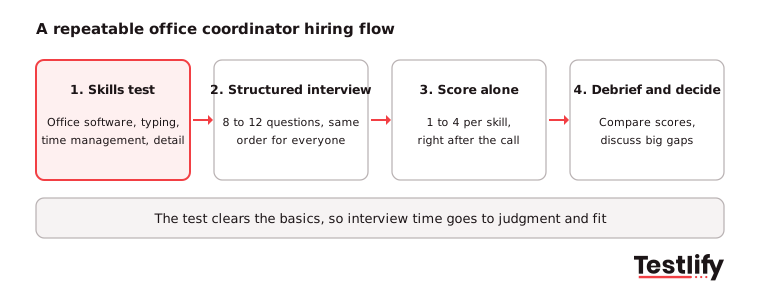
Skills tests before the interview should check what a conversation measures poorly: software skills, typing and data entry accuracy, time management and attention to detail. Testing these first takes basics off the interview, so the time goes to judgment and fit. Testlify's office coordinator test covers the core role skills in one assessment.
Skill | Test to use | Interview question it frees up |
|---|---|---|
Office software | Microsoft Office test | "Which tools have you used?" |
Typing and data entry | "How fast can you type?" | |
Time management | time management test | Basic "how do you prioritize?" |
Attention to detail | attention to detail test | "Are you detail-oriented?" |
Communication and service | communication test and customer service test | "How do you handle callers?" |
Problem-solving | problem-solving test and critical thinking test | Simple scenario questions |
For teams hiring coordinators across several offices, results sync to 100+ ATS and HRIS tools through Testlify integrations, so recruiters see scores next to each application.
Ready to hire your next office coordinator?
Screen candidates on real skills before the first call. Start a 7-day free trial of Testlify, no credit card required, and send the office coordinator test from a library of 3,500+ tests. Hiring for several offices at once? Book a demo to see the workflow on your roles.
Frequently asked questions

People and Talent Partner
Arushi Shah runs day-to-day talent acquisition and candidate experience at Testlify. She writes on interviewing, structured hiring, and giving candidates a fair, fast process.
LinkedInRelated resources
View all
HR & recruitment
Social media assistant interview questions

HR & recruitment
60 Sales Coordinator interview questions to ask job applicants

HR & recruitment
60 Office Assistant interview questions to ask job applicants

HR & recruitment
60 operations supervisor interview questions to ask in 2026

HR & recruitment
60 Financial Advisor interview questions to ask job applicants

HR & recruitment
60 Event Organizer interview questions to ask job applicants
Get started.
Hire on proof, not resumes.
Run your first skills-based assessment free — no credit card required.