
40 inventory control analyst interview questions for 2026
Interview questions for inventory control analysts on forecasting, reorder math and data tools, with sample answers, a scorecard and a test.

Good inventory control analyst interview questions make a candidate show the numbers behind a real decision: how they set a reorder point, traced a stock discrepancy to its cause, cut excess stock or explained a forecast miss to finance. This list gives you 40 questions grouped by skill, five sample answers with what to look for, a weighted scorecard and a 45-minute work sample, so every interviewer judges candidates on the same evidence.
The stakes are real. The US Census Bureau put total US business inventories at $2,818.8 billion at the end of August 2026, up 4.6% on a year earlier, with an inventories-to-sales ratio of 1.33. An analyst who sets stock levels a little too high or too low moves real money in either direction.
TL;DR / Key takeaways
- The best inventory control analyst interview questions ask for one real decision with its numbers: the reorder point, the safety stock, the discrepancy found, the excess stock cleared.
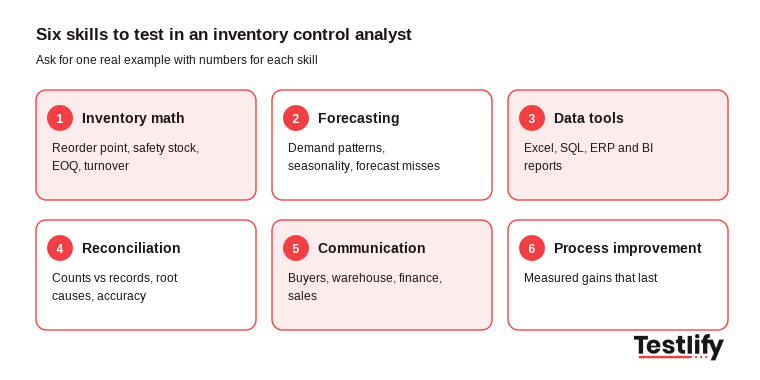
- Test six skills: inventory math, forecasting, data tools (Excel, SQL, ERP), reconciliation, cross-team communication and process improvement.
- A strong candidate can work out a reorder point out loud: average daily demand times lead time, plus safety stock. A weak one only says "I keep an eye on stock levels".
- Ask at least two Excel or SQL questions. Most of the job is pulling, cleaning and explaining data, not counting shelves.
- The role pays well above clerk level: BLS puts the median for logisticians, the closest federal category, at $82,320 in May 2025, against $45,260 for shipping, receiving and inventory clerks.
- Use a 45-minute work sample (reconcile a stock extract and recommend reorder points) and a weighted scorecard, and run a skills test before the first interview to shorten the list.
 ChatGPT
 Gemini
 Claude
 Grok
 Perplexity
What does an inventory control analyst do?
An inventory control analyst keeps stock levels right for the business by working the numbers: forecasting demand, setting reorder points and safety stock, reconciling system records with physical counts, tracking turnover and accuracy, and reporting what is tying up cash. The analyst usually sits in supply chain, operations or finance and works with procurement, the warehouse and sales.
The job differs from nearby roles in where the weight sits:
- Inventory control specialist or clerk: Runs the counts, receiving checks and adjustments on the floor. Accuracy and process discipline matter most. For that role, use our inventory control interview questions.
- Inventory control analyst: Owns the data behind the stock. Analysis, inventory math, systems and clear reporting matter most.
- Inventory planner: Plans future buys and replenishment against a forecast, often by category or supplier. See the inventory planner interview questions.
There is no separate federal category for the title. The closest is logisticians: the US Bureau of Labor Statistics counts 255,100 logistician jobs in 2025, a median pay of $82,320 in May 2025 and 18% projected growth from 2025 to 2035, with about 26,600 openings a year. Demand is strong, so a slow, unstructured interview process loses good candidates.

What are the best inventory control analyst interview questions?
The best inventory control analyst interview questions ask for a real example with a method and a number. If you only have time for ten, use these:
- Walk me through how you set the reorder point and safety stock for one item you managed.
- Tell me about the largest inventory discrepancy you found. What caused it and what did you change?
- Which inventory KPIs did you report on, and what did you do when one moved the wrong way?
- How did you reduce excess or obsolete stock, and how much did it free up?
- Describe a forecast that missed badly. How did you find out why?
- Which Excel functions and SQL queries do you use every week?
- How do you decide which items to count more often in a cycle count program?
- Tell me about a supplier delay that threatened stock. What did you do in the first 48 hours?
- How do you explain an inventory write-down to someone in finance or sales?
- What process did you improve, and how did you prove it worked?
The rest of this list goes deeper on each skill. Pick two or three questions per section so the interview stays under an hour.
What general questions should you ask an inventory control analyst?
General questions show the scale, industry and systems a candidate has worked with, which tells you how fast they will be useful in your setup.
- How many SKUs and locations did you cover in your last role, and what was the annual inventory value?
- Which industries have you worked in, and how did demand behave there (steady, seasonal, promotional, project-based)?
- Which ERP or warehouse management system did you use, and what could you do in it without IT help?
- Who did you report to, and who used your reports?
- What does a normal week look like for you: which reports, which meetings, which checks?
- What would you want to learn in your first 30 days before changing any reorder settings?
Which technical questions test inventory math?
Technical questions check that the candidate can do the core calculations, not just name them. Ask them to talk through the math with a simple example. The table gives you what a correct answer contains.
- How do you calculate a reorder point?
- How do you set safety stock for an item with unsteady demand?
- What is economic order quantity, and when would you not use it?
- How do you calculate inventory turnover and days of inventory on hand?
- How would you run an ABC analysis on 5,000 SKUs?
- How do you measure inventory record accuracy?
- When would you use FIFO, LIFO or weighted average cost, and how does the choice affect reported margin?
Question | What a correct answer contains | Example you can check |
|---|---|---|
Reorder point | Average daily demand x lead time in days, plus safety stock | 40 units a day x 10 days + 120 safety stock = reorder at 520 |
Safety stock | Service level factor x demand variability x square root of lead time; more stock for critical or volatile items | 1.65 (95% service) x 12 units x 3 (square root of 9 days) = about 60 units |
Economic order quantity | Square root of (2 x annual demand x order cost / holding cost per unit); not for items with minimums, price breaks or short shelf life | Square root of (2 x 12,000 x $50 / $3) = about 632 units |
Inventory turnover | Cost of goods sold / average inventory value; days on hand = 365 / turns | $6M / $1.5M = 4 turns, about 91 days on hand |
ABC analysis | Rank SKUs by annual usage value; a small share of A items usually carries most of the value; count and review A items most often | A items counted monthly, C items once or twice a year |
Record accuracy | Locations or SKUs where the system matches the count / all counted, with a tolerance per class | 1,940 of 2,000 counted locations match = 97% |
Pro tip: Give the numbers on paper and ask the candidate to work the reorder point out loud. You learn more from how they handle the lead time and the safety stock than from any definition.
What Excel, SQL and system questions should you ask?
Excel, SQL and system questions matter because most of an inventory control analyst's day is spent pulling, cleaning and explaining data. For the wider logistics analyst family, O*NET lists SQL, Microsoft Access, SQL Server, Power BI, Tableau and VBA among the tools used.
- How would you match a system stock report against a count file with 20,000 rows in Excel? Which functions would you use?
- How do you build a pivot that shows stock value by category, location and age?
- Write or describe a SQL query that finds items with stock on hand but no sales in 180 days.
- How do you check that the data you pulled is complete before you report on it?
- Which inventory reports or dashboards did you build, and who used them?
- What setting in your ERP did you change that improved stock levels, and how did you test it first?
A strong answer names exact functions (XLOOKUP or INDEX MATCH, SUMIFS, pivot tables, Power Query) and a join on item and location in SQL. A weak answer says "I am very good at Excel" without an example. If the role is data heavy, test this before the interview with an Excel skills test and a SQL test.
Which behavioral questions reveal how an inventory control analyst works?
Behavioral questions ask for past situations, so the candidate has to show what they did, not what they would do. Ask for the situation, the action and the result with a number, and probe with "what did you check first?" and "what changed afterwards?".
- Tell me about a time you found a large gap between system stock and the physical count. How did you find the root cause?
- Describe a stockout that hit customers or production. What did you do, and what did you change so it did not happen again?
- Tell me about a time you had to clear excess or obsolete stock. How did you decide what to sell, return, rework or write off?
- Describe a sudden demand spike. How did you adjust reorder settings and allocation?
- Tell me about a supplier delay or disruption. How did you protect the most important items?
- Describe a decision you made with incomplete data. How did you limit the risk?
- Tell me about a mistake you made in a report or a setting. How did you catch it and fix it?
For a consistent way to run these, see our guide to the structured interview.
What questions show how a candidate works with other teams?
Cross-team questions matter because an inventory control analyst only changes stock levels through other people: buyers, warehouse leads, finance and sales.
- How do you get a buyer to change an order quantity when they disagree with your numbers?
- How do you explain an inventory write-down to finance or to a sales director?
- Tell me about a time sales promised stock you did not have. What happened next?
- How do you work with the warehouse team on cycle counts without slowing down picking?
What do strong answers to inventory control analyst interview questions sound like?
Strong answers name the method, the data used and a measured result. Use these five sample answers as a guide to the level you want, not as a script.
Reorder point and safety stock (question 1):
Sample answer: "For a fast-moving spare part we sold about 40 a day with a 10-day supplier lead time. I set safety stock from six months of daily demand variation at a 95% service level, which came to about 120 units, so the reorder point was 520. After two stockouts in a quarter I found the real lead time was closer to 14 days, so I updated it in the ERP and the stockouts stopped."
Look for: the formula, real inputs, and a check against what actually happened.
Large discrepancy (question 2):
Sample answer: "Cycle counts showed a 6% gap on one aisle. I compared transaction logs and found returns were being received into stock before inspection, and half of them were later scrapped without an adjustment. We moved returns to a hold location and added a daily check. Accuracy on that aisle went from 94% to 99% in two months."
Look for: a root cause rather than a recount, a process fix and a number before and after.
Excess and obsolete stock (question 4):
Sample answer: "I ran an aging report and found $400,000 of stock with no movement in 12 months. With the buyers we returned what suppliers would take, bundled some items for sales, and wrote off the rest with finance. Then I added an aging flag to the monthly report so it did not build up again."
Look for: an aging or ABC view, work with buyers and finance, and a step that stops it happening again.
Data tools (question 26):
Sample answer: "I would join the stock on hand table to the sales lines on item and location, filter sales in the last 180 days, and return items where the quantity on hand is above zero and the last sale date is empty or older than 180 days. I would then add the unit cost so the list is sorted by value."
Look for: a correct join, the date filter, and a link to business value.
Communication (question 38):
Sample answer: "I start with the number and why it happened: $85,000 of a discontinued range we could not sell. Then I show what we recover, what the write-down costs this quarter and what we changed in the buying rules. I keep it to one page with one chart."
Look for: plain language, a clear cause and a next step.
How should you score an inventory control analyst interview?
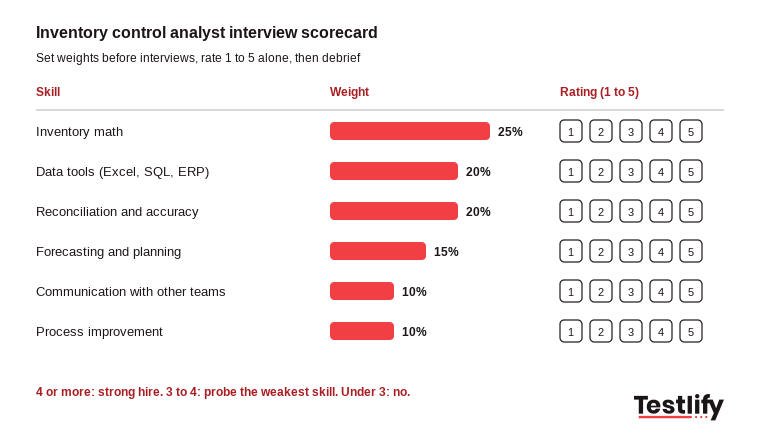
Score each candidate on the same skills, with weights set before the first interview. Each interviewer rates alone, 1 to 5 per skill, before the debrief, so one loud opinion does not decide the hire.
Skill | Weight | What a 5 looks like |
|---|---|---|
Inventory math (reorder point, safety stock, turnover) | 25% | Works the numbers out loud with correct inputs |
Data tools (Excel, SQL, ERP) | 20% | Names exact functions and queries, built reports others used |
Reconciliation and accuracy | 20% | Finds root causes, shows accuracy before and after |
Forecasting and planning | 15% | Explains a forecast miss and what changed |
Communication with other teams | 10% | Explains numbers simply, changes decisions through others |
Process improvement | 10% | Shows a measured gain and how it was kept |
A weighted score of 4 or more is a strong hire, 3 to 4 needs a second look at the weakest skill, and under 3 is a no. For a full template, read our guide to the interview scorecard.
What work sample should you use for an inventory control analyst?
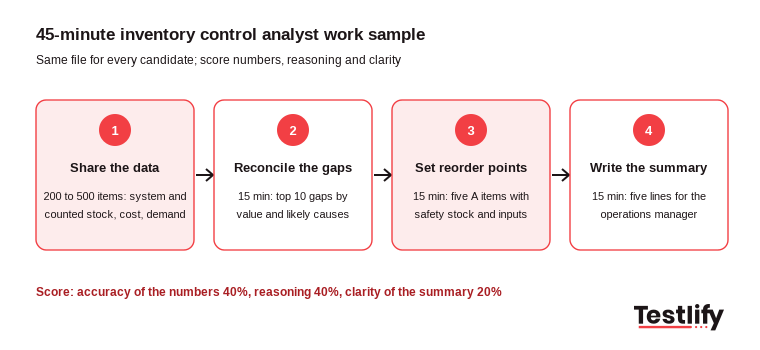
A short work sample shows how a candidate handles real data. Keep it to 45 minutes and use a cleaned extract of your own data or a made-up set of the same shape.
- The data: A stock file with 200 to 500 items: system quantity, counted quantity, unit cost, last 12 months of demand and supplier lead time.
- Task 1 (15 minutes): Reconcile system and counted stock, list the 10 biggest gaps by value and suggest likely causes.
- Task 2 (15 minutes): Set reorder points and safety stock for five A items and explain the inputs.
- Task 3 (15 minutes): Write a five-line summary for the operations manager: what is wrong, what it costs, what to do first.
Score it on the accuracy of the numbers (40%), the reasoning behind each recommendation (40%) and how clear the summary is (20%). Use the same file for every candidate.
What red flags should you watch for?
Red flags in inventory control analyst interviews usually show up as answers with no numbers or no ownership.
- No numbers: The candidate describes "monitoring stock" but cannot give an accuracy rate, a turnover figure or a value.
- Recount as the only fix: Every discrepancy story ends with a recount, never a root cause.
- Tool claims without detail: "Advanced Excel" with no functions named, or an ERP they cannot describe.
- Blame: Stockouts and write-downs are always the buyer's or the warehouse's fault.
- No check after a change: They changed reorder settings but never checked whether stockouts or stock value moved.
Key takeaway: A candidate who can show the formula, the data and the result for one real decision is a better hire than one who knows every term.
How do skills tests help you hire an inventory control analyst?
Skills tests check inventory knowledge and data skills before the interview, so you spend interview time only on candidates who can do the work. Testlify has 3,500+ tests, and these fit the role:
- Inventory management test for stock control methods, reorder logic and accuracy.
- Supply chain management test for planning and supplier knowledge.
- Advanced Excel test and the data analysis test for the daily data work.
- Numerical reasoning test and the attention to detail test for accuracy under time pressure.
Testlify scores every response automatically and gives a per-skill breakdown, and you can add your own questions, including file upload and Excel tasks, from 25+ question types. Results sync with 100+ ATS and HRIS tools, including Workday, Greenhouse and SAP SuccessFactors, so recruiters do not copy scores by hand. For related roles, see the supply chain analyst interview questions.
Ready to hire your next inventory control analyst?
Pick two or three tests from the Testlify test library, send them before the first interview and use the questions above to go deeper with the shortlist. You can start a 7-day free trial with no credit card, or book a demo to see how a test and interview plan would work for your team.
Frequently asked questions

Wordpress Developer
Yash Patel is a Wordpress and SEO Specialist at Testlify with 3+ years of experience in technical SEO, on-page optimization, and content strategy. He works on improving Testlify's organic presence and produces content focused on hiring, talent assessment, and HR technology.
LinkedInRelated resources
View all
HR & recruitment
60 Freight Forwarder interview questions to ask job applicants

HR & recruitment
60 Transportation Coordinator interview questions to ask job applicants

HR & recruitment
60 Operations Analyst interview questions to ask job applicants

HR & recruitment
60 Inventory Planner interview questions to ask job applicants

HR & recruitment
50 retail store manager interview questions to ask in 2027

HR & recruitment
50 public relations manager interview questions to ask in 2026
Get started.
Hire on proof, not resumes.
Run your first skills-based assessment free — no credit card required.