
Testlify vs HR Avatar: A detailed comparison
Discover the perfect solution for evaluating your candidates’ skills with Testlify. Dive into our comprehensive Testlify vs HR Avatar…
 ChatGPT
 Gemini
 Claude
 Grok
Grok Perplexity
Testlify vs HR Avatar at a glance
Testlify and HR Avatar both screen candidates before anyone books an interview, but they bet on different evidence. HR Avatar leads with animated day-in-the-life simulations built for more than 200 job titles. Testlify leads with a broad test library, coding assessments, proctoring controls and ATS integrations, so the assessment sits inside the hiring workflow rather than beside it.
- HR Avatar sells candidate credits in packs, from $50 for one credit to $12,300 for 500. The per-candidate cost falls from $50 to about $24.60 at the top pack.
- HR Avatar covers cognitive ability, personality, emotional intelligence, knowledge, AI-scored writing and simulated job tasks. It does not run coding tests.
- Testlify covers the same non-technical ground and adds programming tests across 45 plus languages, custom coding questions, white labelling and candidate pipeline tools.
- Simulation depth is HR Avatar's strength. Breadth of role coverage plus workflow fit is Testlify's.
- Neither tool should be the only signal you hire on. That is the part most buyers get wrong.

What makes Testlify different from HR Avatar?
Three things, and only one of them is a feature list. First, coverage: Testlify runs technical and non-technical hiring from the same library, so a company hiring a warehouse supervisor and a backend engineer in the same quarter does not need two vendors. HR Avatar has no coding assessment at all.
Second, where the assessment lives. Testlify pushes results into the applicant tracking system, invites candidates in bulk, and lets a hiring team score together with shared reports. That matters more than it sounds. A test that produces a good score and then makes someone copy it into another system by hand is a test people quietly stop running.
Third, control over the candidate's experience. White labelling, custom domains, branded emails and 24/7 candidate support keep the process looking like your company rather than a vendor's. For an employer brand you have spent years building, that is not cosmetic.
HR Avatar's counter-argument is real, though. Its simulations put candidates inside an animated version of the job and score what they do there. That is a genuinely different kind of evidence from a multiple-choice test, and for some frontline roles it is the better one.
What does HR Avatar actually test?
HR Avatar measures cognitive ability, knowledge and skills, personality factors, emotional intelligence, past behaviour, writing ability scored by AI, and performance on simulated job tasks. Each assessment is built for a specific job title rather than assembled from generic modules, and the platform publishes ready-made tests for more than 200 roles.
The competency model behind those tests comes from the O*NET occupational database, the US Department of Labor's public catalogue of what jobs require. That is a defensible starting point. O*NET is built from surveys of people who actually do the work, so a competency profile derived from it is not one vendor's opinion about what a claims adjuster needs.
The limit is the same as the strength. A profile built for a job title is a profile for the average version of that title. Your customer support role at a 40-person fintech and a customer support role at a national insurer share a name and very little else. If the profile fits, you get a strong test off the shelf. If it does not, you are editing around someone else's model of the job.
How do HR Avatar simulations work?
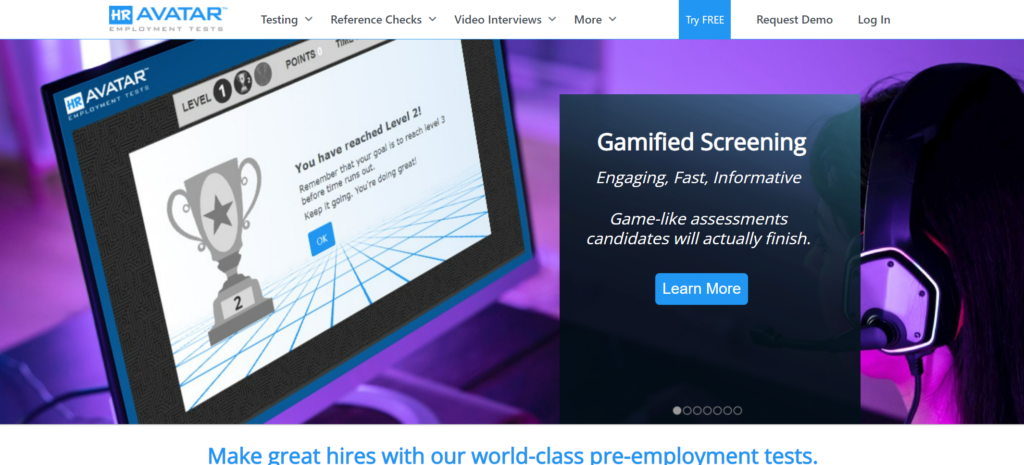
A candidate starts inside a short animated scene that mimics the workplace for the role, then responds to situations as they come up. Their choices are scored in real time against the competencies the role profile says matter. Alongside the simulation, HR Avatar can run video interviews with AI scoring, typing and data entry tests, Microsoft Office skills checks, language tests in more than a dozen languages, and automated reference checks through a multi-rater survey.
Remote proctoring is included on every plan, which is worth noting for a credit-based product: you are not paying extra per candidate for basic test security.
Candidates tend to describe the simulations as time-pressured. That cuts both ways. Time pressure is realistic for a contact centre or a dispatch role, and it is a poor proxy for a job where the valuable thinking is slow and careful. Match the format to the work, not to what demos well.
Feature-wise comparison for Testlify vs HR Avatar
The table below compares the two platforms on test coverage, assessment building, candidate experience, test security, reporting and enterprise controls. It reflects publicly documented features as of August 2026. Vendor feature sets move, so confirm the rows that will decide your purchase before you sign anything.
Features | Testlify | HR Avatar |
|---|---|---|
Test Library | ||
Role-specific tests | Yes | Yes, 200+ job titles |
Cognitive ability tests | Yes | Yes |
Programming tests | Yes | No |
Programming languages supported | 45+ | Not offered |
Situational judgment tests | Yes | Yes |
Animated job simulations | Role simulations and work-sample tasks | Yes, day-in-the-life format |
Typing test | Yes | Yes |
Software skills tests | Yes | Yes |
Non-technical tests | Yes | Yes |
Psychometric tests | Yes | Personality and emotional intelligence |
Personality tests | Yes | Yes |
Motivation test | Yes | Not documented |
Assessment templates | Yes | Ready-made role tests |
Custom assessments creation | Yes | Yes |
Test recommendations for job roles | Yes | Yes |
Coding tests | Yes | No |
Assessments | ||
Custom assessment builder | Yes | Yes |
Custom coding questions | Yes | No |
Multiple-choice questions | Yes | Yes |
Descriptive questions | Yes | Yes, writing scored by AI |
Video interview questions | Yes | Yes |
Assessments curated by I/O psychologists | Yes | O*NET-derived competency models |
Google Docs task | Yes | No |
Google Sheets task | Yes | No |
Google Slides task | Yes | No |
Microsoft Office skills tasks | Yes | Yes |
Audio questions | Yes | Not documented |
Qualifier questions | Yes | Yes |
File upload questions | Yes | Not documented |
Quality check | Peer reviews, sample testing and psychometrician review | O*NET-based job analysis |
Video interview questions | ||
One-way video interview | Yes | Yes |
Custom video questions creation | Yes | Yes |
Recording attempts per question | Yes | Yes |
Live video interview | No | Yes |
AI scoring of interview responses | Yes | Yes |
Automated reference checks | Yes | Yes, multi-rater survey |
Candidate experience | ||
Fully customizable email templates | Yes | Not documented |
Custom invitation and rejection email | Yes | Yes |
Mobile-friendly | Yes | Yes |
Candidate support | Yes, 24/7 | Not documented |
Instructions before assessment | Yes | Yes |
Average assessment length | 40 to 60 minutes | Varies by role profile |
Anti-cheating features | ||
Remote proctoring | Yes | Yes, included on all plans |
Session recording | Yes | Not documented |
Snapshot capturing | Yes | Yes |
Mouse tracking | Yes | Not documented |
Copy-paste disabled | Yes | Not documented |
Microphone and camera access | Yes | Yes |
Location access | Yes | Not documented |
IP address tracking | Yes | Not documented |
Randomization of question sequence | Yes | Not documented |
Reporting and analytics | ||
Detailed reports | Yes | Yes |
Easy to share reports and scorecards | Yes | Not documented |
Exportable reports | Yes | Yes |
Recruiting analytics | Yes | Not documented |
Candidate benchmarking | Yes | Yes |
Completion rate and response insights | Yes | Not documented |
Enterprise friendly | ||
White label feature | Yes | No |
Custom branding | Yes | Limited |
ATS integration | Yes, direct integrations and API | Via partner marketplaces |
User, role, and access management | Yes | Yes |
Bulk candidate invite | Yes | Not documented |
Public link invite to candidates | Yes | Not documented |
Candidate pipeline management | Yes | Not documented |
Multilingual assessments | Yes | Yes, 12+ languages |
Campus hiring support | Yes | Not documented |
Dedicated account manager | Yes | Not documented |
GDPR compliant | Yes | Yes |
Customer support | ||
24/7 support | Yes | No |
On-call support | Yes | Yes |
Email support | Yes | Yes |
Product demo | Yes | Yes |
Training and onboarding | Yes | Yes |
How much do Testlify and HR Avatar cost?
HR Avatar charges per candidate credit, bought up front in packs. Testlify prices by plan, with assessments included rather than metered per person. That single difference changes which tool is cheaper more than any feature on the table above does.
HR Avatar pricing
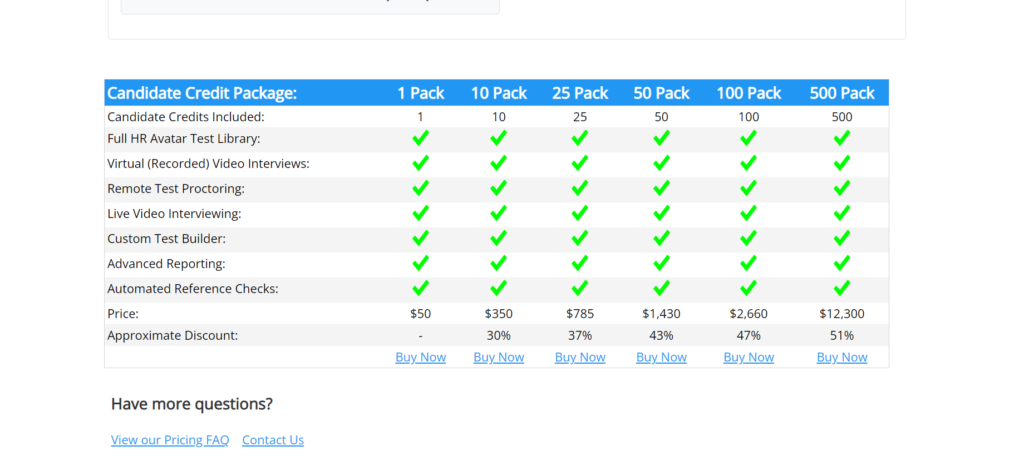
HR Avatar sells six pack sizes, each a one-time purchase of candidate credits:
- 1 credit: $50, which works out to $50 per candidate
- 10 credits: $350, or $35 per candidate
- 25 credits: $785, or $31.40 per candidate
- 50 credits: $1,430, or $28.60 per candidate
- 100 credits: $2,660, or $26.60 per candidate
- 500 credits: $12,300, or $24.60 per candidate
Do the arithmetic against your funnel before the demo. A team screening 40 candidates a month is looking at roughly $12,800 a year at the 100-pack rate. The same volume on a plan-based tool is usually a fixed subscription, so the marginal cost of assessing one more candidate is zero. Testlify's plans and pricing page lists the current tiers.
Per-candidate pricing has one honest advantage worth naming: it is predictable when hiring is lumpy. If you hire nine people a year in bursts, credits you bought in March are still there in October, and you are not paying for months when nobody applied. Low-volume, seasonal hiring is where credit pricing genuinely wins.
The trap is the other direction. Per-candidate cost makes teams ration assessments, so the test gets used only on the shortlist that resumes already produced. That defeats the point. Screening on skills works because it happens early and to everyone, not because it confirms a decision a recruiter already made.
When is HR Avatar the better choice?
When the role is one of the 200 plus titles HR Avatar has built a profile for, the work is operational and observable, and you want a candidate to demonstrate judgment inside a scene rather than answer questions about it. Contact centre, dispatch, retail supervision, claims handling: the animated format earns its keep there.
It also fits a team with no assessment programme and no appetite to build one. Buy a 10-pack, run the ready-made test for the role, read the report. Nobody has to design anything.
Two situations where it is the wrong tool. Technical hiring is the obvious one, because there is no coding assessment to run. The less obvious one is high-volume hiring where the assessment needs to sit inside an existing tracking system: paying per credit and moving results by hand does not survive contact with 300 applicants a week.
Does one simulation predict job performance?
Not on its own, and this is where buyers overreach. A 2022 reanalysis of decades of personnel selection research, published in the Journal of Applied Psychology, found that many long-quoted validity figures had been inflated by an earlier statistical correction and revised them downward. Structured, job-relevant methods held up best. Even those are one signal.
That reanalysis reopened a question the field had treated as settled since a widely cited 1998 summary of 85 years of selection research. The exact corrected coefficients are still argued over in print. The shape of the finding has survived every pass: methods that observe job-relevant behaviour rank near the top, broad proxies rank lower than the field believed, and no single method carries a hiring decision by itself.
The practical version of that finding is the Testlify Multi-Signal Talent Evaluation Model: combine several role-relevant signals, such as a skills assessment, a work sample or simulation, a structured interview and reviewer feedback, and advance the candidate when those signals agree. One signal is fragile. Several pointing the same way is confidence. AI can summarise and structure the evidence; the hiring team still makes the call.
Applied to this comparison, that reframes the question. A simulation is a strong second signal next to a role-skills test, and a weak sole signal. Whichever platform you pick, plan for at least two.
What about compliance and adverse impact?
Any tool that scores candidates automatically is a selection procedure, and US employers work against the Uniform Guidelines on Employee Selection Procedures. Its four-fifths rule is the usual first check on whether a tool is selecting groups at meaningfully different rates. Two caveats travel with it. The threshold is an enforcement rule of thumb agencies use to decide where to look, not a legal definition of discrimination. Clearing it does not make a tool lawful, and missing it does not make it unlawful.
Local rules stack on top. New York City's Local Law 144 requires an annual independent bias audit of automated employment decision tools, plus notice to candidates, for hiring in the city. Both platforms score candidates with AI in at least one place, HR Avatar for written responses and interview scoring, so this applies to either choice.
Pro tip: ask any assessment vendor for two documents before you buy. The validity evidence for the specific tests you plan to run, and their most recent adverse-impact analysis by group. A vendor who produces both quickly has done the work. A vendor who sends a general fairness statement instead has told you something useful too.
Which tool fits your hiring process?
Pick HR Avatar if your hiring is concentrated in operational roles it already profiles, volume is low or seasonal, and a ready-made simulation beats a configured assessment for your team.
Pick Testlify if you hire across technical and non-technical roles, want assessments running inside your tracking system, need branded candidate-facing screens, or expect volume to grow past the point where per-candidate pricing stays sensible. If you are still building a shortlist of vendors, it is worth reading how the wider market compares on talent assessment tools worth shortlisting, and the HR Avatar alternatives breakdown covers the same ground from the switching side.
One test before you commit, and it costs nothing. Take the role you hire most often, write down the three things a person must be able to do in the first 90 days, then ask each vendor to show you exactly which score maps to each of those three. If the mapping is obvious, the tool fits the job. If it takes a sales engineer ten minutes to explain, it does not.
Try Testlify on your next role
Run one open role through a Testlify assessment before the first interview and compare the shortlist you get against the one your resume screen produced. It takes a single hiring cycle to see the difference. You can start free, or book a demo and have someone map the tests to the role with you.
Key takeaways
- The two platforms sell different evidence. HR Avatar sells simulation depth on more than 200 pre-built job titles, Testlify sells breadth across technical and non-technical roles plus workflow fit. Decide which one your hiring mix actually needs before you compare feature grids, because the grid will not answer it.
- Pricing model matters more than price. Credits at $50 down to $24.60 per candidate reward low, lumpy hiring volume and punish testing everyone early. A plan-based subscription makes the marginal assessment free, which is what lets a team screen on skills before the resume filter runs.
- No coding assessment is a hard boundary, not a gap to work around. If engineers, data or IT roles appear in your plan for the next year, HR Avatar cannot cover them and you will end up buying a second tool anyway.
- One score does not carry a hiring decision. The 2022 revision of personnel selection research pushed long-quoted validity figures down and left structured, job-relevant methods on top. Plan for at least two signals per role, whichever vendor you choose.
- Automated scoring brings compliance duties with it. The Uniform Guidelines apply to both tools, New York City's Local Law 144 adds an annual bias audit for hiring in the city, and the vendor who can hand you validity evidence and an adverse-impact analysis on request has already done the work you would otherwise inherit.
- Test the mapping, not the demo. Name the three things a new hire must do in their first 90 days and make each vendor point at the score that predicts each one. That five-minute exercise separates a tool that fits your roles from one that fits a category.
FAQs
Related resources
View all
Competitor Comparisons
Testlify vs ModernHire: A detailed comparison
Competitor Comparisons
Testlify vs Wonderlic: A detailed comparison
Competitor Comparisons
Testlify vs Thomas International: A detailed comparison
Competitor Comparisons
Testlify vs Indeed Hiring Platform: A detailed comparison
Competitor Comparisons
Testlify vs HireQuotient: A detailed comparison
Competitor Comparisons
Testlify vs Testwise: Comparison guide for recruiters
Get started.
Hire on proof, not resumes.
Run your first skills-based assessment free — no credit card required.