
Volunteer Time Off (VTO)
Volunteer time off (VTO) is paid time an employer gives staff to volunteer for a charity, school or community cause during work hours.
 ChatGPT
 Gemini
 Claude
 Grok
 Perplexity
Volunteer time off (VTO) is a paid employee benefit that lets staff spend a set number of work hours volunteering for a charity, school or community cause while still receiving their normal pay. Employers choose how many hours to offer, who qualifies and which activities count, and they track VTO in a separate bank from vacation and sick leave.
Why does volunteer time off matter for enterprise HR?
Volunteer time off matters for enterprise HR because it is a low-cost benefit that gives employees a reason to stay and gives candidates a concrete reason to join. A paid day of volunteering costs one day of salary per person who uses it, and many employees never use the full allowance, so the real spend is often lower than the budget line.
The benefit is still far from universal. According to SHRM's April 2025 report, the share of employers offering paid time off for volunteering has crept up over recent years and reached 28% in 2024, based on its Employee Benefits Survey. Data from the same survey shows 49% of employers run community volunteer programs as a benefit, which means many companies organise volunteering but do not pay people to take part. That gap is the opening for a clear VTO policy.
Three reasons the term deserves a clear definition in your benefits handbook:
- It supports retention: VTO gives people a sense of purpose at work and builds ties across teams, which feeds into your wider employee retention plan.
- It strengthens the employer brand: A named, paid benefit is easier to promote in job ads than a vague promise to "give back", and it fits naturally into your employee value proposition (EVP).
- It links people to company goals: VTO is often the most visible part of a corporate social responsibility (CSR) program, because employees deliver the impact themselves.
What are the core components of a volunteer time off policy?
A volunteer time off policy has six core components: the allowance, eligibility, qualifying causes, excluded activities, the request process and tracking. Getting each one down in writing stops managers from making up the rules case by case.
Allowance
The allowance is the number of paid VTO hours or days each employee gets per year. Published policies commonly range from one day to a full week, and the guides we reviewed for this page quoted ranges from 8 to 80 hours a year. State whether hours reset each year, whether unused hours roll over (most policies say no) and whether staff can take VTO in half days.
Eligibility
Eligibility sets who can use VTO and from when. Decide whether part-time staff get a pro rata allowance, whether new hires must finish probation first and whether contractors are excluded. Tie the rules to the same groups used for your other employee benefits so the policy stays consistent.
Qualifying causes
Qualifying causes are the organisations and activities that count. Most employers accept registered charities, public schools, food banks, shelters and disaster relief. Some add skills-based volunteering, such as an accountant helping a nonprofit with its books, or civic work such as serving as a poll worker.
Excluded activities
Excluded activities are the ones VTO does not cover. Common exclusions are campaigning for a political party or candidate, religious worship (as opposed to a faith group's food bank), and personal favours. Many policies also exclude coaching your own child's sports team or attending a school meeting as a parent, since those are family time rather than volunteering.
Request and approval
The request process covers notice, sign-off and proof. A typical rule is two weeks' notice, manager approval based on workload, and a short confirmation from the organisation afterwards. Keep it light: a slow or heavy process is the fastest way to kill uptake.
Tracking
Tracking means recording VTO in its own bank in your HRIS or leave management tool. A separate bank shows uptake by team and keeps VTO from quietly eating into vacation balances.
Allowance model | Example | Good fit for |
|---|---|---|
Hours per year | 16 paid hours, usable in 2-hour blocks | Shift-based or hourly teams |
Days per year | 2 paid days a year | Office and hybrid teams |
Company volunteer day | 1 shared day, organised by the company | Teams starting their first program |
Tiered by tenure | 1 day in year one, 3 days after year three | Retention-focused programs |
Key takeaway: The allowance gets the attention, but eligibility and exclusions prevent most disputes. Write them down before the first request arrives.
How do you set up a volunteer time off program?
Setting up a volunteer time off program takes six steps, from setting the goal to reporting results.
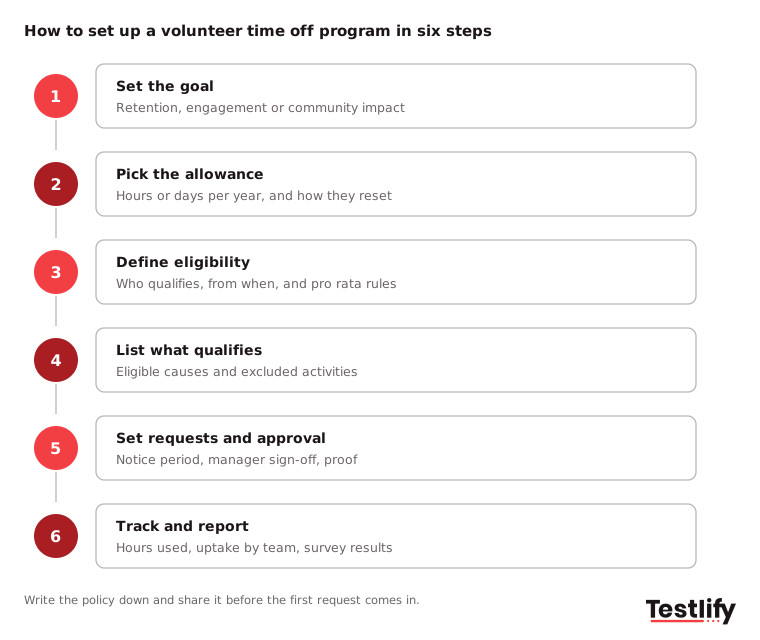
- Set the goal: Decide whether VTO is mainly for retention, engagement, community impact or employer brand. The goal decides what you measure later.
- Set the allowance and budget: Pick hours or days per year, and estimate cost as average daily pay multiplied by expected uptake, not by headcount.
- Define eligibility: Match it to your benefits groups, decide on pro rata rules for part-time staff and set any waiting period.
- List what qualifies and what does not: Name eligible causes and the excluded activities above. Keep the rules neutral so no cause is favoured or blocked for its views.
- Set the request and approval flow: Add VTO as a leave type in your HRIS, set the notice period and make clear that managers can only refuse for workload reasons.
- Launch, track and report: Announce the policy, organise a first company volunteer day to build habit, and report hours used and uptake by team every quarter.
US employers also need to check pay rules before launch. Under the federal rule on civic and charitable work (29 CFR 785.44), time spent on charitable work at the employer's request, under its direction or control, or while the employee must be on the premises is working time. Time spent volunteering on the employee's own initiative outside normal hours is not.
In practice, a Saturday volunteer event the company organises and expects people to attend can count as hours worked for non-exempt staff, and those hours count toward overtime.
Public employers have extra rules. MRSC, a Washington State local government research body, reports that paid volunteer leave in local government must be checked against gift-of-public-funds limits and should keep eligibility rules content and viewpoint neutral, with campaign work excluded (February 2025).
Pro tip: Make VTO a separate leave type in your HRIS from day one. Adding it later means cleaning up months of volunteer hours logged as vacation or "other".
What is the difference between volunteer time off, voluntary time off and PTO?
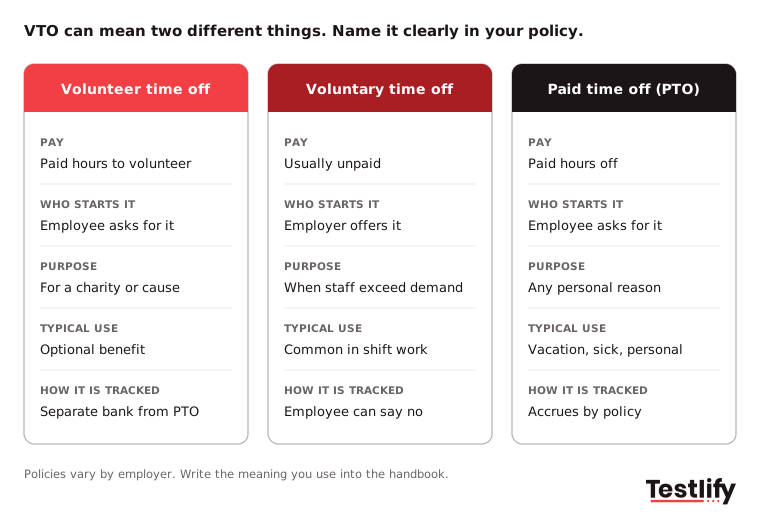
Volunteer time off is paid time to volunteer, voluntary time off is usually unpaid time an employer offers when work is slow, and PTO is paid time for any personal reason. The three are easy to mix up, especially because the first two share the same short form. Use the full name in your handbook and job ads. VTO is also the name of a planning document in the Entrepreneurial Operating System (EOS), so spell it out whenever leaders from different teams are in the room.
Factor | Volunteer time off | Voluntary time off | Paid time off (PTO) |
|---|---|---|---|
Paid? | Yes | Usually no | Yes |
Who starts it | Employee requests it | Employer offers it | Employee requests it |
Purpose | Volunteering for a cause | Cutting hours when staff exceed demand | Rest, illness or personal reasons |
Common in | Office and corporate roles | Warehouses, call centres, retail | All sectors |
Tracked as | Separate VTO bank | Unpaid hours | PTO bank |
PTO itself also overlaps with related leave types such as a floating holiday or a sabbatical leave. Volunteer time off sits apart from both because it is tied to a purpose, not to the calendar or tenure alone.
What are the best practices for volunteer time off?
Volunteer time off works best when the rules are short, fair and visible. These practices keep a VTO program used, fair and easy to run:
- Keep the request process short: Two weeks' notice and one approval is enough. Every extra form lowers uptake.
- Let employees pick causes within clear rules: Choice makes people more likely to use the benefit, while the excluded list protects the company.
- Organise group events as well as individual time: A team volunteer day builds the habit and gives new hires an easy first step.
- Include frontline and shift workers: Offer hours in smaller blocks so people on rotas can use VTO without leaving a shift uncovered.
- Report results to leadership: Share hours used, uptake by team and engagement survey scores, so the benefit keeps its budget.
- Mention VTO in hiring content: Name the allowance in job ads and on the careers page so candidates can weigh it against other offers.
A benefit like VTO tells candidates what a company values, and the hiring process should check for a match from the other side. Teams that hire for values and collaboration, not just experience, often pair structured interviews with skills and behaviour tests, such as Testlify's teamwork test. For more on balancing the two signals, see culture fit vs skill fit. The broader idea of giving time to a cause is covered in our glossary entry on volunteerism.
Frequently asked questions
Volunteer time off is paid time an employer gives staff to volunteer for a charity, school or community cause during work hours. The employer sets the allowance, eligibility and qualifying activities in a written VTO policy.
Cite this page
Copy a ready-made citation for this page in your preferred style.
- APA
Testlify. (2026). Volunteer Time Off (VTO). https://testlify.com/hr-glossary/volunteer-time-off/
- MLA
"Volunteer Time Off (VTO)." Testlify, 28 October 2026, https://testlify.com/hr-glossary/volunteer-time-off/.
- Chicago
Testlify. "Volunteer Time Off (VTO)." Testlify. Last modified October 28, 2026. https://testlify.com/hr-glossary/volunteer-time-off/.
- HTML link
<a href="https://testlify.com/hr-glossary/volunteer-time-off/">Volunteer Time Off (VTO)</a>, Testlify (2026)
Related terms
Voting Leave
Voting leave is time off work, paid or unpaid, that lets employees vote in public elections when their shift leaves too little free time.
W-2
W-2 forms are official documentation of an employee’s wages and taxes withheld, used for accurate tax reporting and simplifying the tax filing process, but can be costly, time-consuming, and vulnerable to identity theft.
W-4
W-4 form is used by employees to indicate their tax withholding status to their employer, by providing information such as their filing status and number of dependents, which the employer uses to determine how much money to withhold from the employee’s paycheck for federal income taxes.
Wage Drift
Wage Drift refers to the gradual increase in wages over time due to inflation and other factors, rather than formal negotiations or agreements.
Wellbeing
Wellbeing is a holistic concept that encompasses physical, mental, emotional, and social well-being, it is an overall sense of contentment and satisfaction with life.
Wellness Program
A Wellness Program is an organized approach to promoting health and well-being in the workplace, typically including health screenings, education, exercise programs, stress management, nutrition, and other resources.
Get started.
Hire on proof, not resumes.
Run your first skills-based assessment free — no credit card required.