
Voting Leave
Voting leave is time off work, paid or unpaid, that lets employees vote in public elections when their shift leaves too little free time.
 ChatGPT
 Gemini
 Claude
 Grok
 Perplexity
Voting leave is time off work that an employer gives an employee so they can vote in a public election. In the US, no federal law requires it for private employers, so state law sets the rules: whether the time is paid, how many hours apply, how much notice the employee gives, and whether the employer must post a notice.
Why does voting leave matter for enterprise HR?
Voting leave matters because most US employers with staff in several states are covered by at least one voting leave law, and each law works differently. According to Mercer's October 2026 review of 52 jurisdictions (the 50 states, Washington D.C. and Puerto Rico), 30 require some time off to vote and 23 of those require it to be paid. The other 22 have no voting leave requirement.
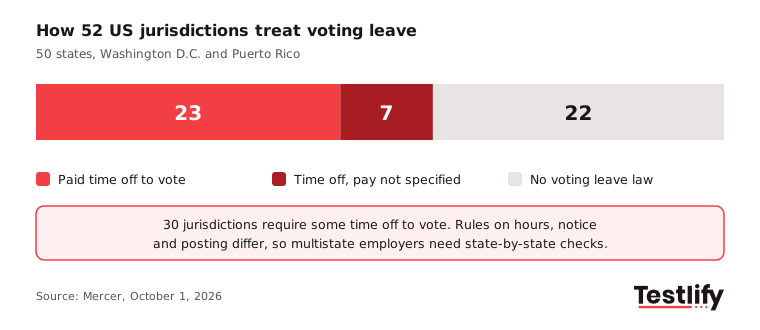
The risk is not only a missed paycheck. Several states treat a refusal as a crime. Mercer lists criminal penalties in Missouri, South Dakota, Texas and Utah, and a fine of $50 to $250 in Arkansas. Even states without a leave law can punish employers who pressure staff over how or whether they vote: Florida makes threats to control an employee's vote a crime, and Mississippi sets a $250 fine for interfering with employees' political rights.
Voting leave also lands on the busiest operational days. Shift-based teams in healthcare, contact centers, retail and manufacturing need cover planned ahead, which is why voting leave sits with leave management and scheduling, not only with legal.
What are the types of voting leave laws?
Voting leave laws fall into a few types, and one state law often combines several of them. The useful way to read any state rule is to ask five questions: is the time paid, how many hours, when does an exemption apply, what notice is needed, and must the employer post a notice.
Paid voting leave
Paid voting leave laws require the employer to pay for a set number of hours, usually up to 2 or 3. California allows up to two hours without loss of pay when an employee does not have enough time to vote outside work, as the California Secretary of State reminded voters in May 2026.
Unpaid or pay-unspecified leave
Some states require the time off but do not require pay, or the statute is silent on pay. Mercer lists seven of these: Alabama, Arkansas, Georgia, Kentucky, Massachusetts, Ohio and Wisconsin.
Polls-open exemptions
Many laws only apply when the polls are not open long enough outside the shift. The window differs: two consecutive hours in Texas and Maryland, three in Colorado and four in New York. Mercer counts 19 states with an exemption of this kind.
Early voting coverage
A newer type covers days before Election Day. Colorado's law, effective June 1, 2026, lets eligible employees take up to two paid hours on any day a voter service and polling center is open, according to Ogletree and Holland & Hart. Mercer also lists Georgia and Oklahoma as extending protection to early voting, and Texas covers early voting periods in its criminal provision.
Notice and posting rules
Notice rules cover both sides. Employees may have to ask in advance (16 jurisdictions allow this, per Mercer), and employers in California, New York and Washington D.C. must post a notice of the right before elections.
Anti-interference only
Some states have no leave requirement but still bar employers from firing, threatening or docking pay because an employee votes. Florida and Mississippi are examples.
Jurisdiction | Paid time | Exemption window | Employee notice | Employer posting |
|---|---|---|---|---|
California | Up to 2 hours | Enough non-work time to vote | 2 working days before | At least 10 days before an election |
New York | Up to 2 hours | 4 consecutive free hours | 2 to 10 working days before | 10 working days before, until polls close |
Texas | Yes, hours not set in statute | 2 consecutive hours outside work | Not set in statute | None in statute |
Colorado | Up to 2 hours, early voting days too | 3 or more consecutive free hours | Request before the day of leave | Not listed in sources checked |
Maryland | Up to 2 hours, with proof of voting | 2 consecutive nonworking hours | Not listed in sources checked | Not listed in sources checked |
Washington D.C. | At least 2 hours, to vote in person | Only if scheduled to work then | Reasonable notice may be required | Required (Jackson Lewis: 60 days before elections) |
How do you build a voting leave policy?
A voting leave policy is built by mapping where employees work, matching each location to its state rule, then writing one clear process that meets the strictest rule you are bound by. Here is the sequence most HR teams can follow.
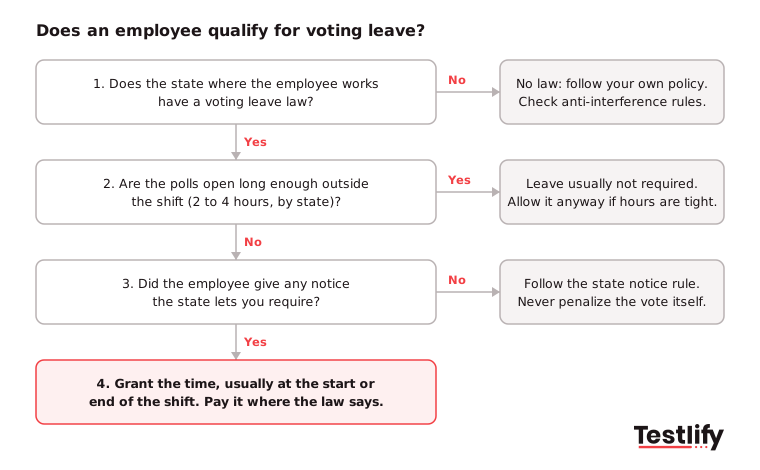
- List every work location: Use where the employee actually works, not where the company is registered. Adams and Reese advises employers with remote staff to identify each employee's state, since one uniform policy may not meet every state's rules.
- Match each state to its rule: Record paid hours, the exemption window, notice and posting duties. Keep the list in your HR statutory compliance tracker so it is reviewed each cycle.
- Choose your baseline: One option is to offer up to two paid hours in every location. A single paid baseline is simpler to explain and to run in payroll than a patchwork of rules.
- Set the request process: Say how and when employees ask, and where state law caps your notice window. New York, for example, lets employees give notice 2 to 10 working days before the election under New York Election Law section 3-110.
- Decide timing rules: Most laws let the employer set the hours, often at the start or end of the shift. Colorado requires you to grant a valid request for the start or end of the shift.
- Post the notices: Put state posters up on time and share them digitally with remote staff. D.C., according to Jackson Lewis, expects remote workers to get the notice individually.
- Publish it in the handbook: Add the policy, or state addenda, to your employee handbook and train managers before early voting opens.
Pro tip: Write the policy around the strictest state you operate in, then add short state addenda for posting and notice. Managers follow one rule more reliably than six.
Voting leave vs PTO: what is the difference?
Voting leave differs from PTO because it is a legal right tied to an election, while PTO is a general benefit the employer designs. Some employers let staff use PTO to vote, but in states that require paid voting leave, PTO cannot replace it.
Point | Voting leave | Paid time off (PTO) |
|---|---|---|
Source | State law, sometimes local law | Company policy (some states mandate sick time) |
Purpose | Voting in a public election | Any personal reason |
Length | Usually 1 to 3 hours | Hours or days, by policy |
Pay | Paid in 23 jurisdictions | Paid by definition |
Employer control | Can often set the hours, cannot refuse | Can approve or deny by policy |
Retaliation risk | Penalties, including crimes, in some states | Policy and wage law apply |
Voting leave is also different from compensatory time off, which replaces overtime pay with time off and has nothing to do with elections.
What are the best practices for voting leave?
Voting leave best practices come down to planning early, keeping the process simple and protecting employees from any pressure.
- Plan cover before early voting starts: Ogletree notes that early voting often opens in mid-October, so requests can arrive weeks before Election Day.
- Pay exempt staff in full: Federal salary rules limit deductions for partial-day absences, so docking an exempt employee for two hours away is a risk.
- Train managers on the script: Managers should approve, schedule and stay neutral. A refusal or a comment about how someone votes can create liability.
- Adjust shifts in 24/7 operations: Ogletree suggests shift swaps, adjusted start times or extra Election Day staffing in healthcare, hospitality and manufacturing, which fits normal shift management.
- Keep records light: Log the request and the hours. Only ask for proof of voting where state law allows it, such as Maryland.
- Review before every cycle: Colorado changed its law in 2026. A yearly check catches changes like this before they cause a missed payment.
Key takeaway: Voting leave is small in hours but large in risk. A short written policy, current state posters and trained managers cover most of it.
Voting leave is also a good test of how well HR staff know the rules they apply. When you hire HR generalists, people ops managers or payroll staff for multistate teams, a role-based test shows whether a candidate can apply leave and posting rules before they handle a live request. Testlify's library of 3,500+ tests includes an HR compliance skills test you can add to a skills-based shortlist.
Frequently asked questions (FAQs)
Voting leave is paid in many states but not all. Mercer counts 23 jurisdictions that require paid time, usually up to two or three hours, and seven where time off is required but pay is not specified. With no state law, pay depends on your policy.
Cite this page
Copy a ready-made citation for this page in your preferred style.
- APA
Testlify. (2026). Voting Leave. https://testlify.com/hr-glossary/voting-leave/
- MLA
"Voting Leave." Testlify, 26 October 2026, https://testlify.com/hr-glossary/voting-leave/.
- Chicago
Testlify. "Voting Leave." Testlify. Last modified October 26, 2026. https://testlify.com/hr-glossary/voting-leave/.
- HTML link
<a href="https://testlify.com/hr-glossary/voting-leave/">Voting Leave</a>, Testlify (2026)
Related terms
W-2
W-2 forms are official documentation of an employee’s wages and taxes withheld, used for accurate tax reporting and simplifying the tax filing process, but can be costly, time-consuming, and vulnerable to identity theft.
W-4
W-4 form is used by employees to indicate their tax withholding status to their employer, by providing information such as their filing status and number of dependents, which the employer uses to determine how much money to withhold from the employee’s paycheck for federal income taxes.
Wage Drift
Wage Drift refers to the gradual increase in wages over time due to inflation and other factors, rather than formal negotiations or agreements.
Wellbeing
Wellbeing is a holistic concept that encompasses physical, mental, emotional, and social well-being, it is an overall sense of contentment and satisfaction with life.
Wellness Program
A Wellness Program is an organized approach to promoting health and well-being in the workplace, typically including health screenings, education, exercise programs, stress management, nutrition, and other resources.
What Are Weingarten Rights?
Learn what Weingarten Rights are, when they apply, and what enterprise HR teams must do when an employee invokes them under NLRA Section 7.
Get started.
Hire on proof, not resumes.
Run your first skills-based assessment free — no credit card required.