
Job Shadowing
Job shadowing is a learning opportunity that allows an individual to observe and follow a worker as they go about their daily tasks and responsibilities.
 ChatGPT
 Gemini
 Claude
 Grok
Grok Perplexity
Job shadowing is the right tool when you need to transfer specific role knowledge quickly and at low cost.
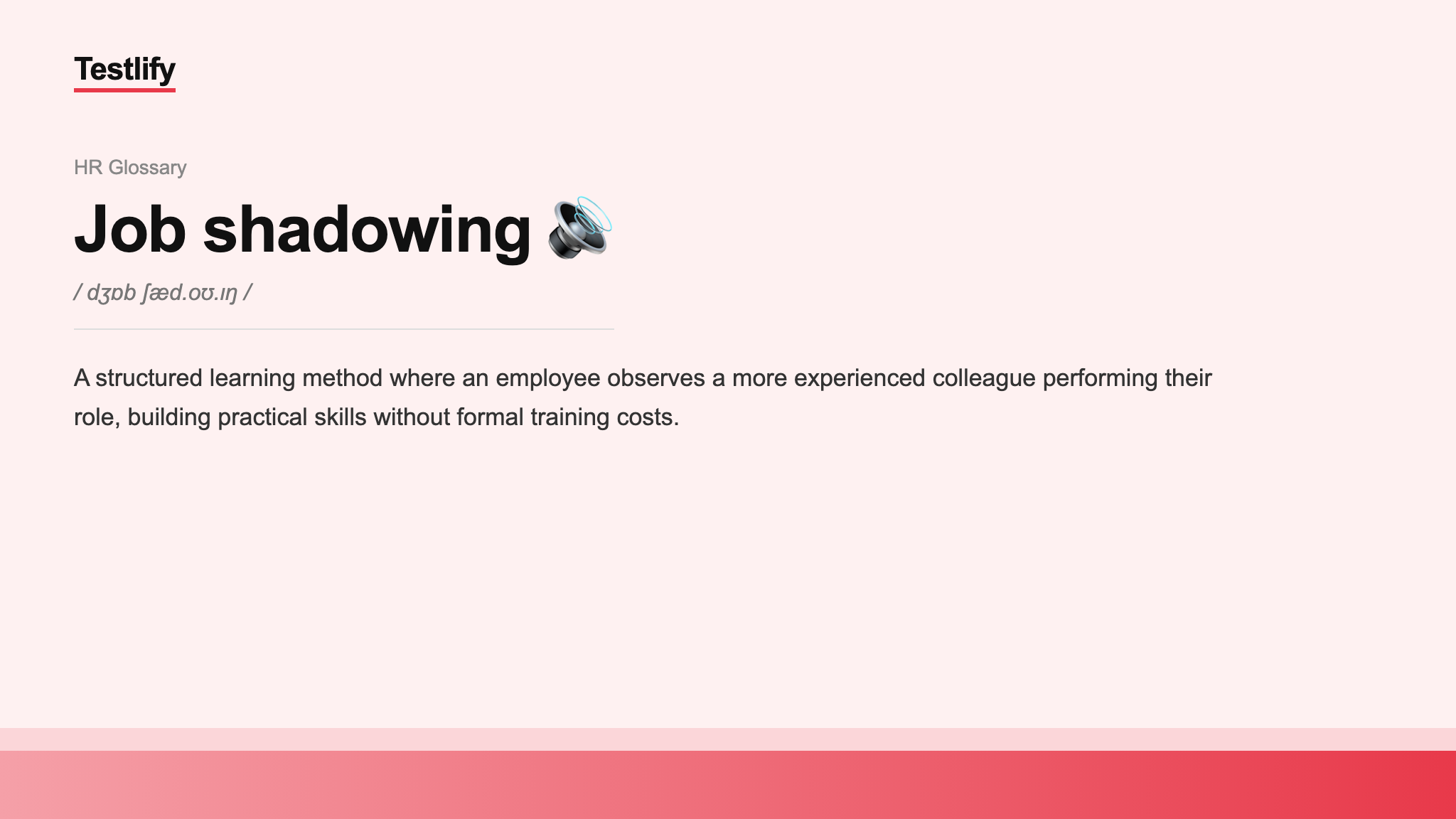
Job shadowing is a structured learning method where an employee observes a more experienced colleague performing their role, building practical skills and organisational knowledge without formal training costs.
Why job shadowing matters for enterprise HR
Organizations with formalized internal shadowing programs fill 41% more positions internally than those relying solely on job postings (Chronus, 2024). For enterprises managing headcount in the hundreds or thousands, that gap translates directly into reduced time-to-fill and lower external hiring costs.
Job shadowing works because it transfers tacit knowledge – the unwritten expertise that experienced employees carry but rarely document. When a senior compliance analyst retires or a key account manager moves on, structured shadowing captures that knowledge before it walks out the door.
At scale, the stakes rise further. Over 75% of organizations report difficulty recruiting full-time employees, while nearly half also struggle to retain them (SHRM, 2024). Job shadowing addresses both sides: it develops internal candidates for open roles and signals organizational investment in employee growth – one of the top drivers of retention (SHRM, 2023). For a deeper view of how development connects to retention strategy, see our guide to talent pipeline management.
For HR teams at companies with 1,000-plus employees, job shadowing also reduces dependency on external hires for specialized or senior roles. Procter and Gamble fills 80% of executive positions through internal promotion – a result that requires systematic knowledge transfer, including shadowing.
Types of job shadowing
Enterprise HR programs use three distinct models, each suited to different learning objectives:
Virtual job shadowing has become standard in hybrid organizations. Remote formats use recorded walkthroughs, live CRM demos, and call-listening sessions. A fintech company that introduced 3-day virtual shadowing for new customer success managers cut onboarding ramp-up time by 30%.
Reverse shadowing – where senior leaders observe frontline employees – surfaces ground-level friction that management rarely sees in reports. It is increasingly used for process improvement and empathy training at large organizations.
The right type depends on the learning objective. Use pure observation for new hire orientation and role exploration. Use structured briefing when the goal is documenting complex workflows. Reserve hands-on exposure for employees being prepared for a specific future role.
How to build a job shadowing program in your organization
A structured program avoids the most common failure mode: informal shadowing that runs without clear objectives, no documentation, and no way to measure outcomes.
Step 1: Define objectives. Clarify whether the program serves onboarding acceleration, internal mobility, succession planning, or cross-functional knowledge transfer. Each goal requires different matching logic and duration.
Step 2: Identify and prepare hosts. Hosts are experienced employees who agree to be observed. Brief them on what to narrate, what to keep confidential, and how to run debrief sessions. In Workday or Greenhouse, tag shadow host volunteers in the employee profile to make matching searchable at scale.
Step 3: Match participants. Match on role relevance and learning objectives, not seniority alone. For succession planning contexts, use skills gap data from your assessment platform to identify which roles each participant needs to observe.
Step 4: Set a structured agenda. Build a day-by-day plan covering which tasks will be observed, which meetings attended, and when debriefs occur. Unstructured shadowing yields weak outcomes.
Step 5: Run debrief sessions. After each shadowing block, host and shadower meet for 20-30 minutes to review observations, clarify questions, and capture key learnings in a shared document.
Step 6: Assess outcomes. Use pre- and post-shadowing skills assessments to measure knowledge gain. Track time-to-proficiency for onboarding cohorts that completed shadowing versus those that did not. Testlify’s role-specific assessments map to the competencies observed during shadowing, giving you objective data to report upward.
Step 7: Collect feedback and iterate. Run a short survey after each cohort. Report participation rates, match quality, and assessment scores to People leadership quarterly.
Job shadowing vs job rotation vs mentoring: key differences
All three are experiential learning tools, but they serve distinct purposes and require different resource commitments.
Job shadowing is the right tool when you need to transfer specific role knowledge quickly and at low cost. Use job rotation when building future leaders who need cross-functional breadth. Use mentoring for sustained career development over time. The three are often combined in enterprise leadership pipeline programs: shadowing first for exposure, rotation for depth, mentoring for long-term guidance.
Best practices for enterprise job shadowing
Document a confidentiality agreement before shadowing begins. Hosts in finance, legal, compliance, and HR roles handle sensitive employee or client data. A written agreement outlining what the shadower may not discuss externally protects the organization and satisfies GDPR data minimization principles.
Apply EEOC-aligned selection criteria. When shadowing programs feed into promotion or succession decisions, use objective criteria tied to job-relevant competencies – not manager preference. The EEOC recommends basing development opportunities on consistently applied, job-related qualification standards (EEOC, Best Practices for Employers). This reduces adverse impact risk.
Integrate with your ATS. Track shadowing completion in Greenhouse or Lever as a development milestone. This creates an auditable record and simplifies reporting on internal mobility metrics during compliance reviews. For more on building defensible hiring and development processes, see pre-employment testing best practices.
Set a minimum program duration. Half-day shadowing rarely produces meaningful skill transfer. Enterprise L&D benchmarks suggest 2-5 days for onboarding contexts and 1-2 weeks for succession-readiness programs.
Pair shadowing with skills validation. Observation alone does not confirm competency. Use a targeted assessment after the shadowing period to verify the participant absorbed the target competencies. This is especially important when shadowing feeds a promotion or lateral move decision (LinkedIn Talent Solutions, 2023).
Report quarterly to leadership. Track participation rates by department, skills gain (pre/post assessment), and time-to-proficiency for employees who completed shadowing. Tie outcomes to business metrics: internal fill rate and first-year retention.
Frequently asked questions
Job shadowing is a structured learning experience in which one person observes an experienced colleague performing their daily tasks and responsibilities. The shadower does not perform work themselves but watches workflows, attends meetings, and participates in debrief conversations. Programs typically last one day to two weeks depending on the learning objective.
Cite this page
Copy a ready-made citation for this page in your preferred style.
- APA
Testlify. (2023). Job Shadowing. https://testlify.com/hr-glossary/job-shadowing/
- MLA
"Job Shadowing." Testlify, 2 January 2023, https://testlify.com/hr-glossary/job-shadowing/.
- Chicago
Testlify. "Job Shadowing." Testlify. Last modified August 6, 2026. https://testlify.com/hr-glossary/job-shadowing/.
- HTML link
<a href="https://testlify.com/hr-glossary/job-shadowing/">Job Shadowing</a>, Testlify (2023)
Related terms
Job Sharing
Job sharing is a flexible work arrangement where two employees split responsibilities and duties of a full-time job by working part-time schedules that overlap.
Johari window
The Johari Window is a model used to improve self-awareness and relationship awareness through communication and self-discovery by dividing self-knowledge into four categories: open, hidden, blind, and unknown.
John Henry Effect
The John Henry Effect is a phenomenon where people are more likely to persist at a task when they are in competition with a machine, it highlights the psychological and social factors that can influence people’s perceptions and reactions to technology.
Just Cause Termination
Just cause termination is the dismissal of an employee for valid, evidence-based reasons, ensuring the action is neither arbitrary nor discriminatory.
Key Employee
Key Employees are considered valuable assets to an organization, due to their skills, knowledge, and unique qualities. They are critical to the success of the organization and their loss can have a significant impact.
Key Performance Indicators (KPIs)
Key Performance Indicators (KPIs) are measurable values used to evaluate performance, aligned with goals, used to identify areas for improvement, monitor progress, facilitate communication and make data-driven decisions.
Get started.
Hire on proof, not resumes.
Run your first skills-based assessment free — no credit card required.