
Employment Credit Check
An employment credit check is an employer review of a candidate's credit report, run with written consent under the FCRA for some roles.
 ChatGPT
 Gemini
 Claude
 Grok
 Perplexity
An employment credit check is a review of a job candidate's or employee's credit report, ordered by an employer from a consumer reporting agency with the person's written consent. The report shows how someone has handled debt, such as payment history, balances and bankruptcies, but not their credit score. Employers mainly use it for roles that handle money or sensitive data.
What does an employment credit check show?
An employment credit check shows a modified version of the candidate's credit report: open and closed accounts, balances, available credit, payment history, accounts in collection, and public records such as bankruptcies. Employers do not see a credit score, and the check counts as a soft inquiry, so it does not lower the candidate's score.
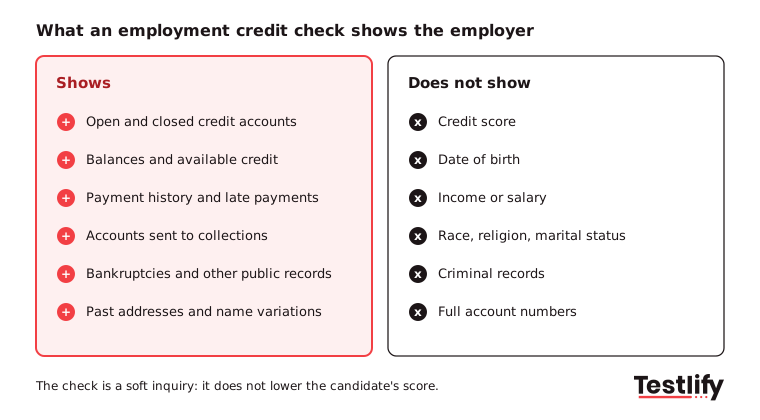
According to Experian, one of the three national credit bureaus, employer reports leave out credit scores, date of birth and other details protected by equal opportunity laws. Income and salary are not on a credit report either, so a credit check is not a way to verify pay history.
Time limits apply too. Under the Fair Credit Reporting Act (FCRA), most negative items drop off after seven years and bankruptcies after 10 years. The FCRA section on what consumer reports may include lifts both limits for jobs with an annual salary of $75,000 or more, so a senior hire can see older records than an entry-level applicant.
Why does an employment credit check matter for enterprise HR?
An employment credit check matters for enterprise HR because it sits where hiring risk and legal risk meet. Banks, insurers, payments firms and BPOs handling card data use credit checks to reduce fraud and theft risk in roles with access to money, and some regulators expect them. Run the check on the wrong role, or skip a notice, and the employer faces FCRA claims or a state-law violation.
The legal map is also moving. New York State signed a law on December 19, 2025 that bars most employers from requesting or using credit history from April 18, 2026, according to an analysis by the law firm Littler. New York became the 11th state with such a rule, alongside 6 cities and counties.
Credit checks also connect to negligent hiring. For a treasury role, a documented, job-related check can show the employer took reasonable care. For a warehouse role, it adds legal exposure and little protection.
Key takeaway: Treat an employment credit check as a role-specific control, not a default step in every background check.
What are the core components of an employment credit check?
The core components of an employment credit check are a written disclosure, the candidate's written authorization, the report from a consumer reporting agency, a review against job-related criteria, and the adverse action process. Skipping any one of them invites a legal claim.
Disclosure
A clear notice, in writing, that the employer may get a consumer report for employment purposes. The notice must stand alone and cannot sit inside the job application.
Authorization
The candidate's written permission. If the employer wants the right to run checks during employment as well, the authorization has to say so clearly.
The consumer report
The report itself, ordered from a background screening company or a credit bureau.
Job-related review criteria
A written rule for what matters and why, set before any report arrives. Example: for a role with signing authority, recent accounts in collection over a set amount trigger a conversation, while medical debt and student loans are ignored.
Adverse action process
A two-step notice process if the employer may reject the candidate because of the report.
How do you run an employment credit check legally?
Running an employment credit check legally means following the FCRA steps in order, then layering state and city rules on top. The FTC's guide for employers using consumer reports sets out the federal steps below.
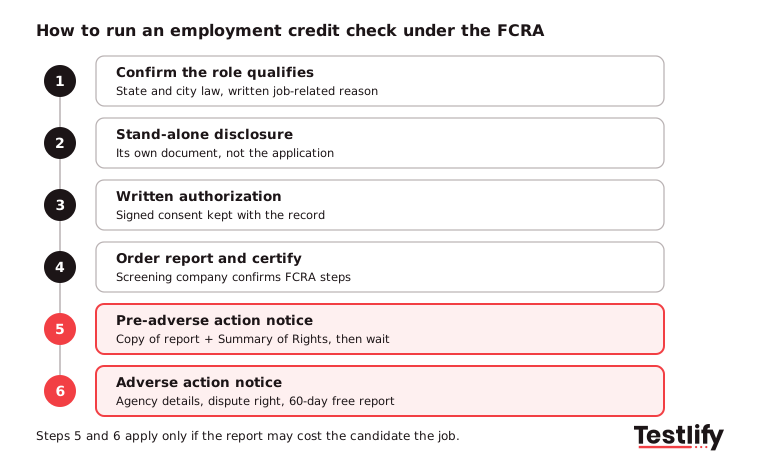
- Confirm the role qualifies: Check state and local law for the work location, and write down why credit history relates to the job.
- Give the stand-alone disclosure: Send it as its own document, not in the application form.
- Get written authorization: Keep a signed copy with the candidate record.
- Order the report and certify compliance: The screening company will ask you to certify the FCRA steps.
- Send a pre-adverse action notice: Include a copy of the report and "A Summary of Your Rights Under the Fair Credit Reporting Act", then wait a reasonable period (many employers use 5 business days) so the candidate can respond.
- Send the adverse action notice: Name the reporting agency, state that it did not make the decision, and explain the right to dispute and to a free copy of the report within 60 days.
When the process ends, store the report securely and dispose of it safely. The CFPB notes that the same consent and dispute rights apply when employers check current employees, not only applicants.
Pro tip: Run the credit check after a conditional offer, as the last step. Recruiters then see credit data only for finalists, after skills and interviews are scored.
Where are employment credit checks restricted?
Employment credit checks are restricted in 11 US states and 6 cities or counties, which limit when employers can ask for or use credit history. Most allow checks only for exempt roles, such as positions required by law, law enforcement, jobs with access to trade secrets, or roles with authority over large sums of money.
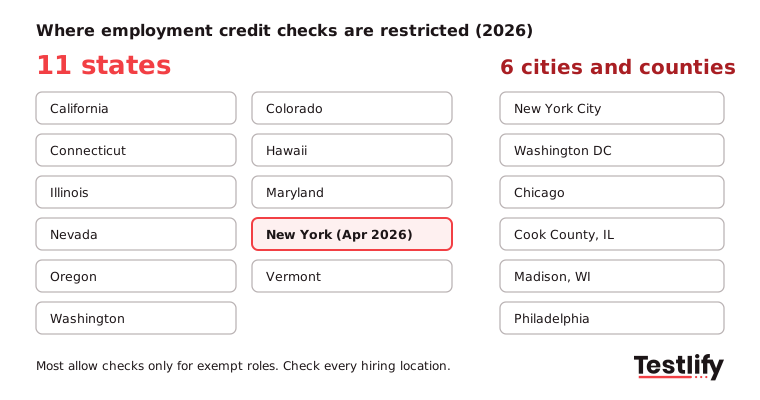
- States: California, Colorado, Connecticut, Hawaii, Illinois, Maryland, Nevada, New York, Oregon, Vermont and Washington.
- Cities and counties: New York City, Washington DC, Chicago, Cook County (Illinois), Madison (Wisconsin) and Philadelphia.
Exemptions differ by law. New York State lists 8 exempt categories, including roles with signing authority over $10,000 or more and roles that can change digital security systems. California's Labor Code section 1024.5 exempts managerial roles, law enforcement and jobs with access to confidential data, among others. Ask employment counsel to map exemptions for every hiring location and recheck them yearly, since these laws often arrive alongside ban the box rules.
Employment credit check vs background check: what is the difference?
An employment credit check is one type of background check that looks only at financial history. A full background check is a bundle of searches, such as criminal records, identity, employment and education verification, and sometimes credit. Both fall under the FCRA when a third party prepares them.
Employment credit check | Background check | Lender credit check | |
|---|---|---|---|
What it covers | Credit accounts, payment history, collections, bankruptcies | Criminal records, identity, past jobs, education, sometimes credit | Full credit file and credit score |
Credit score shown | No | No | Yes |
Effect on credit score | None (soft inquiry) | None | Can lower it (hard inquiry) |
Consent needed | Yes, written | Yes, written | Yes, with a credit application |
Typical use | Finance, cash handling, security roles | Most hires | Loans, cards, mortgages |
State limits | 11 states, 6 localities | Ban-the-box and fair chance laws | Lending laws |
Related checks include background verification and the reference check, which confirm facts rather than financial behaviour.
What are the best practices for employment credit checks?
The best practices for employment credit checks are to limit them to roles where finances relate to the job, apply one written standard to everyone in that role, and give candidates a real chance to explain.
- Limit checks to qualifying roles: A narrow list is easier to defend.
- Apply the same standard to everyone: The EEOC guidance on background checks warns that asking only people of a certain race about financial history is evidence of discrimination.
- Watch for adverse impact: Credit problems can track income and medical debt, so check whether your rule screens out a protected group at a higher rate (adverse impact).
- Look at recent, relevant items: A collection account from last year means more for a treasury role than a student loan from 8 years ago.
- Let candidates explain: Errors on credit reports are common, and a job loss or illness often explains a bad patch.
- Audit forms once a year: Confirm the disclosure stands alone and notices name the right agency.
How do skills tests fit alongside an employment credit check?
Skills tests fit alongside an employment credit check by measuring what a credit report cannot: whether the person can do the job and handle financial decisions well. A credit report shows past debt, not judgment. For finance and cash-handling roles, many teams pair a narrow, job related credit check with an integrity test and role-specific tests, such as Testlify's financial accounting test, so the shortlist rests on skills first and the credit check stays a final control.
Frequently asked questions
An employer cannot run an employment credit check through a consumer reporting agency without the candidate's written permission. The FCRA requires a stand-alone disclosure and a signed authorization first.
Cite this page
Copy a ready-made citation for this page in your preferred style.
- APA
Testlify. (2026). Employment Credit Check. https://testlify.com/hr-glossary/employment-credit-check/
- MLA
"Employment Credit Check." Testlify, 28 October 2026, https://testlify.com/hr-glossary/employment-credit-check/.
- Chicago
Testlify. "Employment Credit Check." Testlify. Last modified October 28, 2026. https://testlify.com/hr-glossary/employment-credit-check/.
- HTML link
<a href="https://testlify.com/hr-glossary/employment-credit-check/">Employment Credit Check</a>, Testlify (2026)
Related terms
Employment History
What is employment history? Employment history is typically provided by job candidates on their resumes and is verified by the employer through reference checks and background checks. Employment history is typically provided by job candidates on their resumes and is verified by the employer through reference checks and background checks. It is essential for job…
Employment Laws
Employment law compliance is a foundational HR responsibility that protects employees and shields organizations from costly legal liability. What are employment laws? Employment laws and regulations govern the relationship between employers and employees and protect employees from discrimination, mistreatment, and other workplace misconduct. Overall, employment laws are in place to protect employees from mistreatment and…
Employment Rate
The employment rate is a measure of the percentage of the working-age population that is currently employed. It is often used as an indicator of the health of the labor market and the overall economy.
Employment Status
Employment Status refers to the legal relationship between an individual and an organization for which they work.
Encore Career
An encore career is a term used to describe a career change that takes place later in an individual’s working life, typically after age 50.
Enterprise Resource Planning (ERP)
Enterprise Resource Planning (ERP) is a software system that helps organizations manage and automate various business processes such as accounting, inventory management, human resources, procurement, and customer relationship management.
Get started.
Hire on proof, not resumes.
Run your first skills-based assessment free — no credit card required.