
How to create a positive blue collar workplace in 2027
Eight practical steps for HR and operations leaders to build a blue-collar workplace people stay in, backed by 2025 worker survey data.

Ask a hands-on worker why they quit, and the answer is rarely the work itself. Late paychecks, rotas that change overnight and supervisors who never listen are the usual causes.
To create a positive blue collar workplace, start with fair pay, predictable schedules and a site where people go home safe. Then add a real voice, better managers, recognition and a visible path to the next role.
TL;DR:
- A positive blue-collar workplace is one where pay feels fair, schedules are predictable, safety is shared, and workers have a say in how the job is done.
- Pay and schedules come first. UKG's 2025 frontline survey found pay is the top reason people stay, with schedule flexibility second.
- Voice is the biggest gap. Top Employers Institute found 82% of blue-collar workers want a say in how work gets done, but only 65% feel heard.
- Frontline managers decide most of the experience. Gallup says managers account for 70% of the variance in team engagement.
- Track six numbers monthly: 90-day turnover, absence, safety near-miss reports, internal fills, schedule changes and pulse scores.
- Hiring is part of culture. Fair, skills-based hiring and promotion put the right people and the right supervisors on the floor.
 ChatGPT
 Gemini
 Claude
 Grok
 Perplexity
What makes a blue-collar workplace positive?
A positive blue-collar workplace is a site, plant, warehouse or crew where people are paid fairly, know their hours in advance, trust that the work is safe, and feel that their experience counts. Free lunches and team outings help, but they do not fix a broken schedule or an unsafe line.
Blue-collar work covers hands-on roles such as construction workers, machine operators, electricians, drivers, warehouse staff and maintenance technicians. These workers rarely sit at a desk, often work shifts, and usually hear about company news last.
A positive workplace closes that gap. If you need the definitions first, see white-collar vs blue-collar jobs.

Why does a positive blue collar workplace matter for retention?
A positive blue collar workplace matters because blue-collar turnover is expensive and often driven by fixable basics. When pay, hours and supervision feel unfair, people leave within months, and every exit means another round of hiring, training and safety risk from new starters.
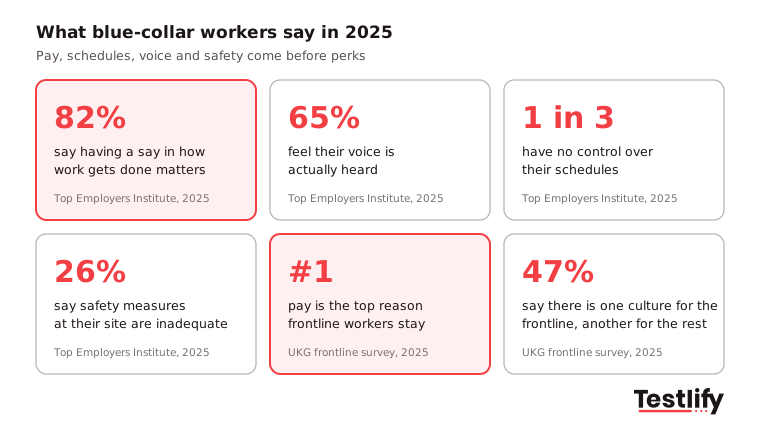
The 2025 data points in the same direction:
- Pay and schedules decide who stays: UKG's 2025 survey of more than 8,000 frontline workers in 10 countries found pay is the top factor in staying and schedule flexibility is second. 56% said they live paycheck to paycheck, and more than three quarters reported burnout.
- Two cultures in one company: 47% of frontline workers in the same UKG survey said their workplace has one culture for the frontline and another for everyone else.
- Voice and information gaps: According to Top Employers Institute's 2025 report, a quarter of blue-collar workers never receive information about their jobs, and 39% get updates less than once a week.
- Short tenure: Deloitte's Blue Collar Workforce Trends 2025 found 69% of blue-collar hires in India are temporary and average tenure is 21 months.
For what each early exit really costs, see the cost of losing talent.
How do you create a positive blue collar workplace?
You create a positive blue collar workplace in eight steps: fix pay and hours, make schedules predictable, share ownership of safety, give workers a voice, train frontline managers, recognize good work, open clear growth paths, and onboard people properly. Do the first three before anything else, because culture programs do not land on top of unfair pay or unsafe work.
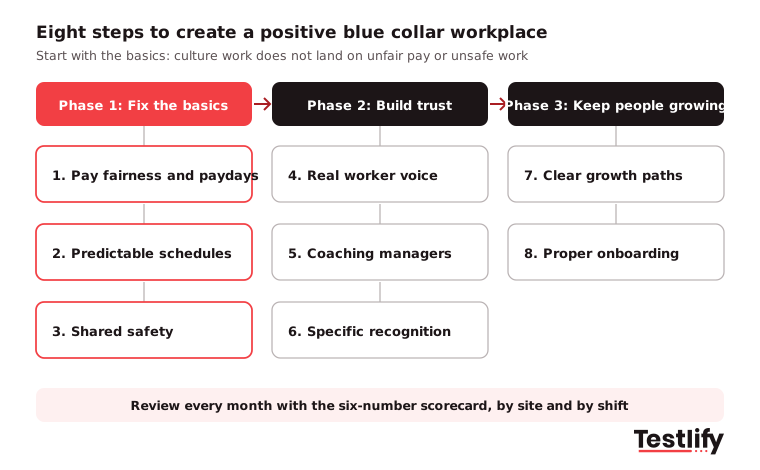
1. Fix pay fairness and paydays first
Financial security is the top priority for blue-collar workers, twice as popular as recognition in the Top Employers Institute data. Benchmark wages for each role and shift, explain how overtime and shift premiums are calculated, and never pay late.
For pay and benefits that keep people, see how to attract and retain blue-collar talent.
2. Make schedules predictable
One in three blue-collar workers have no control over their schedules, and 41% say more predictable scheduling would help, per Top Employers Institute. Publish rotas at least two weeks ahead, cap last-minute changes, allow shift swaps between qualified workers, and give notice of overtime early.
3. Make safety a shared job
Safety is the floor of a positive workplace, not a poster. Top Employers Institute found 26% of blue-collar workers say their site's safety measures are inadequate.
Use OSHA's recommended practices for safety and health programs, which put worker participation next to management leadership. Let crews report hazards and near misses without blame, act on reports quickly, and tell people what changed.
4. Give workers a real say
Top Employers Institute found 82% of blue-collar workers say having a say in how work gets done matters, but only 65% feel heard. Run a five-minute start-of-shift huddle, set up a safety or improvement committee with frontline members, and use short surveys by text or kiosk in the languages your crews speak.
Close the loop: post what you changed because of feedback.
5. Train frontline managers to coach
Most blue-collar supervisors were promoted for being good at the job, not for leading people. Give them training on fair scheduling, feedback, de-escalation and spotting burnout, and judge them on retention and safety, not only output.
The next section covers the weekly routine.
6. Recognize good work quickly and specifically
Recognition works best when it is specific and close to the work: name the person, the task and the result at the huddle. Peer shout-outs, safety milestones and skills badges cost little.
Keep recognition fair across shifts, so the night crew is not forgotten.
7. Open clear growth paths
Many hands-on workers want to move up but cannot see how. Map the steps from operator to lead to supervisor, list the skills for each, and offer paid training and certifications.
Fill lead and supervisor roles from inside first, using the same skills checks for every applicant.
8. Onboard people properly
Most early exits start in the first weeks. Pair every new starter with a buddy, cover safety and site basics on day one, and check in at day 7, 30 and 60.
See how to onboard and train blue-collar workers for a full plan.
Pro tip: Ask your crews which of the eight steps is weakest on your site before you plan anything. A ten-question pulse survey in two or three languages, taken on a phone at the start of a shift, gives you a baseline in a week.
What should frontline managers do every week?
Frontline managers should spend part of every week on the people side of the job: a daily huddle, one-to-one check-ins, a walk of the floor for safety, and quick recognition. Gallup found that managers account for 70% of the variance in team engagement, so their routine shapes the workplace more than any company program.
Routine | How often | What good looks like |
|---|---|---|
Start-of-shift huddle | Daily, 5 minutes | Priorities, safety point, one shout-out, one question to the crew |
Floor and safety walk | Daily | Ask about hazards, fix or log them, report back on old ones |
One-to-one check-in | Every 2 weeks per worker | Workload, schedule issues, training goals, what would help |
Schedule review | Weekly | Rota published 2+ weeks ahead, swaps approved, overtime shared fairly |
Feedback follow-up | Weekly | Post "you said, we did" on the board or team chat |
Recognition | Weekly | Name people for safety, quality and helping new starters |
Gallup's research on frontline managers also found 54% of employees with top-quartile managers plan to stay two years, against 39% with bottom-quartile managers. Gallup's 2026 State of the Global Workplace report adds that only 22% of managers were engaged in 2025, so support your managers before you ask more of them.
For more, see the role of leadership in employee engagement.
How do you make a blue-collar workplace inclusive?
An inclusive blue-collar workplace gives every worker the same access to good shifts, training, overtime and promotion, whatever their gender, age, language or background. Inclusion on a site is practical: fair rotas, equipment and PPE that fit everyone, information in the languages people speak, and zero tolerance for harassment.
- Fair access: Share overtime, preferred shifts and training places by a clear rule, not by who the supervisor likes.
- Fit for everyone: Stock PPE in a full range of sizes, provide clean facilities for all workers, and adapt tasks where possible.
- Language: Translate safety rules, rotas and surveys, and use pictures on safety signs.
- Harassment: Train every supervisor on reporting and act fast on complaints. US employers should follow the EEOC's harassment guidance on what they are responsible for.
For broader steps, see practical strategies to build an inclusive workplace.
How do you measure whether the workplace is improving?
You measure a blue-collar workplace with a short monthly scorecard of six numbers: early turnover, absence, safety reporting, internal fills, schedule stability and a pulse score. Track them by site and shift, because one bad shift can hide inside a good site average.
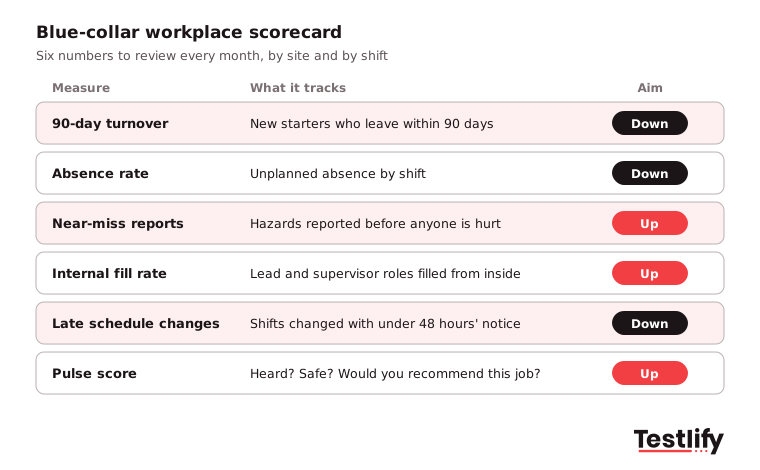
The six measures below each show a different part of site health. Read them together by site and shift, and look for trends over several months, not one-off spikes.
- 90-day turnover: The share of new starters who leave within 90 days. It shows onboarding and supervisor problems first.
- Absence rate: Unplanned absence by shift. Rising absence often signals burnout or schedule pain.
- Near-miss reports: More reports usually means more trust, not more danger. Track recordable injuries next to them. The BLS injury and illness release puts the US private industry rate at 2.3 cases per 100 full-time workers in 2024, a useful outside benchmark.
- Internal fill rate: The share of lead and supervisor roles filled from inside.
- Schedule changes: Shifts changed with less than 48 hours' notice.
- Pulse score: Three questions monthly: do you feel heard, is the work safe, would you recommend this job to a friend.
For engagement measures in more depth, see how to measure and improve blue-collar productivity and engagement.
Key takeaway: A positive blue-collar workplace is built shift by shift. Fix pay, schedules and safety, give people a voice, and measure the same six numbers every month.
What mistakes make a blue-collar workplace worse?
The most common mistakes are copying office perks, surveying people and changing nothing, and promoting the best operator into a supervisor role with no training. Each one tells workers that the company does not understand their job.
- Office perks for a floor team: Remote days and desk snacks do not help a forklift driver. Ask what would help first.
- Surveys with no follow-up: People stop answering when nothing changes. Share results and actions within a month.
- Untrained supervisors: A great welder is not automatically a great lead. Test leadership and judgment before promotion, then train.
- Safety as paperwork: Sign-off sheets without action teach people to stay quiet.
- Two cultures: Town halls at 10 am, when the night shift is asleep, leave half the workforce out. Repeat key updates on every shift.
How does hiring shape a positive blue-collar workplace?
Hiring shapes a positive blue-collar workplace because every new starter and every new supervisor changes the crew. Hiring on proven skills, safety attitude and reliability, rather than on gut feel, brings in people who fit the work and treats every applicant the same way.
Testlify helps hiring teams do this with role-specific skills tests for blue-collar jobs, among 3,500+ tests in the Testlify test library:
- Safety: The safety awareness test checks how candidates think about hazards before they reach the floor.
- Technical skills: Tests such as mechanical reasoning and forklift operator check job knowledge directly.
- Promotion: The first-line supervisor test gives internal candidates for lead roles the same fair check.
- Multilingual crews: Assessments run in 15+ languages, so candidates can show skill in the language they work in.
For the full process, see the Testlify guide to blue-collar hiring.
Ready to hire blue-collar workers who stay?
Book a demo to see Testlify's skills tests for blue-collar roles in action, or start a 7-day free trial with no credit card. Build your first skills-based assessment from your own job description.
Frequently asked questions (FAQs)

People and Talent Partner
Arushi Shah runs day-to-day talent acquisition and candidate experience at Testlify. She writes on interviewing, structured hiring, and giving candidates a fair, fast process.
LinkedInRelated resources
View all
HR & recruitment
Acing pre-employment tests: Strategies and tips

HR & recruitment
10 volume recruiting trends for enterprise HR teams

HR & recruitment
Pre-employment screening: types, process, and how assessment-first hiring improves quality of hire

HR & recruitment
How Skills Assessments Cut Time to Hire

HR & recruitment
Why skill-based assessments offer more precision in tech hiring

HR & recruitment
Why Do Recruiters Use Virtual Interviews in 2026?
Get started.
Hire on proof, not resumes.
Run your first skills-based assessment free — no credit card required.