
Big Five personality at work: a guide for hiring teams
How the five OCEAN traits show up on the job, which roles they suit, and how to use Big Five results fairly in hiring and team management.

A candidate can pass every skills test and still struggle once the real work starts. Big Five personality at work explains why: it shows how people plan, collaborate, handle pressure and react to change.
Five broad traits drive those habits: openness, conscientiousness, extraversion, agreeableness and emotional stability. Hiring teams can match each trait to the role and use results fairly next to skills tests.
TL;DR:
- The Big Five (OCEAN) measures openness, conscientiousness, extraversion, agreeableness and neuroticism, also called emotional stability, on a spectrum rather than as fixed types.
- Conscientiousness is the trait most consistently linked to job performance across roles. Emotional stability matters most in high-pressure work.
- Extraversion, agreeableness and openness help or hurt depending on the role, so match traits to the job, not to an ideal personality.
- Only 23% of organizations use self-report tests such as personality assessments in hiring, while 55% of US employers say judging soft skills is the hardest part of hiring, according to SHRM.
- Use Big Five results next to skills tests and structured interviews, and never as a pass or fail gate on their own.
- Under EEOC rules, a personality test must not screen out a protected group unless the employer can show it is job-related.
 ChatGPT
 Gemini
 Claude
 Grok
 Perplexity
What does Big Five personality at work mean?
Big Five personality at work means using the five-factor model of personality to explain and anticipate behavior in a job: how someone organizes tasks, works with colleagues, deals with stress and adapts to change. Each trait is scored on a spectrum, so a profile shows degrees, not categories, and most people sit somewhere in the middle.
The model is often called OCEAN after its five traits:
- Openness to experience: curiosity, imagination and comfort with new ideas.
- Conscientiousness: organization, reliability and follow-through.
- Extraversion: social energy, assertiveness and talkativeness.
- Agreeableness: cooperation, trust and empathy.
- Neuroticism: sensitivity to stress. At work it is usually reported the other way round, as emotional stability.
Interest in these "human" traits is rising because they are hard to see on a resume. SHRM's 2025 look at human-centered skills notes that, in the World Economic Forum's Future of Jobs Report 2025, four of the top five core skills employers want are cognitive or social-emotional, including resilience, flexibility and agility, and leadership and social influence.
For a short definition of each trait, see the Big Five personality traits glossary entry.

How does each Big Five trait show up at work?
Each Big Five trait shows up at work as a set of everyday habits: how a person plans a project, speaks up in meetings, handles disagreement and reacts to a missed deadline. Neither end of a trait is good or bad on its own.
What matters is whether the habit fits the demands of the role and the team around it.
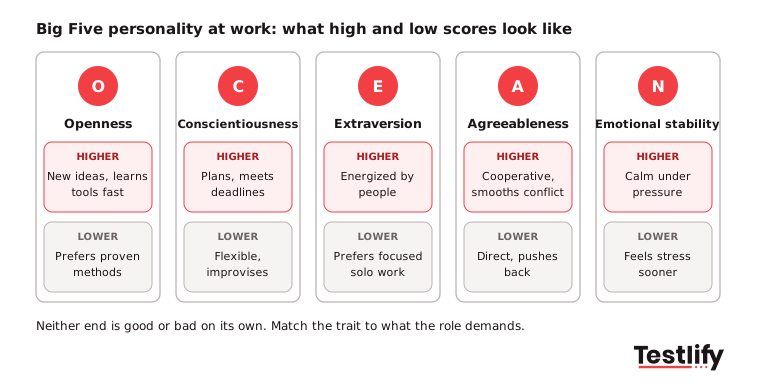
A few patterns hiring managers see most often:
- Openness: People high in openness adapt quickly when a process or tool changes. They can lose interest in work that repeats every day.
- Conscientiousness: People high in conscientiousness keep commitments without reminders. The best fit is high enough to execute but not so rigid that it blocks a needed change.
- Extraversion: People high in extraversion get energy from interaction, which helps in sales, account management and leadership. Introverted people often do their best work with fewer interruptions.
- Agreeableness: Highly agreeable people make strong teammates and service staff. Lower agreeableness can help in negotiation and in roles that require hard feedback.
- Emotional stability: Emotionally stable people keep their judgment under pressure, which matters most in customer escalations, healthcare and leadership.
Which Big Five trait matters most for job performance?
Conscientiousness is the Big Five trait most consistently linked to job performance, across almost every type of role. Conscientious people set goals, plan their work, follow through and keep their standards without being chased.
Emotional stability comes next in high-pressure jobs, while the other three traits matter only in some roles.
The other traits are more dependent on context:
- Extraversion matters most where talking to people is the job, such as sales, customer success and management, and much less in analytical or independent work.
- Agreeableness helps in collaborative and service roles, but can work against people in roles built on negotiation or competition.
- Openness matters most in roles that change often or require learning and creative problem solving.
Key takeaway: There is no single best personality at work. Conscientiousness is a safe signal for most roles, so start from what the job demands for the other four traits.
Which roles suit which Big Five traits?
Roles suit Big Five traits when the daily work rewards the habits that trait brings. Customer-facing roles reward extraversion and emotional stability, operations and finance reward conscientiousness, and research, product and design roles reward openness.
These are tendencies, not rules: plenty of introverts sell well, and skills still decide whether someone can do the job.
Role family | Traits that usually help | Why |
|---|---|---|
Sales and business development | Extraversion, emotional stability, conscientiousness | Constant outreach, rejection and targets |
Customer support and contact centers | Agreeableness, emotional stability | Calm, patient handling of upset customers |
Operations, finance and compliance | Conscientiousness | Accuracy, deadlines and process discipline |
Software engineering and data | Conscientiousness, openness | Careful work plus fast learning of new tools |
Product, design and marketing | Openness, extraversion | New ideas, pitching them and testing them |
People managers | Emotional stability, conscientiousness, extraversion | Steady direction, follow-through and visible leadership |
Healthcare and safety-critical roles | Conscientiousness, emotional stability | Precision and composure when stakes are high |
Pro tip: Before you pick traits for a role, ask the managers of your best performers what those people do differently day to day. Then map each behavior to a trait, so the profile stays tied to the real job.
How do teams use Big Five personality at work?
Teams use Big Five personality at work in five main ways: to add a work-style signal to hiring, to plan onboarding, to adapt how managers lead each person, to balance team make-up and to target development. Hiring gets most of the attention, but the same profile keeps paying off after the offer is signed.
- Hiring: A Big Five profile adds a view of work style to the skills evidence, so the interview can probe the traits the role depends on.
- Onboarding: A new hire low in emotional stability may need clearer early milestones. A new hire high in openness may need early exposure to how decisions get made.
- Managing: Managers can adjust how much structure, feedback and autonomy each person gets. A highly conscientious person may want a plan; a highly open one may want room to try things.
- Team design: A team full of high-openness people may lack someone who finishes the details. A profile view shows those gaps before a project starts.
- Development and coaching: Results give people a shared language for strengths and blind spots, such as stress management or speaking up in meetings.
How do you use Big Five results in hiring fairly?
Using Big Five results in hiring fairly means starting from the job, measuring only the traits the job needs, combining the results with skills evidence and keeping a person in charge of every decision. Personality should shape interview questions and comparisons between finalists, never reject a candidate alone.
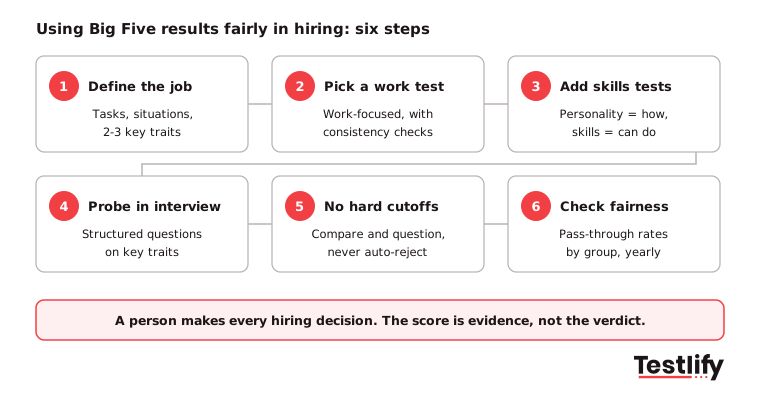
- Define the job first: List the tasks and situations the role involves, and the two or three traits that matter most for them.
- Choose a work-focused test: Use a Big Five test written for work situations, with clear reports and consistency checks.
- Combine it with skills: Pair the personality test with role-specific skills or cognitive tests, because personality explains how someone works, not whether they can do the work. The guide to hiring with the Big Five personality test shows how to set this up.
- Probe in the interview: Turn each low or unexpected score into a structured interview question, such as "Tell me about a time a deadline moved suddenly."
- Avoid hard cutoffs: Use results to compare and question, not as a pass or fail filter.
- Check for adverse impact: Review pass-through rates by group at least once a year.
The legal bar is clear. The EEOC's guidance on employment tests lists personality tests among the selection procedures covered by Title VII and the ADA, and warns that a test that disproportionately excludes people by race, sex or another protected trait is unlawful unless the employer can justify it.
Faking is the other practical risk. Text questionnaires make it easy for candidates to pick the answer they think the employer wants. Forced-choice items, consistency checks and picture-based formats make that harder.
What are the limits of the Big Five at work?
The Big Five has five main limits at work: it describes preferences rather than ability, it is self-reported, it ignores the situation, it can be turned into stereotypes, and it says nothing about values or integrity. Each limit is manageable, but only if the team knows about it before using the results.
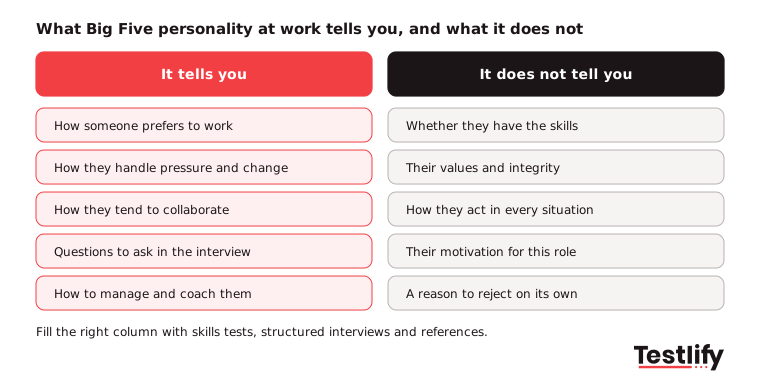
- Preference, not ability: A high conscientiousness score does not mean someone can build a financial model.
- Self-report bias: Candidates can present an idealized version of themselves, especially in high-stakes hiring.
- Context: People behave differently in a familiar team than in a new one, and a single test captures one moment.
- Stereotyping: Labels such as "the introvert" can stick and limit how people are seen and developed.
- Narrow scope: Motivation, values, integrity and skills sit outside the five traits.
Automated scoring adds another duty. If software scores or ranks candidates for jobs in New York City, Local Law 144 requires a bias audit within one year of use, a public summary of the results and notice to candidates.
How does Testlify measure Big Five personality at work?
Testlify measures Big Five personality at work with several tests in its library of 3,500+ tests, so hiring teams can add a work-style view to the same assessment as their skills tests. The main options are the PicOCEAN picture-based test, the Big Five personality test and the SMART personality test, which is also based on the Big Five.
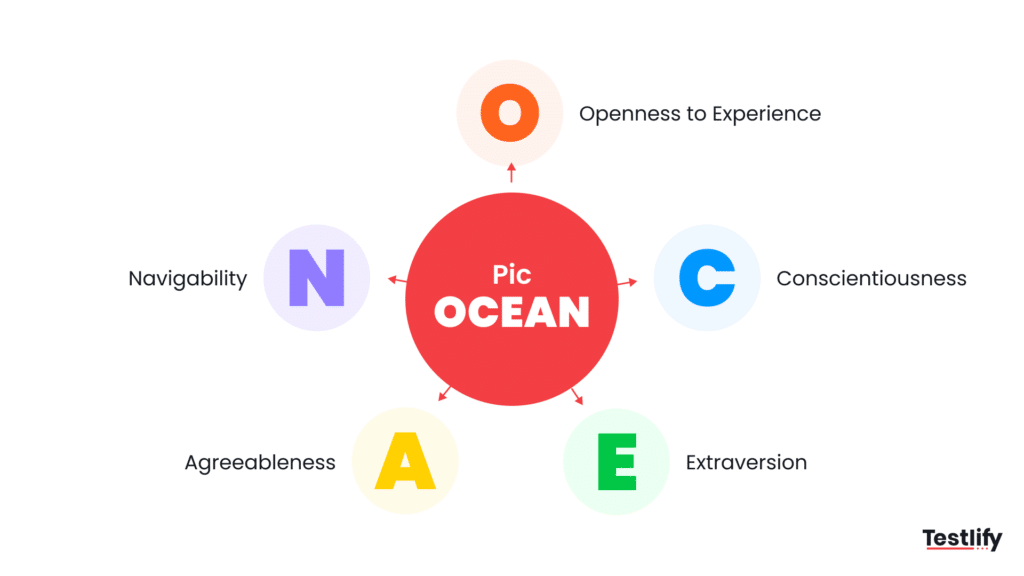
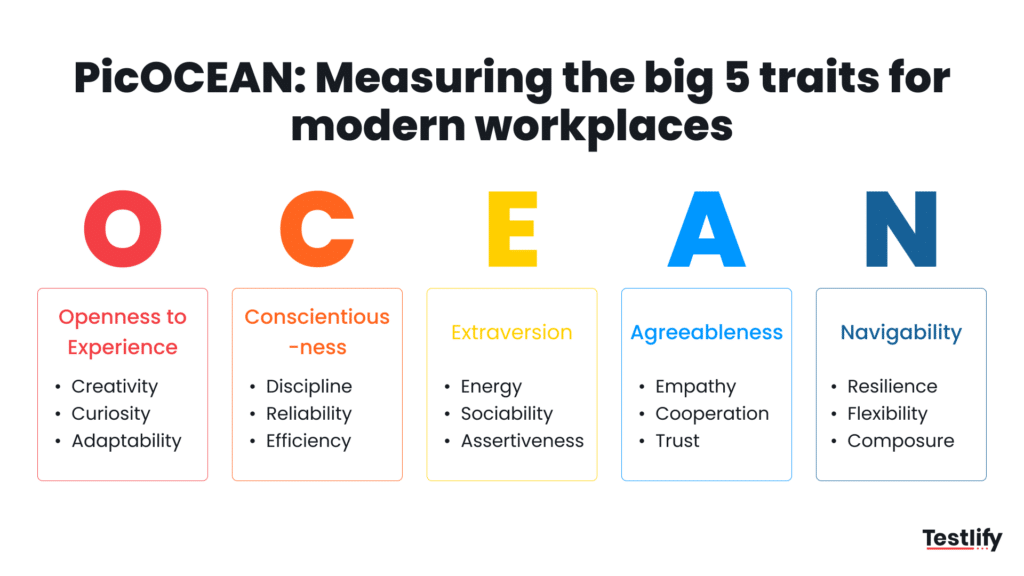
The PicOCEAN personality test asks candidates to choose images instead of reading long text statements. It reports five work-focused dimensions:
- PicO: openness to experience, including adaptability and new ideas.
- PicC: conscientiousness, including responsibility and follow-through.
- PicE: extraversion, including energy and the ability to engage others.
- PicA: agreeableness, including collaboration and working relationships.
- PicN: navigability, how well someone handles complex, fast-changing work.
The five dimensions break down into 15 sub-factors, and the test works on mobile. Because candidates react to pictures rather than wordy statements, the format is quicker to complete and leaves less room to guess the "right" answer.
For how picture formats work in more detail, read our guide to the image based personality test.
Personality results sit next to skills scores in one candidate report, with 20+ proctoring checks and support for 15+ languages. Teams that also want a behavioral style view can add the DISC personality assessment.
Ready to add personality insight to your hiring?
Pick the personality test that fits your role, pair it with the skills tests the job needs, and compare finalists on evidence instead of gut feel. Browse the Testlify test library to find the right tests.
Book a demo to see Testlify in action, or start a 7-day free trial with no credit card required.
Frequently asked questions (FAQs)

Human Resources Lead
Snehi Parmar leads People at Testlify, owning hiring, culture, performance, and retention for a 90-person team. She writes on practical HR strategy and building people processes that scale.
Related resources
View all
HR & recruitment
Why visual personality tests are the future of hiring
HR & recruitment
What Is Quiet Quitting? Causes, Signs, and How to Prevent It in 2026

HR & recruitment
Hiring without borders: how HR and fintech empower global talent acquisition
HR & recruitment
Picture personality test vs. traditional personality tests: What’s the difference?

HR & recruitment
How Testlify is changing the 5 traits personality test using images

HR & recruitment
What is skill issue and how to fix it? A definitive guide
Get started.
Hire on proof, not resumes.
Run your first skills-based assessment free — no credit card required.