
Why test English proficiency in hiring? 7 reasons for 2027
Resumes overstate English and interviews misjudge it. What weak English costs, which level each role needs and where the law draws lines.

A candidate writes "fluent English" on the resume and sounds great on a friendly 20-minute call. Three weeks into onboarding, they struggle to write a clear incident report.
Why test English proficiency in hiring? Because resumes overstate English and interviews reward confidence more than skill.
An English proficiency test measures the reading, listening, writing and speaking a role uses, on one scale for every candidate. Below are seven reasons to run one, the level each role needs and where the law draws lines.
TL;DR:
- Testing English proficiency in hiring checks a skill that resumes overstate and interviews misjudge, using one scale for every candidate.
- Weak English is expensive: 83% of 1,325 HR decision-makers in ETS's 2026 survey said it raises turnover or cuts productivity, and 74% said it strained client relationships.
- Set the level by role, not company-wide. Most support and sales roles need B1 to B2 on the CEFR scale; client-facing leaders and writers need C1.
- Some laws set a level for you: the UK Skilled Worker visa requires B2, and US commercial drivers can be put out of service for failing English checks since 2025.
- The EEOC allows a fluency requirement only to the degree the job needs, so testing for more than the role uses is a legal risk.
- Put a short test right after the application, auto-shortlist by level, and use interviews for everything else.
 ChatGPT
 Gemini
 Claude
 Grok
 Perplexity
Why test English proficiency in hiring?
Testing English proficiency in hiring gives every candidate the same, job-related check of the language skills the role depends on. Resumes overstate language ability, interviews judge confidence and accent more than skill, and weak English costs money once someone is in the seat.
A short test scored on the CEFR scale fixes all three before interview time is spent.
The practice is already mainstream. In ETS's 2026 TOEIC Global English Skills Report, a survey of 1,325 HR decision-makers across 17 countries, 78% said they already use English assessments for recruitment or screening, and 84% expect every new hire in their country to be assessed for English within five years.
The demand sits on top of a very uneven talent pool. The EF English Proficiency Index 2025, based on test results from 2.2 million adults in 123 countries and regions, shows how wide the spread is between and within countries.
A degree from one country and a degree from another tell you almost nothing about how well either person writes in English.

What does weak English cost a business?
Weak English costs a business through higher turnover, lower productivity and damaged client relationships. The cost rarely shows up on a single report, because it is spread across rework, escalations, slower onboarding and managers rewriting emails.
The ETS survey puts numbers on it:
Finding (ETS TOEIC Global English Skills Report, March 2026) | Share of employers |
|---|---|
Hiring candidates with insufficient English creates costs such as turnover or lower productivity | 83% |
Miscommunication from weak English has strained client relationships | 74% |
Organisations whose staff are not fluent are at a competitive disadvantage | 86% |
AI tools at work increase the need for English proficiency | 81% |
Standardised third-party English tests are "very effective" (vs 47% for informal checks) | 55% |
ETS sells the TOEIC test, so read the numbers as the view of HR buyers rather than independent research. Even so, the pattern matches what most contact centre and support leaders describe: the English gap is found in week three of onboarding, not at the offer stage.
Key takeaway: The cheapest place to find an English gap is the screening stage. Every later stage, from interviews to training to a client complaint, costs more.
What are the main reasons to test English proficiency?
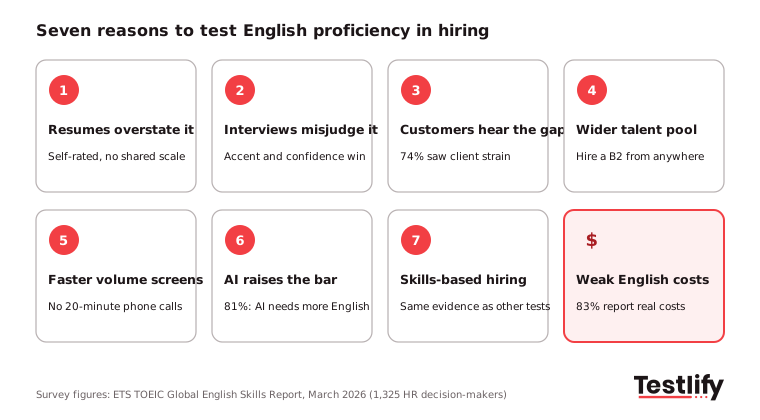
The main reasons to test English proficiency are accuracy, fairness, speed and fit to the role. Each reason below answers a specific problem hiring teams run into when English is checked informally.
1. Resumes overstate language skills
"Fluent" and "professional working proficiency" are self-ratings. Candidates have no shared scale, so two people with the same resume line can be two CEFR levels apart.
A test replaces the claim with a measured level.
2. Interviews are a weak English check
Interviewers tend to reward confidence, familiar accents and small talk, which are not the skills most roles need. A test scores grammar, vocabulary, reading and listening against fixed criteria, and a recorded speaking task can be scored the same way for everyone.
3. Customers hear the gap first
In support, sales and account management, English is the product the customer experiences. The 74% figure on strained client relationships is the clearest case for testing customer-facing hires, especially in BPO and contact centre hiring.
4. It widens the talent pool instead of narrowing it
A measured level lets you hire a strong B2 candidate from any country instead of screening for a native speaker or a particular university. That matters for remote and global teams that compete for the same skills.
5. It speeds up high-volume screening
A 20-minute phone screen per applicant does not scale. A short online test sent at the application stage lets recruiters shortlist by level and spend calls only on people who meet it.
6. AI tools raise the English bar
Writing prompts, checking AI output and editing AI drafts are English tasks. In the ETS survey, 81% of employers said AI tools increase the need for English, and about nine in ten said English is needed to write effective prompts and evaluate AI-generated information.
7. It supports skills-based hiring
English is a skill, so it belongs in a skills-based process with the same evidence standard as any other test. LinkedIn's Future of Recruiting 2025 found that 93% of TA professionals say accurately assessing skills is crucial to improving quality of hire.
Why test English proficiency in hiring when interviews already check it?
Interviews check whether a conversation felt easy, which is not the same as checking English. An interview is unstructured for language: each candidate gets different questions, the interviewer has no scale, and a confident speaker with weak writing passes while a careful writer with an accent can be marked down.
A test and an interview do different jobs:
Comparison point | Informal interview check | English proficiency test |
|---|---|---|
Skills covered | Mostly speaking and listening | Reading, writing, listening and speaking, chosen per role |
Scale | Interviewer's impression | CEFR levels A1 to C2 |
Same for every candidate | No | Yes |
Evidence you can review later | Notes, if any | Scores and recorded answers |
Cost per candidate | 15 to 30 minutes of recruiter time | Candidate time only |
The fix is not to drop the conversation. Keep interviews structured and focused on judgement, motivation and role skills, and let the test carry the English measurement.
Pro tip: If a role is mostly written, such as chat support or technical writing, weight the reading and writing scores. If it is mostly spoken, such as voice support or sales, add a recorded speaking task instead of relying on the interview.
Which English level does each role need?
The English level each role needs depends on the tasks the person does in English every week, not on the job title or seniority. The CEFR scale from the Council of Europe gives six levels, from A1 (basic phrases) to C2 (near-native mastery), and most roles sit between B1 and C1.
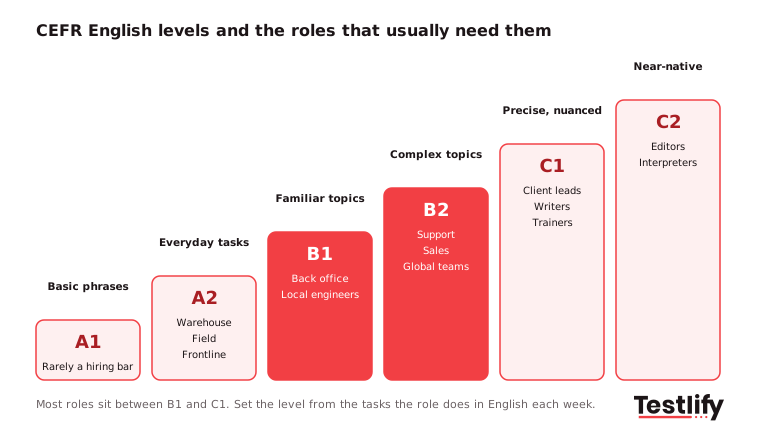
Use the table as a starting point and adjust it after you list what the person reads, writes, hears and says in a normal week:
Role type | Typical English tasks | Starting level | Testlify test to start from |
|---|---|---|---|
Warehouse, field and frontline roles | Safety signs, short instructions, simple forms | A2 | English proficiency test for employment (A1 to A2) |
Customer support, chat and voice agents | Follow-up questions, clear replies, handling complaints | B1 to B2 | |
Sales, account management, project roles | Calls, proposals, meetings with clients | B2 | |
Engineers and analysts on global teams | Documentation, tickets, written collaboration | B1 to B2 | B1 to B2 English test |
Client-facing leaders, writers, trainers | Negotiation, presentations, polished writing | C1 |
Two cautions apply. First, set one level per role, not one for the whole company. A single "fluent English required" rule either blocks good frontline hires or lets weak writers into client roles. Second, write the level into the job description, so candidates know what to expect.
When does the law set an English requirement?
The law sets an English requirement in a few specific cases, usually immigration and safety. In those cases the level is not your choice, and a test is how you show you checked it.
- UK sponsored hires: A Skilled Worker visa applicant must show English at CEFR level B2 in reading, writing, speaking and listening. People who already held the visa before 8 January 2026 and are extending it need B1.
- US commercial drivers: Executive Order 14286, signed on 28 April 2025, told the Federal Motor Carrier Safety Administration to revise its rules so a driver who fails the English proficiency requirement is placed out of service. Fleets now have a direct reason to check functional English before a driver reaches the road, for example with a functional English assessment for drivers.
- Regulated and safety-critical roles: Healthcare, aviation and some financial roles set language standards through their licensing bodies. Check the regulator for each role rather than assuming a general rule exists.
Outside these cases, no law requires a general English test for private-sector hiring. For most roles, the job sets the level, not a regulator.
How do you keep English testing fair and legal?
English testing stays fair and legal when the level matches the job, every candidate takes the same test, and the result is one input among several. The EEOC's national origin guidance says a fluency requirement is permissible only if it is required for effective performance of the position, and that requiring more fluency than the position needs may violate Title VII.
In practice:
- Write down why: Record the tasks that need English and the level they need, per role. That is your evidence if the requirement is challenged.
- Test the same way for everyone: Same test, same cut-off, same stage. Do not send the test only to candidates with a foreign name or accent.
- Do not test what the job does not use: A warehouse role does not need a C1 writing task.
- Watch the pass rates: Compare pass rates across groups and look for adverse impact. A big gap is a signal to check whether the cut-off is set too high.
- Offer accommodations: Extra time or alternative formats for candidates with disabilities, stated in the invite.
How do you add an English test without slowing hiring?
An English test adds no delay when it runs at the application stage, scores itself and feeds the result back to your ATS. The flow below is what most teams settle on.
- Set the level per role: Use the table above and the tasks list. Write it into the job post.
- Pick the skills to score: Reading and listening for most roles; add writing for written roles and a recorded speaking task for voice roles.
- Send the test right after the application: An automatic invite from the ATS stage removes the recruiter from the loop. Pair it with a role-skills test in the same assessment so candidates take one link, not two.
- Shortlist by level: Auto-advance candidates who meet the level and review borderline scores by hand.
- Interview for everything else: Use the interview for role skills, judgement and motivation, and read the English result before the call.
- Review the cut-off every quarter: Compare test levels with early performance and adjust the role level if it is too high or too low.
If you want sample items to share with hiring managers, see these English proficiency test questions for candidates.
How does Testlify test English proficiency?
Testlify tests English proficiency with CEFR-aligned language tests from A1 to C2, scored automatically and placed in the same assessment as role skills. The CEFR English test covers reading, writing, speaking and listening, and the test library has level-specific and business English tests.
- Speaking, not only grammar: Voice AI and Video AI interviews and one-way video interviews capture spoken answers and score them against the same criteria for every candidate.
- Integrity checks: 20+ proctoring checks, including tab tracking, copy and paste blocking and speech authenticity detection for voice and video answers. See anti-cheating and proctoring.
- One platform for every role: 3,500+ tests, so the English test and the role test go out in one invite.
- Fits your stack: Two-way sync with 100+ ATS and HRIS tools through integrations, and the platform runs in 15+ languages for candidates.
Ready to check English before the first interview?
Pick the level each role needs and send a CEFR-scored English test with the application. Spend interview time only on candidates who meet it.
Book a demo to see it in action, or start a 7-day free trial, no credit card needed.
Frequently asked questions (FAQs)

People and Talent Partner
Arushi Shah runs day-to-day talent acquisition and candidate experience at Testlify. She writes on interviewing, structured hiring, and giving candidates a fair, fast process.
LinkedInRelated resources
View all
HR & recruitment
How to simplify candidate screening with English proficiency test

HR & recruitment
How English proficiency test help you screen candidates

HR & recruitment
How to hire top talent using English proficiency test

HR & recruitment
Leadership assessment: types, methods and how to use it in hiring

HR & recruitment
Key components of a comprehensive technical aptitude test

HR & recruitment
Recruitment tests for successful recruitment process: types, stages and setup
Get started.
Hire on proof, not resumes.
Run your first skills-based assessment free — no credit card required.