
Testlify vs Indeed Hiring Platform: A detailed comparison
Discover the perfect solution for evaluating your candidates’ skills with Testlify. Dive into our comprehensive Testlify vs Indeed Hiring…
Testlify and the Indeed Hiring Platform solve two different problems. Indeed gets your job in front of millions of active job seekers and collects applications; Testlify tells you which of those applicants can actually do the work, through skills assessments, AI interviews and proctored testing. Since Indeed discontinued its own assessments in October 2024, the two no longer overlap at all, and most teams that compare them end up using both, connected through Testlify's Indeed integration. This 2026 comparison covers what each platform does today, what Indeed dropped, what both cost, and when Indeed alone is enough.
TL;DR
- Indeed is where applicants come from: free and Sponsored job posts, Indeed Apply with screener questions, a resume database (Smart Sourcing) and built-in video interviewing. It no longer includes skills tests.
- Testlify is how you find out who can do the job: 25+ question types, conversational AI video, voice and phone interviews, three proctoring presets, and a simple built-in hiring pipeline for teams with no ATS.
- The average job now draws 244 applications, up from 116 in 2022, and time to fill has stretched to almost 60 days. A job board without a screening layer is where that pile lands.
- Structured interviews and work-sample style evidence predict performance far better than the years-of-experience signals a job board sorts on.
- Testlify publishes its prices (Starter from $139 a month on annual billing). Indeed posting is budget-based and set by you, and Smart Sourcing Professional lists at $520 a month.
- Pick Indeed alone for one or two hires a year with a manager who can interview everyone. Add Testlify the moment volume, remote hiring or consistency becomes the problem.
 ChatGPT
 Gemini
 Claude
 Grok
Grok Perplexity
What is the Indeed Hiring Platform in 2026?
The Indeed Hiring Platform is Indeed's set of employer tools for getting a job seen and collecting applications: job posts (free and Sponsored), Indeed Apply with screener and deal-breaker questions, Smart Sourcing for searching and messaging candidates in Indeed's resume database, Indeed Interview for video calls, and Hiring Events for interviewing lots of people in a short window. It's a distribution and sourcing platform first, with light applicant tracking attached.
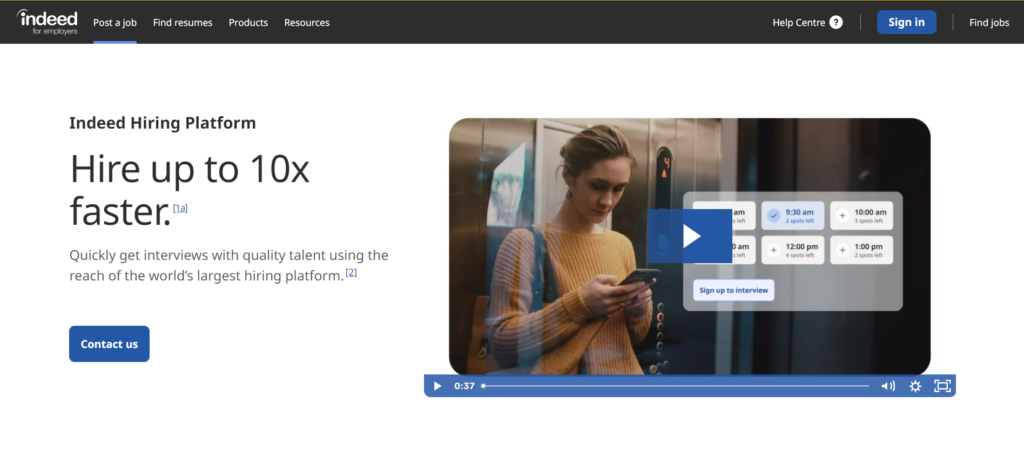
The name matters less than it used to. Indeed markets these tools as Indeed for Employers now rather than under the "Hiring Platform" label, but the query still lives on, so this page keeps the name.
What Indeed does well is reach. Post a role and it's in front of active job seekers quickly, and Sponsored Jobs let you buy more visibility for the roles that need it. Indeed Apply means candidates apply with a stored Indeed profile instead of re-entering their details, which is good for volume and bad for signal. Screener questions filter on hard requirements (a licence, a shift pattern, a location), and that's roughly where Indeed's evaluation of a candidate stops.
What Indeed no longer does is test skills. Its own product update on discontinuing assessments says that from October 2024 "skills tests will no longer be offered" as Indeed discontinued "self-serve and employer-requested assessments" globally, and that it is "not replacing the assessment tool with another one". Employers were pointed back to the candidate profile. Every comparison page that still credits Indeed with a test library, including the previous version of this one, is describing a product that has been switched off.

What is Testlify?
Testlify is a pre-hire assessment and interviewing platform. You build an assessment from role-based tests and custom questions, invite candidates, and get scored, proctored evidence of what each person can do before anyone books an interview. It doesn't post jobs to the open web at scale or sell access to a resume database, and it doesn't pretend to. Its job starts when an applicant exists.
Three things set it apart from the "quiz tool" picture people carry in their heads:
- Question breadth. At least 25 question types, including live Google Docs, Sheets and Slides tasks, Microsoft Word, PowerPoint and Excel tasks, a typing test scored 60% accuracy and 40% speed by default, file uploads, and coding questions run in an embedded VS Code editor with up to 20 visible or hidden test cases. A "vibe coding" mode lets candidates direct AI tools to a working solution instead of typing syntax, which is what a lot of real 2026 engineering work looks like.
- Interviewing built in. One-way video, two-way conversational AI video with selectable avatars and voices, voice questions, and outbound AI phone interviews billed at $0.18 a minute. You set attempts, recording time and preparation time; the platform auto-transcribes any recording of 30 seconds or more and auto-scores answers, with AI scores that can be kept out of the final average entirely.
- Integrity you can configure. Standard, Strict and Custom proctoring presets, webcam snapshots, tab-switch and multi-monitor detection, AI-assistance detection, and dual-device proctoring where the candidate's phone becomes a second camera and the assessment can't start until it's live. Face verification data is deleted after 30 days.
For teams that don't run an applicant tracking system, Testlify also ships a simple built-in hiring pipeline: job requisitions, an application form, publishing to job boards, and an applied, reviewed, shortlisted, rejected flow. It's a mini ATS for a team that has none, not a system of record for a company that already runs one. If you do run one, Testlify plugs in as the screening layer through 100+ ATS integrations.
Testlify vs Indeed: what's the real difference?
Indeed answers "who applied?" and Testlify answers "who can do the job?". That's the whole comparison in one line. Indeed's unit of work is the job post and the application; Testlify's unit of work is the candidate's demonstrated skill. Neither replaces the other, and Testlify isn't an Indeed clone dressed up as an assessment tool, whatever the search suggestions imply.
The confusion is understandable. Until late 2024 Indeed did sell assessments, so a buyer could reasonably ask whether a job board's tests were good enough to skip a dedicated platform. That question is now closed. The live question is a workflow one: applications arrive from Indeed, and something has to sort 244 of them per role into a shortlist a hiring manager will actually read. Indeed's tools for that are screener questions and a resume view. Testlify's tools for that are scored assessments, AI interviews and proctoring, with results that sync back to wherever your pipeline lives.
The Testlify and Indeed integration makes this a single flow: applicants arriving from Indeed are invited to an assessment automatically, and their scores, results and status sync back for review. Set it up once and screening scales with applicant flow instead of with recruiter hours.
Feature comparison: Testlify vs Indeed Hiring Platform
Every Indeed row below is something Indeed sells today. Every Testlify row is backed by a string in the live product, not a slide.
Area | Testlify | Indeed Hiring Platform |
|---|---|---|
Core job | Assess and interview applicants on skills | Distribute jobs, collect applications, source resumes |
Job posting and reach | Publishes to job boards from the built-in pipeline; no candidate marketplace of its own | Free and Sponsored posts to one of the largest job-seeker audiences; Indeed Apply |
Skills assessments | Role, cognitive, coding, language, personality, situational judgement, software skills, simulations; 25+ question types | None. Assessments discontinued globally in October 2024, no replacement |
Screening questions | Qualifier questions that gate the assessment, plus scored questions of any type | Screener and deal-breaker questions on the application |
Video interviewing | One-way video, two-way conversational AI video with avatars and voices, voice and AI phone interviews, auto-transcripts, auto-scoring with human override | Indeed Interview for live video calls, plus virtual Hiring Events |
Live human interview scheduling | Not offered | Scheduling inside Indeed Interview and Hiring Events |
Resume database and sourcing | Not offered (Testlify starts once an applicant exists) | Smart Sourcing with AI matching and outreach, Professional plan 100 contacts a month |
Proctoring and anti-cheating | Standard, Strict and Custom presets; dual-device proctoring; AI-assistance detection; green, yellow, red flags with human review | Not applicable (no assessments to proctor) |
Coding evaluation | Embedded VS Code editor, up to 20 test cases, SQL test cases, vibe coding | Not offered |
Office and spreadsheet tasks | Live Google Docs, Sheets, Slides and Microsoft Word, Excel, PowerPoint tasks | Not offered |
Analytics | Per-question difficulty and discrimination index, score and time distributions, candidate benchmarking, PDF and CSV exports | Post performance, application counts, Sponsored spend |
Applicant tracking | Mini ATS for teams without one (requisitions, application form, four-stage pipeline); 100+ ATS integrations as an add-on | Candidate management dashboard; integrates with ATSs through Indeed Apply |
Enterprise controls | SAML SSO and 2FA, SCIM provisioning, custom roles, audit logs with SIEM streaming, white label (SSO and white label are paid add-ons on self-serve tiers) | Multi-user employer account |
Published pricing | Yes: Starter, Basic and Business tiers listed publicly | Posting is budget-based and set by you; Smart Sourcing Professional lists at $520 a month |
Free trial | 7-day free trial, no card required | Free job posting tier |
Why does a job board need a screening layer?
Because the pile got a lot bigger while the team reading it didn't. Greenhouse's Hire Standard benchmarks, built on 640 million applications across more than 6,000 companies, put the average number of applications per job at 116 in 2022, 189 in 2023, 223 in 2024 and 244 in 2025. Time to fill moved the same direction, from 43.64 days in 2022 to 59.67 days in 2025. More applicants, slower hires. That's what happens when the sorting is manual.
The applicants know it too. In Greenhouse's June 2025 announcement, 66% of candidates described the market as extremely or very competitive, and applications per job had risen 102% between Q3 2022 and Q4 2024. The same release found that 46% of US candidates abandon an application that makes them re-type their resume, which is exactly why one-tap applying on Indeed produces so many of them.
Zoom out and the labour market hasn't stopped moving. The Bureau of Labor Statistics JOLTS release for July 2026 counted 7.3 million job openings, 5.1 million hires and 3.1 million quits in a single month. Every one of those hires started as a stack of applications somebody had to sort. Indeed is very good at building the stack. Sorting it is a different tool's job.
Here's the practical version. A 40-person marketing agency hiring 20 people this year, at the 2025 average, will receive close to 4,900 applications. If a hiring manager spends four minutes on each, that's more than 320 hours of screening before a single interview. A 40-minute assessment sent to the 30 strongest applicants per role changes the manager's job from "read 244 resumes" to "compare 30 scored reports", and the ranking is on evidence rather than on who wrote the punchiest summary.
What predicts performance once applicants arrive?
Structured evidence, not the signals a job board sorts on. A 2022 reanalysis of decades of selection research, Sackett, Zhang, Berry and Lievens (2022) in the Journal of Applied Psychology, revised decades of validity estimates downward and reordered them. Structured interviews came out on top at a corrected validity of .42, empirically keyed biodata at .38, cognitive ability tests at .31, and conscientiousness measures at .19. Years of experience and years of education, the two things a resume database filters on most easily, sit among the weakest predictors in that literature.
Two honest caveats. First, the exact coefficients are still argued about in print; what survives every reanalysis is the ordering, structured over unstructured and demonstrated skill over credentials. Second, no single method is enough on its own. A .42 validity is strong for one signal and still leaves most of the variance in performance unexplained.
That's the reasoning behind the Testlify Multi-Signal Talent Evaluation Model: combine multiple role-relevant signals (assessments, interviews, simulations, references and reviewer feedback) so that a candidate advances when several independent signals point the same way, not because one resume read well or one interview went smoothly. Indeed gives you one signal, the profile. Testlify is built to add the others and keep the final call with a human.
"AI scores and insights are for guidance only. Use human judgment for final decisions."
That sentence ships inside the Testlify product, next to a toggle that decides whether the AI score counts toward the final average at all. For anyone hiring under NYC Local Law 144 or preparing for the EU AI Act, the advisory-by-default design is the detail worth asking every vendor about.
How does Testlify screen Indeed applicants?
In three steps, most of which run without a recruiter touching them.
- Connect and invite. Turn on the Indeed integration (or, with no ATS, publish the role from Testlify's built-in pipeline). Applicants are invited to the assessment automatically, and qualifier questions gate out anyone who fails a hard requirement before a credit is spent.
- Assess on the real work. Build the assessment from the Testlify test library and add custom questions that look like the job: a Sheets task for an analyst, a coding problem with hidden test cases for an engineer, a two-way AI video interview for a customer-facing role, a typing test for support. Difficulty runs Easy, Medium or Hard, and question banks can serve a random subset so two candidates rarely see the same paper.
- Review evidence, then decide. Each report shows question-level scores, proctoring flags (green means clean, yellow means "a quick manual review is recommended", red means confirmed cheating), interview transcripts and AI insights. Results and status sync back to Indeed or your ATS, and multiple reviewers can score the same candidate so one person's impression isn't the whole decision.
Pro tip: send the assessment before the first phone screen, not after. Teams that assess late spend their interview hours on people the assessment would have ruled out, and candidates read a late test as a hurdle rather than a fair shot. Early assessment also fixes the volume maths above, because the manager only ever meets a scored shortlist. If your candidate screening methods currently start with a resume sort, that's the one change to make first.
The AI interviewing piece deserves its own paragraph because it's where the two platforms look most similar and are least alike. Indeed Interview is a live video call. Testlify's interviews are asynchronous and configurable: choose the AI avatar and voice, write the prompts or pick from interview templates, set the number of attempts (including no limit), recording time and preparation time, cap videos at five minutes, and let the platform transcribe and score. A candidate in a different time zone completes it at 11pm; the hiring manager reads a transcript and a scored summary at 9am and overrides anything the AI got wrong. For a remote or multi-country pipeline, that's the difference between screening 30 people and screening 8.
What changed at Indeed in 2024 and 2026?
Three things, and all three push in the same direction: Indeed is concentrating on distribution and sourcing, and expecting evaluation to happen elsewhere.
October 2024: assessments discontinued
Indeed stopped offering self-serve and employer-requested assessments globally, saying the tests "added confusion and extra steps for everyone" and that it was not replacing them. If your process relied on a candidate's "Proficient" or "Expert" badge from an Indeed test, that signal is gone.
March 31, 2026: the single-source feed policy
As HR Dive reported on the day it took effect, jobs sent to Indeed through a single-source XML feed are no longer shown for free if they could be sent through an applicant tracking system instead; such jobs appear only when sponsored, while feeds from non-integrated ATSs are exempt. An Indeed spokesperson framed the move as encouraging ATS integration for "improved reliability, data quality, and consistency". If you post directly in Indeed's employer dashboard, nothing changes. If a job-distribution vendor pushes your roles to Indeed through a feed, check which side of that line you're on.
Smart Sourcing is the growth product
Indeed's resume product, now Smart Sourcing, is where the AI investment went: a Sourcing Assistant that builds a candidate list from a plain-language prompt, AI-drafted outreach and bulk messaging. The Professional plan is listed at $520 a month or $4,992 a year for 100 candidate contacts a month (unused contacts roll over for six months), with extra contacts at $5.20 each. Indeed's own page claims candidates sourced this way are "2.9X more likely to be hired". Note what it measures: hired, not performing. Sourcing quality and screening quality are still two separate problems.
Testlify vs Indeed pricing in 2026
The two price models don't line up, so compare them by what you actually pay for. Indeed charges for visibility and for contacts. Testlify charges per candidate who starts an assessment.
Testlify pricing (annual billing, from the live pricing page)
Tier | Credits a year | Price | Seats | Extra credits |
|---|---|---|---|---|
Starter | 100 | $139 a month, billed $1,668 a year | 3 | $21 each |
Basic | 300 | $279 a month, billed $3,348 a year | 5 | $14 each |
Business | 1,000 | $699 a month, billed $8,388 a year | 10 | $10 each |
Premium, Enterprise, Custom | 3,000 to 25,000+ | Contact sales | 20 to 40 | Volume-based |
One credit is consumed per started assessment by a qualified candidate; credits don't roll over. Monthly billing uses the same tier names at different credit counts and prices (Starter is $198 a month for 10 credits). Every tier gets a 7-day free trial with no card, a 30-day money-back guarantee, a price locked for 24 months, and extra seats at $15 a seat a month. White labeling and the 100+ ATS integrations are $2,388 a year add-ons on the self-serve tiers and included on Custom, so budget for the integration line if you plan to sync with an ATS. Full detail is on the Testlify pricing page.
Indeed pricing
Indeed product | How it's priced | What you get |
|---|---|---|
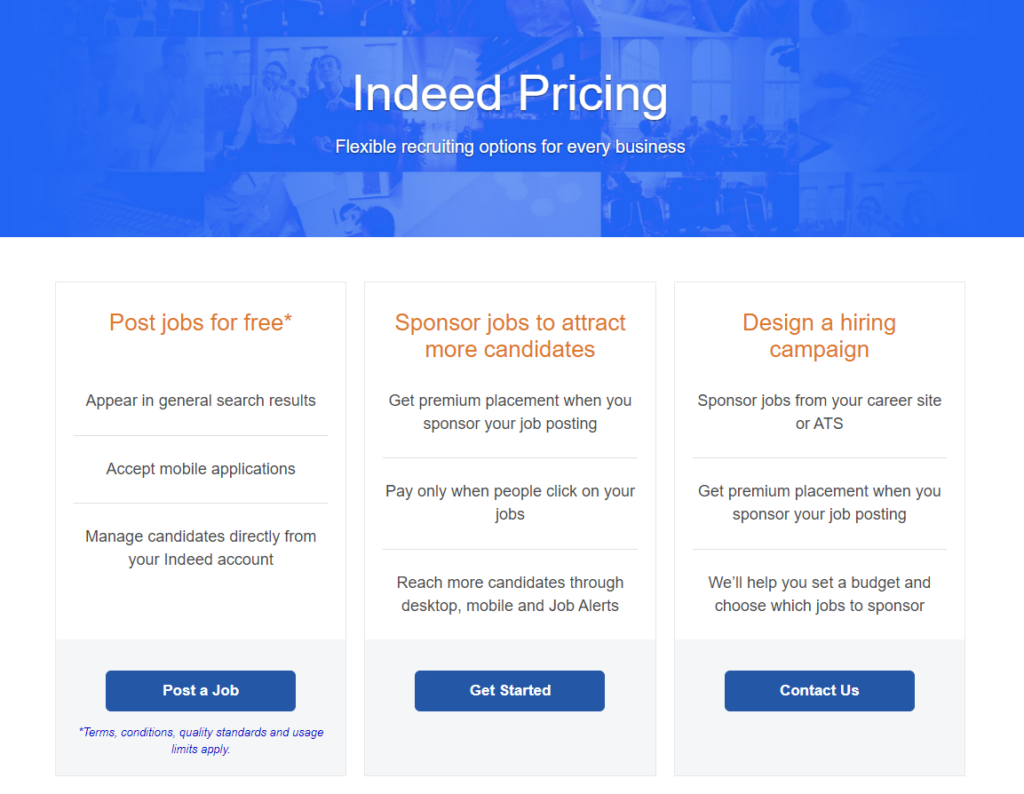
Job posting | Free tier, plus Sponsored Jobs at a budget you set; what a Sponsored post actually costs depends on role, location and competition, and there is no fixed public rate card | Visibility to active job seekers, Indeed Apply, screener questions |
Smart Sourcing Professional | $520 a month or $4,992 a year, per user | 100 candidate contacts a month with 6-month rollover, extra contacts $5.20 each, Sourcing Assistant |
Indeed Interview and Hiring Events | No public rate card | Live video interviews, virtual and in-person hiring events |
A worked example (illustrative, not a customer)
Take that 40-person marketing agency hiring 20 people a year. It posts every role on Indeed, sponsors the hard ones, and invites the 30 strongest applicants per role to a Testlify assessment: 600 started assessments. The Basic tier's 300 credits plus 300 extra credits at $14 comes to $7,548; the Business tier's 1,000 credits at $8,388 costs $840 more and leaves 400 credits for retakes, second-stage interviews and the roles that overrun. Business is the sensible buy, and it works out to about $14 per assessed candidate or $419 per hire, before any ATS add-on. On the Indeed side the agency pays whatever Sponsored budget it sets, plus $4,992 a year if one person takes Smart Sourcing Professional to hunt for the two roles that never get enough inbound. The two bills buy different things, which is the point: one buys applicants, the other buys certainty about them.
When is Indeed alone enough?
Often, honestly. Indeed alone is the right answer when:
- You hire one or two people a year and the manager has time to interview everyone plausible.
- The role is defined by a hard credential (a licence, a certification, a shift) that screener questions check completely.
- You're testing whether a market has candidates at all before you invest in a process.
Add Testlify when:
- Volume is the problem: 100-plus applications per role and a manager who has stopped reading past the first page.
- The role has a skill you can't see on a resume (a spreadsheet model, a customer call, a code review) and unstructured interviews keep getting it wrong.
- You hire remotely or across countries and need proctored, asynchronous evidence with a transcript, not a calendar full of first calls.
- Consistency and defensibility matter: multiple reviewers, the same questions for every candidate, and a record of why each person advanced.
The teams that get the most out of the pairing are usually under 200 people, often with a founder or operations lead doing the hiring rather than a recruiting department. For them the question isn't Testlify or Indeed. It's how quickly the Indeed applicants can be turned into a scored shortlist, and the answer with the integration on is "before you've read the first resume". The case for skills-based hiring is strongest exactly where the resume pile is tallest.
Where to go from here
Keep posting on Indeed. Then run your next role through a Testlify assessment before the first phone screen and compare the shortlist you get with the one your resume sort would have produced. The 7-day free trial covers one full hiring loop with no card, and if you'd rather see the Indeed integration and the AI interviewer on your own roles first, book a demo and bring a live job post with you.
Key takeaways
- Different categories, not rivals. Indeed distributes jobs and sources candidates; Testlify assesses and interviews them. Since Indeed discontinued its assessments in October 2024 there is no overlap left, so the buying decision is about how to connect them, not which to drop.
- The volume problem is real and measured. Applications per job more than doubled from 116 in 2022 to 244 in 2025 while time to fill grew to 59.67 days. A screening layer is what turns a bigger stack into a faster hire instead of a slower one.
- Screen on evidence that predicts. Sackett et al. (2022) put structured interviews at .42 and cognitive ability at .31, well above the experience and education signals a resume database sorts on. Build the shortlist on what candidates can do, then interview.
- Keep humans on the final call. Testlify's AI scores are advisory by design and can be excluded from the final average. That's the setting to look for under NYC Local Law 144 and the EU AI Act, whichever vendor you pick.
- Know Indeed's 2026 rules. Free organic visibility for single-source XML feeds ended on March 31, 2026 where an ATS route exists. Direct posting is unaffected; feed-based distribution needs a check.
- Price what you use. Testlify's Business tier covers roughly 20 hires with 30 assessed candidates each for $8,388 a year, about $419 per hire. Indeed's cost is your Sponsored budget plus $4,992 a year per Smart Sourcing Professional seat. Budget them as two lines that buy two things.
FAQs
Related resources
View all
Competitor Comparisons
Testlify vs HireQuotient: A detailed comparison
Competitor Comparisons
Testlify vs Testwise: Comparison guide for recruiters
Competitor Comparisons
Testlify vs Symphony Talent: Which Is Better in 2026?
Competitor Comparisons
Testlify vs TestTrick: Which skills assessment platform is best for recruiters?
Competitor Comparisons
Testlify vs CodeSignal: Which Talent Assessment Platform is Best for You?
Competitor Comparisons
Testlify vs. Equip: Which Skills Assessment Platform is Best for HR Teams?
Get started.
Hire on proof, not resumes.
Run your first skills-based assessment free — no credit card required.